How to Improve Team Productivity: Proven Strategies That Work

If you want to improve team productivity, you have to change how you think about it. It’s not about tracking hours or making sure everyone looks busy. It’s about creating a place where real, goal-focused work gets done without all the friction. That means focusing on clear goals, psychological safety, and the right tech.
Rethinking What Team Productivity Really Means
The old way of measuring productivity—equating long hours with great results—is completely broken. In the modern workplace, especially with remote and hybrid teams, that mindset just leads to burnout, disengagement, and wasted effort. It’s time to look past the surface-level metrics and figure out what actually drives a high-performing team.
True productivity isn't about brute force. It grows out of a specific mix of factors that empower people to do their best work. It's less about relentless grinding and more about building a system where efficiency just happens naturally. This approach helps us tackle the real challenges managers face, from juggling distributed teams to cutting through the constant digital noise.
The Shift from Busywork to Meaningful Impact
The heart of this new perspective is simple: know the difference between being busy and being productive. A team can spend an entire day bouncing between meetings and clearing their inbox, look incredibly active, but achieve nothing that matters. Real productivity is about getting significant results that actually move the company's key objectives forward.
"Productivity is never an accident. It is always the result of a commitment to excellence, intelligent planning, and focused effort." – Paul J. Meyer
Think of this guide as your game plan for building a team that’s not just active, but truly effective. We'll get into how to create an environment where people feel valued, work smarter, and are all pulling in the same direction.
Why Engagement Is the Engine of Productivity
One critical piece of the productivity puzzle that often gets ignored is employee engagement. Someone who isn't engaged might check off tasks, but they’re not going to innovate, collaborate well, or go the extra mile. Strong engagement is directly tied to better business outcomes—it’s not just a feel-good metric.
For example, highly engaged teams can drive up to 21% higher profitability. Despite that, global employee engagement is stuck at a shockingly low 21%, costing companies a fortune in lost productivity every year. This proves that boosting engagement isn't just an HR thing; it's a core business strategy for any leader who's serious about performance. You can find more insights on how employee engagement impacts productivity.
In the end, learning how to improve team productivity is about building a sustainable culture of effectiveness, not just demanding more output in the short term. It’s about creating a workplace where clear goals, smart systems, and a supportive atmosphere let people do their best work.
Pinpointing Your Team's Productivity Killers

Before you can fix your team's productivity, you need to put on your detective hat. You can't solve a problem you don't understand, and just guessing at what's slowing everyone down is a surefire way to launch initiatives that fall flat and leave your team feeling more frustrated than ever.
Instead of making assumptions, your first move is to diagnose the real issues hiding beneath the surface. Is that missed deadline just one person's poor time management? Or is it a symptom of a broken project kickoff process that’s tripping everyone up? The key is learning to see the difference between individual struggles and system-wide bottlenecks.
Uncovering the Truth with Anonymous Feedback
Your team knows where the problems are. They live with the daily friction of confusing workflows, redundant tasks, and communication black holes. The catch? They might not feel comfortable bringing these issues to you directly, worried it will sound like complaining.
This is where anonymous surveys are absolute gold. By guaranteeing anonymity, you create a safe space for people to share unfiltered, honest feedback about process snags, unclear priorities, and morale killers without any fear of blowback.
To get the good stuff, you have to ask the right questions. Steer clear of simple yes/no and instead ask specific, open-ended questions like these:
- What is one task you do every week that feels like a complete waste of time? This is brilliant for spotting low-value work that could be automated or just scrapped entirely.
- When you get stuck on a project, what's the biggest thing holding you back? The answers here can expose everything from problems with resource access to communication silos.
- What's the single biggest source of frustration in your daily workflow? This question gets right to the heart of the recurring pain points that drain energy and kill output.
Your goal here is to collect stories, not just data points. As the responses roll in, look for the patterns. If you see "waiting for approval" or "conflicting instructions" pop up again and again, you've probably just found a major systemic problem that needs your attention.
Conducting a Workflow Audit
While surveys tell you what is broken, a workflow audit helps you understand the how and the why. This is where you roll up your sleeves and review a specific process from start to finish. Think of it like mapping a river to find where the current gets sluggish. You're charting the exact path work takes to pinpoint every single point of friction.
Pick a core process to start with—something like deploying a new software feature or launching a marketing campaign. Get the team involved and map out every single step. At each stage of the map, ask some critical questions:
- How long does this step actually take?
- Who is responsible for this? Is that clear to everyone?
- What information or tools are needed to get this done?
- Where does a handoff happen? Is it smooth or clunky?
This exercise can reveal some truly shocking inefficiencies. You might find out a "simple" approval actually bounces between five different people, or that the team spends hours every week manually copying data between two systems that could easily be integrated.
I once worked with a marketing team convinced they were just "too slow" at content production. A workflow audit revealed the real culprit: an "everything is urgent" culture. With no clear prioritization system, every new request was treated as a top priority. This led to constant context-switching, burnout, and delayed projects. The bottleneck wasn't their work ethic; it was a total lack of a prioritization process.
Distinguishing People Problems from Process Problems
It's so important to figure out if you're dealing with a performance issue or a flawed system. If one person is constantly missing deadlines, it might be a need for more training or a conversation about motivation. But if your entire team consistently struggles to hit a certain milestone, that's a giant red flag that the process itself is broken.
When you combine anonymous feedback with detailed workflow audits, you start to get a crystal-clear picture of your team's biggest productivity killers. These aren't just small annoyances—they're the major roadblocks that sap energy, create friction, and stop your team from doing their best work. Once you know exactly what they are, you can start building solutions that treat the cause, not just the symptoms.
Building a Foundation of Clear Goals and Communication
High-performance teams don't just happen. They're built, piece by piece, starting with a bedrock of clarity. Every single person needs to be pulling in the same direction, guided by a crystal-clear understanding of what success looks like and how they're expected to talk to each other about getting there.
Without this foundation, even the most talented people will waste energy on misaligned tasks and fall into frustrating communication loops. This is where the real work of boosting team productivity begins—not with fancy software or trendy management fads, but by getting the absolute essentials right.
Setting Goals That Actually Motivate
Vague goals are productivity killers. "Increase sales" or "improve customer satisfaction" might sound good in a meeting, but they leave your team wondering what they should actually do differently tomorrow morning. To spark real action, you need a way to translate those big ambitions into concrete, actionable steps.
Two of the most battle-tested frameworks for this are SMART goals and OKRs (Objectives and Key Results). Far from being just corporate buzzwords, they are practical tools for ensuring everyone gets both the 'what' and the 'why' behind their work.
-
SMART Goals (Specific, Measurable, Achievable, Relevant, Time-bound): This method is perfect for specific projects or team initiatives. Instead of a fuzzy goal like "improve the blog," a SMART goal gets specific: "Increase organic blog traffic by 15% in Q3 by publishing eight new SEO-optimized articles and updating our top five existing posts." The clarity is undeniable.
-
OKRs (Objectives and Key Results): This framework is fantastic for connecting your team's day-to-day work to the company's larger vision. The Objective is the ambitious, qualitative goal (e.g., "Become the go-to resource in our industry"). The Key Results are the measurable outcomes that prove you're on track (e.g., "Achieve 50,000 monthly unique visitors to our learning center").
The real magic happens with collaborative goal-setting. When your team helps define the objectives, they develop a powerful sense of ownership. Their motivation shifts from just checking off tasks to actively achieving a mission they helped create.
Creating a Team Communication Charter
Constant pings, overflowing inboxes, and back-to-back meetings create a storm of digital fatigue and context-switching. This isn't just annoying; it directly harms output. A 'communication charter' is a simple but incredibly powerful document that brings calm to this chaos.
At its core, a communication charter is a guide your team creates together, defining which tool to use for which purpose. It's not about creating rigid, bureaucratic rules. It's about removing the guesswork that drains mental energy every single day. For a deeper dive into creating this kind of clarity, check out these effective internal communication best practices.
Creating a communication charter isn't about control; it's about giving your team the gift of focus. By agreeing on the 'how' and 'when' of communication, you free up valuable cognitive resources for the actual work that matters.
This simple guide illustrates how to thoughtfully implement tools that truly support your team's workflow and communication, rather than adding to the noise.
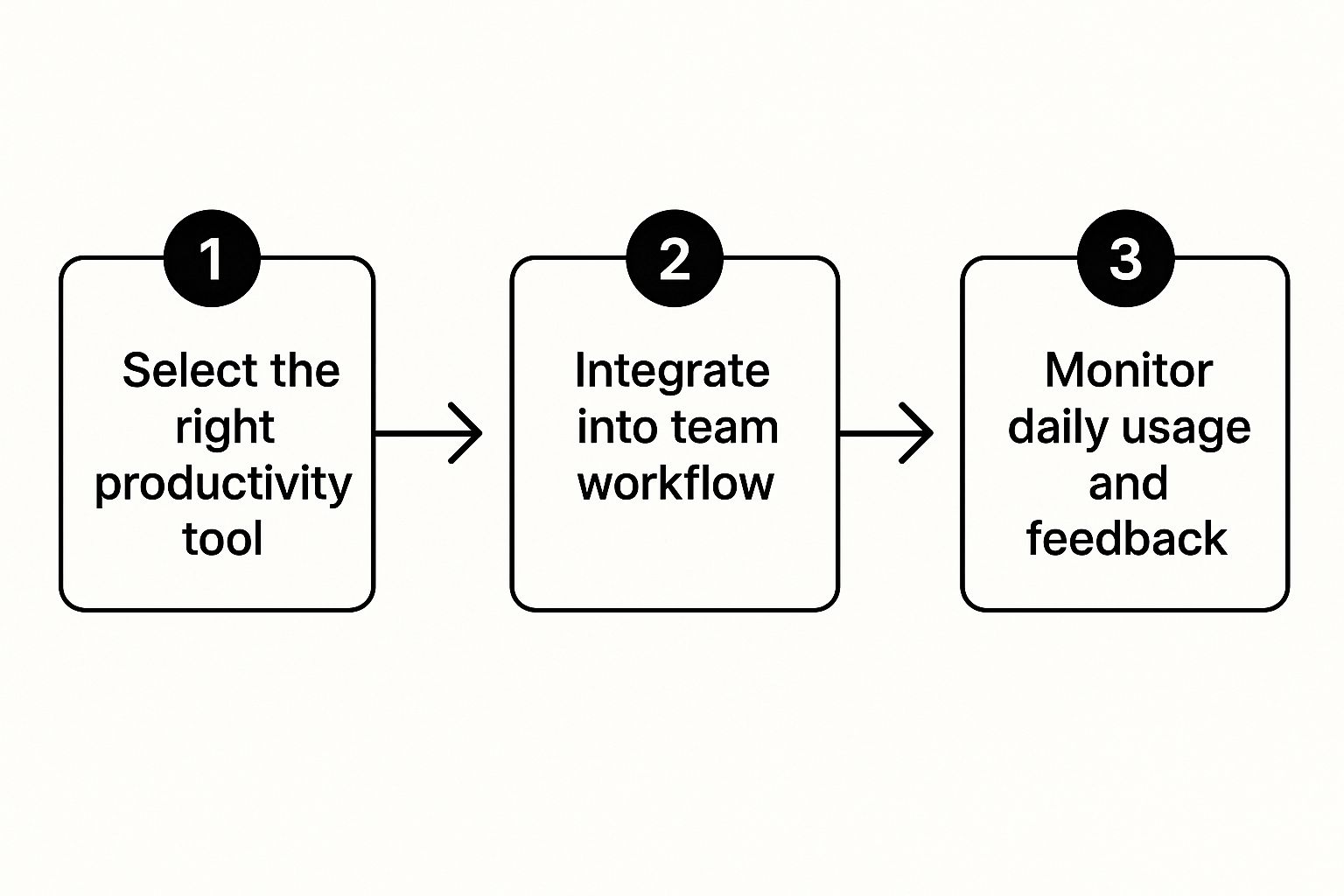
As the visual shows, successful tool adoption isn't a one-time setup. It’s a continuous cycle of selection, integration, and gathering feedback to make sure it's actually working.
To make this practical, here’s a quick guide to help your team decide where a conversation should happen.
Choosing the Right Communication Channel
This table helps your team select the best communication tool for various situations, reducing noise and improving clarity.
| Scenario | Recommended Channel | Reasoning |
|---|---|---|
| Urgent, needs immediate answer | Slack/Teams Direct Message | Real-time, quick response for blocking issues. |
| General team announcement | Slack/Teams Announcement Channel | Reaches everyone without cluttering inboxes. |
| In-depth project discussion | Scheduled Video Call (e.g., Zoom) | Allows for nuanced conversation, screen sharing, and clear decisions. |
| Formal project update/report | Email or Project Management Tool | Creates a documented record, perfect for asynchronous review. |
| Quick feedback on a document | Comments in Google Docs/Notion | Keeps feedback contextual and easy to track. |
By having these simple ground rules, you eliminate the mental friction of deciding how to communicate, letting the team focus on what they're communicating.
Making Every Interaction Count
With a charter in place, you can start refining specific communication rituals, like the daily stand-up. Too often, these devolve into rote status updates where people ramble without a clear point. An effective stand-up is sharp, structured, and focused entirely on momentum and roadblocks.
A better script is as simple as asking each person to answer three questions:
- What did I accomplish yesterday to move our goals forward?
- What will I focus on today to advance those same goals?
- What is blocking my progress?
This structure keeps the conversation laser-focused on the team's shared objectives. That last question is the most critical—it turns the meeting from a status report into a real-time problem-solving session, ensuring small hurdles don't grow into major delays.
Using Technology to Empower Your Team

The right technology can feel like a superpower for your team. But the wrong tech? It’s just another distraction that adds friction and drains energy. The secret to boosting team productivity with new tools isn't just about grabbing the latest software—it's about making smart, strategic choices that genuinely support and simplify your team’s daily grind.
Too often, organizations impose tools from the top down without asking how people actually get things done. This forces the team to twist their effective workflows to fit a new tool's rigid structure. It’s frustrating and counterproductive. The core principle should always be to fit the tool to your team, not the other way around.
Choosing Tools That Solve Real Problems
Before you even sit through a software demo, you need a crystal-clear answer to one question: "What specific problem are we trying to solve?" Without a strong 'why,' you'll fall for flashy features that don't touch your team's real pain points. Are you dealing with a lack of project visibility, scattered conversations, or a constant hunt for important documents?
Start by pinpointing the friction in your current processes. That's what will guide you to the right kind of tool.
- For Project Visibility: Tools like Asana, Trello, or Jira bring order to chaos. They make it obvious who is doing what, by when, and how each task fits into the bigger picture.
- For Centralized Communication: A platform like Slack or Microsoft Teams can drastically cut down on the internal email madness. It creates dedicated channels for projects, keeping conversations focused and reducing noise.
- For a Single Source of Truth: A knowledge base like Notion or Confluence puts an end to the frustrating search for information. It becomes the central hub for everything from project briefs to company policies.
When you're picking a new tool, remember this: Complexity is the enemy of adoption. A simple tool that 80% of your team uses every single day is far more valuable than a powerful platform that only 20% of the team actually understands.
Leveraging AI Responsibly, Not Mindlessly
Artificial intelligence has officially moved past the hype stage and is now a practical asset for any team's output. Used correctly, AI acts like an intelligent assistant, taking over repetitive, time-sucking tasks so your people can focus on the strategic, creative work that really drives value.
The key, however, is to be intentional. Avoid "AI-washing"—adopting it just for the sake of it. Instead, find specific, high-impact areas where automation can make a real difference. For a deeper dive into making this work, it's worth learning how to streamline business processes with AI automation.
Here are a few concrete examples of smart AI use:
- Automate Meeting Summaries: AI tools can transcribe meetings and spit out concise summaries with clear action items. This saves hours of admin work and makes sure nothing gets missed.
- Generate First Drafts: Instead of staring at a blank page, your team can use AI to create a solid first draft of a report, email campaign, or blog post. Then, they can come in and refine it with their expertise.
- Handle Repetitive Data Entry: AI can pull info from invoices, forms, or emails and plug it into your systems automatically, getting rid of a tedious and error-prone job.
The data backs this up. While global productivity growth has been slow, companies that use AI heavily have seen 72% higher productivity and 59% better job satisfaction. In fact, about 75% of knowledge workers say AI helps them save time, stay focused, and be more creative.
The Essential Role of Human Oversight
Even with the most advanced AI, human oversight is non-negotiable. AI is a powerful tool for augmentation, not a replacement for human judgment, critical thinking, or ethical calls. For instance, an AI can analyze customer feedback data, but it takes a human to interpret the subtle emotional context and make a sound strategic decision.
Ultimately, the goal is a tech stack that empowers your team, not overwhelms them. Each tool should have a clear purpose and make someone’s job easier. For managers looking to get a clear view of how these tools are being used and ensure work stays on track, you might want to explore how to boost productivity with the best computer monitoring software. By being thoughtful and strategic, you can build a tech ecosystem that fuels collaboration, automates the boring stuff, and frees your team up to do amazing work.
Creating a Culture of Deep Work and Well Being
Let's get one thing straight: a burnt-out team is an unproductive team. It's a simple truth that often gets lost in the constant push for more output. Sustainable performance isn't fueled by sheer willpower; it grows from a healthy, focused, and respected team.
Building this kind of culture is about getting to the human side of performance. You have to actively fight the "always on" mentality and carve out the space people need to do their best thinking. This isn't about being 'soft'—it's about building the resilience and trust your team needs to succeed for the long haul.
Championing Focus in a World of Distractions
Deep work—the ability to focus without distraction on something mentally demanding—is where real breakthroughs happen. But the modern workplace is basically a minefield of interruptions that shatter concentration.
Productivity is fragile. Studies show that workers face interruptions roughly every three minutes and need an astonishing 23 minutes to get back on track after each one. Even though the average workday is getting shorter, fully remote employees are gaining 29 more minutes of productive time each day, proving just how powerful an uninterrupted environment can be. You can dig into more workplace productivity statistics at eptura.com.
To fight back, leaders have to be intentional about protecting their team's focus. Here are a few things that actually work:
- Implement 'No-Meeting' Days: Dedicate one day a week, like a 'No-Meeting Thursday,' to pure, uninterrupted work. This gives everyone a predictable block of time to dive deep into complex projects without their schedule getting chopped to pieces.
- Encourage 'Focus Time' Blocks: Make it normal for people to block out 'focus time' on their calendars. Treat these blocks with the same respect you'd give a client meeting. It sends a clear signal that the person is off-limits for random pings and questions.
- Champion Real Breaks: Actively encourage your team to step away from their screens. A proper lunch break or a 15-minute walk isn't a luxury; it’s a non-negotiable part of staying sharp all day.
Setting Clear Boundaries Around Work
The lines between work and life have become hopelessly blurred, feeding an 'always on' culture that just leads to burnout. Setting clear, respected boundaries is one of the most powerful things a manager can do for their team's productivity and well-being.
This means laying out explicit expectations around working hours and response times. For example, making it clear that no one is expected to answer emails after 6 p.m. or on weekends takes the pressure off. This philosophy is a key part of what we discuss in our article on how asynchronous communication enhances team productivity.
A team that rests is a team that performs. By protecting personal time, you’re not just being a good person—you’re making a strategic investment in your team’s long-term energy and focus.
You also have to lead by example here. If you're firing off emails at 10 p.m., your team will feel obligated to be online too, no matter what the official policy says. Get familiar with the 'schedule send' feature. It lets you write your emails when you want but ensures they arrive during work hours, reinforcing the very boundaries you're trying to set.
Cultivating Psychological Safety
Psychological safety is the shared belief that it's safe to take interpersonal risks on the team. It's the bedrock of a culture where people feel comfortable flagging problems, admitting they made a mistake, or throwing out a wild new idea without fear of being shamed or punished.
When psychological safety is high, teams are more innovative and engaged. People aren't wasting mental energy trying to protect themselves; they're channeling it into solving problems and pushing things forward.
As a manager, you can build this environment with a few consistent actions:
- Admit Your Own Mistakes: When you openly own up to your errors, it shows the team that it's okay to be human. It signals that learning is valued more than perfection.
- Frame Work as a Learning Process: Make it clear that not every project will be a home run. Encourage experiments and treat failures as valuable data, not as something to be blamed on someone.
- Ask for Input and Actually Listen: Regularly ask questions like, "What are your thoughts on this?" or "What might we be missing here?" Then, truly listen to the answers without immediately jumping in to defend your own idea.
Ultimately, a culture of deep work and well-being isn't built overnight with grand gestures. It's built through small, consistent actions that signal trust, respect, and a genuine commitment to sustainable performance.
Common Questions About Improving Team Productivity
Even when you've rolled out the best strategies, you're still going to hit those tricky, real-world roadblocks when you're working on how to improve team productivity. Knowing how to handle these specific situations is a huge part of being a good leader. This section tackles some of the most common questions managers run into.
Think of this as your quick-reference guide for navigating those tough conversations and scenarios with confidence. The goal here is to get into the weeds a bit—the stuff that general advice sometimes glosses over—to keep your team on track.
How Do I Boost Productivity for a Remote or Hybrid Team?
Managing a team that's spread out comes with its own set of challenges. When you don't have the natural structure of an office, communication can get messy, people can feel isolated, and performance can definitely take a hit.
The secret isn't to reinvent the wheel but to double down on the fundamentals and adapt them for a remote-first world.
- Over-communicate with clarity. You can't rely on body language or a quick chat by the coffee machine anymore. All your communication needs to be crystal clear. It helps to have a charter that spells out when to use Slack, when to send an email, and when to just hop on a video call.
- Focus on outcomes, not hours. Trying to micromanage someone's activity from afar is a fast track to frustration and mistrust. Instead, set clear, outcome-based goals and trust your team to get the job done. As long as the work is top-notch, it doesn't really matter when they do it.
- Create intentional connection points. You have to purposefully build the social fabric that’s missing. Schedule regular, non-work virtual events like coffee chats or team-building games. These moments are critical for building trust and genuine collaboration.
When your team is remote, you can't manage by walking around. You must manage by objectives and trust. This shifts the focus from perceived effort to actual results, empowering your team and fostering a culture of accountability.
For a deeper dive into more comprehensive strategies, this guide on increasing team productivity offers some fantastic insights. It’s all about making sure everyone is aligned, no matter where they’re logging in from.
What if a Team Member Resists New Processes or Tools?
Change is hard, and it’s almost guaranteed you'll get some pushback, especially from team members who have their workflow dialed in. When someone resists a new process or tool designed to make things better, it’s rarely because they’re just trying to be difficult.
Often, that resistance is rooted in fear—fear of the unknown, fear of looking incompetent while learning something new, or even a genuine belief that the old way really is better. Your job is to dig into the "why" behind their pushback. For more ideas on this topic, you can also read our guide on how to improve productivity at work and skyrocket efficiency.
The first step is to just listen. Hear out their concerns without getting defensive. Ask open-ended questions to really understand where they're coming from. A lot of the time, simply including them in the rollout process or giving them a bit of extra training can turn a resistor into your biggest advocate. Make sure you frame the change in terms of what's in it for them, like how it will eliminate a tedious task or make their day less frustrating.
How Can I Measure Productivity Without Micromanaging?
Yes, you need to measure productivity, but it should never feel like Big Brother is watching. The goal is to collect data to spot systemic problems and celebrate wins, not to track individual keystrokes. You want to focus on team-level metrics that show progress toward shared goals.
Try tracking key performance indicators (KPIs) like these:
- Task Completion Rate: What percentage of tasks get done within a given sprint or week?
- Project Timelines: Are projects consistently hitting their deadlines, or are they always slipping?
- Quality of Work: Look at things like the number of bugs in a software release or how often work has to be redone for a client.
By keeping the focus on collective output and quality, the conversation stays centered on team performance and process improvement. This builds trust and gets everyone to take ownership of the team's success—which is exactly what you want.
Ready to gain clear insights into your team's workflow and remove productivity bottlenecks without micromanaging? DeskCove provides the data-driven reports you need to optimize performance, ensure focus, and build a more efficient team. Start making informed decisions and empower your team to do their best work. Discover how DeskCove can help.