A Modern Guide to Measuring Employee Engagement

Measuring employee engagement isn't just about running a few surveys. It's about systematically taking the pulse of your organization to understand the emotional commitment and drive of your team. This means blending hard data from surveys (like eNPS and pulse checks) with the rich, nuanced feedback you get from one-on-one meetings and exit interviews. The whole point is to get a clear, data-backed picture of how connected people feel to their work.
Why Measuring Employee Engagement Matters More Than Ever
Let's be real—"employee engagement" can sound like just another piece of corporate jargon. But a disengaged workforce is a silent killer of your company's potential. This isn't just about keeping people happy; it's a direct measure of your organization's health and a powerful predictor of your bottom line.
Think of it as your company's early warning system. It helps you spot dips in morale, identify flight risks, and get to the root of productivity slumps before they spiral out of control. Without this data, you're flying blind, making critical decisions based on gut feelings instead of actual evidence.
The Real Cost of Disengagement
The financial hit from a checked-out team is staggering. Disengagement isn't a "soft" problem with "soft" consequences; it shows up in cold, hard numbers across every part of the business.
- Sky-High Turnover Costs: When employees are disengaged, they're not just unhappy—they're actively looking for the exit. Replacing an employee costs a huge chunk of their annual salary when you factor in recruiting, onboarding, and the productivity lost while the new hire gets up to speed.
- Sluggish Productivity: An unmotivated employee simply isn't going to give their best. They'll do the bare minimum, miss deadlines, and won't have that creative spark you need for real innovation.
- Poor Customer Satisfaction: Disengaged employees on the front lines can poison customer relationships. Their lack of enthusiasm is contagious, leading to subpar service and a tarnished brand.
This problem is far more common than most leaders think. Global employee engagement recently dropped to a shocking 21%, a two-point fall from the previous year. That's not just a statistic; it's a crisis costing the world economy an unbelievable $438 billion in lost productivity for that year alone. You can find more insights on this trend over at InclusionGeeks.com.
Here’s a simple picture: Team A is fired up and engaged. They tackle a tough project by collaborating, brainstorming, and putting in that extra effort to nail it. Team B is disengaged. Faced with the same challenge, they coast, point fingers, and deliver mediocre work. That difference in outcome directly hits your revenue and market standing.
Moving From Reactive to Proactive
Ultimately, measuring employee engagement is about flipping the script from a reactive to a proactive management style. Instead of waiting for a star performer to quit before you ask what went wrong, you can spot their frustrations early and actually do something about them.
This consistent pulse check helps you build a more resilient, competitive, and profitable company. It’s the first, most crucial step in creating a workplace where people feel valued, heard, and motivated to bring their A-game. Understanding your team’s pulse isn’t just good practice—it's a strategic must-have for any business that wants to win in the long run.
Designing Your Engagement Measurement Strategy
Before you start sending out surveys or digging into data, you need a solid game plan. A well-designed strategy is the difference between collecting numbers for the sake of it and gathering real insights that actually lead to meaningful change. Without a clear plan, even the best tools can feel like you're just going through the motions.
First things first, what does “engagement” actually mean for your organization? You have to get specific. Is your main goal to slash turnover in the sales department? Maybe you need to spark more creativity from your product teams. Or perhaps the big push is to improve customer satisfaction scores. Nailing this down is non-negotiable because your objective dictates every metric you choose to track.
This simple flow shows the direct line from employee disengagement to the financial consequences that get leadership's attention.
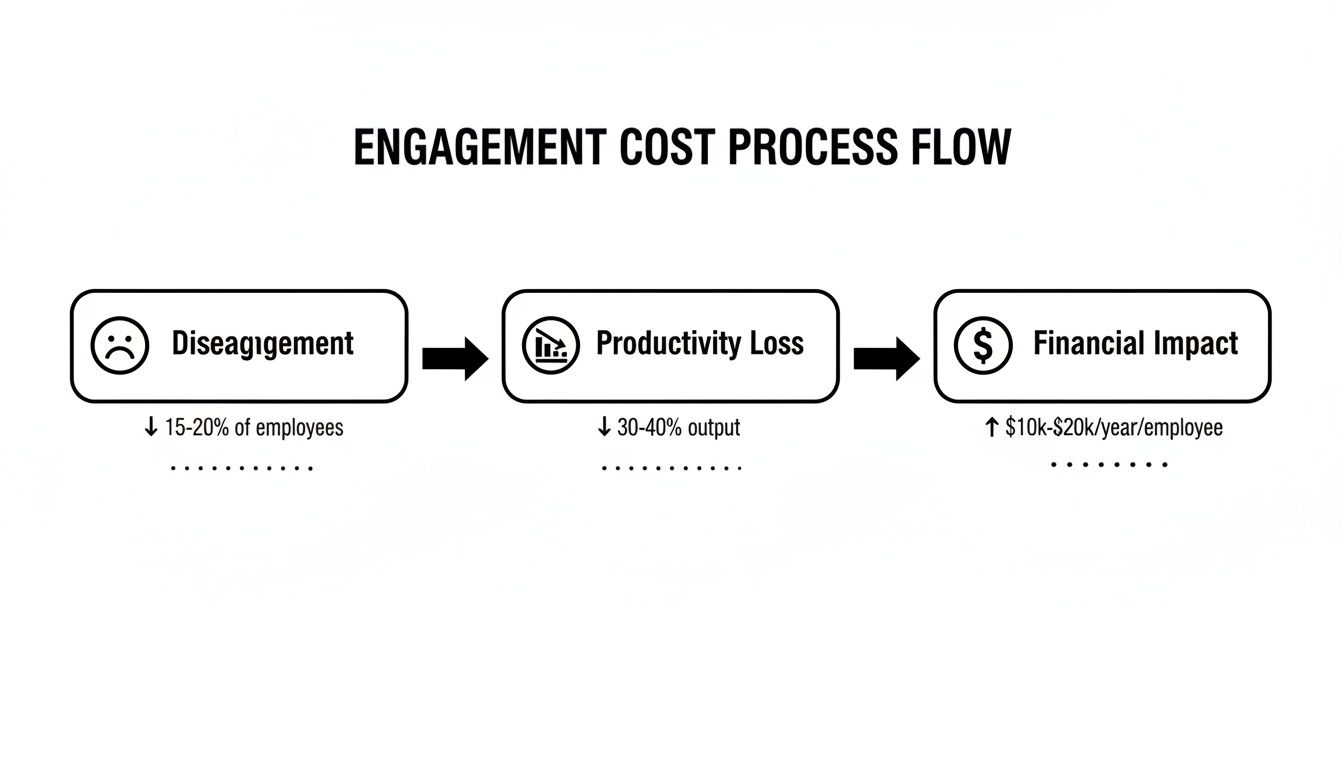
As you can see, what starts as a sentiment problem quickly snowballs into productivity losses and a direct hit to your bottom line.
Balancing The "What" and The "Why"
Once your core objective is set, your strategy needs to be built on two pillars: quantitative data (the "what") and qualitative data (the "why"). If you rely on just one, you’re only getting half the story, and it's often the misleading half.
Quantitative data gives you the hard numbers you can chart and compare over time—think of them as your workforce’s vital signs.
On the other hand, qualitative feedback provides the context, emotion, and nuance that numbers just can't capture. It’s all about understanding the employee experience through direct, human communication.
Choosing Your Employee Engagement Metrics
Picking the right mix of metrics is crucial. Here's a breakdown of some of the most common ones to help you decide what fits your goals.
| Metric Type | Specific Metric | What It Measures | Best For |
|---|---|---|---|
| Quantitative | eNPS (Employee Net Promoter Score) | An employee's likelihood to recommend your company as a great place to work. | Getting a quick, high-level snapshot of overall loyalty and advocacy. |
| Quantitative | Retention & Turnover Rates | The rate at which employees leave the organization over a specific period. | Identifying systemic issues; a direct, bottom-line indicator of engagement. |
| Quantitative | Absenteeism Rates | The frequency of unplanned employee absences. | Flagging early signs of burnout, low morale, or team-specific disengagement. |
| Qualitative | 1-on-1 Conversation Notes | Direct feedback from managers' regular check-ins on workload, roadblocks, and morale. | Gaining candid, real-time insights into individual and team challenges. |
| Qualitative | Exit Interview Feedback | Honest, unfiltered reasons why employees are choosing to leave. | Uncovering deep-rooted cultural or management issues you might be missing. |
| Qualitative | Open-Ended Survey Comments | Written responses from employees elaborating on their survey ratings. | Adding context and specific examples to your quantitative survey data. |
This table isn't exhaustive, but it gives you a solid foundation. The real magic happens when you combine these metrics to see the full picture. A drop in eNPS (quantitative) might be explained by themes you spot in open-ended comments (qualitative).
A common mistake is getting so obsessed with tracking numbers that you forget the people behind them. Data points are just signals. They tell you where to dig, but the real answers are always found in conversation.
This is why a balanced approach is so powerful. To get started quickly, using structured employee satisfaction survey templates can give you a great head start on gathering both types of feedback.
The goal is to weave together a complete story that merges hard data with human experiences. This gives you a powerful foundation to build on. If you're looking to get more advanced with your data, understanding the fundamentals of workforce analytics is a great next step. We have a detailed guide that breaks down what is workforce analytics and how you can apply it.
Tracking the Right Quantitative Engagement Metrics
Once your strategy is set, it's time to dig into the numbers. The right data tells a powerful story about the health of your organization. Quantitative metrics give you that hard, objective evidence you need to measure employee engagement effectively. These aren't just feelings or gut instincts; they're the solid baselines you can use to track progress and spot trends before they become problems.
The stakes are high. Engaged employees deliver incredible results, with stats showing 78% less absenteeism and turnover rates that are 21% lower in high-turnover companies and a staggering 51% lower in low-turnover ones. On the flip side, disengaged workers are 18% less productive and 42% more likely to be looking for a new job. These numbers make it crystal clear: tracking engagement isn't just an HR task, it's a core business function.
Pulse Surveys and Employee Net Promoter Score (eNPS)
Forget those long, once-a-year surveys that nobody wants to fill out. Today's most agile organizations use pulse surveys—short, frequent check-ins that give you a real-time snapshot of how people are feeling. We're talking 5-10 quick questions, sent out monthly or quarterly. They're easy for employees to answer and even easier for you to analyze on the fly.
A key part of most pulse surveys is the Employee Net Promoter Score (eNPS). It’s a beautifully simple metric that comes from a single, powerful question:
On a scale of 0 to 10, how likely are you to recommend our company as a great place to work?
Based on their answers, your team falls into one of three buckets:
- Promoters (9-10): These are your champions. They're engaged, loyal, and actively advocating for your company.
- Passives (7-8): They're satisfied, but not emotionally bought-in. Think of them as being on the fence, often open to offers from competitors.
- Detractors (0-6): These are your unhappy employees. They're disengaged and could be spreading negative sentiment.
Calculating your eNPS is straightforward: just subtract the percentage of Detractors from the percentage of Promoters. Any positive score is a good start, but if you're hitting above 50, you're in excellent shape.
Employee Turnover and Attrition Analysis
Nothing screams "disengagement" louder than a revolving door of employees. High turnover is one of the most direct—and expensive—indicators that your employee experience is falling short. But just looking at the overall turnover number doesn't tell you the whole story.
You need to get more granular. A smart analysis separates attrition into a couple of key types:
- Regrettable Attrition: This is when you lose your high-performers, the valuable people you absolutely wanted to keep.
- Non-Regrettable Attrition: This happens when low-performing or culturally misaligned employees decide to leave.
Your real focus should be on curbing regrettable attrition; that’s where you'll get the biggest return on your efforts. By slicing this data—looking at it by department, manager, or even employee tenure—you can pinpoint specific trouble spots that need immediate attention.
Productivity Signals and Participation Rates
Modern tools give us a window into work patterns without ever feeling like Big Brother. Productivity signals, when viewed correctly, offer powerful clues about engagement. Data from tools like DeskCove, for example, can reveal trends in things like focus time, collaboration hours, or application usage. This isn't about micromanaging individuals. It’s about spotting macro-level trends. A sudden, team-wide drop in activity could be a warning sign of burnout or disengagement.
A well-designed dashboard can make these signals easy to interpret at a glance.

This kind of visualization helps managers see team-level work patterns, spotting potential workload imbalances or early signs of disengagement. For a deeper dive, our guide on employee performance metrics examples breaks down which signals are most effective.
Another great proxy for engagement is participation in company initiatives. Are people actually signing up for that optional training? Are they getting involved in wellness challenges or volunteering for company events? When you see low participation in these voluntary activities, it often points to lower overall engagement across the board.
Uncovering Deeper Insights with Qualitative Feedback
Your quantitative data tells you what is happening—a dip in eNPS, a spike in turnover. But it's the qualitative feedback that gets to the heart of why.
These conversations and open-ended comments are where the real story lives. They add crucial context, turning abstract numbers into human experiences you can actually act on. This is where you find the hidden roadblocks, frustrations, and brilliant ideas that sterile metrics alone will always miss.
Measuring employee engagement well means going beyond scores and percentages. You have to commit to listening. Often, the most powerful insights come from a single offhand comment in a 1-on-1 or a recurring theme you spot in exit interview notes.
Turning 1-on-1s into Listening Sessions
Your routine 1-on-1 meetings are probably the most powerful tool you have for gathering real-time, honest feedback. They shouldn't just be status updates; they need to be structured listening sessions.
When managers create a safe, consistent space for dialogue, they can uncover career goals, brewing frustrations, and ideas that would never make it into a formal survey.
To make these conversations truly count, managers have to move beyond project talk. It’s about asking open-ended questions that dig a little deeper:
- "What's one thing we could change about our team's process that would make your job easier?"
- "What part of your work energizes you the most right now? What part drains you?"
- "Are there any roadblocks I can help remove for you this week?"
The real key here is to listen more than you talk. A manager’s role in these meetings is to be a detective, gently probing to understand the employee’s world. It’s in these moments you might discover that a simple software issue is driving everyone crazy, or that a star performer is feeling stuck and looking for their next challenge.
The Art of the Exit Interview
You never want to see a great employee walk out the door, but their departure is a priceless opportunity for unfiltered feedback.
When done right, exit interviews can give you an honest look at your organization's weaknesses. The goal isn't to change the person's mind; it's to gather constructive feedback that helps you keep the great people you still have.
To get honest answers, the interview should be conducted by a neutral party, like someone from HR, not the direct manager. Frame the conversation around their experience and ask forward-looking questions:
- "What was the key factor that led you to start looking at other opportunities?"
- "What did you enjoy most about your role here, and what did you find most challenging?"
- "If you were in my shoes, what’s the first thing you would change to make this a better place to work?"
This kind of feedback is absolute gold. It can shine a light on deep-seated issues with management, compensation, or company culture that your current employees might be too hesitant to bring up.
A single employee mentioning a lack of growth opportunities is a data point. Five departing employees from the same department citing the same reason is a clear, actionable trend pointing to a systemic problem.
Analyzing Open-Ended Feedback
Whether the feedback comes from surveys, focus groups, or suggestion boxes, all those open-ended comments are a treasure trove. The challenge is sorting through everything to spot the meaningful patterns.
This is where theme analysis is so important. Instead of reading each comment in isolation, start grouping them by recurring topics like "communication," "work-life balance," or "career development."
For example, you might see dozens of comments that seem like minor complaints about slow approval processes. Individually, they're just noise. But when you group them, they paint a clear picture of a systemic bottleneck that’s killing productivity and morale. After you’ve gathered this rich qualitative data, you'll need to use effective mastering qualitative data analysis techniques to pull out solid conclusions.
Ultimately, qualitative feedback provides the story behind your data. It connects the dots and shows you exactly where to focus your efforts. For more tips on this, our guide on how to get better feedback from employees offers practical strategies you can implement right away.
Turning Your Engagement Data Into Action
Collecting data is the easy part. The real work—and where you get all the value—is in turning those numbers and comments into real improvements. This is the moment you close the loop between measuring engagement and actually building a better place to work.
If you don't have a clear plan for what comes next, all your surveys and metrics are just noise. Even worse, your team quickly learns that their feedback goes into a black hole.
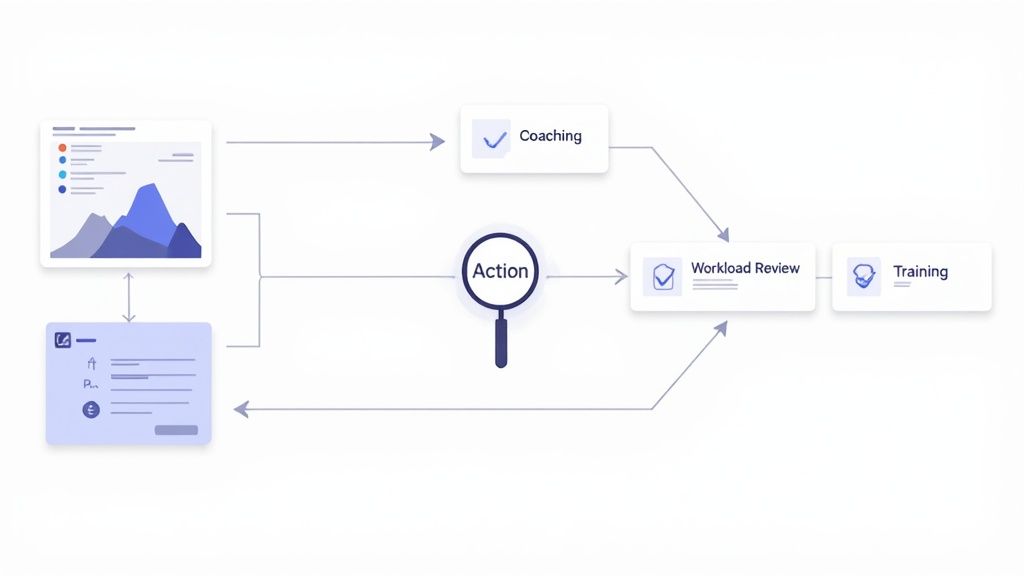
First, you need to bring everything you've gathered into one place. Look at your hard numbers—like eNPS, retention rates, and productivity signals—right alongside the qualitative feedback from one-on-ones and open-ended comments. The goal is to connect the "what" with the "why." A dip in your eNPS score is a signal, but it’s the comments from detractors that really tell you the story behind that number.
This process turns measurement from a simple check-in to a powerful diagnostic tool for your company's health.
From Raw Data to Clear Insights
Raw data can feel like a tidal wave. To make sense of it all, you have to look for trends and, most importantly, segment your results. Don't just stare at the overall company score. Slice the data to find the issues hiding below the surface.
- Segment by Department: Is low engagement stuck in one specific team? That often points to a management or workload issue that needs a targeted fix.
- Segment by Role: Are your frontline folks feeling less supported than senior staff? This can reveal a serious communication gap or a lack of real growth opportunities.
- Segment by Location or Work Style: Are your remote employees reporting different challenges than your in-office team? This is how you tailor support for different work setups.
The business case for this level of detail is huge. Disengaged employees are incredibly costly, with recent global engagement rates dropping from 23% to 21%. That slump cost an estimated $438 billion in lost productivity alone, which shows the massive ROI you get when you turn data into smart engagement initiatives. You can read more about the global impact of engagement on ADP's research site.
A common mistake is trying to react to every single piece of feedback. Don't do it. Instead, focus on the recurring themes. If one person mentions a problem, it's an anecdote. If twenty people mention it, you have a clear mandate for action.
By spotting these patterns, you can move from scattered complaints to strategic priorities.
Creating Actionable Interventions
Once you have your insights, it’s time to create specific, targeted interventions. Generic solutions just don't work. Your actions have to directly address the problems you've uncovered.
This means drawing a straight line from the data point to the proposed solution. Vague goals like "improve morale" are useless. Get concrete.
Here are a few real-world scenarios I’ve seen play out:
-
Insight: Your eNPS data shows a ton of Detractors in the engineering team. Digging into their comments, you see "unclear priorities" and "last-minute changes" pop up again and again.
- Action: You roll out a workshop for product and engineering managers on agile project management and better roadmap communication. The goal is to improve planning and stop scope creep in its tracks.
-
Insight: Productivity data from a tool like DeskCove shows your customer support team is consistently working late with very little focus time. You also notice that absenteeism is creeping up.
- Action: You kick off a workload review. This could lead to hiring another person, investing in automation tools to handle repetitive tasks, or scheduling dedicated "no-interruption" blocks for complex tickets.
-
Insight: Exit interviews consistently bring up the same theme: your best people are leaving because they don't see a path for career growth.
- Action: You launch a formal mentorship program and make it mandatory for managers to build individual development plans (IDPs) with every team member during their quarterly check-ins.
These examples show how specific data can lead directly to practical, measurable actions.
Building a Continuous Feedback Loop
Measuring employee engagement should never be a one-and-done event. It has to be a continuous cycle of listening, acting, and refining. After you implement changes, the job isn't over. You have to measure their impact.
- Communicate Your Findings: Start by sharing the high-level results and your action plan with everyone. Transparency builds trust and shows people their voices were actually heard.
- Implement the Changes: Roll out your targeted fixes, whether that's new training, a policy update, or a process improvement.
- Measure Again: Use your next pulse survey or check-in to see if the needle moved on the specific issues you tackled. Did the eNPS score in engineering go up? Did absenteeism in the support team go down?
- Refine and Repeat: Look at the new data. Some of your actions will hit the mark, while others might need a tweak. Use these fresh insights to fine-tune your approach and keep the cycle going.
This loop turns your engagement strategy into a living, breathing part of your culture. It moves you from just measuring engagement to actively shaping a more positive, productive, and resilient organization.
Common Questions About Measuring Employee Engagement
Even the best-laid plans run into questions once you start putting them into practice. Measuring employee engagement is no different. It's totally normal to have a few "what ifs" and "how tos" pop up.
Here are some straightforward answers to the questions we hear most often, designed to help you clear any hurdles and get your measurement program running with confidence.
How Often Should We Measure Employee Engagement?
There’s no magic number here, but the most successful companies use a hybrid approach. The goal isn't just to conduct a survey; it's to create an ongoing conversation with your team.
A balanced cadence helps you spot both long-term shifts and immediate issues before they grow.
- The Annual Deep-Dive: Once a year, go deep with a comprehensive engagement survey. This gives you a solid baseline to track significant, year-over-year changes in big-picture areas like career growth opportunities and trust in leadership.
- Quarterly or Monthly Pulse Checks: Shorter, more frequent pulse surveys are perfect for getting a quick read on timely topics. Think of them as a great way to check in on morale during a big project or get feedback on a new company policy right after it rolls out.
- Continuous, Real-Time Feedback: The most immediate insights come from embedding feedback into your daily culture. Regular 1-on-1s and always-on feedback channels are what let you be proactive instead of just reactive.
This layered strategy keeps you in tune with your organization's health without burning everyone out on endless feedback requests.
What Are the Biggest Mistakes to Avoid?
Measuring engagement can seriously backfire if you’re not careful. The single biggest mistake is asking for feedback and then doing nothing with it. When employees take the time to share their thoughts and see zero action, it kills trust. You're not just creating "survey fatigue"—you're actively breeding cynicism.
Another massive pitfall is failing to guarantee anonymity. If people think their honest feedback could come back to bite them, you're only going to get sanitized, useless responses.
The whole point of measuring employee engagement isn't just to gather data—it's to spark meaningful dialogue and drive positive change. If you ask, you have an obligation to listen and respond, even if it’s just to say, "We heard you, and here's what we can (and can't) do right now."
Other common trip-ups include asking loaded questions that skew the results, failing to segment data by department or team to find hidden hot spots, and getting fixated on a single metric instead of looking at the whole picture.
How Can We Encourage Higher Survey Participation?
Getting more people to participate really boils down to one thing: trust. When your team trusts the process and believes their voice actually matters, they'll show up.
Here are a few practical ways to build that trust and boost your numbers:
- Communicate the "Why": Don't just blast out a survey link. Take the time to explain why you're doing this and exactly how the feedback will be used to make things better. Frame it as a team effort.
- Get Leaders On Board: Participation flows from the top down. When senior leaders visibly support the survey and talk about its importance, it signals to everyone that this is a real priority.
- Guarantee Confidentiality (And Mean It): Be crystal clear about how you’re protecting anonymity. Reassure everyone that individual responses are private and that results will only ever be shared in aggregate.
- Close the Loop: This is the most critical step of all. After the survey is done, share the high-level findings with the entire company. More importantly, tell them the specific, concrete actions you plan to take based on what they said. When people see their input leads to real change, they'll be invested for the long haul.
Ready to turn your engagement data into real productivity insights? DeskCove gives you the tools to understand work patterns, spot burnout before it happens, and help your team succeed. See how it all works by visiting https://deskcove.com.