Overcome Your Time Management Problems Today

Let's be honest, those common time management problems feel like more than just little daily annoyances. They're the big roadblocks that can stall a career, tank productivity, and send stress levels through the roof. Issues like never-ending distractions or a to-do list that just won't quit usually point back to one thing: our work habits haven't caught up with the demands of the modern workplace.
The Real Cost of Unmanaged Time

That chaotic, never-quite-caught-up feeling isn't just in your head—it's a real struggle with a real price tag. Juggling deadlines, fighting off a constant barrage of notifications, and staring down an impossible to-do list can feel like a personal failing. But these challenges are rarely about a lack of effort. More often, they're a sign of a fundamental mismatch between our work systems and the hyper-connected world we live in.
Getting to the root of your time struggles is the absolute first step toward building a system that actually works. Because when time goes unmanaged, the fallout goes way beyond a few missed deadlines. It slowly eats away at both your professional and personal life.
Beyond Personal Frustration
When you don't get a handle on time management, the problems create a ripple effect. It's not just about feeling frazzled by 5 PM. We're talking about a cumulative hit to your career, your team's morale, and your overall well-being. Think of it like a slow leak in a tire—you might not notice it at first, but leave it alone and it will completely deflate your momentum, leaving you stranded.
This isn't just a personal problem; it has massive economic consequences. In fact, low employee engagement, which is often made worse by poor time management, is estimated to cost the global economy $438 billion annually in lost productivity. You can discover more insights about employee productivity on teamout.com.
The biggest drain on your productivity isn't laziness—it's the silent cost of context switching, minor interruptions, and working without a clear system. Each small disruption adds up, creating a significant deficit in your workday.
Identifying the Core Issues
Before you can solve these problems, you have to know what you're looking for. Most of us run into the same handful of core challenges, each with its own unique way of derailing our day. Spotting these patterns is how you start to take back your focus and energy.
To help you get started, we've put together a quick look at some common time management problems and the real-world impact they have.
Common Time Management Problems and Their Impact
| Common Problem | Primary Cause | Impact on Work |
|---|---|---|
| Constant Distractions | Lack of focus boundaries, too many notifications | Shallow work, increased errors, mental fatigue |
| Vague Priorities | No clear goals or planning | Time wasted on low-value tasks, critical projects stall |
| Procrastination | Feeling overwhelmed or anxious about a task | Last-minute rushes, stress, subpar quality of work |
| Overcommitment | Inability to say "no," poor scope management | Spreading yourself too thin, burnout, missed deadlines |
Recognizing which of these are holding you back is the first step. Once you've identified the problem, you can start building a system to fix it. Here’s a closer look at a few of the biggest culprits:
- Constant Distractions: Every ping, notification, and "quick question" shatters your concentration. This leads to surface-level work and a much higher chance of making mistakes.
- Vague Priorities: When everything feels important, you end up doing nothing that truly matters. This is how you spend a whole day busy but not productive, letting crucial projects fall behind.
- Procrastination: This isn't just laziness; it's often driven by feeling overwhelmed. Pushing tasks off creates a vicious cycle of last-minute panic and rushed, low-quality results.
- Overcommitment: Saying "yes" to everything is a recipe for disaster. It guarantees you're spread too thin to give any single task the focus it truly needs, leading straight to burnout.
Why Procrastination Is a Feeling, Not a Flaw
Procrastination is one of the most misunderstood roadblocks in time management. We tend to see it as simple laziness or a personal failure, beating ourselves up for not just getting things done. But what if it's not a character flaw at all?
Think of procrastination as an emotional reflex. It’s a self-defense mechanism that kicks in when a task brings up uncomfortable feelings like anxiety, boredom, or the sheer dread of being overwhelmed. Your brain, hardwired to seek comfort, latches onto a distraction for immediate relief. The problem is, the original task—and all the stress that comes with it—is still there, looming larger than before.
The Stress Credit Card Analogy
Imagine procrastination as a "stress credit card." When you put off a task, you get that instant hit of relief, much like buying something you can't quite afford. The immediate payment is a feeling of ease. But you’re not getting away with anything.
Later on, as the deadline rushes toward you, the bill arrives with massive interest penalties: crushing anxiety, guilt, and a desperate scramble to finish. You’ve simply traded a small bit of discomfort now for a much bigger, more painful payment down the road. Seeing this pattern is the first real step to breaking the cycle.
This habit of avoidance is a massive drain on productivity. One workplace survey found that a staggering 82% of people admit they don't have a time management system, leading to countless wasted hours. On average, workers burn 51% of their day on tasks with little real value, often as a way to "productively procrastinate." You can read the full research on workplace efficiency.
Pinpointing Your Procrastination Triggers
To really solve the procrastination puzzle, you have to figure out what triggers your urge to delay. Everyone procrastinates for different reasons, and understanding your personal style is the key to finding a fix that actually works. It's about shifting from self-blame to practical problem-solving.
Procrastination is not a time management problem; it's an emotion regulation problem. By addressing the underlying feeling, you can dismantle the urge to delay and regain control of your focus.
The goal isn't to bulldoze through the discomfort with brute force. It's to understand why that discomfort is there in the first place. Once you know the root cause, you can treat the source of the feeling instead of just battling the symptom of avoidance.
Common Procrastination Styles and Their Causes
While everyone's triggers are a bit different, most procrastination habits fall into a few common buckets. See if you recognize yourself in any of these—this is where the real insight begins.
- The Perfectionist: You can't bring yourself to start because you’re terrified the final product won't be perfect. The pressure to create something flawless is so intense that doing nothing feels safer.
- The Overwhelmed: The project looks like a mountain. It’s so huge and complicated that you don't even know where to begin. This paralysis sends you scrambling for smaller, easier tasks to get a quick, even if hollow, sense of accomplishment.
- The Anxious Avoider: This task is tied to a fear of judgment or negative feedback. It could be a big presentation or just a tough conversation, but you put it off to dodge the wave of anxiety you know is coming.
- The Bored Resistor: Let's be honest—the task is just dull, tedious, or completely uninspiring. Your brain craves something more interesting and actively rebels against mind-numbing work, searching for any distraction it can find.
Identifying which style sounds most like you is a game-changer. It moves you from a vague, nagging guilt to a clear understanding of your own time management hurdles. With that knowledge, you can pick strategies that target your specific emotional trigger, making it so much easier to get started and see things through.
Winning the Battle Against Digital Distractions

In today's workplace, your focus is under constant assault. Every notification, email chime, and "quick question" on Slack is a tiny papercut to your concentration. While each one feels minor in the moment, they add up, leaving your productivity bleeding out by the end of the day.
This relentless stream of interruptions is one of the biggest time management problems we face. It yanks you out of deep work, fractures your attention, and forces you to constantly restart your mental engine. The real fight for effective time management isn't just about organizing tasks—it's about defending your focus from a thousand tiny digital invaders.
Understanding Attention Residue
Ever check a "quick" email and then spend the next five minutes trying to remember what you were doing before? That mental fog has a name: attention residue. It’s the cognitive hangover from switching tasks. Even after you've moved on, part of your brain is still stuck on the previous activity.
Think of it like building a complex LEGO set. Every time someone taps you on the shoulder, you have to put the pieces down, turn around, and then try to recall exactly where you were. Each interruption makes it harder and harder to get back into the flow, and you're far more likely to make a mistake.
The modern workplace often rewards responsiveness over focus, creating a culture where constant interruptions are the norm. But real productivity comes from sustained, deep work—a state that's impossible to reach when your attention is fragmented every few minutes.
Even a quick glance at a notification is enough to leave behind this cognitive residue. It silently sabotages your ability to perform at your best. This is why a day packed with interruptions feels so exhausting yet so unproductive; you're burning more mental energy switching contexts than actually doing meaningful work.
Creating Your Distraction-Free Zone
Winning this battle requires a deliberate strategy. You have to build a fortress around your focus, actively blocking out the noise that derails your day. This isn't about ignoring your colleagues; it's about carving out dedicated windows for deep work so you can be more effective for them later.
Remote and hybrid work has thrown a new set of challenges into the mix. The average employee now spends 11.3 hours per week in meetings, which is nearly a third of their workweek. This environment often creates a direct link between disengagement and frequent interruptions, making it even tougher to manage your time. You can learn more about these workplace collaboration challenges from Archie.
Here are a few practical strategies to start reclaiming your focus:
- Tame Your Notifications: Go into the settings of your communication apps—email, Slack, Teams—and be ruthless. Turn off all non-essential banners, sounds, and alerts. The goal is to check messages on your terms, not when an algorithm decides to interrupt you.
- Set Clear Communication Boundaries: Let your team know when you're in a focus block. A simple status message like "Deep Work Session: Will respond after 11 AM" sets expectations and empowers your colleagues to respect your time.
- Batch Your Tasks: Group similar activities together. For example, set aside specific times to check and respond to emails instead of dealing with them as they arrive. This cuts down on context switching and saves your mental energy for more demanding work.
Using Tools to Identify Your Time Sinks
You can't fix what you can't see. One of the most powerful steps in solving time management problems is getting an honest look at where your time actually goes. We almost always underestimate how much time is lost to small, seemingly insignificant distractions.
Tools like DeskCove can offer a huge advantage here by tracking your application and website usage. This data isn't for micromanagement; it's for self-awareness. It gives you a clear, objective picture of your daily habits and shines a light on your biggest time sinks.
Once you see that you're losing an hour each day to aimless browsing or social media checks, you can take specific, targeted action. By understanding your patterns, you can build a more intentional workflow and make sure your most valuable asset—your attention—is spent on the tasks that truly matter.
How to Prioritize When Everything Is a Priority
Does your to-do list feel less like a plan and more like a shouting match for your attention? If so, you're not alone. This is one of the most common time management problems out there. When every task is marked "urgent," it's easy to get paralyzed, jumping on whatever's loudest instead of what’s actually most important.
The real issue is a classic brain trick. We naturally drift toward small, easy tasks because checking them off gives us a quick hit of satisfaction. But this is just productive procrastination. It keeps us busy but leaves the critical, high-impact work sitting on the back burner until the deadline is screaming at us. Real progress comes from having a reliable system to tell the difference between what's genuinely urgent and what's just making noise.
When it feels like you're juggling a dozen projects at once, learning effective strategies for managing multiple projects simultaneously can completely change the game. It gives you the mental tools to assess, sort, and execute your work with total clarity.
The Eisenhower Matrix: Your First Line of Defense
One of the most powerful and refreshingly simple tools for cutting through the chaos is the Eisenhower Matrix. It forces you to sort tasks based on just two criteria: urgency and importance. This simple framework helps you stop reacting to deadlines and start acting on your strategic goals.
Think of it like a filter for your brain. By dropping each task into one of four quadrants, you get an instant visual map of what truly deserves your focus.
- Urgent & Important (Do First): These are the fires you have to put out now. Think fixing a major client issue or finishing a report that's due this afternoon.
- Not Urgent & Important (Schedule): This is where the magic happens—the home of strategic growth. This quadrant includes things like planning a new project, learning a new skill, or building key relationships.
- Urgent & Not Important (Delegate): These are the constant interruptions that demand attention but don’t move the needle on your core goals. Think routine admin work or responding to non-critical emails.
- Urgent & Not Important (Eliminate): These are the time-wasters that offer zero real value. Mindless social media scrolling or unnecessary busywork live here.
Making this matrix a habit trains you to spend more time in Quadrant 2—the important but not urgent tasks that quietly drive long-term success.
This image shows just how dramatically productivity and well-being can shift once a clear prioritization system is in place.
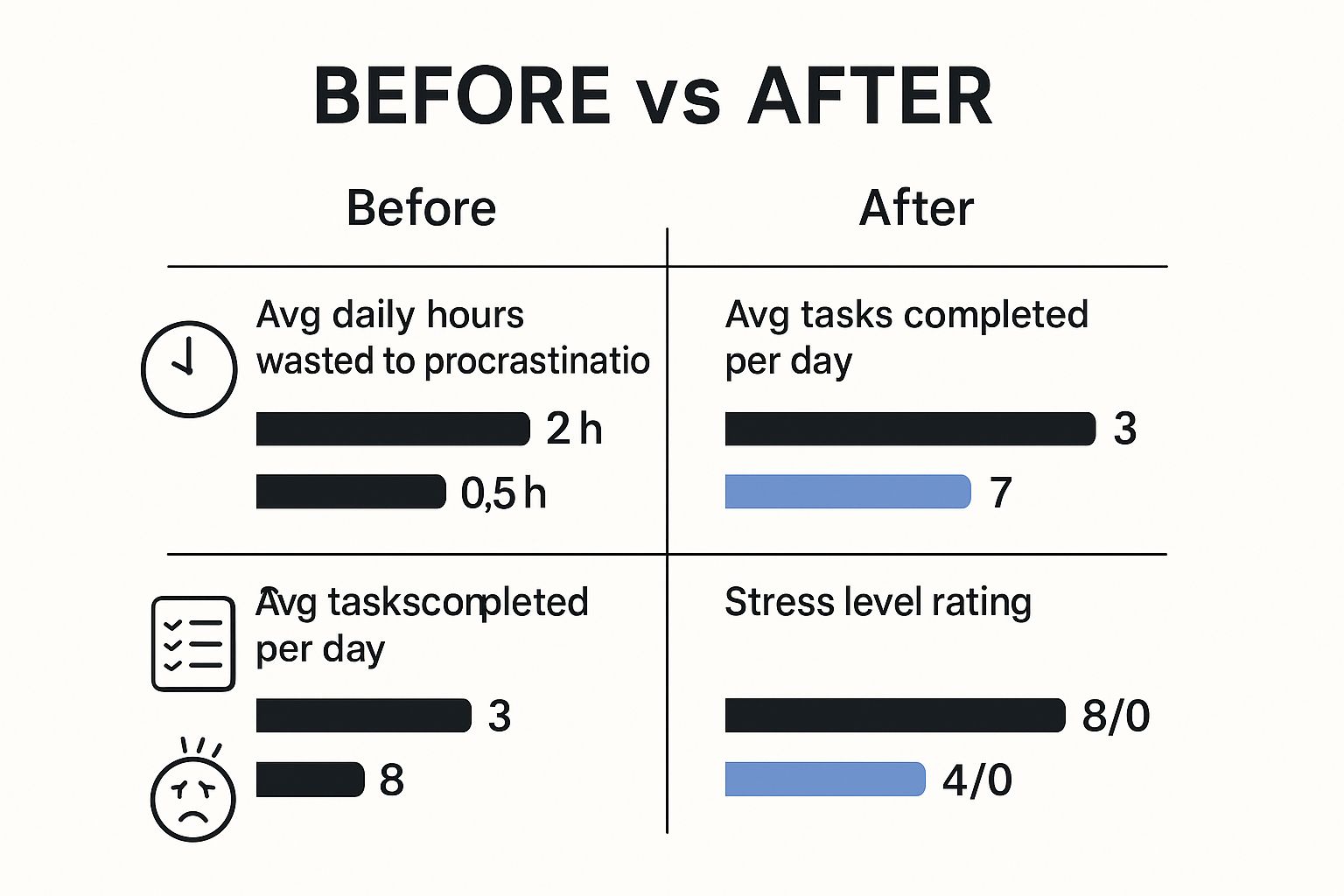
The data is pretty clear: putting these techniques into practice can slash procrastination by a massive 75%, while more than doubling your daily output and seriously cutting down on stress.
The MoSCoW Method for Project Clarity
When you're dealing with more complex projects that have a ton of features or deliverables, the MoSCoW method adds another powerful layer of clarity. This technique is a lifesaver for teams trying to agree on what's absolutely essential for a project's success. It sorts every requirement into four simple buckets.
Prioritization isn't just about managing your time—it's about managing your energy and attention. A good system ensures you're putting your most valuable resources toward the tasks that deliver the biggest results.
The MoSCoW framework forces teams to have those tough but necessary conversations about what’s a non-negotiable versus what’s just a "nice-to-have."
- Must-Have: These are the absolute deal-breakers. If these aren't done, the project is a failure. Period.
- Should-Have: These are important, but not quite vital. The project can still launch without them, but it’ll probably hurt.
- Could-Have: These are desirable features that would be great to include but have a pretty minor impact if they're left out. They're usually the first on the chopping block when time or money gets tight.
- Won't-Have (This Time): These are the features or tasks that the team has intentionally decided not to do right now, keeping the project focused and on track.
Comparing Popular Prioritization Techniques
Choosing the right framework depends entirely on your situation. A simple daily to-do list has different needs than a complex, multi-stage project. This table breaks down some of the most effective methods to help you pick the best tool for the job.
| Technique | Best For | Key Benefit | Potential Drawback |
|---|---|---|---|
| Eisenhower Matrix | Daily and weekly task management for individuals. | Incredibly simple and fast for sorting priorities. | Can be too basic for complex, multi-dependent projects. |
| MoSCoW Method | Product development and project management with teams. | Creates clear alignment on project scope and must-haves. | Requires team consensus, which can sometimes slow things down. |
| Kanban Board | Visualizing workflow and managing ongoing tasks. | Provides a clear, at-a-glance view of progress and bottlenecks. | Less focused on initial prioritization, more on workflow. |
| Time Blocking | Individuals who need to protect time for deep work. | Allocates specific time slots for tasks, ensuring they get done. | Can feel rigid and may be difficult to stick to if interruptions are frequent. |
Ultimately, the goal is to find a system that clicks with how you work and helps you bring order to your workload.
By graduating from a simple to-do list to a structured approach like the Eisenhower Matrix or MoSCoW method, you turn chaos into a clear, actionable plan. It’s about taking back control of your workload and focusing your energy where it will actually create meaningful results.
Building Your Personal Time Management System
Let's be honest: there's no magic wand for fixing your time management problems. The best system isn't something you can just buy or download. It’s something you build, piece by piece, to fit your unique workflow, personality, and challenges.
So many of us have tried and failed to get organized because we tried to force ourselves into a rigid, one-size-fits-all method. The real solution is to create a personalized toolkit of strategies. This way, you can pick and choose the right tool for the right job, giving you the flexibility to adapt when priorities inevitably shift.
Core Techniques for Your Toolkit
Building a solid system starts with a few foundational techniques. These aren't mutually exclusive; in fact, they work best when you use them together to tackle different parts of your day.
Before you dive in, exploring various effective time management tools can give you a great starting point. But remember, the techniques below are the engine that makes those tools actually work.
Here are three powerful methods to get you started:
- Time Blocking: This is a game-changer. Instead of a simple to-do list, you assign every single task a specific block of time on your calendar. This turns a vague intention like "I'll work on the report today" into a concrete commitment: "I will work on the report from 9 AM to 11 AM." It's incredibly effective for protecting your deep work time.
- The Pomodoro Technique: Consider this your best weapon against procrastination and burnout. You work in focused 25-minute sprints (called "Pomodoros"), separated by short 5-minute breaks. After four of these cycles, you take a longer break. This simple rhythm breaks overwhelming projects into bite-sized chunks and keeps your mind fresh.
- The 2-Minute Rule: Made popular by David Allen, this rule is as simple as it is brilliant. If a new task pops up and you know it will take less than two minutes to complete, just do it immediately. This prevents tiny, easy tasks from cluttering up your to-do list and your brain, helping you keep your momentum on bigger projects.
Combining Techniques into a Cohesive System
The real power kicks in when you stop seeing these as isolated tactics and start weaving them into your daily workflow. A well-built system is the bridge between knowing what to do and actually getting it done, turning your big plans into concrete, daily actions.
The goal of a personal time management system isn't to control every minute of your day. It’s to create a reliable structure that reduces friction, protects your focus, and frees up mental energy for the creative, high-impact work that truly matters.
Let’s walk through what this looks like in the real world. Imagine you have a huge project proposal due at the end of the week.
Here’s how you could structure your day using a combined approach:
- Morning Planning (Time Blocking): First thing in the morning, you look at your calendar. You create a three-hour "Time Block" from 9 AM to 12 PM dedicated solely to "Project Proposal Research & Outline." You've now ring-fenced the time for your most important task.
- Deep Work (Pomodoro Technique): During that three-hour block, you don't just stare at a blank page. You break it down using the Pomodoro Technique. You work in focused 25-minute bursts on research, then take a 5-minute break to stretch or grab water. This keeps your energy high and prevents the task from feeling like an endless marathon.
- Managing Interruptions (2-Minute Rule): An email from a colleague dings your inbox. It's a quick question. Instead of letting it derail you, you apply the 2-Minute Rule. It's a fast reply, so you handle it during your 5-minute Pomodoro break and get right back to deep work without losing your train of thought.
Making Your System Stick
This kind of personalized system gives you a clear, repeatable process for tackling your workload. It solves the most common time management issues by giving you a default plan for how to approach your day. For more ideas on building a routine that lasts, you might find our guide on effective time management strategies for a stress-free workday helpful.
The key is to start small. Don't try to implement everything at once. Pick one technique, like Time Blocking, and just use it for a week. Once that feels natural, try layering in the Pomodoro Technique for your most important blocks. By building your system gradually, you create a powerful and sustainable habit that will serve you for years to come.
Your Path to Reclaiming Control of Your Time

Getting a handle on your schedule isn’t about a single magic bullet; it's about building a consistent practice of intentional choices. Every common time management problem we’ve talked about—from the magnetic pull of procrastination to the constant barrage of digital pings—can be overcome. It all starts by accepting one simple truth: this is a skill you can learn, not a talent you’re born with.
Think of strategies like Time Blocking or the Eisenhower Matrix as tools in your workshop. Each one is designed to help you regain command over your day. The whole point is to build a workflow where you're the one in the driver's seat, steering your energy toward what actually moves the needle.
An Actionable Checklist to Start Now
Ready to jump in? To help you take that first step, here’s a quick-start checklist pulling the most powerful strategies from this guide.
- Identify Your Triggers: Get honest about the emotions that send you running toward procrastination. What are they?
- Create Focus Blocks: Go into your calendar right now and schedule dedicated, do-not-disturb time for your most important work.
- Prioritize Ruthlessly: Use a framework like the Eisenhower Matrix to finally separate what feels urgent from what is genuinely important.
- Automate Repetitive Work: If you’re a business owner or bogged down with admin, find tools that do the grunt work for you. For instance, using efficient invoice automation software to boost efficiency can claw back hours of your time each month.
Frequently Asked Questions About Time Management
Even with the best game plan, you're going to hit some specific roadblocks when you're trying to fix those nagging time management problems. Let's tackle some of the most common questions that come up as people try to build better habits and win back their focus.
What Is the Most Effective First Step?
If you're just starting out and feeling overwhelmed, Time Blocking is almost always the most powerful first move you can make. It’s a simple concept: instead of staring at a chaotic to-do list, you carve out specific blocks of time for your most important tasks and schedule them directly on your calendar.
That simple action turns a vague goal into a real commitment. You don't have to overhaul your whole day, either. Just start by scheduling one or two "focus blocks" each day for your absolute highest-priority work. This single habit creates a powerful foundation you can build on.
How Do I Handle Constant Urgent Requests?
Ah, the classic problem. This one requires a mix of clear communication and setting some firm boundaries. The next time an "urgent" request lands on your desk, take a breath and calmly figure out where it actually fits.
Ask a simple question like, "Right now, I'm focused on [Your Top Priority]. Does this new item need to push that aside?"
The trick to managing interruptions isn't about getting rid of them completely—that's impossible. It's about controlling how and when you choose to respond. When you set clear expectations, you teach others to respect your focused time, which ultimately helps everyone get more done.
A simple status message in your team chat can also work wonders. Letting colleagues know you're in deep work mode and unavailable for non-critical pings empowers you to finish what you started without constant disruptions.
Why Do I Fail to Stick with New Systems?
If you've tried different time management systems and nothing has stuck, it’s probably not you—it's the system. Most of the time, failure happens because the system was too rigid or just didn't mesh with how you naturally work. Lasting change almost never happens overnight.
So, instead of trying to adopt a complex new method all at once, just start with a single, simple habit. For example, commit to using the Pomodoro Technique for only the very first task of your day. Once that feels automatic, you can add another small habit, like planning your top three priorities the night before.
For more ideas on making habits stick, check out these essential time management tips you need to stay productive. The real key is making small, incremental changes and tweaking your system as you go.
Ready to finally get a clear, honest picture of where your time is really going? DeskCove gives you the insights needed to pinpoint distractions, fine-tune your workflow, and solve your most persistent time management problems for good. Start tracking your productivity and take back control of your day at https://deskcove.com.