How to Keep Focused at Work and Reclaim Productivity

If you want to stay focused at work, you have to realize one critical thing: focus isn't about raw willpower. It’s a skill. You build it by intentionally designing your environment and your habits to keep distractions at bay. Think of it less like trying harder and more like training a muscle through smart, strategic systems.
Why Staying Focused Feels Impossible Today
Does your to-do list feel more like a wish list by the end of the day? You probably start with great intentions, only to get pulled in a dozen different directions by notifications, "urgent" pings, and the constant pressure to be available right now. If that sounds familiar, you're not alone. The modern workplace is practically a minefield for our attention.
This struggle to keep your head down and work isn't a personal failure. It’s a direct result of an environment completely saturated with digital interruptions. Our brains are constantly switching contexts, and that process is mentally exhausting. It drains your energy and makes that deep, meaningful work feel totally out of reach.
The Real Reasons for a Wandering Mind
This constant barrage of information has a real, measurable impact on performance and how engaged we feel. The issue isn't just about losing a few minutes to a notification—it's the cumulative effect that slowly chips away at our ability to think deeply. This widespread disengagement has become a massive problem for businesses.
Recent data shows that only about 21% of workers worldwide feel actively engaged at work, a dip often tied to the "quiet quitting" phenomenon. The fallout from this is a staggering loss in productivity, costing the global economy an estimated $438 billion. You can dig deeper into the numbers with these employee productivity statistics.
The core problem is that we treat focus as a matter of self-discipline when it's largely a matter of environmental design. By blaming ourselves for being distracted, we overlook the systemic issues that make concentration so difficult in the first place.
Instead of fighting a constant uphill battle against distractions, the key is to reshape your work habits and your environment. Once you recognize that focus is a skill you can build, you can move from frustration to action. The following strategies aren’t just about concentrating better today; they're about building a sustainable system for getting into that "deep work" zone consistently.
Design Your Workspace for Deep Work
Your ability to focus is directly tied to your surroundings. It's a simple truth many of us overlook. A cluttered environment, both physically and digitally, constantly pulls at your attention. On the flip side, a space intentionally designed for concentration sends a clear signal to your brain: it's time to get things done.
This isn't just about tidying up. It's about strategically shaping your environment to support your most important goals.
Get Your Physical Space in Order
Small adjustments to your physical workspace can make a massive difference. When you're uncomfortable, your body becomes the biggest distraction. Aches and pains pull your focus away from the task at hand.
Getting your ergonomics right is non-negotiable for sustained concentration. For a complete walkthrough, an ergonomic workstation setup guide is a great place to start.
Sound is another focus-killer. A good pair of noise-canceling headphones can create an instant bubble of concentration, even in a busy office or a noisy home.
Create a Digital Sanctuary
Just as a messy desk creates visual chaos, a disorganized digital workspace clutters your mind. Think about it: every unnecessary icon, notification, and open tab is a potential distraction. Applying a minimalist approach to your computer can transform it from an enemy of focus into a powerful ally.
One of the most effective tricks I've learned is to create separate browser profiles for "Work" and "Personal" use. Your work profile should only have bookmarks and extensions directly related to your job. When it’s time to concentrate, you close the personal browser. The temptation to check social media or news sites simply vanishes.
A well-designed workspace isn’t just about aesthetics; it’s a cognitive tool. Every element, from the height of your chair to the icons on your desktop, either adds to your mental load or reduces it. Choose reduction.
This infographic breaks down how organizing both your physical and digital worlds creates an environment primed for focus.
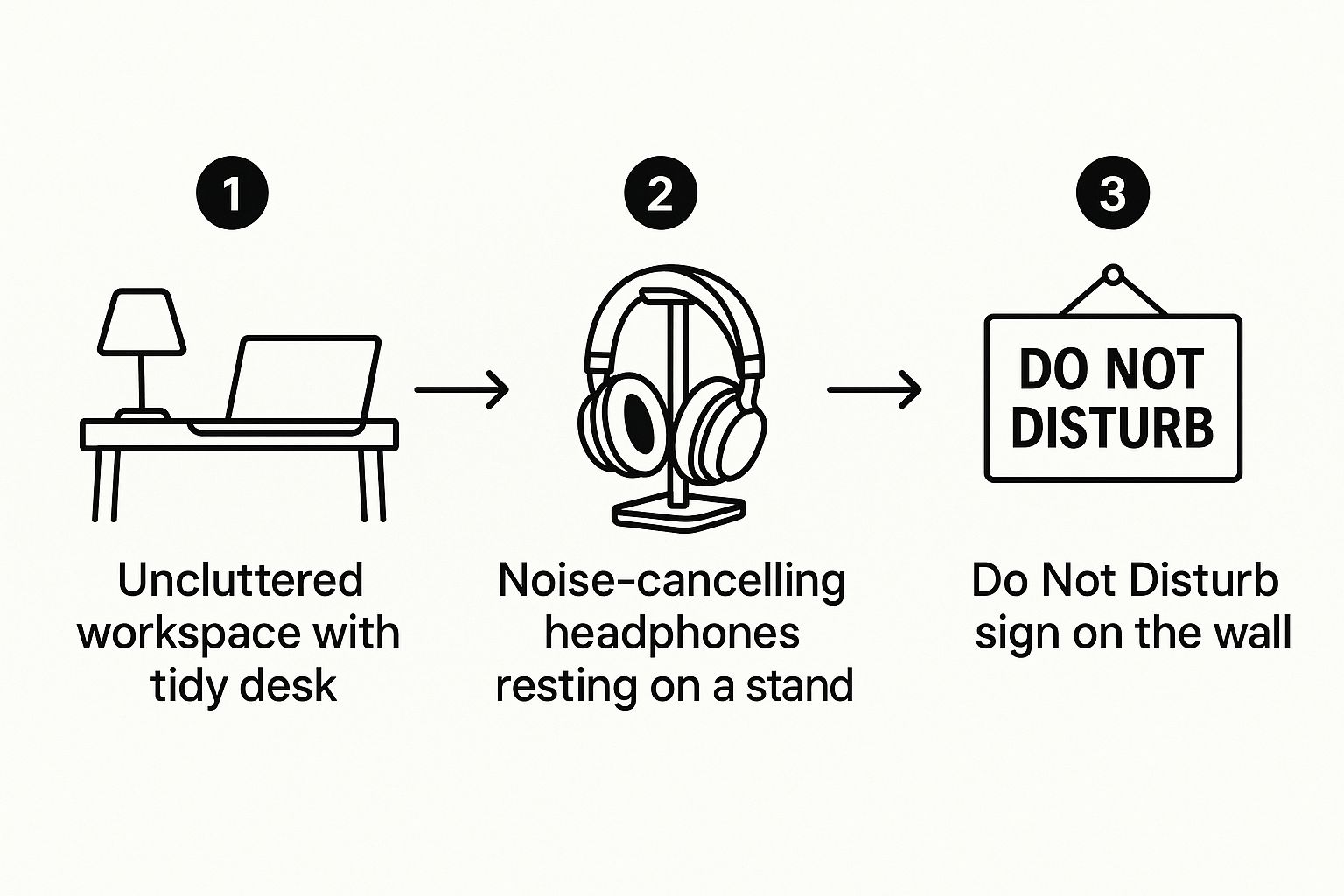
As the visual shows, a truly effective workspace considers both the tangible stuff, like a clean desk, and the intangible, like minimizing digital pings and pop-ups.
Your Focus-Friendly Workspace Checklist
Not sure where to start? This simple checklist can help you audit your own space and make immediate improvements. Run through these action items to turn your desk into a haven for deep work.
| Area | Action Item | Why It Boosts Focus |
|---|---|---|
| Physical Desk | Clear everything except essentials. | Reduces visual clutter and the mental load of seeing unfinished tasks. |
| Ergonomics | Adjust chair, monitor, and keyboard height. | Prevents physical discomfort from becoming a primary distraction. |
| Sound | Use noise-canceling headphones or a white noise app. | Creates an auditory "bubble" that blocks out unpredictable interruptions. |
| Digital Desktop | Remove unused icons and files. | A clean desktop signals a fresh start and prevents you from getting sidetracked. |
| Browser | Use separate "Work" and "Personal" profiles. | Eliminates the one-click temptation of non-work-related websites. |
| Notifications | Turn off all non-essential alerts on your computer and phone. | Puts you in control of your attention, rather than letting apps dictate it. |
Taking even 15 minutes to go through this list can fundamentally change how you feel at your desk. It’s about creating an environment where focus is the path of least resistance.
Master Your Time with Proven Focus Methods
Ever feel like your day is running you, instead of the other way around? It’s a frustratingly common feeling, but you can absolutely take back control. Mastering your time isn't about trying to cram more into an already packed schedule; it's about building a structure that fiercely protects your focus.
The first step is figuring out when you're naturally at your best. Are you a morning person who's sharpest before noon? Or do you hit your stride in the afternoon? Pinpoint that peak productivity window and guard it like a fortress—this is your prime time for tackling the most demanding work.
Eat That Frog First
A fantastic way to build momentum right from the start is the "Eat the Frog" principle. It's a simple but incredibly powerful idea: tackle your biggest, ugliest, most important task first thing in the morning. That "frog" is the one thing on your list you're most tempted to put off.
By getting it out of the way immediately, you not only guarantee it gets done, but you also get a massive psychological win. The sense of accomplishment sets a productive, positive tone for the rest of your day, making everything else feel like a cakewalk in comparison.
Structure Your Day for Deep Work
Once your frog is out of the picture, you can bring in other strategies to structure the rest of your day. These methods create the boundaries you need to maintain concentration for longer stretches. For a deeper dive into this, check out these time management tips you need to stay productive.
Here are a couple of my favorite, battle-tested techniques:
- The Pomodoro Technique: This classic method has you work in hyper-focused 25-minute sprints, followed by a short 5-minute break. After four of these cycles (or "Pomodoros"), you take a longer break. It’s brilliant for chipping away at big projects and keeping your brain from burning out.
- Time Blocking: Think of this as putting your to-do list on a strict schedule. Instead of just listing tasks, you assign each one a specific block of time on your calendar. This forces you to be realistic about your day and kills the temptation to multitask, since each time block is dedicated to one single thing.
The real goal here isn't to become a robot chained to a schedule. It's about being intentional. You're making a conscious choice about where your attention goes, which is the secret sauce to staying focused at work.
The Power of Strategic Breaks
It sounds backward, but one of the best things you can do for your focus is to step away from your work. Our brains simply aren't wired for eight hours of nonstop concentration. Taking short, purposeful breaks is non-negotiable for preventing burnout and staying sharp.
And no, mindlessly scrolling through social media doesn't count. A real strategic break is a deliberate pause—a quick walk outside, a few minutes of stretching, or even just staring out the window. These moments let your brain reset and recharge, making your next block of focused work that much more effective.
Taming the Constant Flow of Digital Interruptions
Let's be honest: digital notifications are the biggest enemy of deep, focused work. That endless stream of pings, pop-ups, and alerts from emails and chat apps isn't just a small distraction. It's a productivity wrecking ball, constantly derailing your train of thought and making it nearly impossible to stay on task.
Every time an alert yanks you away from what you're doing, you pay a steep price. Research has found that office workers get interrupted roughly every three minutes. The real kicker? It takes an average of 23 minutes just to get back to the same level of focus you had before. This stop-and-start cycle makes any kind of sustained concentration a real challenge. For a deeper dive, check out these workplace productivity statistics.
It’s time to get proactive. Regaining control means you start managing your tools, instead of letting them manage you.
Mute the Noise and Take Command
The most straightforward way to cut through the chaos is to simply turn off non-essential notifications. This doesn’t mean going completely off-grid, but it does require being strategic. Dive into your system settings and communication apps to disable banners and sounds for anything that isn't absolutely critical to your immediate role.
Many people I know find success by scheduling specific times to check in. It’s a simple but powerful shift.
- Email Blocks: Instead of keeping your inbox open all day, try checking it only at set times, like 10 AM and 3 PM.
- Chat Status: Don't be afraid to aggressively use "Do Not Disturb" or "Focus" modes during your deep work sessions.
- Phone Away: Put your phone on silent and place it out of arm's reach. The physical distance does wonders to reduce the temptation for a quick scroll.
By silencing the constant digital chatter, you're creating intentional pockets of quiet that are essential for deep thinking. You’re setting a boundary not just with your colleagues, but with your technology itself.
Set Clear Communication Boundaries
Managing your tech is only half the battle. You also need to manage the expectations of your team. This is all about clear, polite, and firm communication. You're essentially teaching others how you work best so you can deliver your best work for them. If you want more ideas on structuring your day around these principles, take a look at these effective time management strategies.
You can set these boundaries with a few simple tweaks. For example, add a line to your email signature that says something like, "To focus on deep work, I check emails twice daily. For urgent matters, please call." This small change can make a huge difference in resetting expectations and protecting your most valuable asset: your focus.
Turn Technology Into Your Focus Ally
It’s a classic Catch-22: the same technology that connects us to our work is often the biggest source of distraction. But what if you could flip the script? The trick is to be intentional. Instead of letting tech dictate your day, you can hand-pick tools designed to protect your focus and encourage deep work.
This is about moving from a reactive mindset—constantly swatting away notifications—to proactively building a tech stack that works for you. Just a few smart additions can create powerful boundaries, helping you stay locked in on what matters.
Build Your Focus Toolkit
There’s a whole world of software out there built specifically to help you stay on task. Think of them as your digital partners in the war against distraction. They provide the structure needed to reinforce the good habits you’re trying to build.
Some of the most popular and effective tools fall into a few key categories:
- Website Blockers: These are non-negotiable for me. They stop you from mindlessly drifting over to social media, news sites, or your favorite online shops during your dedicated focus blocks.
- Focus Timers: Tools based on principles like the Pomodoro Technique are fantastic for working in intense, structured sprints. They train your brain to concentrate for a set period, knowing a break is just around the corner.
- Streamlined Project Management Platforms: A good platform corrals all your tasks, deadlines, and communications into one place. This alone cuts down on the mental load of trying to track everything across emails, chats, and sticky notes.
Technology is only a distraction if you let it be. When used deliberately, it can become your greatest asset for building and maintaining deep focus.
Let Tech Handle the Tedious Work
One of the sneakiest drains on your mental energy is all the repetitive, low-value work that crops up during the day. This is where modern tools, especially AI-powered ones, can be a game-changer. Learning how to Automate Excel Tasks is a perfect example of this. When you offload the mindless stuff to software, you save your brainpower for complex problem-solving.
On a similar note, you can't improve what you don't measure. Time-tracking software is an invaluable ally here, giving you a crystal-clear picture of where your hours are really going. It helps you pinpoint your biggest time sinks and, just as importantly, your most productive windows.
For managers, seeing how automated time tracking is a game-changer for remote teams can unlock insights that help build smarter, more focused habits across the entire organization.
Got a Specific Focus Problem? Let's Troubleshoot.
Even with the best game plan, some days are just harder than others. Certain challenges pop up again and again, derailing even the most disciplined among us. Let's tackle a few of the most common focus-killers head-on with some practical, real-world advice.
"How Can I Possibly Focus in This Loud, Open-Plan Office?"
This is a big one. The key is to build your own personal "focus bubble." Your first and best investment is a solid pair of noise-canceling headphones. Seriously, they're a total game-changer for tuning out chatty coworkers and the general office buzz.
Putting on headphones also acts as a universal "do not disturb" sign. To really lock in, try playing some instrumental music or ambient soundscapes. If you have tasks that require deep, uninterrupted thought, don't be afraid to book a quiet room or find an unused corner of the office to camp out for a bit.
"I Got Interrupted. How Do I Get Back on Track Quickly?"
The secret here is creating a simple "reset ritual." The second an interruption happens, grab a sticky note and jot down a single sentence about what you were just doing and what your very next action was going to be. Think of it as leaving a breadcrumb for your future self—it makes finding your way back infinitely easier.
Once the interruption is over, take three deep breaths to clear the mental clutter. Look at your note to instantly re-engage your brain with the task at hand. Whatever you do, resist that magnetic pull to "just quickly check" your email or phone. Diving right back into a small, easy piece of your task is the fastest way to regain your momentum.
Your ability to refocus is just as crucial as your ability to focus in the first place. A simple reset routine can slash the average 23-minute refocusing time down to mere moments.
"My Focus Is Great in the Morning but Tanks After Lunch. What Gives?"
That post-lunch slump is completely normal! It’s your body's natural energy rhythm, so the trick is to work with it, not fight it.
The best strategy is to front-load your day. Tackle your most challenging, brain-draining tasks first thing in the morning when your focus is at its peak. This is often called the "Eat the Frog" method, and it works.
Save your afternoons for lower-stakes activities. This is the perfect time for answering emails, sitting in on meetings, or planning out your schedule for the next day. To fight off the sleepiness, try a quick 15-minute walk outside, do some light stretching, or have a protein-heavy snack. A big, carb-heavy lunch is usually the main culprit, so a lighter meal can make a world of difference.
Ready to understand your team's productivity patterns and build a more focused work environment? DeskCove provides the insights you need to eliminate distractions and boost efficiency. See how your team really works and start making data-driven improvements today by visiting DeskCove.