Fix Your Time Management Problem for Good

If you’re constantly struggling with a time management problem, you’re not alone. It’s easy to feel like it's a personal failing, but the truth is, it’s usually a symptom of deeper issues baked into how we work today. The real problem isn’t a lack of effort—it's that we're fighting against our own psychology, endless digital noise, and the modern myth that being busy means being productive.
Why Solving Your Time Management Problem Is So Hard
Feeling like you're always racing against the clock has become the default experience in most jobs. The generic advice to "just get organized" or "buy a planner" falls flat because it completely misses the point. The issue is rarely about a lack of desire to be productive.
Instead, the challenge comes from a few powerful, often invisible, forces. We've been told multitasking is a strength, even though study after study shows it torpedoes focus and quality. Think about it: a single notification can completely derail you, and research shows it takes an average of over 23 minutes to get your concentration back.
The Psychological Traps We All Face
Sometimes, our own brain is our biggest obstacle. We're wired to chase the quick win—tackling small, easy tasks to get a little hit of accomplishment, even while the big, important projects just sit there. This is a classic psychological quirk called the urgency effect, where we prioritize what feels urgent over what’s actually important for our long-term goals.
On top of that, there's the constant pressure to be available and responsive. This traps us in a reactive cycle, where our days are spent putting out fires in our inbox instead of proactively moving our own work forward.
The real challenge isn't managing the clock, it's managing your focus. When you understand where your attention is truly going, you can start making meaningful changes to your schedule and output.
Before you can fix the problem, you need a clear diagnosis. Most of us feel the symptoms of poor time management, but we struggle to pinpoint the actual root cause. This table breaks down the most common issues to help you identify what's really going on.
Common Time Management Problems and Their Root Causes
| Symptom (The Problem You Feel) | Root Cause (The Real Issue) | Potential First Step |
|---|---|---|
| "I'm always busy but never get anything done." | You're stuck in reactive work, letting emails and messages dictate your day. | Block out "focus time" in your calendar and turn off notifications. |
| "I can't seem to focus for more than 15 minutes." | You're a victim of constant context-switching from digital interruptions. | Use a time tracker to see how often you switch tasks. |
| "I procrastinate on my most important projects." | You're prioritizing urgent but unimportant tasks over high-impact work. | Use the Eisenhower Matrix to separate what's truly important from what's just noisy. |
| "My to-do list just keeps getting longer." | You have a lack of clear priorities or you're overcommitting. | Define your top 1-3 priorities for the week and say no to everything else. |
| "I feel completely burned out by the end of the day." | You're not taking effective breaks or you're trying to multitask constantly. | Schedule short, intentional breaks away from your screen every 60-90 minutes. |
Once you see your problem laid out like this, it stops feeling like a personal weakness and starts looking like a solvable puzzle. The next step is to get a real, data-backed picture of where your time is actually going.
The Modern Workplace Paradox
Here's the irony: the very tools meant to make us more connected and efficient are often the source of our biggest time management headaches. The constant stream of noise from chat apps, email threads, and social media puts us in a state of continuous partial attention. It's an environment that makes deep, thoughtful work nearly impossible.
- The Multitasking Myth: Juggling tasks can slash your productivity by as much as 40%.
- Productivity Pressure: The cultural expectation to always be "on" leads straight to burnout, not better results.
- Lack of Clarity: You can't fix the leaks if you don't know where they are. Without a clear picture of how you spend your time, any attempt to "fix" it is just a guess.
Solving your time management problem for good starts with acknowledging these realities. It’s not about finding a magical app or a rigid new system. It’s about getting crystal clear on your actual work patterns—that’s the only way you can start reclaiming your focus and building a workflow that actually works for you.
How to Diagnose Your Personal Time Leaks
Before you can solve any time management problem, you have to play detective. It's impossible to fix a leak if you don't know where it's coming from, and honestly, most of us are flying blind when it comes to where our hours really go. The first step isn’t about guessing; it's about conducting a practical self-audit to get some hard data on your habits.
This whole process is about swapping assumptions for facts. So many people I've worked with assume meetings are their biggest time sink. But after a bit of tracking, they discover the real culprit: those seemingly innocent 30-second glances at their email inbox, which happen dozens of times a day and completely shatter their focus. The goal here is to gather honest insights without making it a huge, time-consuming chore.
This flowchart breaks down the simple journey from feeling the symptom to finding the solution.
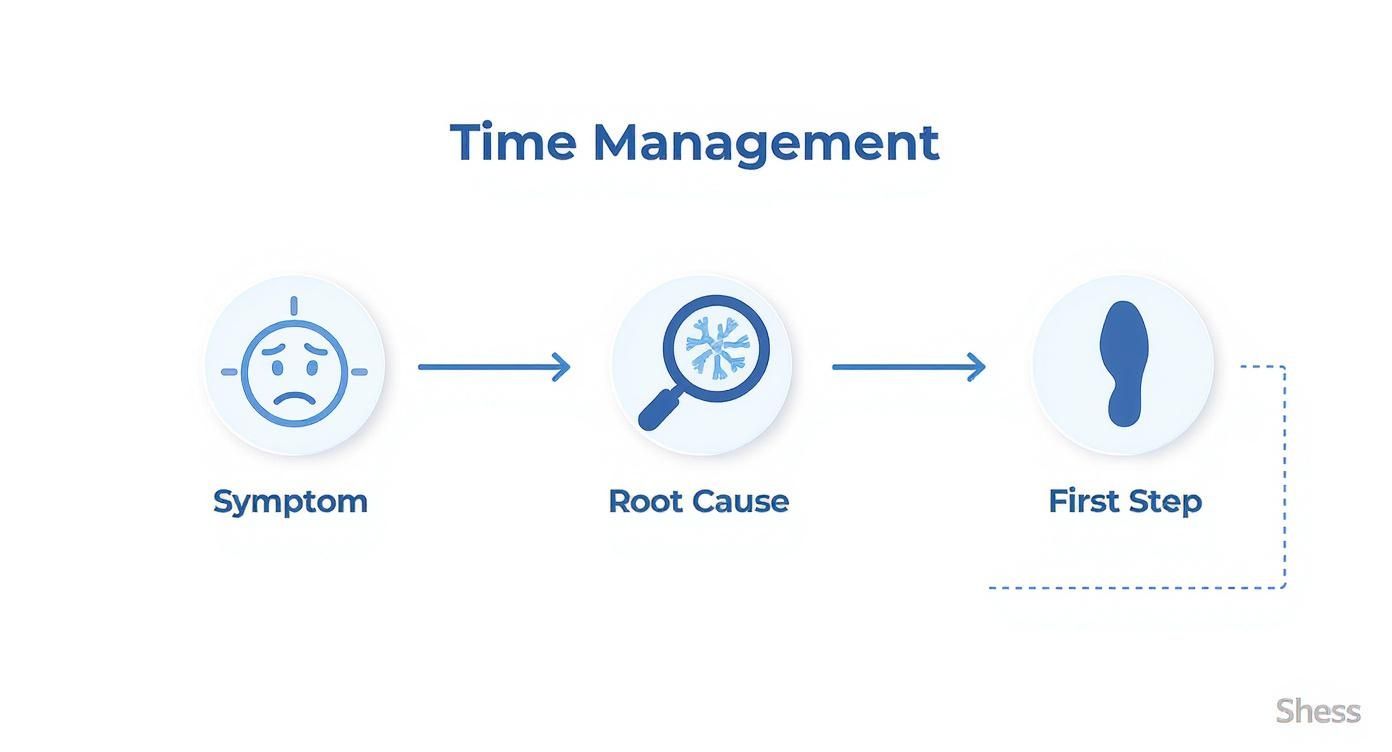
As you can see, figuring out the root cause is the crucial bridge that takes you from feeling overwhelmed to taking action that actually works.
Start with a Simple Time Log
Just for one week, keep a basic log of your activities. This doesn't need to be fancy—a simple notebook, a spreadsheet, or an app will do the trick. The only rule is you have to be consistent.
- Track in 30-minute blocks. Just jot down what you worked on or accomplished during that time.
- Be brutally honest. Did you get sucked into a social media rabbit hole for 15 minutes? Write it down. This is for your eyes only.
- Note your energy levels. Next to the task, add a quick note about how you felt. Were you on fire in the morning but dragging after lunch?
This initial audit gives you a baseline. After just a few days, I guarantee patterns will start to pop out that you never noticed before. These are the first real clues to where your biggest time leaks are hiding. You can even automate a lot of this by learning how to integrate time tracking into your workflow now.
Differentiate Shallow Work from Deep Work
Once you have your time log, it's time to categorize each activity into one of two buckets. This distinction is so important because it helps you understand the quality of your time, not just the quantity.
Deep Work: This is the stuff that requires intense, uninterrupted focus. It's the work that pushes your brain, creates new value, and actually moves the needle on big projects.
Shallow Work: These are the logistical tasks that don't demand much mental horsepower. Think answering routine emails, scheduling meetings, or filling out expense reports. They have to get done, but they don't drive major results.
Now, look at your log. A classic time management problem is a schedule absolutely packed with shallow work, leaving almost no room for the deep, meaningful stuff. If your ratio is way off, you’ve just found a major leak.
Identify Your Procrastination Triggers
Procrastination isn't just about being lazy; it's usually an emotional reaction to a specific task. Look at the important things you kept putting off in your log. What do they have in common?
Some of the most common triggers I see are:
- Lack of Clarity: You're not 100% sure what the next step is, so it’s easier to just avoid the task.
- Feeling Overwhelmed: The project just feels too massive and complicated to even think about starting.
- Fear of Failure: The stakes are high, and you're worried about not doing it perfectly, so you don't do it at all.
Pinpointing these personal time leaks also means recognizing how much damage constant context-switching does to your focus, a challenge that can be managed with the right essential productivity tools. Once you know why you procrastinate, you can finally address the root of the problem—like breaking that huge, scary project into small, manageable steps.
The Hidden Costs of Distractions and Poor Communication
It’s not just about personal habits. Two of the biggest productivity killers out there are constant interruptions and sloppy communication. These are the external forces that can completely derail even the most organized person. You can have the perfect schedule, but it's doomed to fail if your work environment is basically designed for distraction.
Think about what really happens. That "quick question" on Slack might seem harmless, but it triggers a context switch. You drop what you're doing, fire off an answer, and then try to get your head back into a complex task. That process isn't instant. Workers are interrupted roughly every three minutes, and it can take a staggering 23 minutes to fully regain focus after each break. Do the math—a few of those "quick questions" can easily eat up hours of your day.

The costs, both in time and money, are enormous. Knowledge workers, for instance, can spend as much as 88% of their week just on communication like emails and meetings. On top of that, poorly run meetings alone cost businesses an estimated $37 billion a year in wasted time. When you realize that chatty coworkers are the number one distraction for 41% of employees, the scale of the problem becomes crystal clear.
To get a better handle on how these interruptions chip away at our focus, you can check out our guide on managing distractions at work.
Reclaiming Focus with Clear Boundaries
The answer isn’t to stop talking to each other. It’s about being more intentional about how and when you communicate. Instead of letting a constant stream of notifications run your day, you need to set up some firm boundaries to protect your focus.
This boils down to a few key strategies:
- Time Blocking: Block out specific chunks of time on your calendar for "deep work." During these blocks, all notifications get shut off—email, chat, phone, everything. You commit to one high-priority task and nothing else.
- Asynchronous Communication: Not every message needs an answer this very second. Fostering a team culture where it’s okay to reply later allows people to respond on their own terms, preserving those long, uninterrupted stretches of work.
- Disciplined Meetings: Every single meeting needs a clear agenda, a specific goal, and a hard stop time. If a meeting isn't absolutely necessary, kill it. Handle the topic over email or in your project management tool instead.
Building a Communication-First Culture
Ultimately, fixing this kind of time management problem requires a cultural shift. It means setting clear expectations around response times and valuing focused work just as much as you value collaboration. To really cut down on digital noise and improve communication, it's crucial to adopt effective email management best practices.
Creating an environment for deep work is a shared responsibility. It requires individual discipline to manage notifications and team-wide agreements to respect each other's focused time.
By making these small but strategic changes, you can pull back hours of productive time each week. It's the difference between a chaotic, reactive workday and one that's structured, effective, and a lot less stressful.
Building a Framework That Actually Works for You
Let's get one thing straight: there's no single, magical method that will solve all your time management problems. We've all heard of popular frameworks like the Pomodoro Technique or the Eisenhower Matrix, and while they're great starting points, the real key is building a personal system.
What works for a freelance designer is going to feel completely wrong for a project manager juggling three different teams. The goal isn't to force yourself into a box. It's to build a flexible toolkit that feels natural and, most importantly, sustainable.
Start with a Proven Foundation
You don't need to reinvent the wheel. The smartest approach is to start with an established method and then tweak it until it fits you perfectly. This gives you a solid structure to build from.
Pick one that directly addresses your biggest headache:
- Can't focus or keep getting distracted? Try the Pomodoro Technique. The concept is dead simple: work in focused 25-minute bursts, then take a short break. The real power here isn't just the focused work; it's the permission it gives you to completely switch off during your breaks.
- Completely overwhelmed by a massive to-do list? The Eisenhower Matrix will be your best friend. It forces you to sort tasks into four quadrants based on how urgent and important they are. It’s an instant dose of clarity, helping you see what actually matters versus what's just making noise.
- Does your week feel reactive and chaotic? Give Time Blocking a shot. Instead of just working off a list, you schedule every single task into a specific time slot on your calendar. This makes you much more realistic about what you can actually get done in a day.
Mix and Match for a Hybrid Approach
This is where you make the system your own. The most effective time management frameworks are almost always hybrids. There are no rules saying you have to follow one method to the letter.
For example, you could use the Eisenhower Matrix on Monday morning to map out your high-priority tasks for the week. From there, you could use Time Blocking to carve out specific, non-negotiable times in your calendar to tackle them.
And during those blocked-out focus sessions? That’s the perfect time to fire up the Pomodoro Technique to stay locked in and avoid burning out.
Your time management system should empower you, not constrain you. If a rule or technique feels more like a burden than a help, it's not the right fit. The best system is the one you can stick with consistently.
Experimentation is everything. Keep track of what's working and what isn't. You might find that 45-minute focus blocks are your sweet spot, not the classic 25. This is the data that helps you fine-tune your approach over time.
Evolve Your System as Your Role Changes
Finally, understand that your framework isn't set in stone. Your job will change, new projects will pop up, and your own work style will shift. A system that works perfectly this quarter might need a complete overhaul next.
Take a few minutes every month to do a quick review. Ask yourself a few simple questions:
- What parts of my system are helping the most?
- Where am I still feeling friction or stress?
- Is there a new technique I could try to solve a specific problem?
This mindset of continuous improvement turns time management from a rigid set of rules into a dynamic skill. For a deeper look at building out your process, check out our complete guide on creating a time management system for maximizing efficiency and productivity. When you treat your framework like a living document, you ensure it’s always serving you, no matter what your workday throws at you.
Rethinking Hours Worked vs. Real Productivity
The modern workplace has a deeply ingrained, almost heroic, obsession with working long hours. We’ve been conditioned to equate the time spent at a desk with the value we create, but this is one of the most damaging myths fueling today's time management problem.
Let’s be honest: busyness isn't a badge of honor. More often than not, it's just a sign of inefficiency.
True productivity has nothing to do with logging more hours. It’s about making the hours you do work actually count. A shorter, intensely focused workday will almost always outperform a long, distracted one. Shifting your mindset from a culture of busyness to one of genuine effectiveness is the real key to sustainable performance.

This outdated belief that more time equals more output ignores a fundamental human reality—our brains need breaks. We aren't machines. Strategic downtime isn't lazy; it's a critical component of high performance.
The Power of Strategic Breaks
Think of your focus like a muscle. You can't just keep lifting indefinitely without rest, right? You'd get tired, your form would get sloppy, and you'd eventually risk injury. The same principle applies to your brain. Pushing through for hours on end without a break leads to diminishing returns, sloppy work, and eventual burnout.
True time management isn't about filling every minute of your calendar. It's about intentionally creating space for rest so you can bring your full cognitive power to your most important tasks.
So, instead of powering through an eight-hour marathon, try working in focused sprints. This could be as simple as scheduling short, 15-minute breaks every 90 minutes. Step away from your screen, stretch, or just let your mind wander for a bit. You'll be surprised at how refreshed you feel when you return, ready to tackle your work with renewed clarity.
Setting Boundaries to Prevent Burnout
A huge reason people work long hours is the complete lack of clear boundaries between their work and personal lives. When you're always "on," you never truly disconnect and recharge. That slowly erodes your productivity and your well-being.
- Define Your Workday: Set a hard stop time for your day and actually stick to it. This forces you to prioritize more effectively within the hours you have.
- Communicate Your Availability: Let your team know when you're available and, just as importantly, when you're offline. This manages expectations and reduces the pressure to respond instantly.
- Protect Your Downtime: Your evenings and weekends are crucial for recovery. Seriously, stop checking work emails or messages during your personal time.
It’s interesting to look at the historical data. Despite a massive reduction in average working hours over the last century, many of us still struggle to manage our time. For example, workers back in 1850 averaged a staggering 60-70 hours per week, while the US average is now around 34.5 hours.
Yet, freelancers often work much longer, with 69% clocking more than 39 hours weekly. This just goes to show that more hours don't always correlate with better output. If you want to see more fascinating data on how work hours have evolved, check out these time management statistics from My Hours. It really highlights the critical difference between time spent working and actual effectiveness.
How Technology and Flexibility Can Fix a Broken Work Culture
If you're struggling with time management, you're not just fighting a personal battle—you're experiencing a symptom of a much bigger issue impacting workplaces everywhere. That feeling of being constantly overwhelmed, unable to get ahead no matter how many hours you clock in? It's a major reason why so many people are 'quiet quitting' and checking out from their jobs.
This isn't about individual failure; it's a systemic problem. But the good news is, two powerful forces are starting to turn the tide: smart technology and flexible work. By getting to the root of what drains our time and energy, these shifts are helping people get back in control and find their motivation again.
The Real Cost of Bad Time Management: Disengagement
Employee disengagement is a massive, global problem, and poor time management is right at its core. The numbers are pretty staggering. Right now, only 21% of employees around the world feel genuinely engaged at work. This collective burnout is costing the global economy an estimated $438 billion in lost productivity.
The potential for improvement is just as massive. Simply getting engagement levels up could inject an extra $10 trillion into the global GDP. It’s a clear signal: when people can manage their time well, they feel a sense of control and accomplishment, which naturally leads to a stronger connection with their work. You can dig deeper into the data on how productivity statistics reveal major workplace trends.
This isn't about just telling people to "work harder." It's about working smarter, and that's where the right tools and work structures completely change the game.
Smart Tech: Your Ally in the Fight for Focus
Modern technology, especially tools built with AI, are becoming essential for anyone drowning in busywork and administrative tasks. These aren't just glorified timers; they’re designed to actively optimize how you spend your day.
The proof is in the results. Companies that have adopted AI-powered tools are seeing real benefits. A full 72% report higher productivity, while 59% say their teams have better job satisfaction. On the ground level, 75% of knowledge workers find that AI helps them save time, freeing them up to focus on the creative, strategic work that actually moves the needle.
The best thing technology does for our time management is automate the mundane. It handles the boring, repetitive stuff so we can save our brainpower for the deep, meaningful work that matters.
Flexibility: The Secret to Retention and Productivity
Beyond just tools, the structure of work itself is getting a much-needed overhaul. The old-school, 9-to-5 office grind simply doesn't work for everyone. Forcing people into that rigid box is a fast track to burnout and disengagement. Hybrid models, however, are proving to be a fantastic middle ground.
Research has found that employees who work from home just two days a week are just as productive as their fully in-office colleagues. But here’s the kicker: they also show a 33% lower intention to quit. Giving people the autonomy to work when and where they’re most effective is a direct investment in their job satisfaction and loyalty.
Ultimately, by fixing your own time management with the right strategies, you’re doing more than just making your own life easier. You’re playing a part in building a healthier, more engaged, and far more productive work culture for everyone.
Ready to tackle your team's time management challenges and boost engagement? DeskCove offers the tools you need to track productivity, automate administrative tasks, and truly support a flexible work environment. Take back your time and see the difference it makes. Learn more at DeskCove.com.