10 Actionable Ways to Improve Employee Productivity in 2025

In today's competitive business environment, the need to improve employee productivity is a constant for remote teams and SMEs. This isn't about demanding longer hours or micromanaging tasks; it's about building a smarter, more efficient work ecosystem. True productivity stems from an environment where employees feel engaged, focused, and empowered to deliver their best work. It requires a strategic approach that addresses core drivers of performance, from clear objectives to employee well-being.
This guide moves past generic advice and provides a comprehensive roundup of 10 proven, actionable strategies designed for immediate implementation. We're not just telling you what to do. Each item is a complete toolkit, broken down into a practical framework that explains:
- Why it works: The psychological and operational principles behind each strategy.
- How to implement it: A step-by-step guide to get you started.
- What to measure: Key metrics to track your progress and prove ROI.
- Real-world examples: Scenarios you can relate to and learn from.
Furthermore, we will show you how modern tools can provide the data-driven insights needed for success. You will see how features like automatic time capture, activity tracking, and detailed reports can support each tactic, turning abstract goals into tangible results. This listicle is your roadmap to unlocking your team's full potential, boosting efficiency, and driving meaningful business growth. Get ready to transform your approach to productivity.
1. Clear Goal Setting and OKRs (Objectives and Key Results)
To truly improve employee productivity, you must first define what productivity means for your organization. The Objectives and Key Results (OKR) framework provides a powerful structure for setting clear, measurable goals. An Objective is what you want to achieve, while Key Results are the specific, measurable outcomes that demonstrate progress toward that objective. This system, famously used by companies like Google and Intel, creates alignment from the top down, ensuring every employee understands how their work contributes to the company's vision.
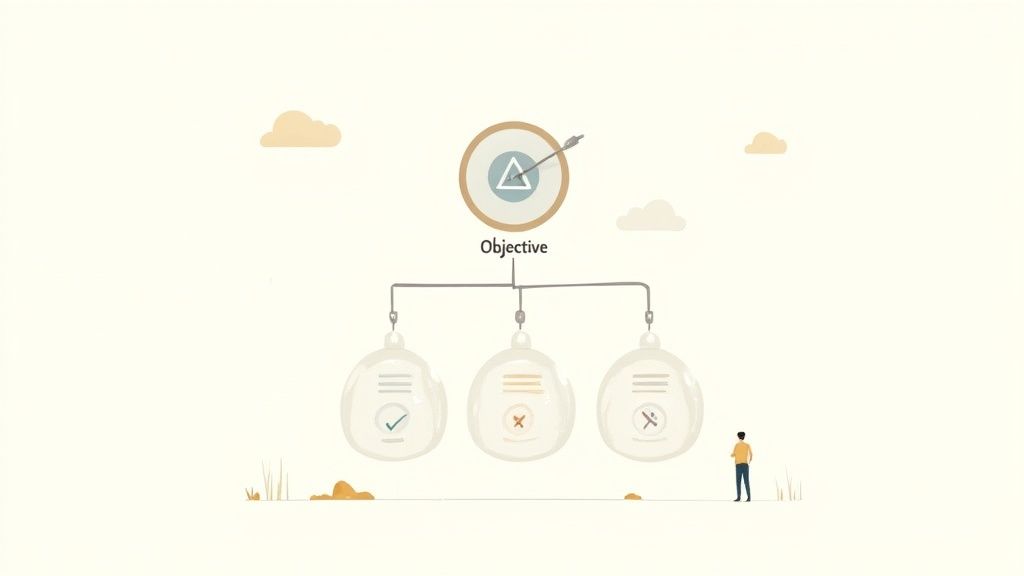
This clarity eliminates ambiguity and gives employees a sense of purpose. When individuals see a direct line between their daily tasks and major company milestones, their motivation and focus naturally increase.
How to Implement OKRs
- Define Company-Level Objectives: Start at the top. What are the 3-5 most critical goals for the company this quarter? Make them ambitious and inspirational.
- Cascade to Teams: Each team then creates its own OKRs that directly support the company-level objectives.
- Set Individual OKRs: Finally, individuals set personal OKRs that align with their team's goals. This ensures everyone is pulling in the same direction.
- Track and Review: Conduct weekly or bi-weekly check-ins to review progress. Transparency is key, so make all OKRs visible across the organization.
Pro-Tip: Aim for "stretch goals." A 70% achievement rate on an ambitious OKR is often more valuable than achieving 100% of an easy one. It encourages innovation and pushes teams beyond their comfort zones. For a deeper dive into this framework, you can learn more about how to master Objectives and Key Results to enhance business success.
How DeskCove Supports Goal Alignment
DeskCove helps translate high-level OKRs into daily execution. With automatic time and activity tracking, managers can see which projects and tasks are consuming the most resources. This data allows for a direct comparison between effort (time spent) and results (OKR progress). For instance, if a team is spending 80% of its time on a task contributing to only 10% of a key result, managers can quickly identify the misalignment and redirect focus, ensuring that work hours directly contribute to achieving strategic goals and ultimately improve employee productivity.
2. Remote Work and Flexible Work Arrangements
Embracing remote and flexible work arrangements is a transformative strategy to improve employee productivity. This approach grants employees autonomy over where and when they work, whether it's a fully remote, hybrid, or flexible schedule. By trusting employees to manage their own time and environment, companies like GitLab and Automattic have built successful, fully distributed workforces. This model recognizes that peak performance isn't tied to a physical office, leading to higher job satisfaction and reduced burnout.

This flexibility allows individuals to work during their most productive hours and create an environment that minimizes distractions, directly boosting their output and quality of work. When employees feel trusted and empowered, their engagement and commitment to their roles naturally increase.
How to Implement Flexible Work Models
- Establish Clear Policies: Create a formal remote work policy that outlines expectations for communication, availability, and performance metrics.
- Provide the Right Tools: Equip your team with the necessary technology, including collaboration software, project management tools, and secure network access.
- Invest in Home Office Setups: Offer stipends or provide essential equipment like ergonomic chairs and secondary monitors to ensure a comfortable and productive workspace.
- Maintain Regular Communication: Schedule regular video check-ins, both for 1-on-1s and team meetings, to foster connection and maintain alignment.
Pro-Tip: Focus on outcomes, not hours. Shift performance management from measuring "time at desk" to evaluating the successful completion of tasks and goals. This trust-based approach is fundamental to a thriving flexible work culture.
How DeskCove Supports Flexible Work
DeskCove is essential for managing productivity in a flexible work environment without resorting to micromanagement. Its automatic time and activity tracking provides transparent insights into work patterns, helping managers understand when their team is most productive. For instance, reports can show if an employee consistently logs productive hours outside the traditional 9-to-5, validating the effectiveness of their flexible schedule. This data-driven approach allows managers to support individual work styles while ensuring accountability and consistent output, which is crucial to improve employee productivity across distributed teams.
3. Employee Recognition and Rewards Programs
Feeling valued is a powerful motivator. A systematic approach to acknowledging employee contributions reinforces positive behaviors and creates a culture of appreciation, which is essential to improve employee productivity. When employees see that their hard work is noticed and celebrated, their engagement and commitment to company goals deepen significantly. Companies like Salesforce and Deloitte have built robust recognition programs that directly link appreciation to performance and cultural values.
This goes beyond an annual bonus; it’s about creating an environment where timely and specific praise is the norm. Recognizing both major achievements and incremental progress keeps morale high and sustains momentum, preventing burnout and encouraging consistent effort from your team.
How to Implement a Recognition Program
- Define Clear Criteria: Establish what behaviors and achievements will be recognized. Link these directly to your company's core values and strategic objectives to reinforce what matters most.
- Offer Diverse Rewards: Combine monetary and non-monetary rewards. Options can include bonuses, gift cards, extra paid time off, public shout-outs in company meetings, or professional development opportunities.
- Empower Peer-to-Peer Recognition: Don’t make recognition a top-down process. Implement a system, perhaps through a dedicated communication channel, where team members can publicly praise their colleagues for their help and accomplishments.
- Be Timely and Specific: Recognition is most effective when it’s immediate. Instead of a generic "good job," specify what the employee did well and what impact it had. For example, "Thank you for staying late to fix that critical bug; it saved the client presentation."
Pro-Tip: Make recognition visible. Whether it's a dedicated Slack channel, a section in your company newsletter, or a "wall of fame," public acknowledgment amplifies the positive impact and motivates others. Celebrate wins openly to build a positive and supportive atmosphere.
How DeskCove Supports Recognition Efforts
DeskCove provides objective data to fuel a fair and effective recognition program. By using activity tracking and productivity reports, managers can identify top performers based on concrete evidence, not just perception. For instance, if a report shows an employee consistently exceeding project time estimates while maintaining high activity levels, it provides a clear, data-backed reason for a reward. This data ensures that recognition is distributed equitably, helping you accurately identify and appreciate the key contributors who genuinely improve employee productivity.
4. Professional Development and Learning Opportunities
Investing in your team's growth is a direct investment in your company's productivity. When employees acquire new skills and deepen their expertise, they become more competent, efficient, and innovative in their roles. Providing professional development opportunities shows employees they are valued assets, which boosts morale, engagement, and loyalty, ultimately helping to improve employee productivity. Companies like Amazon, with its Career Choice program, recognize that fostering a culture of continuous learning builds a more capable and motivated workforce.
This commitment to growth creates a positive feedback loop. Skilled employees perform better, driving business success, which in turn allows for further investment in their development. This approach not only addresses immediate skill gaps but also builds a resilient talent pipeline for future leadership roles.
How to Implement a Learning Program
- Identify Skill Gaps and Needs: Survey managers and employees to understand which skills are most needed to achieve business goals. Align training opportunities with both individual career paths and strategic company objectives.
- Offer Diverse Learning Formats: Cater to different learning styles by providing a mix of options, such as online courses (like Coursera), workshops, mentorship programs, and industry conferences.
- Create a Clear Process: Make the learning budget and application process transparent and accessible to everyone. To ensure your professional development initiatives are structured and scalable, consider implementing a robust employee training program template.
- Encourage Knowledge Sharing: Ask employees who complete training to share what they’ve learned with their teams through presentations or lunch-and-learn sessions. This reinforces their learning and multiplies its impact.
Pro-Tip: Connect learning directly to performance. Set goals with employees for how they will apply new skills and track the impact on their key results. This makes the value of training tangible for both the employee and the business.
How DeskCove Supports Skill Development
DeskCove helps quantify the ROI of your training initiatives. By using automatic time tracking, you can monitor the time employees dedicate to approved training activities and projects where they apply new skills. The activity tracking and reports features allow managers to see tangible changes in efficiency and output post-training. For instance, if a developer completes a course on a new coding language, you can track their productivity on related tasks and see a measurable improvement, proving the direct link between professional development and enhanced performance.
5. Ergonomic Workspace Design and Well-being Programs
A comfortable and healthy employee is a productive one. Focusing on ergonomic workspace design and well-being programs directly addresses the physical and mental health of your team, which are foundational pillars to improve employee productivity. An ergonomic setup minimizes physical strain, reducing fatigue and the risk of work-related injuries, while wellness initiatives boost energy, focus, and overall morale. Companies like Apple and Google have long invested in this, recognizing that the work environment itself is a tool for success.
When employees aren't distracted by back pain, eye strain, or stress, they can dedicate their full cognitive resources to their tasks. This proactive approach leads to fewer sick days, higher engagement, and sustained high performance.
How to Implement Ergonomics and Wellness
- Conduct Ergonomic Assessments: Regularly evaluate both in-office and remote workstations. Provide checklists or offer virtual consultations to ensure proper setup.
- Invest in Adjustable Furniture: Provide adjustable chairs, desks, and monitor stands to accommodate different body types. Crucial for preventing strain and improving focus, finding the best ergonomic office chair is a cornerstone of a productive workspace.
- Launch Wellness Programs: Offer resources that support holistic health, such as subscriptions to mental health apps, gym membership stipends, or organized wellness challenges.
- Promote Movement: Encourage regular breaks for stretching and moving around. This can be as simple as setting team-wide reminders to stand up and walk for a few minutes every hour.
Pro-Tip: For remote teams, provide an annual stipend specifically for home office improvements. This empowers employees to create a personalized, ergonomic setup that works for them, showing the company's commitment to their well-being no matter where they work.
How DeskCove Supports Employee Well-being
DeskCove’s features can help reinforce healthy work habits that are critical for well-being. The platform’s automatic time tracking can be configured to include reminders for breaks, prompting employees to step away from their screens, stretch, and recharge. Managers can use activity reports to spot potential signs of burnout, such as consistently long hours or work late into the night, without micromanaging. This data allows for proactive conversations about workload and balance, ensuring that the drive to improve employee productivity doesn't come at the cost of health.
6. Minimizing Distractions and Deep Work Blocks
The modern workplace is filled with constant notifications, context switching, and interruptions that fragment an employee's day. To truly improve employee productivity, especially for cognitively demanding tasks, you must create an environment that champions "deep work." This concept, popularized by Cal Newport, involves dedicated, distraction-free blocks of time where individuals can focus entirely on a single, high-value task. By intentionally carving out these periods, you enable your team to produce higher-quality work in less time.

This approach recognizes that shallow, administrative tasks and constant communication come at a high cost to focused concentration. Companies like Microsoft, with its "No-Meeting Tuesdays," and Meta, which establishes quiet hours for engineers, have proven that structured focus time directly translates to better outcomes and innovation.
How to Implement Deep Work Blocks
- Establish "Focus Time" Policies: Schedule company-wide or team-specific "no-meeting" blocks for 2-4 hours each day. This protects employees' most productive hours from being fragmented.
- Define Communication Protocols: Create clear guidelines for when to use instant messaging versus email or a project management tool. A question that isn't urgent shouldn't interrupt someone's deep work session.
- Encourage Task Batching: Coach employees to group similar administrative tasks (like answering emails or filing reports) into specific, short blocks of time outside their deep work periods.
- Promote "Do Not Disturb" Statuses: Normalize the use of "do not disturb" or "focus" modes on communication platforms to signal unavailability and manage expectations for response times.
Pro-Tip: Lead by example. When managers and executives respect and visibly participate in focus time, it validates the practice for the entire organization. This cultural shift is crucial for long-term adoption and success. For more strategies, you can learn more about how to stay focused at work and conquer daily distractions.
How DeskCove Supports Focus Time
DeskCove's features provide the data-driven foundation needed to implement and measure the effectiveness of deep work policies. By using automatic time and activity tracking, managers can identify patterns of distraction. For example, reports might show that employees are frequently switching between communication apps and their primary work software, indicating a highly fragmented workflow. With this insight, you can introduce targeted interventions like scheduled focus blocks. The software then helps verify if these new policies are actually reducing distractions and allowing for longer, uninterrupted periods of productive work, directly helping to improve employee productivity.
7. Regular Feedback and Performance Coaching
The outdated model of the annual performance review is failing modern workplaces. To genuinely improve employee productivity, organizations must shift to a culture of continuous feedback and real-time coaching. This approach moves away from a single, high-stakes yearly evaluation to frequent, constructive conversations that help employees adapt, grow, and align their performance with expectations on an ongoing basis. Companies like Adobe and Deloitte have famously replaced annual reviews with systems that prioritize regular check-ins and immediate guidance.
This constant loop of communication prevents small issues from becoming major problems and keeps employees engaged. When staff receive timely, specific advice, they feel more supported and have a clear understanding of what they need to do to succeed, directly boosting their confidence and output.
How to Implement Continuous Feedback
- Schedule Regular One-on-Ones: Make bi-weekly or weekly one-on-one meetings a non-negotiable part of the manager-employee relationship.
- Train Your Managers: Equip leaders with the skills to provide constructive, strengths-based feedback. Teach them to focus on specific behaviors and their impact, rather than making broad, personality-based judgments.
- Promote Psychological Safety: Create an environment where employees feel safe enough to receive feedback without becoming defensive and are encouraged to provide feedback upwards and to their peers.
- Use a Simple Framework: Implement a straightforward model like "Situation-Behavior-Impact" to keep feedback objective and actionable.
Pro-Tip: Frame feedback as a coaching opportunity, not a critique. Instead of just pointing out a mistake, a manager should ask questions like, "What challenges did you face here?" or "How could we approach this differently next time?" This transforms the conversation from judgmental to developmental.
How DeskCove Supports Performance Coaching
DeskCove provides the objective data needed for effective coaching conversations. With its activity tracking and productivity reports, managers can move beyond subjective opinions and ground their feedback in concrete facts. For instance, a manager might notice from a report that an employee's productivity dips significantly in the afternoons. Instead of making an assumption, they can use this data to open a conversation: "I noticed your activity levels tend to change in the afternoon. Let's talk about how we can structure your day to better suit your energy cycles." This data-driven approach makes feedback more precise, fair, and effective, helping to improve employee productivity in a targeted way.
8. Autonomy and Empowerment in Decision-Making
Micromanagement is a notorious productivity killer. To truly improve employee productivity, you must shift from a command-and-control mindset to one of trust and empowerment. Granting employees the autonomy to make decisions within their defined scope fosters a powerful sense of ownership, accountability, and intrinsic motivation. When employees feel trusted to manage their own work, they become more invested in the outcomes and are more likely to find innovative, efficient solutions.
This approach, central to modern management philosophies like Daniel Pink's "Motivation 3.0" and practiced by highly successful companies like Netflix, recognizes that talented individuals do their best work when given freedom. It allows them to leverage their unique skills and adapt their processes without the constant friction of seeking approval, leading to faster execution and a more resilient, engaged workforce.
How to Implement Employee Autonomy
- Define Clear Guardrails: Autonomy doesn’t mean chaos. Clearly communicate the scope of authority, strategic goals, and non-negotiable boundaries. This gives employees a safe framework within which they can operate freely.
- Focus on Outcomes, Not Processes: Shift performance management from supervising tasks to measuring results. Trust your team to find the best path to the finish line, as long as they meet the agreed-upon objectives.
- Create Psychological Safety: Foster an environment where employees feel safe to make decisions, even if they sometimes lead to mistakes. Frame errors as learning opportunities, not punishable offenses, to encourage calculated risk-taking and innovation.
- Provide Necessary Resources and Support: Empowered employees need access to information, tools, and training to make informed decisions. Act as a coach and a resource, not a gatekeeper.
Pro-Tip: Start small. Grant autonomy on a specific project with a clear scope and a limited blast radius. As employees build confidence and demonstrate accountability, you can progressively expand their decision-making authority. This builds trust on both sides.
How DeskCove Supports Empowerment
While DeskCove tracks activity, its true power in this context is providing the data-backed transparency needed to foster trust. Managers can step back from direct oversight because they have access to high-level productivity reports and dashboards. Instead of asking, "What are you working on?" they can see which projects are receiving attention.
This allows for a more strategic, coaching-focused management style. If a project is lagging, a manager can use the data to initiate a supportive conversation about roadblocks rather than making assumptions. This data-driven trust allows managers to grant more autonomy confidently, knowing they have the tools to verify that freedom is being used effectively to improve employee productivity.
9. Team Building and Psychological Safety
Productivity isn't just about tools and processes; it's deeply rooted in human connection and trust. A psychologically safe environment is one where employees feel secure enough to take risks, voice dissenting opinions, and admit mistakes without fear of negative consequences. This foundation of trust, as highlighted by Google's famous "Project Aristotle" study, is the single most important factor in high-performing teams.
When team members feel safe, they are more likely to innovate, collaborate openly, and engage in constructive conflict, all of which are essential to improve employee productivity. This culture prevents the fear of failure from stifling creativity and encourages a collective sense of ownership over challenges and successes.
How to Foster Psychological Safety
- Lead by Example: Leaders must model vulnerability. When managers openly admit their own mistakes or knowledge gaps, it signals to the team that it's okay not to be perfect.
- Frame Work as a Learning Process: Position challenges and even failures as learning opportunities rather than punishable offenses. Ask, "What can we learn from this?" instead of "Whose fault is this?"
- Promote Open Dialogue: Create structured forums for feedback where every voice is heard. This can include regular retrospectives or dedicated brainstorming sessions where all ideas are welcomed.
- Encourage Respectful Dissent: Actively invite different viewpoints and thank team members for challenging the status quo. A culture that values diverse perspectives is an innovative one.
Pro-Tip: Respond to bad news or difficult feedback with appreciation. Simply saying, "Thank you for bringing this to my attention," encourages transparency and ensures you hear about problems while they are still small enough to solve easily.
How DeskCove Supports a Trusting Culture
While psychological safety is about culture, data can support it by providing objective insights. DeskCove's activity tracking and project reports offer a transparent, data-driven view of where effort is being directed. This shifts performance conversations from subjective assumptions to objective facts, reducing the potential for blame. Managers can see who is overloaded and rebalance workloads proactively, demonstrating care for employee well-being. By focusing on productivity patterns and team-wide trends rather than individual scrutiny, DeskCove helps build a culture of trust and accountability, creating an environment where teams can thrive.
10. Technology Stack Optimization and Automation
The right tools can act as a force multiplier for your team's efforts, while the wrong ones create friction and wasted time. Technology stack optimization involves selecting and integrating the best software to streamline workflows, while automation focuses on eliminating repetitive, manual tasks. This approach allows employees to shift their focus from low-value administrative work to strategic, high-impact activities that truly drive the business forward.
By using tools like Zapier to connect different apps or implementing project management systems like Asana, you create a seamless operational environment. This reduces context-switching and mental load, which are significant drains on productivity. The goal is to build a digital ecosystem where information flows effortlessly and routine processes run on autopilot.
How to Implement Technology Optimization
- Audit Current Workflows: Map out key business processes and identify bottlenecks or repetitive tasks. Ask employees where they spend the most time on manual data entry or administrative duties.
- Prioritize Automation Opportunities: Start with high-frequency, low-complexity tasks. Automating a 10-minute daily report for 20 employees saves over 65 hours per month.
- Select Integrated Tools: Choose software that works well together. A well-integrated stack (e.g., Slack, Google Workspace, and your CRM) prevents data silos and simplifies collaboration.
- Provide Thorough Training: Roll out new tools with comprehensive training and support. Ensure everyone understands how to use the new technology to its full potential to improve employee productivity.
Pro-Tip: Don't just add more tools; be strategic. Regularly review your tech stack and remove redundant or underutilized software. A leaner, more effective set of tools is always better than a bloated, confusing one. For more ideas, you can explore these powerful business process automation examples to inspire your strategy.
How DeskCove Supports Tech Stack Analysis
Optimizing your tech stack requires understanding how it's actually being used. DeskCove's application and URL tracking provides clear data on which software and websites your team uses most frequently. This insight is invaluable for a tech audit. You can identify underutilized subscriptions that can be cut to save costs or pinpoint where employees are spending too much time in inefficient applications. This data-driven approach ensures your technology investments are directly contributing to enhanced productivity, not hindering it.
10-Point Employee Productivity Comparison
| Item | Implementation Complexity 🔄 | Resource Requirements ⚡ | Expected Outcomes 📊 | Ideal Use Cases 💡 | Key Advantages ⭐ |
|---|---|---|---|---|---|
| Clear Goal Setting and OKRs (Objectives and Key Results) | Medium–High; structured rollout and alignment needed 🔄 | Moderate; time for planning, training and tracking tools ⚡ | Improved alignment, accountability, measurable progress — ⭐⭐⭐⭐ | Strategic alignment, cross-team coordination, scaling org goals 💡 | Clear priorities, measurable outcomes, transparency ⭐ |
| Remote Work and Flexible Work Arrangements | Medium; policy, culture and tooling changes 🔄 | Moderate; collaboration tools, stipends, IT support ⚡ | Higher retention, broader talent pool, flexible capacity — ⭐⭐⭐ | Distributed teams, hiring across locations, work-life balance initiatives 💡 | Flexibility, reduced overhead, access to wider talent pools ⭐ |
| Employee Recognition and Rewards Programs | Low–Medium; program design and fairness controls 🔄 | Low–Moderate; platform, budget for rewards, manager involvement ⚡ | Increased engagement and retention, morale boost — ⭐⭐⭐⭐ | Improving morale, motivating high performers, reducing churn 💡 | High-impact, relatively low cost, reinforces desired behaviors ⭐ |
| Professional Development and Learning Opportunities | Medium–High; program design, content curation, tracking 🔄 | High; training budgets, LMS, time allocation ⚡ | Improved skills, internal mobility, long-term capability — ⭐⭐⭐⭐ | Skill gaps, leadership pipeline, retention-focused strategies 💡 | Builds competencies, increases loyalty, promotes internal promotion ⭐ |
| Ergonomic Workspace Design and Well-being Programs | Low–Medium; assessments and program deployment 🔄 | Moderate–High; furniture, wellness services, space adjustments ⚡ | Reduced injuries/absences, improved focus and wellbeing — ⭐⭐⭐ | Office-centered workforces, health-focused benefits, hybrid offices 💡 | Lower health costs, improved comfort and sustained productivity ⭐ |
| Minimizing Distractions and Deep Work Blocks | Low–Medium; policy and cultural shift required 🔄 | Low; scheduling, quiet zones, communication norms ⚡ | Higher-quality output, creativity, reduced context-switching — ⭐⭐⭐⭐ | Knowledge work, engineering, writing, design tasks needing focus 💡 | Strong focus, better work quality, fewer mistakes ⭐ |
| Regular Feedback and Performance Coaching | Medium; cadence and manager training needed 🔄 | Moderate; manager time, coaching resources, feedback tools ⚡ | Faster development, improved engagement and performance — ⭐⭐⭐⭐ | Development-focused teams, performance improvement, leadership growth 💡 | Actionable growth, stronger manager-employee relationships ⭐ |
| Autonomy and Empowerment in Decision-Making | Medium; requires cultural change and guardrails 🔄 | Low–Moderate; training, decision frameworks, trust-building ⚡ | Faster decisions, higher motivation and ownership — ⭐⭐⭐⭐ | Agile teams, innovative environments, senior knowledge workers 💡 | Speed, ownership, reduced managerial bottlenecks ⭐ |
| Team Building and Psychological Safety | Medium–High; leadership modeling and sustained effort 🔄 | Moderate; facilitation, training, time for team activities ⚡ | More collaboration, innovation, open communication — ⭐⭐⭐⭐ | Cross-functional teams, high-innovation or high-risk projects 💡 | Trust, increased idea-sharing, safer learning from failure ⭐ |
| Technology Stack Optimization and Automation | High; integration, vendor selection, change management 🔄 | High; software, implementation, training and security controls ⚡ | Major efficiency gains, fewer errors, scalable operations — ⭐⭐⭐⭐ | Repetitive processes, scaling operations, analytics-driven improvements 💡 | Time savings, error reduction, actionable insights from data ⭐ |
Putting It All Together: Your Roadmap to a More Productive Team
Navigating the path to enhanced team performance can seem complex, but it boils down to a fundamental principle: productivity is not about working harder, it's about working smarter. The ten strategies we've explored provide a comprehensive blueprint for any small to medium-sized enterprise or remote team aiming to not just boost output, but to cultivate a thriving, engaged, and resilient workforce. This journey isn't a one-time initiative with a clear finish line; it’s an ongoing cycle of implementation, measurement, and refinement.
The strategies detailed in this article, from establishing crystal-clear OKRs to optimizing your technology stack, are not isolated tactics. They are interconnected components of a holistic system. For instance, empowering employees with autonomy (Strategy 8) is far more effective when they have the professional development opportunities (Strategy 4) to build their skills and the regular feedback (Strategy 7) to guide their decisions. Similarly, fostering deep work (Strategy 6) is only possible in an environment built on psychological safety (Strategy 9), where employees feel secure enough to focus without fear of interruption or micromanagement.
Key Takeaways for Immediate Action
To truly improve employee productivity, focus on creating a supportive ecosystem rather than just implementing isolated policies. The foundation of this ecosystem rests on three core pillars:
- Clarity and Purpose: Every team member must understand the "why" behind their work. This starts with clear goals and OKRs that connect individual tasks to broader company objectives. When people see the impact of their contributions, their intrinsic motivation soars.
- Trust and Empowerment: Productivity flourishes in an atmosphere of trust, not surveillance. Granting autonomy, offering flexible work arrangements, and empowering employees to make decisions shows that you value their judgment and expertise. This trust is the bedrock of a high-performance culture.
- The Right Tools and Environment: You cannot expect peak performance with subpar tools or a distracting environment. This involves investing in technology that automates mundane tasks, providing ergonomic support, and actively promoting well-being to prevent burnout.
Your Actionable Next Steps
Instead of feeling overwhelmed by the number of strategies, start small and build momentum. Select one or two initiatives that address your team's most pressing challenges right now.
- Conduct a Team Survey: Ask your employees directly. Where are the biggest bottlenecks? What tools would make their jobs easier? What part of their work is most draining? Their insights are your most valuable resource for prioritizing action.
- Launch a Pilot Program: Choose one strategy, like implementing "Deep Work Wednesdays" or introducing a new recognition system for a single team. Measure its impact over a quarter. Use data from tools like DeskCove to see how work patterns, focus time, and overall activity levels change.
- Analyze Your Data: True improvement is data-driven. Look at project completion rates, employee feedback scores, and productivity metrics. Objective data helps you understand what’s working and what isn’t, allowing you to iterate effectively rather than relying on guesswork.
Ultimately, the quest to improve employee productivity is an investment in your most valuable asset: your people. By creating an environment where they are supported, empowered, and equipped with the right resources, you are not just increasing output. You are building a sustainable competitive advantage, fostering innovation, and creating a workplace where talented individuals can do their best work. This is the true engine of long-term business success.
Ready to gain the visibility you need to implement these strategies effectively? DeskCove provides the data-driven insights essential to understand work patterns, identify bottlenecks, and measure the impact of your productivity initiatives. See exactly how your team's time is spent and make informed decisions to improve employee productivity with our powerful, yet user-friendly, platform.