How to set smart goals: A practical framework for real results

Setting SMART goals is a classic for a reason. It's the framework that takes those big, fuzzy wishes and turns them into actual, concrete plans by making them Specific, Measurable, Achievable, Relevant, and Time-bound. This isn't just business school talk; it's a practical system for giving your ambitions the clarity and structure they need to become reality.
Why Most Goals Fail Before They Even Start
Let's be real for a second. How many New Year's resolutions have you set, full of optimism, only to have them completely vanish by February? You're not alone. The issue isn't a lack of drive; it's a lack of clarity.
Vague goals like "get in shape" or "improve sales" are practically designed to fail. Why? Because they don't give you a map. There's no clear path forward and no finish line, leaving you to guess what to do next. That guesswork quickly turns into frustration, and frustration leads to giving up.
This is where the SMART goal framework completely changes the game. It forces you to get granular, to define exactly what you want to achieve, and how you'll know when you've done it. It cuts through the ambiguity that causes so many great ideas to fizzle out.

From Wishful Thinking to Actionable Plans
The real magic of SMART goals is how they transform a wish into a step-by-step plan. You're pushed beyond just saying what you want and forced to actually build the roadmap to get there.
Once a goal is clearly defined, it's so much easier to break down the tasks needed to reach it. If you want to dive deeper into this, our guide on workload management shows how clear objectives are the key to preventing team burnout.
This structured approach also creates momentum. Every small, measurable win acts as a powerful motivator, keeping you and your team pushing forward. Instead of being paralyzed by a massive, undefined objective, you can just focus on the next logical step. And the data backs this up.
A study from the Dominican University of California found that people who set specific goals are 42% more likely to achieve them than those who don't. That’s a huge difference, all from adding a little structure.
Laying the Foundation for Success
Ultimately, learning how to set SMART goals is about building a solid foundation from day one. It makes sure every objective you set—for yourself or for your team—has a clear purpose, a deadline, and a shared understanding of what "done" actually looks like.
In this guide, we'll walk you through exactly how to put this framework into practice. We're covering:
- Real-world examples that show you what each component looks like in action.
- Actionable advice you can start using right away.
- Practical tips for managers who are leading individuals and remote teams.
By the time you're finished, you'll have the tools to set goals that are built to be achieved, not just forgotten.
Breaking Down the SMART Goal Framework
Knowing the SMART acronym is one thing; truly understanding how each piece clicks together to forge a powerful, actionable objective is another. Let's get past the textbook definitions and dig into how this framework transforms a fuzzy idea into a concrete plan for success.

S for Specific
A specific goal cuts through the noise and ambiguity. Think of it as answering the classic "5 Ws" to give everyone crystal-clear direction. When goals are vague, team members are left to guess, which almost always leads to wasted effort and mismatched results.
To nail down the specifics, you have to ask the right questions:
- What is the exact outcome we're aiming for?
- Who is responsible for each part of this?
- Where will this take place (e.g., on which platform, in which market)?
- When does this need to happen?
- Why are we doing this? (This is crucial for motivation!)
For example, a goal like "Improve our blog" is basically useless. A specific goal sounds more like: "Increase organic blog traffic from search engines by publishing SEO-optimized content to attract more qualified leads." Now we're getting somewhere.
M for Measurable
If you can't measure it, you can't manage it. It's an old cliché because it's true. The 'Measurable' part of your goal adds the numbers, the KPIs, and the tangible proof that you're actually making progress.
Goals aren't set in stone. They're dynamic and need regular check-ins. Having clear metrics from the start makes it obvious when you're on track, falling behind, or need to pivot because the landscape changed.
A measurable goal answers "How much?" or "How many?" with cold, hard data.
From Vague to Measured:
- Before: Get more email subscribers.
- After: Grow our email list by 500 new subscribers per month.
A for Achievable
Ambition is great, but a goal has to be grounded in reality. This is the 'Achievable' gut-check. It forces an honest look at your resources—your team's time, the budget, and the skills you have on hand. Nothing kills motivation faster than assigning a team a goal that's fundamentally impossible to hit.
Ask yourself: Is this goal a stretch, or is it a fantasy? Does my team have everything they need to win? If not, what’s missing? Often, making a huge goal feel achievable is as simple as breaking it down into smaller, bite-sized milestones.
R for Relevant
A goal can tick all the other boxes—specific, measurable, and achievable—but if it doesn't actually matter to the business, it's just busywork. The 'Relevant' test ensures your objective is tightly aligned with the company's bigger strategic priorities. It’s the ultimate safeguard against working hard on things that don’t move the needle.
To check for relevance, ask:
- Does this directly support a larger company objective?
- Is now the right time to tackle this?
- Does this fit within our team's core mission?
T for Time-Bound
Finally, every single goal needs a deadline. The 'Time-bound' component creates a healthy sense of urgency and gives everyone a finish line to race toward. Without a target date, even the most important tasks can drag on forever and lose momentum.
A time-bound goal has a clear start and end date. For bigger initiatives, you should also set deadlines for those smaller milestones you identified earlier. This builds a simple, effective timeline that keeps the whole team focused and accountable.
From "Someday" to "Done":
- Before: Launch a new feature.
- After: Launch the new user dashboard feature by the end of Q3.
The table below provides a quick cheat sheet for transforming your own goals from vague wishes into powerful SMART objectives.
Turning Vague Goals into SMART Objectives
| Vague Goal | SMART Element | Actionable Question | Refined SMART Goal |
|---|---|---|---|
| Improve customer support | Specific | What does "improve" mean? Which area? | Reduce the first-response time for high-priority support tickets submitted via email. |
| Get more followers | Measurable | How many more? By what rate? | Increase our Instagram follower count by 15% over the next quarter. |
| Become an industry leader | Achievable | Is this a realistic first step? What can we do now? | Secure one speaking slot at a major industry conference within the next 12 months. |
| Create more video content | Relevant | Why video? Does it align with our marketing goals? | Produce a series of 5 customer testimonial videos to support the Q4 sales team's goal of improving social proof. |
| Redesign the website | Time-bound | By when? What's the deadline? | Complete the user testing phase for the new homepage design by July 31st. |
By systematically applying each of these five elements, you're not just setting a goal; you're building a clear, actionable roadmap that your team can actually follow to get real results.
Common Mistakes to Avoid When Setting Goals
Just knowing the SMART framework is half the battle. The real trick is putting it into practice without stumbling into the usual traps that even the most well-meaning managers fall into. If you want to get good at this, you need to know which pitfalls to sidestep.
One of the biggest blunders is setting goals from an ivory tower. A manager dreams up an objective without a single conversation with the people who will actually be doing the work. This is a surefire way to kill motivation and miss out on crucial insights from the front lines about what’s actually doable.
Along the same lines, so many goals die on the vine because they’re missing clear, objective metrics. If you can't measure progress with real numbers, you’re just winging it. You'd be surprised how often this happens.
Setting Vague or Unmeasurable Targets
A goal will almost always flounder if no one can agree on what "done" looks like. The classic example is aiming to "improve customer satisfaction." It sounds noble, but it's not a SMART goal until you nail down how you'll measure it. Will you track a drop in support tickets? A higher Net Promoter Score? Faster first-response times?
Without those specific KPIs, your team is flying blind. That ambiguity makes it impossible to celebrate a win because no one knows where the finish line is.
This isn't just a hunch; the research backs it up. An Australian study that picked apart 512 different goals found that every single one failed to meet the full SMART criteria. While most were specific, less than 25% detailed how they’d be measured, and a jaw-dropping 93.5% had no way to monitor progress at all. The full research on goal quality shows just how pervasive this problem is.
Aiming Too High Too Soon
Ambition is great, but setting goals that are wildly unrealistic is a one-way ticket to burnout. A good goal should stretch your team, not break them. Aiming for an impossible target right out of the gate can crush morale before anyone even gets started.
Instead of staring up at one giant, intimidating mountain of a goal, break it into smaller hills.
- Create Quarterly Milestones: Chop that huge annual goal into four smaller, more digestible quarterly targets.
- Establish Monthly Sprints: For each quarterly goal, set specific monthly objectives that build on one another.
- Focus on Weekly Wins: Break down the monthly aims into actionable weekly tasks to keep the momentum going.
Creating a series of small, achievable wins builds a powerful sense of progress. That momentum is what keeps a team engaged and fired up for the long haul, turning a marathon into a series of manageable sprints.
And let's not forget another classic mistake: forgetting the "R" for relevant. A team can work their tails off to hit a perfectly crafted SMART goal, but if that goal doesn't connect to the bigger company strategy, all that effort goes nowhere. Always, always double-check that your objectives are actually pushing the organization's top-level priorities forward.
Setting SMART Goals for Remote and Hybrid Teams
Leading a distributed team brings a whole set of complexities you just don't run into in an office. When you can't rely on hallway chats or reading the room, setting SMART goals has to be incredibly intentional. Otherwise, you risk people drifting in different directions.
The real enemy isn't distance; it's ambiguity. For remote and hybrid teams, the standard SMART framework needs a serious boost from two things: radical transparency and clear accountability. Every goal has to be out in the open for everyone to see, and the way you measure success needs to be black and white.
Radical Transparency in Goal Setting
For a remote team, "out of sight, out of mind" is a constant danger. You combat this by making the team's goals absolutely impossible to ignore. This means getting them out of isolated spreadsheets and into a central hub where the entire team lives and breathes them.
- Shared Documents: Use a tool like Google Docs, Notion, or your project management software to create a living, breathing document for your team goals. Every single person should have access to see the objectives, the key results, and where things stand right now.
- Visible Ownership: Put a name next to every goal and key result. This isn't about blame; it's about clarity. Having a single point of contact prevents confusion and ensures someone is actively pushing that specific piece forward.
This kind of transparency kills the dreaded scenario where two people accidentally work on the same thing or, worse, on tasks that conflict with each other. When everyone is looking at the same map, they can self-correct and stay aligned without a manager needing to constantly intervene.
Without a shared source of truth, a remote team isn't a team at all—it's just a group of individuals working on separate tasks. Centralizing your goals is the first step toward building a cohesive, results-driven remote culture.
Establishing Effective Check-In Rhythms
In a remote world, check-ins are about connection and clearing roadblocks, not micromanagement. The trick is to find a consistent rhythm that feels supportive instead of like you're looking over their shoulder.
A weekly or bi-weekly meeting focused only on goal progress can be a game-changer. Ditch the generic "What did you do this week?" and instead ask, "What progress did we make on our goals, and what's blocking us?" This keeps the conversation strategic and focused on outcomes. To get this right, you have to nail the fundamentals of managing remote teams effectively.
Leveraging Technology for Accountability
This is where the 'Measurable' and 'Time-bound' parts of SMART goals really shine for remote teams. Trust is everything, but it's best built on a foundation of verifiable data. This is exactly where tools built for remote work prove their worth. For a deeper look at this, our complete guide on how to manage a remote team offers more practical strategies.
For instance, using software with project-based time tracking and activity reports gives you the hard data you need to see progress objectively.
This isn't about spying. It's about giving real teeth to the 'M' in SMART. It provides an unbiased view of where time and effort are actually going, helping you spot bottlenecks, celebrate wins, and shift resources intelligently. This data-driven approach takes the emotion out of performance conversations and truly empowers your team to succeed from anywhere.
How to Track Progress and Adapt Your Goals
Alright, let's be honest. Setting a goal is the easy part. It’s the starting line, not the finish. The real work—and where most people stumble—is in the consistent, day-in-day-out follow-through. A goal isn't something you can just "set and forget." It's a living guide that needs regular attention.
What separates successful outcomes from abandoned projects is consistent tracking and the willingness to make smart adjustments along the way.
This means you need a solid system for review. Whether you hold quick weekly check-ins for short-term goals or more in-depth monthly reviews for the big annual ones, establishing a rhythm of assessment is absolutely key. These sessions are your chance to see what's actually working, spot roadblocks early, and pivot before you lose all that precious momentum.
Creating a System for Follow-Through
Think of your goal as a living document, not a rigid rule carved in stone. The trick is to use real performance data to drive your review sessions. This keeps conversations objective and productive, moving them away from "I feel like…" to "The numbers show…"
For remote teams, this process really boils down to three core steps: making sure goals are visible to everyone, holding regular check-ins, and using data to track progress.
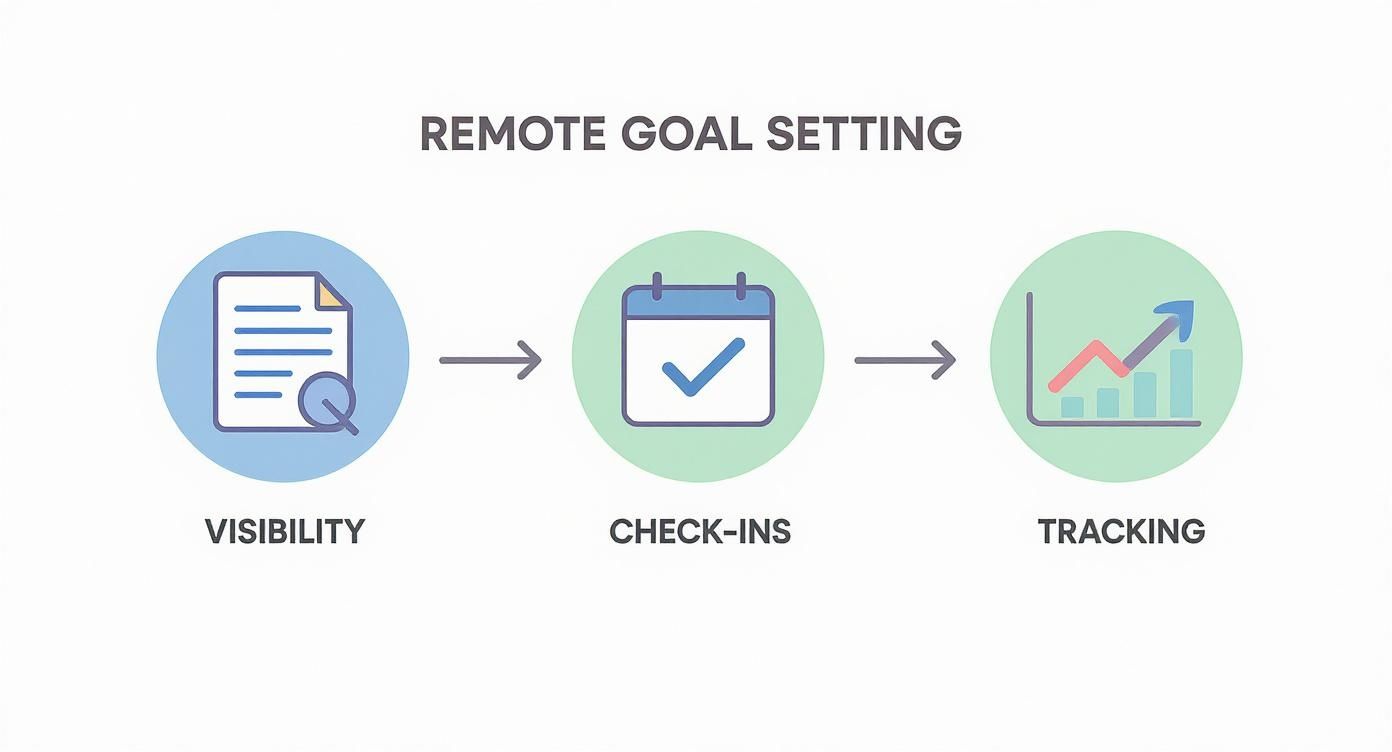
This simple flow—a shared document for visibility, a calendar for check-ins, and a chart for tracking—creates a powerful loop of accountability that keeps everyone on the same page.
Sadly, this kind of diligent follow-through is surprisingly rare. The data paints a pretty stark picture: only 51% of companies even attempt to develop aligned goals. Worse, a mere 6% regularly revisit them to make adjustments. Another study from Harvard Business Review found that just 20% of companies manage to complete about 80% of their strategic goals.
The heart of successful goal achievement is an iterative cycle: act, measure, and refine. Your initial plan is just a hypothesis. It’s the real-world feedback that sharpens it into a winning strategy.
Making Data-Driven Adjustments
Let's get one thing straight: adapting your goals isn't a sign of failure. It's a sign of intelligent leadership. When the data shows that a certain strategy isn't delivering the results you expected, the smart move is to pivot.
This requires having a crystal-clear understanding of your key performance indicators (KPIs). If you're running training programs, for instance, you need to know how to measure training effectiveness to see if they're actually moving the needle.
This is especially true for complex projects where the path forward is rarely a straight line. For a much deeper dive into this, check out our guide on how to measure project success. It offers some great frameworks for tracking progress when the metrics aren't so simple. By combining regular reviews with hard data, you transform goal-setting from a hopeful wish into a predictable system for getting things done.
Your Questions About SMART Goals Answered
Even with a perfect framework on paper, real-world questions always come up when you start putting a new process into practice. Getting SMART goals right is no different. Let's tackle some of the most common questions that pop up once teams start setting and tracking their goals.
Think of this as your go-to guide for handling those tricky situations so you can keep your momentum going strong.
How Often Should I Review My SMART Goals?
There’s no magic number here—the right review cadence really depends on the goal's timeline. The shorter the goal, the more often you need to check in. It's just that simple.
A good rule of thumb I've seen work well:
- Quarterly Goals: Plan to check in weekly or bi-weekly. This is your chance to catch small issues before they become big roadblocks and make adjustments on the fly.
- Annual Goals: A formal monthly review is a great baseline. But remember, that big annual goal is built on smaller milestones, so you'll want to check on those even more frequently.
The most important thing is to be consistent. Put your review sessions on the calendar ahead of time. Treat them like any other important meeting, because they are.
What if a Goal Is No Longer Relevant?
Pivoting isn't failure; it's just smart business. The 'R' for Relevant in SMART isn't a one-and-done checkbox. It's a filter you need to apply continuously. If company priorities make a hard left turn or a key project gets shelved, clinging to an old goal is just a waste of energy.
Don't just let an outdated goal quietly fade away. Formally archive it. Take a moment to document exactly why it's no longer a priority. Then, build a new SMART goal that actually lines up with your new reality. This shows agility and strategic thinking, not a lack of focus.
Can I Use SMART Goals for Creative Projects?
Absolutely. This is a huge point of confusion for a lot of people, but the framework is more flexible than you might think. The trick is to stop trying to measure the final, subjective creative output itself. Instead, focus on measuring the actions and the process milestones that get you there.
For instance, a vague goal like "Launch a new blog" is a classic creative trap.
Let's make it SMART:
"Launch the new company blog by March 1st (Time-bound) by publishing four fully researched, 1,500-word articles (Measurable) designed to attract an initial 1,000 unique visitors in Q2 (Specific, Relevant)." See the difference? Now there's a clear, actionable path for a creative project.
Ready to see how your team is really progressing on their goals? DeskCove gives you the clarity and data you need to keep your remote team aligned and productive. See exactly how our time tracking and activity reports can bring your SMART goals to life.
Explore DeskCove's features and see it in action.