What Is Operational Efficiency for Your Business

Simply put, operational efficiency is the art of getting the best possible results with the fewest resources. It's not just about pinching pennies; it's about wringing maximum value from every dollar you spend, every hour your team works, and every tool in your arsenal.
Think of it like the difference between a frantic, disorganized kitchen and a Michelin-star restaurant. In one, there's a lot of running around, wasted motion, and stress. In the other, every chef moves with precision and purpose, creating amazing dishes with seemingly effortless grace. That's operational efficiency in action.
Understanding Operational Efficiency Beyond the Buzzwords

It’s easy to get bogged down and think operational efficiency just means doing things faster or cheaper. While speed and savings are definitely nice perks, they're really just the symptoms of a much smarter, deeper strategy.
True efficiency is all about creating a healthy, seamless balance between your inputs and outputs.
Inputs are all the resources you pour into your business:
- Your team's time and labor
- The capital and budgets you operate with
- Software, tools, equipment, and raw materials
Outputs are the valuable results you create:
- Revenue and healthy profit margins
- Finished products or delivered services
- Happy, loyal customers
An operationally efficient business is one where the ratio of outputs to inputs is consistently high. Your organization isn't just working hard; it's working smart, cutting out wasted effort to focus only on what drives real growth.
To bring this concept to life, let’s look at the core components that make up a truly efficient operation.
The Core Pillars of Operational Efficiency
| Pillar | Description | Real-World Example |
|---|---|---|
| Process Optimization | Refining workflows to eliminate bottlenecks, reduce manual steps, and ensure a smooth flow from start to finish. | An e-commerce company automates its order fulfillment process, cutting shipping times by 25%. |
| Resource Management | Intelligently allocating people, money, and tools to the tasks where they will have the greatest impact. | A marketing agency uses project management software to assign tasks based on team member availability and skills, preventing burnout. |
| Technology Integration | Using the right software and tools to automate repetitive tasks, improve communication, and provide better data for decisions. | A customer support team adopts a unified helpdesk platform, reducing average response time from hours to minutes. |
| Performance Measurement | Consistently tracking key metrics (KPIs) to identify what’s working, what isn’t, and where improvements are needed. | A sales team tracks its conversion rate daily, allowing them to quickly adjust their pitch and strategy based on real data. |
Ultimately, these pillars work together to create a business that is agile, profitable, and resilient.
The Core Idea: A Ratio of Value
At its heart, operational efficiency is all about that input-to-output ratio.
Imagine two companies each spend $10,000 on a marketing campaign. Company A brings in $20,000 in new sales, while Company B generates $50,000. It’s clear Company B is far more operationally efficient because it squeezed much more value out of the exact same investment.
This simple principle holds true for every part of a business, from the factory floor and logistics to your marketing department and customer service desk. It’s a journey of continuous improvement, not a one-and-done project.
To dig even deeper, it's worth exploring the concepts behind workforce optimization, which provides a great framework for boosting team productivity. This shift in thinking—from just cutting costs to maximizing value—is what transforms efficiency from a buzzword into a powerful engine for long-term success.
Why Operational Efficiency Is Your Competitive Edge
Chasing operational efficiency isn't just some internal spring-cleaning project. It's a hardcore strategy for carving out your space in a crowded market. It’s about turning slicker processes into real-world business wins, creating a ripple effect that boosts your profits, delights your customers, and energizes your team.
Picture two companies slinging the exact same product. One is drowning in slow, manual tasks, while the other has its workflow dialed in. That second company can ship faster, price more competitively, and pivot on a dime when the market shifts. That's not just an edge; it's a massive advantage.
Boost Your Bottom Line by Reducing Waste
Deep down, every single inefficiency is a hidden cost bleeding your business dry. Wasted time, duplicated work, and unused resources are all nibbling away at your profit margins. When you get serious about operational efficiency, you’re basically going on a scavenger hunt to find and eliminate this financial drain.
Cutting these hidden costs pays off immediately. For instance, just by automating a repetitive data entry task that eats up five hours of an employee's week, you reclaim over 250 hours of productive time every single year. That’s time you can pour back into things that actually make you money, like drumming up new sales or building out your next big product feature.
Operational efficiency isn't just about saving money; it’s about redirecting resources from low-value tasks to high-impact opportunities. Every process you streamline is a direct investment back into your company's growth potential.
This laser focus on trimming the fat doesn't just make your business leaner; it makes it more profitable and a whole lot tougher. Companies that run like a well-oiled machine usually have healthier cash flow and a much stronger foundation to ride out any economic storm.
Create Unforgettable Customer Experiences
In today's world, customer loyalty is the name of the game. Operational efficiency is your secret weapon for turning happy customers into die-hard fans. How? By delivering an experience that’s consistently fast, reliable, and top-notch.
When your internal house is in order, the benefits spill right over to the customer:
- Faster Service: Orders get processed in a snap, support tickets are closed out quicker, and products land on doorsteps without any frustrating delays.
- Fewer Errors: Standardized and automated workflows slash the chances of human error. That means customers get the right thing, the first time.
- Consistent Quality: Efficient operations mean every customer interaction hits a high standard of excellence, building the kind of trust that keeps them coming back.
Think about a customer service agent fumbling through five different clunky systems just to find one simple answer. That inefficiency creates long waits and seriously frustrated customers. An efficient team, armed with a single, unified platform, can solve that same problem in minutes, leaving the customer wowed and ready to sing your praises.
Empower Your Team and Foster Innovation
Let's not forget the human side of all this. When your team spends their days fighting frustrating bottlenecks and mind-numbing repetitive tasks, morale takes a nosedive and burnout becomes a real threat. These daily struggles are a creativity killer, preventing them from doing the smart, strategic work you hired them for.
By clearing those roadblocks, you give your team the freedom to focus on what actually moves the needle. An efficient workplace is almost always a happier one, where people feel like their time and talent are valued. This morale boost leads to lower employee turnover and creates a culture where new ideas can actually take root, turning your business into an agile competitor that’s ready for anything.
How to Measure Operational Efficiency
You can’t improve what you don’t measure. To really understand and boost your operational efficiency, you have to move beyond gut feelings and into the world of hard data. This means tracking specific Key Performance Indicators (KPIs) that act as a scorecard for your processes.
Think of it like a car's dashboard. You don't just guess if you have enough fuel or if the engine is overheating; you look at the gauges. KPIs serve the same purpose for your business, giving you clear, objective insights into how well your operational engine is running.
This infographic shows how centralizing efficiency directly impacts key business outcomes like profits, customer loyalty, and market agility.
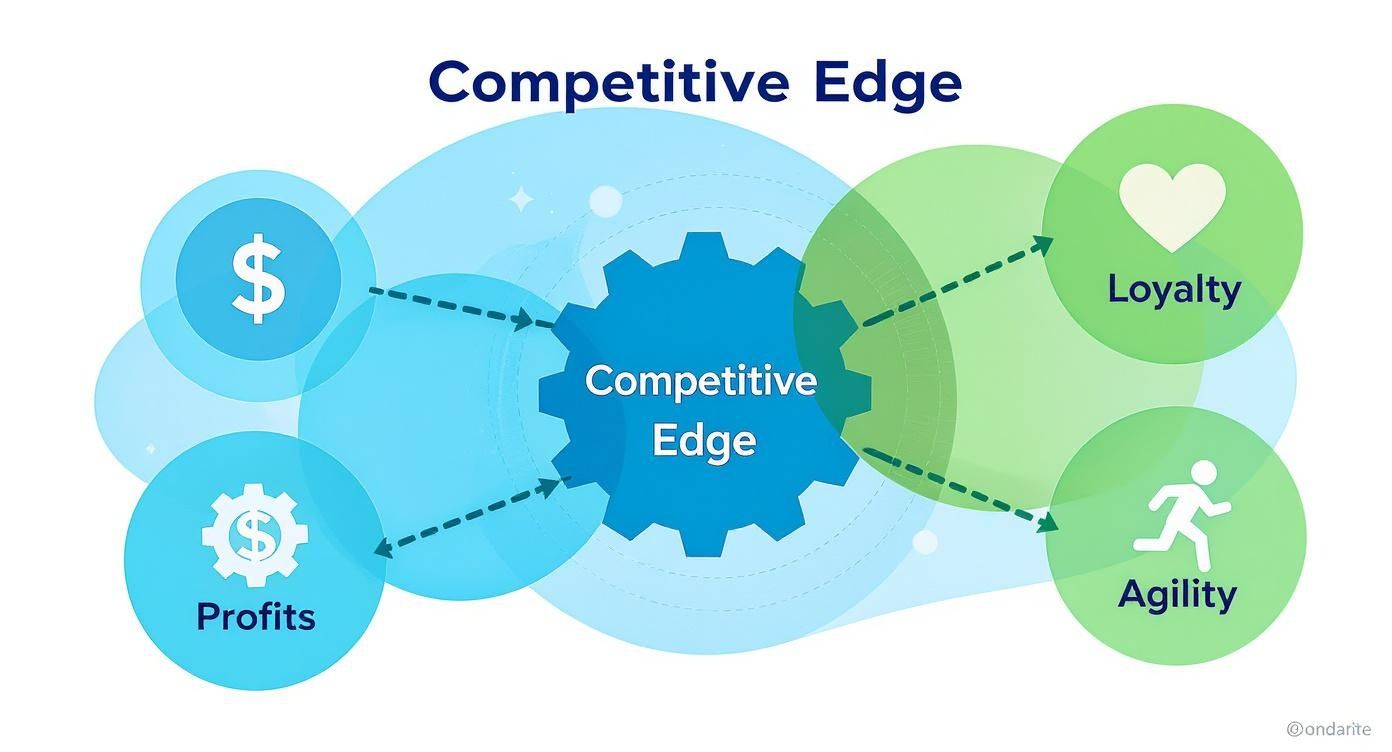
As you can see, improving your core processes creates a powerful ripple effect that strengthens every aspect of your business.
Key Metrics You Should Track
While every industry has its own unique metrics, there are a few universal KPIs that offer a powerful starting point for any business looking to check its operational health. Each one tells a different part of the story, from financial prudence to production speed. Let's break down some of the most crucial ones.
1. Operating Expense Ratio (OER)
This metric is a direct measure of how much it costs to run your business versus the revenue it brings in. A lower OER is a strong signal of financial efficiency.
- Formula: Operating Expenses / Gross Revenue = OER
- What It Means: If your OER is 30%, it means that for every dollar you earn, you spend 30 cents just to keep the lights on. Tracking this helps you spot when costs are creeping up faster than your income.
2. Production Cycle Time
This KPI measures the total time it takes to turn raw materials into a finished product ready for the customer. It's a critical indicator of manufacturing and service delivery speed.
- Formula: Process End Time – Process Start Time = Cycle Time
- What It Means: A shorter cycle time means you can fulfill orders faster, which directly impacts customer satisfaction and your ability to scale production.
By focusing on reducing cycle time, a business can often uncover hidden bottlenecks in its workflow, such as delays in approvals or inefficient handoffs between teams.
3. Capacity Utilization Rate
This metric reveals how much of your total production capacity you are actually using. It helps you understand if you're making the most of your available resources, like machinery or employee hours.
- Formula: (Actual Output / Maximum Possible Output) x 100 = Capacity Utilization Rate
- What It Means: A rate of 90% shows you're running very efficiently. However, a rate that's too high (like 99%) might signal that you have no room for unexpected demand, while a low rate suggests wasted potential and idle resources.
4. Inventory Turnover
This ratio shows how many times your company has sold and replaced its inventory during a specific period. It’s a vital sign of sales health and supply chain efficiency.
- Formula: Cost of Goods Sold / Average Inventory = Inventory Turnover
- What It Means: A high turnover rate is excellent; it means products are flying off the shelves. A low rate, on the other hand, might point to poor sales or overstocking, which can tie up your cash flow in unsold goods.
These are just a handful of examples. For a deeper look into this topic, you can learn how to measure productivity metrics to optimize business outcomes and discover even more ways to track your team's performance. The key is to choose the metrics that best reflect your business goals and use them to guide your improvement efforts.
Actionable Strategies to Improve Your Operations
Knowing your numbers is one thing, but actually putting that knowledge into practice? That’s where the magic happens. Moving from theory to action is how you truly unlock operational efficiency.
The real goal is to build a culture of constant improvement—turning efficiency into a daily habit, not just a one-off project. It’s all about methodically ironing out the kinks, automating what you can, and freeing up your team to do their best, most impactful work.
Let’s get into some practical strategies you can start using today.
Embrace Process Automation
Automation is easily one of the most powerful levers you can pull to boost efficiency. So many businesses get bogged down by those repetitive, manual tasks that eat up valuable time and are just begging for human error. Think about things like data entry, pulling the same reports every week, or sending routine follow-up emails.
Look for the tasks that follow a predictable pattern and don't require much human judgment. By automating them, you not only speed things up but also reduce mistakes. This is where low-code or no-code tools are a game-changer, letting your teams build automated workflows without needing a developer on speed dial.
The point of automation isn't to replace people. It's to free them from soul-crushing, repetitive work. When your team can hand off the boring stuff to software, they get back time and brainpower for the things that really matter: solving complex problems, thinking creatively, and talking to customers.
Standardize Your Workflows
Inconsistency is the silent killer of efficiency. When everyone on the team has their own unique way of doing the same task, it becomes a nightmare to track performance, train new people, or guarantee quality. Standardizing your workflows means creating a single, best-practice way to get things done.
You can get there with a few simple steps:
- Create Checklists: For any process with multiple steps, a simple checklist is your best friend. It ensures nothing critical gets missed.
- Develop Templates: Use templates for common documents, project plans, or emails. This saves a ton of time and keeps your brand voice consistent.
- Document Everything: Create a central knowledge base or a set of Standard Operating Procedures (SOPs) that anyone can look up.
When you standardize, you get rid of the guesswork. That means faster work, fewer mistakes, and much smoother handoffs between team members.
Adopt Lean Principles
The lean methodology, which got its start in manufacturing, is built on one powerful idea: eliminating waste. In an office setting, "waste" is anything that doesn't add value for the customer. That could be wasted time, unnecessary steps in a process, or even untapped talent on your team.
Putting lean principles into action involves a few key moves:
- Identify Value: First, get crystal clear on what your customers actually find valuable.
- Map the Value Stream: Sketch out your entire workflow, from the very beginning to the final delivery. This helps you see exactly where value is created and where waste is creeping in.
- Create Flow: Hunt down and eliminate bottlenecks and interruptions so work can move smoothly from one stage to the next.
- Pursue Perfection: This isn't a one-and-done thing. Constantly look for new ways to trim waste and make the process even better.
This mindset helps build a disciplined, efficient culture that’s laser-focused on delivering the most value with the least amount of effort. If you're looking for a deeper dive, you can explore other top strategies to improve operational efficiency.
Using Technology to Unify Your Operations

In today's business world, technology should be your biggest advantage. But when your systems are a jumbled mess of disconnected apps, that advantage quickly turns into a major bottleneck. This is what happens when you’re dealing with tool sprawl—a slow, creeping problem where your company ends up with dozens of separate tools that don’t talk to each other.
Think about it: your project management software can’t sync with your time tracker, and neither of them can connect to your invoicing system. This forces your team into a mind-numbing cycle of manual data entry, copying and pasting information from one window to another. This isn’t just annoying; it creates data silos, trapping critical information inside one app where no one else can see it. The result is a clunky, disjointed workflow that grinds everything to a halt.
The answer is to build an integrated worktech ecosystem. You need to get your software working together to create a single, reliable source of truth for your entire operation.
The Power of a Unified Tech Stack
A unified tech stack isn't just a collection of individual tools; it's a powerful, interconnected platform that runs your business. Instead of fighting with mismatched data and juggling a dozen different logins, your team can operate from a central hub where information flows seamlessly between departments.
This kind of strategic integration is no longer a "nice-to-have"—it's essential for operational efficiency. It's wild, but many businesses are juggling an average of 17 disconnected worktech solutions. That friction adds up, creating hidden costs and dragging down productivity. By bringing those systems together, you create a far more focused and effective work environment. You can check out more stats and insights on workplace productivity trends over at eptura.com.
A unified system brings a few game-changing advantages to the table:
- Smarter Automation: When your apps are connected, you can build powerful automated workflows that handle tasks across multiple departments without anyone lifting a finger.
- Faster Decision-Making: With all your data in one place, you get a clear, real-time view of what's happening in your business. No more guesswork.
- Frictionless Workflows: Your team can get work done without constantly switching between different programs, which saves a ton of time and cuts down on frustration.
Creating a Single Source of Truth
The ultimate goal here is to create a single source of truth. This simply means all your critical business data is accurate, consistent, and easy to access from one central location. It’s the holy grail of tech unification. It completely eliminates the confusion and arguments that happen when different departments are all working from different sets of data.
When your entire team trusts the data they see, you spend less time arguing about which numbers are correct and more time making smart, strategic moves. That alignment is the cornerstone of a highly efficient operation.
For instance, imagine your CRM is integrated with your project management tool. As soon as a salesperson closes a new deal, a project is automatically created with all the right client details. This seamless handoff prevents costly errors and lets your delivery team hit the ground running. You can explore more real-world business process automation examples to get more ideas on how to connect your workflows.
By thoughtfully integrating your technology, you stop fighting with your tools and start using them as a true competitive advantage, pushing your business toward peak operational efficiency.
Boosting Efficiency for Remote and Hybrid Teams
The switch to remote and hybrid work completely rewrote the rulebook. Keeping a distributed team on the same page, feeling connected, and staying productive takes a lot more thought than just dragging office routines online.
When you lose the natural rhythm of a physical workspace, new problems creep in. Communication gets fuzzy, engagement drops off, and productivity can take a nosedive. The key is to build a remote-first culture from the ground up, setting crystal-clear expectations for everything from communication to project handoffs. With the right approach and the right tools, distance can become a strength, not a weakness.
Confronting the Engagement Crisis
One of the biggest hurdles with remote work is keeping people engaged. When team members feel disconnected, their motivation and output can plummet, creating a serious drag on the business. This isn't just a minor morale issue; it's a massive financial leak that hits operational efficiency hard.
Gallup estimates that low employee engagement led to a staggering $438 billion in lost productivity worldwide. On the flip side, companies that actively use AI to support their teams report much higher productivity levels. You can dig into more of these productivity statistics and their impact on archieapp.co.
These numbers paint a clear picture. By tackling the engagement problem head-on and giving teams smarter tools, companies can plug that productivity drain and build a more resilient, motivated workforce.
Leveraging AI to Reclaim Time
Artificial intelligence is quickly becoming a game-changer for remote and hybrid teams. In fact, around 75% of knowledge workers say AI helps them claw back valuable time and sharpen their focus by automating the repetitive, soul-crushing tasks that fill their days.
Think about all the administrative junk AI-powered tools can handle:
- Automated Meeting Summaries: No more frantic note-taking. AI can generate transcripts and pull out key action items from calls.
- Smart Scheduling: It can find the perfect meeting time across a dozen different time zones without the endless email chains.
- Data Analysis: Need insights from a huge spreadsheet? AI can pull them out in seconds, saving hours of manual work.
By offloading these tasks, your team is free to focus on the bigger picture—the strategic thinking and creative problem-solving that actually move the needle. This kind of automation is a cornerstone of modern operational efficiency.
Fostering Connection and Accountability
But technology isn't just about automation; it's also about bringing people together. Project management platforms are non-negotiable for creating transparency. They act as a central hub where everyone can see what's happening, understand their role, and see how their piece of the puzzle fits into the grand scheme.
On top of that, integrating tools for time tracking for remote employees helps build a culture of accountability built on trust, not micromanagement. When used the right way, these tools provide incredible insights into how work is flowing and where the bottlenecks are. Managers can spot early signs of burnout, rebalance workloads, and make sure everyone is supported.
This blend of smart automation, clear communication, and mutual accountability is the new foundation for operational efficiency in today's workplace.
Common Questions About Operational Efficiency
As you start digging into operational efficiency, a few questions always seem to pop up. Let's clear the air on some of the most common ones so you can move forward with confidence.
What Is the Difference Between Productivity and Efficiency?
It’s really easy to mix these two up, but they measure totally different things.
Productivity is about quantity—it's the sheer volume of work someone gets done. If an employee plows through 100 customer emails in a day, you'd say they're highly productive. No doubt about it.
Efficiency, on the other hand, is about quality and resourcefulness. An efficient employee might only answer 80 emails, but they solve every single problem on the first try, using less time and fewer company resources for each ticket. So while the productive person did more, the efficient one created more lasting value with less waste.
Think of it this way: Productivity is just building as many houses as you can. Efficiency is building the best possible houses with the least amount of wasted time and materials.
What Are the First Steps for a Small Business?
Jumping into operational efficiency doesn't have to feel like a massive, overwhelming project for a small business. The best way to start is to find the biggest pain points in your daily workflow and smooth them out.
You can get some serious momentum with these simple first steps:
- Map Out a Core Process: Pick one crucial workflow, like how you fulfill an order or bring a new client on board. Actually write down every single step from start to finish. You’ll be surprised at where you find bottlenecks or pointless extra steps.
- Talk to Your Team: Your employees are in the trenches every day; they know exactly what’s clunky and what’s frustrating. Ask them straight up: "What’s the most annoying or time-consuming part of your job?" Their answers are pure gold.
- Automate Just One Thing: Find one small, repetitive task that eats up time—like sending reminder emails or manually copying data from one spreadsheet to another. Use a simple tool to automate it. Nailing that one small win makes it much easier to tackle bigger changes later on.
Does Improving Efficiency Mean Cutting Jobs?
This is a totally fair and common fear, but the goal of modern operational efficiency isn't about replacing people. It's about empowering your team by getting rid of the frustrating, low-value work that nobody wants to do anyway.
When you automate repetitive tasks and simplify messy processes, you give your employees their time and brainpower back. This frees them up to focus on the things that actually require a human touch—like building stronger relationships with customers, coming up with new ideas, or solving complex problems that a machine could never handle.
Real efficiency doesn't discard human talent; it elevates it.
Ready to boost your team's efficiency and get a crystal-clear view of productivity? DeskCove provides the tools you need to understand workflows, track time effortlessly, and empower your remote team to do their best work. Start optimizing your operations with DeskCove today!