Agency Time Tracking Software to Boost Profitability

For any creative or marketing agency, your team's time isn't just a number on a spreadsheet—it's the actual product you sell. Thinking about agency time tracking software isn't about micromanaging your people; it's about gaining essential business intelligence that fundamentally changes how you measure profitability and plan for growth.
Why Time Tracking Is Your Agency's Financial Compass

Picture your agency’s revenue as a bucket of water. Every unbilled hour, every overlooked task, every bit of scope creep is a tiny leak. Individually, these drips might not seem like a big deal, but over the course of a year, they add up to a significant financial drain.
This is exactly where time tracking software steps in to act as your financial compass. It gives you the clear, data-driven direction you need to navigate the chaos of client work and internal projects. You can finally stop guessing and start knowing precisely where every minute of your team's effort is going.
From Common Agency Pains to Software Solutions
It’s easy to talk about benefits in the abstract, but let’s connect the dots. Here’s a quick look at how time tracking software directly addresses the everyday headaches that agencies face.
| Common Agency Challenge | How Time Tracking Software Solves It |
|---|---|
| "Are we even making money on this client?" | Provides a clear, project-by-project breakdown of hours vs. budget, revealing true client profitability. |
| "We keep underbidding new projects." | Uses historical data from similar projects to create accurate, confident quotes that protect your margins. |
| "This 'small favor' for the client is eating up our week." | Flags projects that are creeping past their allocated hours, so you can address scope creep before it gets out of hand. |
| "Our team feels overworked and burned out." | Offers insights into individual workloads, helping you rebalance tasks and prevent burnout before it happens. |
As you can see, the right tool doesn't just track time; it provides direct answers to your most pressing financial and operational questions.
From Guesswork to Concrete Strategy
Without accurate tracking, you're forced to make critical business decisions based on gut feelings. You might feel like a project is a winner or that a client retainer is worth the effort, but feelings don't keep the lights on. The right software provides the hard data to back up your intuition—or show you where it's wrong.
This newfound visibility allows you to:
- Pinpoint True Profitability: See exactly which clients, projects, and even specific services are your biggest moneymakers. This lets you double down on what's working.
- Quote with Confidence: Pull historical data to build sharp, competitive quotes for new work, killing the risk of underbidding and working for free.
- Spot Scope Creep Instantly: Get real-time alerts when a project is tipping over its estimated hours, giving you the power to have proactive conversations with clients before it eats into your bottom line.
By meticulously tracking time, an agency transforms abstract hours into a tangible asset. It's the single most effective way to understand your operational health and build a sustainable strategy for growth.
The Impact on Your Bottom Line
At the end of the day, implementing time tracking is a direct investment in your agency's financial health. It systematically plugs the leaks in your revenue bucket by making sure every billable minute is captured and accounted for.
For an agency, figuring out how to increase productivity by working smarter, not just harder, is the clearest path to a stronger bottom line. This also means making better calls on internal work, like understanding the real value of non-billable time. This kind of strategic insight turns a simple timesheet into one of your most powerful tools for sustainable growth.
Unlocking the Core Benefits Beyond the Timesheet
Let's be honest, effective time tracking is about so much more than just filling out a timesheet. For agencies, this data is the bedrock of a smarter, more profitable operation. It changes the entire conversation from "How long did that take?" to "How can we do this better next time?"
This shift is everything. Why? Because sloppy, gut-feeling quotes are silent profit killers. Without hard data on past projects, you're essentially guessing on proposals. This often leads to underbidding, which puts a project in the red from the moment it’s approved. Agency time tracking software gets rid of the guesswork and gives you a reliable history of your team's actual performance.
Armed with this data, you can build quotes based on reality, not assumptions. You’ll be able to price projects with confidence, knowing your estimates are backed by evidence. That means protecting your margins and setting expectations with clients that you can actually meet.
Optimize Your Most Valuable Asset
Beyond just quoting, time data is your secret weapon for managing your people effectively. It gives you a crystal-clear view of your team's capacity, showing you exactly who's drowning in work and who has room for more. This visibility is absolutely key to preventing burnout, a plague in the fast-paced world of agency life.
By truly understanding workloads, managers can spread tasks out more evenly. This ensures your top talent is focused on the most critical work without overloading any one person. For agencies, these wins are a huge part of effective marketing resource management, which helps you streamline how you work and keep key assets organized. The end goal is to get your team operating at peak efficiency.
The demand for these tools is exploding for a reason. The global time tracking software market was valued at $5.23 billion in 2023 and is on track to smash $12.3 billion by 2030. That's not just a trend; it's a fundamental shift in how agencies are choosing to manage their most important asset: their people.
Build Trust and Automate the Annoying Stuff
Another huge win is the ability to generate transparent, data-backed reports. The next time a client questions an invoice or the hours logged on a task, you won't have to scramble. You can just show them a detailed, undeniable breakdown. This level of transparency builds incredible trust and makes it easy to justify your agency's value, turning potentially tense conversations into productive ones.
Finally, think about all the tedious administrative work your team gets bogged down with. Good time tracking software puts that on autopilot.
- Generating Invoices: Automatically turn billable hours into pixel-perfect invoices with just a few clicks. No more manual calculations.
- Running Payroll: Simplify payroll by exporting precise timesheet data. What used to take hours now takes minutes.
- Creating Reports: Instantly generate reports on project budgets, profitability, and team utilization.
This automation frees up your creative and strategic minds to focus on what they do best: delivering amazing work for clients. You can also boost productivity with employee time tracking simply by lifting that administrative weight off everyone's shoulders.
Decoding Must-Have Software Features for Agencies
Choosing the right time tracking software for your agency can feel overwhelming. There's a sea of options out there, all screaming about features and buzzwords. Let's cut through the noise and focus on what actually moves the needle for your agency's efficiency and bottom line. These aren't just flashy extras; they're the core functions that make or break a system.
The first big question is how your team will actually log their time. It usually boils down to two main approaches: manual or automated. Manual entry, where team members use timers or fill out timesheets, is straightforward and gives them a sense of control. But let’s be honest, people forget. That's where automated tracking comes in. It runs quietly in the background, capturing activity without anyone having to constantly start and stop a timer, which dramatically cuts down on forgotten hours and administrative headaches.
This image neatly sums up the three pillars of any worthwhile agency time tracking tool: accurate logging, insightful reporting, and smooth integrations.
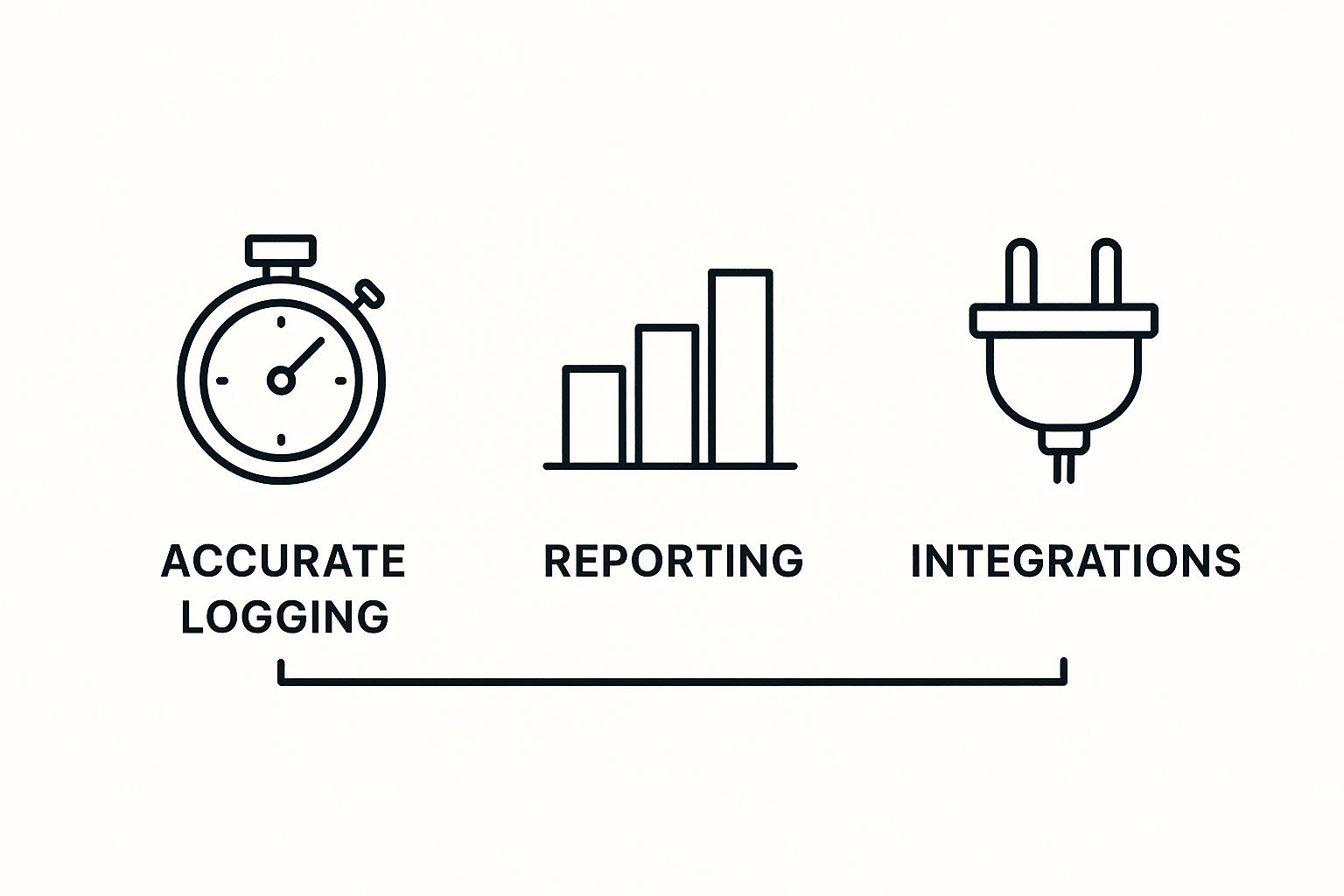
Think of these as the legs of a stool. If one is missing, the whole system wobbles. Together, they give you a crystal-clear view of your agency's health, from the nitty-gritty of a single task all the way up to high-level financial performance.
Granular Tracking for Real Insights
Just logging hours against a project name is old news. To really understand your business, your agency needs task-level tracking. This is where the magic happens. Knowing a project took 100 hours is okay, but knowing that 40 of those hours were spent on unexpected client revisions? That’s the kind of data that transforms how you operate.
This level of detail lets you:
- Spot Bottlenecks: Easily identify the specific tasks that always seem to blow past their estimates.
- Quote with Confidence: Build future proposals based on what similar tasks actually took, not just a gut feeling.
- Sharpen Your Workflows: See exactly where your processes are breaking down and how to make your team more efficient.
The best agency time tracking software does more than just count hours. It tells the story of how your team's effort becomes project progress—and ultimately, profit.
Reporting and Dashboards That Tell a Story
Piles of raw data are completely useless. You need software that comes with powerful, visual reporting dashboards that make sense of it all. Your tool should be able to instantly answer the big questions: Is this project on budget? Is the team stretched too thin? Which clients are actually making us money? A solid reporting suite turns a mountain of timesheet entries into clear, actionable intelligence.
At a minimum, look for customizable reports that show:
- Project Budget vs. Actuals: A live look at hours burned versus the total project budget.
- Team Utilization Rates: A bird's-eye view of who's slammed and who has room for more work.
- Profitability by Client: A no-nonsense breakdown of your most and least profitable accounts.
Seamless Integrations for a Unified Workflow
Your time tracker can't be a lone wolf. It needs to play nice with the other tools your team lives in every day. When your software connects smoothly, you create a single, unified system that gets rid of data silos and the soul-crushing task of manual double-entry.
For any agency, the most critical connections are with project management and accounting tools. When your time tracker syncs with platforms like Asana, Jira, or QuickBooks, you create one source of truth for everything related to a project. You can master time tracking tools with integration to see how a connected workflow pays off. This synergy makes invoicing, resource planning, and project management faster and far more accurate, freeing up your team to do what they do best: great client work.
Seeing Time Tracking in Action with Agency Scenarios
Theory is great, but let's get real. The true value of agency time tracking software clicks when you see it solve the messy, day-to-day problems agencies actually face. So, let’s walk through a few common situations to see how this data helps protect profits, guide smarter decisions, and build bids that win.
These aren't just hypotheticals; they're stories that play out in agencies every single day. Each one highlights a familiar pain point and shows how tracking hours isn't just about counting minutes—it's about finding the story hidden in the data.
The Creative Agency and the Never-Ending Project
We’ve all been there. A creative agency kicks off a big branding project with a perfectly clear scope. Then the client starts with the "small tweaks." A little change here, a quick adjustment there… and before you know it, the project has spiraled completely out of control.
Without a way to track this, those endless revisions become a silent killer, slowly draining the project's profitability. But by using task-level tracking, the project manager can see exactly where the hours are going. They can separate time spent on the original scope from time spent on new client requests. This gives them a clear, data-backed report to share, turning a tense chat about scope creep into a straightforward discussion about adjusting the budget.
Time tracking data turns vague "extra work" into a hard number. It gives you the evidence you need to protect your margins by showing exactly when a project has gone off the rails.
The Digital Marketing Agency Uncovering Profit Drains
Now, imagine a digital marketing agency juggling a dozen clients on monthly retainers. From the outside, everything looks great—revenue is flowing in. But after they dig into their time tracking data, they find a nasty surprise: two of their biggest clients are actually losing them money.
The numbers don't lie. The team is pouring far more hours into these accounts than their retainers justify. With this new insight, the agency suddenly has options:
- Go back to the client and renegotiate the retainer to match the actual workload.
- Look for ways to streamline their process and work more efficiently on those accounts.
- Politely fire the unprofitable client to free up their team for more valuable work.
This kind of analysis is impossible without detailed reports that break down time by client and by service. It's the difference between feeling busy and actually being profitable.
The Web Dev Agency Bidding with Confidence
Lastly, picture a web development agency putting together a proposal for a complex, fixed-price project. In the past, this was a guessing game. They’d often underbid just to win the business, only to lose money hand over fist during the actual development. Not anymore.
Now, they use historical data from their agency time tracking software. They can pull up reports from similar projects they've completed and see precisely how long each phase—from discovery and design to development and testing—really took. This allows them to build a bid that is not only competitive but also profitable, based on hard data instead of wishful thinking. They’re minimizing risk and setting projects up for success right from the start.
It's no surprise that more agencies are catching on. The global time and attendance software market, currently valued at $3.06 billion, is projected to hit nearly $5.58 billion by 2033. You can explore the full market projections on this growing industry to see where things are headed.
How to Choose the Right Software for Your Agency

Let’s be honest: there’s no single "best" agency time tracking software. The best tool is the one that molds perfectly to your agency’s unique DNA. Picking the right platform is a big strategic decision, and it goes way beyond just comparing feature lists. It demands a hard look at your specific needs, your daily workflows, and where you want to be in a few years.
The first step is looking inward. A tight-knit team of five operates in a completely different universe than a sprawling agency of fifty. You also need to think about your billing models. Are you juggling fixed-price projects, billing by the hour, or managing monthly retainers? The right software has to align perfectly with how you get paid.
Evaluate Your Current Tech Stack
Your new time tracker absolutely must play nicely with the tools you already use. If it can't connect to your project management or accounting software, you’re just creating frustrating data silos and more manual work for your team. Nobody wants that. So, before you even start browsing options, make a list of the mission-critical tools your team relies on every single day.
- Project Management: Does it need to sync with platforms like Asana, Jira, or Trello to automatically pull in projects and tasks?
- Accounting: Can it connect to QuickBooks or Xero to make invoicing and payroll a breeze?
- Communication: Will it integrate with Slack or Microsoft Teams for real-time notifications?
Think of integrations as bridges between islands of data. Without them, your information is stranded, and a truly unified workflow is impossible. For any modern agency that values efficiency, this is a total non-negotiable.
Plan for Future Growth
Picking a tool that only solves today's problems is a classic recipe for future headaches. You have to think about scalability. The software you choose should grow with you, not hold you back. As you bring on more clients, expand your team, and add new services, your platform needs to handle that extra complexity without breaking a sweat.
The right software is a long-term partner, not a temporary fix. Prioritize platforms that offer tiered plans and advanced features you can grow into, ensuring you won't have to migrate systems in just a couple of years.
The global time tracking software market is exploding for a reason. It was valued at around $3.35 billion and is expected to hit $3.93 billion by 2025. This isn't just a trend; it's a massive shift toward automation and more flexible ways of working. You can dig deeper into the 2025 time tracking software market overview to get a sense of where the industry is headed.
Prioritize Team Adoption and Support
At the end of the day, even the most powerful software is completely useless if your team hates using it. User adoption is the ultimate measure of success. Look for a tool with a clean, intuitive interface that makes tracking time feel like a natural part of the day, not another dreaded chore.
And please, don't overlook customer support. When something inevitably goes wrong, you need a responsive and genuinely helpful support team to get you back on track fast. Scour the reviews and see what other agencies are saying about their support experience. A great product backed by a great team—that’s the winning combination that will deliver real value for your agency's future.
Answering Your Questions About Time Tracking
Even with all the benefits laid out, bringing in any new software can stir up some questions. For agency leaders, the real challenges are usually more about people than technology. Let’s get ahead of the common worries to make sure your switch to agency time tracking software goes smoothly from the start.
The number one concern we hear comes from creative teams. They worry that "time tracking" is just a nicer way of saying "micromanagement." This is a totally fair point, and the only way to handle it is with honesty and a change of perspective. You have to frame the software not as a watchdog, but as a tool to protect their time and creative energy.
When you can track hours against specific projects, you have proof when a project is understaffed or scope creep is blowing up deadlines. This data gives managers the backbone they need to push back on wild client requests or bring in more help, which prevents burnout and keeps the team focused.
Securing Team Buy-In
Getting your team on board is the single most critical step. The conversation isn’t about watching their every move; it’s about getting the clarity needed to make everyone’s job better.
Here’s how to position the discussion to win over even the biggest skeptics:
- Focus on Protection, Not Policing: Explain that the real goal is to guard their work-life balance by spotting overloaded schedules and impossible timelines before they cause a problem.
- Show Them the "Why": Connect time tracking directly to more accurate project quotes. When you quote better, you avoid those frantic, underpaid crunch times everyone hates.
- Highlight Fairness: Tracking time makes everyone's effort visible. It ensures work is distributed more fairly and that no one’s contributions go unnoticed.
The point of time tracking isn't to ask, "Were you busy?" It’s to ask, "Do you have what you need to do your best work?" It's a support system, not a surveillance camera.
Workflow Integration and ROI
Another common hesitation is the fear of adding more complexity to the day. Nobody wants another piece of software that gets in the way. That’s why modern agency time tracking software is built to slip right into the tools your team already uses every day, like Asana, Jira, or Slack.
The right software should feel like a natural part of their workflow, not some clunky chore. Features like automatic timers and background tracking can capture activity without needing constant manual entry, keeping things smooth and ensuring the data is accurate without breaking anyone's creative flow.
Finally, let's talk about the return on investment (ROI). Sure, saving money is part of it, but the real value is much bigger. Think about the ROI in three layers:
- Efficiency Gains: By finding and fixing bottlenecks, your team simply gets more high-quality work done in less time.
- Profitability Increases: Good data leads to smarter quoting, less scope creep, and a clear picture of which clients are actually driving your revenue.
- Client Satisfaction: When you can back up your work with clear, transparent reports, you build trust, justify budgets, and create stronger, longer-lasting client relationships.
By tackling these common questions with empathy and clear communication, you can turn the rollout of time tracking software from a dreaded change into a unified step toward a healthier, more profitable agency.
Ready to gain the clarity your agency needs to grow? DeskCove provides the seamless time tracking and productivity insights that protect your team, boost profitability, and simplify your workflows. See how it works at https://deskcove.com.