What is Capacity Planning? Optimize Resources & Avoid Burnout

At its core, capacity planning is the art and science of matching your resources to what your business needs to deliver—now and in the future. It’s about making sure you have the right people, tools, and materials ready to go, precisely when you need them.
What Is Capacity Planning, Really?
Let’s get practical. Imagine you run a local pizza shop. On a sleepy Tuesday afternoon, one oven and two employees are probably more than enough. But what happens on a Friday night? That same setup would quickly spiral into chaos, leading to long waits, cold pizzas, and a wave of unhappy customers.
Capacity planning is simply the foresight to anticipate that Friday night rush. It’s making sure you have enough ovens fired up, enough dough prepped, and enough staff on the schedule to handle the demand without breaking a sweat. It isn't some complex formula; it's a fundamental business practice of aligning what you have with what you'll need.
Moving Beyond Guesswork
Without a clear picture of your capacity, you’re flying blind. You're just guessing. This is where so many common—and costly—business problems start. A solid plan helps you get out in front of these issues before they can hurt your team's morale or your bottom line.
Here’s where capacity planning brings immediate clarity:
- Team Workload: You can instantly see if your team is stretched too thin or if there's untapped potential hiding in plain sight. This prevents both burnout and wasted talent.
- Project Timelines: When you know your team's actual availability, you can set deadlines that are ambitious but achievable. This builds trust with clients because you deliver on your promises.
- Financial Health: Good planning stops you from over-hiring for projects that might not even happen. It also prevents the lost revenue that comes from turning down work you could have handled.
If you want to dive deeper into how this works for your team, check out an in-depth guide to workforce capacity planning.
In essence, capacity planning transforms resource management from a reactive fire-fight into a proactive strategy. It gives you the data-driven confidence to say "yes" to the right opportunities and the foresight to prepare for future growth.
Ultimately, it’s all about building a business with the strength and flexibility to meet customer demand, time and time again. It’s the bridge connecting where you are today with your ambitions for tomorrow, making sure you can scale successfully without stumbling along the way.
Why Effective Capacity Planning Drives Business Growth
Understanding the "what" of capacity planning is just the start. The real magic happens when you see its impact on your business's health and growth. This isn't just another operational task to check off a list; it’s a strategic lever that connects your daily resource decisions to your biggest company goals.
When you nail the balance between your team's workload and incoming demand, you're directly shaping your bottom line. Think of it as a precision tool for boosting profitability by systematically cutting out the waste. No more paying for idle teams waiting for the next project, and no more bleeding cash by overstaffing for work that never shows up.
This alignment ensures every dollar you invest in your people is put to its best use, turning your workforce into a finely tuned engine for revenue instead of an unpredictable cost.
Boosting Profitability and Efficiency
Proper capacity management is one of the most direct paths to a healthier balance sheet. When you can accurately forecast your needs, you make smarter hiring decisions. You get to skip the panic-hiring circus that so often ends with mismatched skills and a bloated payroll.
Here’s where you’ll see the financial wins:
- Reduced Overtime Costs: When workloads are balanced, those last-minute scrambles and expensive overtime hours become a rarity, not a routine.
- Improved Project Margins: Assigning the right people to the right jobs means projects get done efficiently. This protects your profit margins from the slow drains of scope creep and unexpected delays.
- Maximized Billable Hours: For agencies and consultancies, knowing your true capacity allows you to confidently take on the perfect amount of client work, pushing revenue up without ever letting quality slip.
Fostering Employee Well-being and Retention
Your team is your most valuable asset, and capacity planning is your best defense for protecting it. Chronic overwork is a primary driver of burnout, a problem that can cripple a company with lost productivity and high turnover. In fact, a staggering 79% of employees report experiencing work-related stress.
Effective capacity planning acts as a buffer against burnout. It ensures workloads are challenging but manageable, creating a sustainable environment where employees can thrive.
This approach naturally leads to higher morale, better engagement, and a team that sticks around. When people feel their workload is fair and their efforts are valued, they’re far more likely to stay and grow with you. That alone saves you the enormous cost and disruption of constantly hiring and training new people.
Enhancing Client Trust and Satisfaction
Ultimately, your reputation is what fuels your growth. Consistently missing deadlines or delivering subpar work because your teams are stretched thin is the fastest way to break client trust.
Good capacity planning lets you set realistic expectations from the very beginning. When you give a client a delivery date, it’s backed by real data on your team’s availability, not just wishful thinking. That reliability quickly becomes your competitive edge. Clients learn they can count on you, which leads to stronger relationships, more repeat business, and glowing referrals—the very foundation of sustainable growth.
Choosing Your Capacity Planning Strategy
Once you've got a handle on your current capacity and a solid forecast for what's coming down the pike, it's time to decide how you'll close any gaps. This isn't a one-size-fits-all kind of decision. The right move really depends on your industry, your budget, and frankly, how much risk you’re willing to stomach.
There are three main strategies businesses lean on to match their resources with customer demand. Each one comes with its own set of pros and cons, and picking the right one is a make-or-break moment for sustainable growth.
This infographic does a great job of breaking down the different levels of capacity planning, all the way from lofty strategic goals to the nitty-gritty of daily operations.
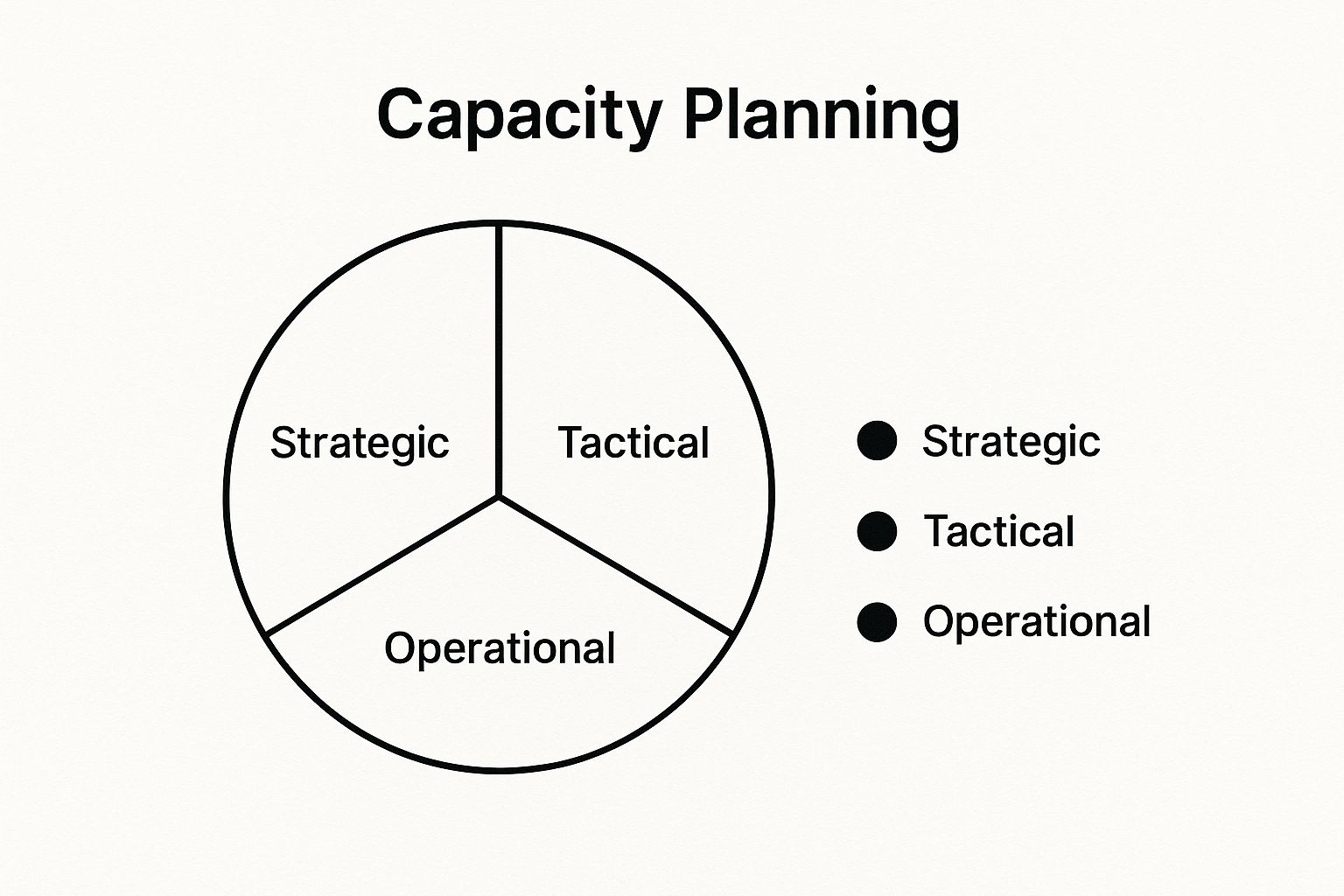
As you can see, these strategies play out over different timelines—strategic, tactical, and operational. It’s a good reminder of how the small, everyday actions connect back to the big-picture business objectives.
The Lag Strategy: A Reactive Approach
The Lag strategy is the most conservative play you can make. With this method, you only add more capacity after you see demand spike and start to feel the pressure on your resources. It’s a purely reactive model designed to keep risk at an absolute minimum.
Think of a bustling local coffee shop. The owner, using a lag strategy, would only hire a new barista after the morning line starts wrapping around the block and customers are grumbling about the wait.
This strategy is super low-risk and keeps your resources working at full tilt, since you never pay for capacity you don't immediately need. The flip side? You can easily miss out on sales, burn out your staff, and leave customers unhappy during those busy spells.
The Lead Strategy: A Proactive Approach
On the complete opposite end of the spectrum is the Lead strategy. This one is aggressive and all about looking ahead. You add capacity in anticipation of future demand, banking on strong forecasting and a confident outlook on growth.
A great example is a streaming service that upgrades its server infrastructure months before dropping a blockbuster new series. They’re investing upfront to make sure millions of viewers have a perfect, buffer-free experience from the get-go.
This approach means you're always ready for whatever customers throw at you, which can be a massive competitive edge. The big catch is the financial risk—if that forecasted demand never shows up, you're stuck with expensive, underused resources. Nailing this often comes down to sharp resource allocation across different teams to make sure every dollar is well-spent.
The Match Strategy: A Hybrid Approach
Trying to get the best of both worlds? That’s the Match strategy. Also known as the tracking strategy, this is all about finding a middle ground. You add capacity in smaller, more frequent increments that closely follow the rising tide of demand. It's a flexible way to balance risk with responsiveness.
Picture an e-commerce warehouse gearing up for the holidays. Instead of hiring a ton of permanent staff, they use a match strategy by bringing on temporary workers just for that peak shopping frenzy from November to January.
This method is far less risky than going all-in with the lead strategy but much more agile than the lag approach. The real challenge is the complexity; it demands constant monitoring and tweaking to keep supply and demand perfectly in sync.
To make it easier to see how these strategies stack up, here’s a quick comparison.
Comparison of Capacity Planning Strategies
| Strategy | Description | Best For | Pros | Cons |
|---|---|---|---|---|
| Lag | Add capacity only after demand increases. A reactive, low-risk approach. | Stable industries, businesses with tight budgets, or those prioritizing high resource utilization. | Minimizes financial risk, ensures high utilization of resources, avoids waste from over-provisioning. | Can lead to missed sales opportunities, poor customer service during peaks, and employee burnout. |
| Lead | Add capacity in anticipation of future demand. A proactive, high-risk approach. | High-growth markets, tech companies, businesses aiming for a first-mover advantage. | Ensures you can always meet customer demand, provides a competitive edge, prevents service disruptions. | High financial risk if forecasts are wrong, can lead to underutilized assets and wasted investment. |
| Match | Add capacity in small, incremental steps that closely follow demand. A balanced, flexible approach. | Industries with predictable seasonality (e.g., retail, hospitality), businesses that need to balance risk and growth. | Balances risk and responsiveness, more flexible than lead or lag strategies, avoids major over- or under-capacity. | Requires constant monitoring and adjustment, can be more complex to manage, may not be fast enough for sudden demand spikes. |
Choosing the right strategy is less about finding a single "correct" answer and more about finding the approach that aligns best with your business's goals, market position, and appetite for risk. By understanding these core methodologies, you can make a much more informed decision that sets your team up for success.
An Actionable Framework for Capacity Planning
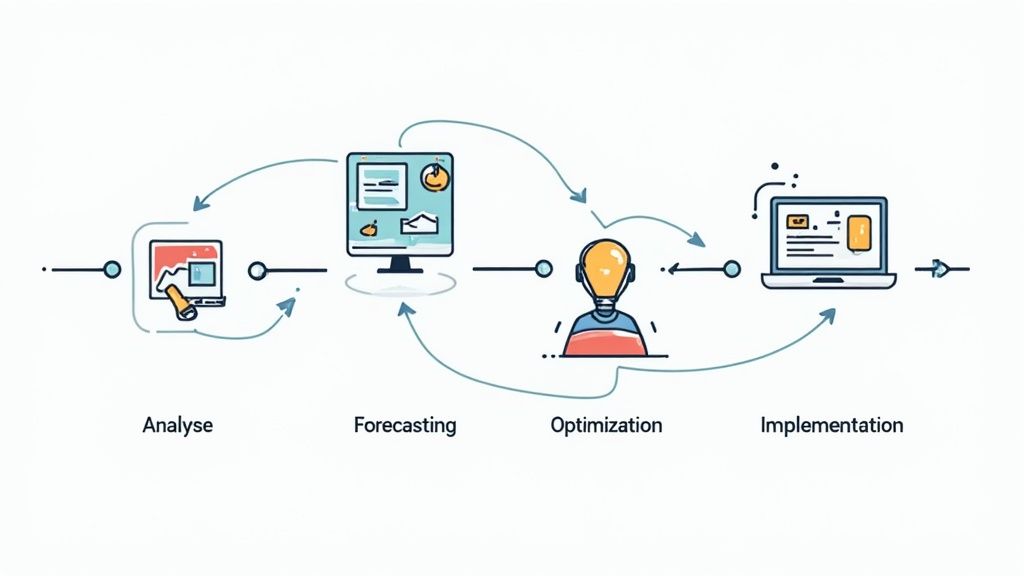
It’s one thing to talk strategy, but putting it into practice is where the real work begins. A great capacity plan isn't some dusty document buried on a server; it's a living, breathing process that actively guides your decisions.
Think of this as your roadmap from reactive fire-fighting to proactive, strategic resource management. This simple framework breaks the entire process down into four clear, repeatable steps you can start using today. Each step builds on the last, giving you a crystal-clear picture of where you are, where you're going, and exactly how you'll get there.
Step 1: Determine Your True Capacity
Before you can plan for the future, you need an honest look at your present. That means calculating your team's true capacity—the actual number of productive hours you have in the tank. A common mistake is just multiplying employees by 40 hours a week. That math is easy, but it gives you a wildly inflated number that will set you up for failure.
You have to account for all the time that isn't spent on direct project work. These are the essential, non-billable activities that quietly fill up every workday.
- Administrative Tasks: All that time spent on emails, internal reporting, and other operational duties.
- Meetings and Training: This includes internal sync-ups, one-on-ones, and professional development sessions.
- Paid Time Off: Don't forget to factor in vacations, holidays, and sick days. They’re a reality of business.
Once you subtract these activities, you land on a realistic baseline for your team’s available hours. For a detailed guide on this, you can learn how to accurately calculate Full-Time Equivalent (FTE) to improve your workforce planning.
Step 2: Forecast Your Future Needs
With a firm grasp of your current capacity, it’s time to look ahead. Forecasting your future needs is all about predicting the demand for your team over the next few weeks, months, or even quarters. This isn't about gazing into a crystal ball; it's about using the data you already have to make informed predictions.
Start by digging into historical project data. Review your sales pipeline to see what deals are likely to close. Talk to key stakeholders about upcoming initiatives. The goal here is to paint a demand forecast that's as accurate as possible.
Step 3: Identify and Analyze Gaps
Now for the moment of truth. Put your true capacity from Step 1 right next to your forecasted demand from Step 2. That space between the two numbers? That's your capacity gap.
It can go one of two ways. A surplus means you have more capacity than demand, which could signal underutilized team members and wasted resources. A deficit, on the other hand, means demand is crushing your capacity. That's a red flag for burnout, project delays, and missed opportunities.
Identifying this gap is the pivotal moment in capacity planning. It transforms abstract concerns about workload into a concrete, measurable problem that you can solve with a targeted plan.
Step 4: Develop Your Action Plan
The final step is to build a plan to close the gap you just uncovered. This is where strategic decision-making really kicks in. Based on your analysis, you have several levers you can pull to bring capacity and demand back into alignment.
Your action plan could include a mix of tactics, such as:
- Hiring New Talent: Bringing on full-time employees or contractors to handle long-term deficits.
- Upskilling Current Staff: Investing in training for your existing team so they can take on new types of work, which adds flexibility.
- Optimizing Workflows: Finding ways to improve processes so your team can get more done with the capacity they already have.
- Adjusting Timelines: Strategically pushing back lower-priority projects to free up resources for what's most critical right now.
This plan gives you a clear path forward. It ensures you’re making deliberate choices instead of just reacting to the latest crisis.
Best Practices for Sustainable Capacity Management
Putting together your first capacity plan is a solid first step. But the real magic happens when you make it a living, breathing part of your day-to-day operations. The old way—dusting off a static spreadsheet once a quarter—just doesn't cut it anymore. To stay on your feet, you have to move from a reactive, "set-it-and-forget-it" mindset to a proactive cycle of continuous review.
What does that look like in practice? It means your plan needs to be as nimble as your business. When a new project gets the green light or a deadline suddenly shifts, that information needs to flow directly into your capacity outlook. This is how you stop small resource gaps from snowballing into massive delivery headaches down the road.
Embrace Real-Time Data and Analytics
The most effective capacity management is built on a foundation of current, accurate data—not last month's assumptions. Modern tools give you an up-to-the-minute picture of what your team is working on, how projects are tracking, and where bottlenecks might be forming.
By pulling data from different sources into one place, you create a single source of truth for making decisions. This lets you spot trends early and make smart adjustments before problems can impact your clients or your team's morale. Making this data-first approach a core part of your strategy is non-negotiable. To really dig in, you can explore the role of workforce analytics in modern business operations and see how granular data powers smarter leadership.
Involve Your Team in the Process
Capacity planning should never happen in an ivory tower. Your project managers and team members on the ground have the clearest view of how long tasks actually take and what roadblocks might pop up. Bringing them into the planning process accomplishes two critical things.
First, you'll get far more realistic and accurate forecasts. Second, it builds a powerful sense of ownership and buy-in across the company. When your team understands the "why" behind workload decisions, they become more engaged and proactive in helping keep everything balanced.
A collaborative approach turns capacity planning from a top-down mandate into a shared responsibility, leading to better data and stronger team alignment.
Integrate Planning Across Business Functions
Your capacity plan can't exist on an island. For it to be truly effective, it has to be woven into the fabric of other core business functions, creating a single, cohesive operational strategy.
- Financial Forecasting: Aligning your team's capacity with financial goals ensures your hiring and resource decisions actually support your revenue targets without letting costs get out of hand.
- Project Management: When your capacity plan syncs with project management tools, you get real-time data on progress. This allows you to make dynamic adjustments to who is working on what.
- Performance Management: Understanding how your team performs helps you gauge their true capacity. On top of that, solid performance management best practices are vital for getting the most out of your team without pushing them toward burnout.
When these different parts of the business are all talking to each other, you build a much more resilient and efficient organization that's ready for whatever comes next.
Frequently Asked Questions About Capacity Planning
Even with a solid game plan, you're bound to have some questions once you start putting these ideas into practice. Let's clear up some of the common points of confusion that pop up when teams first dive into capacity planning.
We’ll tackle the subtle differences between similar terms, give you a sense of how often you should be revisiting your plan, and shine a light on the pitfalls that can trip up even the best managers. Think of this as your quick-reference guide for navigating those real-world challenges.
What Is the Difference Between Capacity Planning and Resource Planning?
This is a great question, and it’s one that trips up a lot of people. Getting the distinction right is key.
Let's use a simple analogy: imagine you’re managing a pizza shop.
Capacity planning is the big-picture, strategic thinking. It answers questions like, "How many pizzas could we possibly make on a Friday night?" This involves looking at the size of your oven, the number of staff you have on the payroll, and how much dough you can prep ahead of time. It's all about your maximum potential.
Resource planning, on the other hand, is the in-the-moment, operational work. It’s about answering, "Who is working the oven tonight from 6-8 PM, who is on the delivery route for the downtown area, and do we have enough pepperoni for the evening rush?" This is about the specific allocation of people and supplies to get the job done right now.
In short, capacity planning determines the size of your pizza oven. Resource planning is deciding who uses that oven and when.
How Often Should My Team Review Its Capacity Plan?
There's no magic number here—the right cadence really depends on how fast your business moves. A plan that's set in stone is a plan that's doomed to fail.
Here are a couple of good rules of thumb:
- For Stable Industries: If you're in a business with predictable cycles or long-term contracts, a quarterly review is probably perfect. It gives you enough time to spot trends and make meaningful adjustments without getting lost in the weeds.
- For Dynamic Environments: Working at a marketing agency, a software startup, or a consulting firm? Things change fast. You'll likely want to do a monthly review. Some of the most agile teams I've worked with even touch on capacity during their bi-weekly sprint planning meetings.
The key is to treat your capacity plan as a living document. It’s not something you create once a year and forget about. The goal is to build a rhythm of review that lets you stay ahead of changes, whether that's a surprise new project or a shift in a client's priorities.
What Are the Most Common Mistakes in Capacity Planning?
Knowing what not to do is just as important as knowing what to do. Most teams make a few mistakes when they're starting out, but you can sidestep the most common traps if you know what to look for.
A huge one is using outdated or inaccurate data. Making decisions based on numbers from last quarter is like trying to drive by only looking in the rearview mirror. Your plan is only as good as the information you feed it, and without real-time data, you're flying blind.
Another classic error is failing to account for non-billable time. It’s tempting to look at a 40-hour workweek and assume you have 40 hours of project time. That's never true. Forgetting to block out time for meetings, admin tasks, training, and PTO creates a wildly optimistic plan that’s impossible to execute.
Finally, the most critical mistake is planning in a silo. A capacity plan created by a manager without any input from the people actually doing the work is destined to fail. This top-down approach almost always creates unrealistic deadlines, kills morale, and sets the team up for failure. Real, effective planning has to be a conversation.
Ready to stop guessing and start making data-driven decisions about your team's workload? DeskCove provides the real-time insights you need to understand your team's true capacity, prevent burnout, and drive productivity. Take control of your capacity planning today.