Mastering Resource Allocation Optimization

Resource allocation optimization is just a fancy way of saying you’re putting your resources—people, money, and tools—where they’ll do the most good. At its core, it's about making sure your best people are tackling your biggest priorities at exactly the right time.
Why Resource Allocation Is Your Hidden Superpower
Ever seen a world-class orchestra where every musician has the wrong sheet music? You’ve got all the talent in the world, but instead of a beautiful symphony, you get pure chaos. That’s exactly what happens in a business with poor resource allocation. It's a silent killer of productivity and growth.
This guide isn't about some stuffy corporate buzzword. Think of resource allocation optimization as the art of conducting your business symphony. It’s the hands-on practice of putting your most valuable assets in the right place, at the right time, to focus on what truly matters. Get it right, and you turn potential chaos into a smooth, effective operation.
Moving Beyond Outdated Methods
Let's be honest, those old-school, static methods of resource planning just don't cut it anymore. A spreadsheet you made at the start of the quarter is pretty much useless the moment project priorities change, a key employee takes a sick day, or a golden opportunity lands in your lap. Sticking to an outdated plan is like trying to navigate a new city with a map from the 1980s—it won't show you the new highways or the sudden roadblocks.
This reactive approach almost always leads to the same old headaches:
- Team Burnout: Your top performers get buried under a mountain of critical tasks, leading to exhaustion and a drop in quality.
- Wasted Talent: Meanwhile, other team members are left sitting on the sidelines, their skills gathering dust while they wait for the next assignment.
- Delayed Projects: You can't hit deadlines when the right people aren't available when you need them. Momentum grinds to a halt.
- Skyrocketing Costs: Every bit of inefficiency hits the bottom line, whether it's from missed deadlines or the frantic scramble to hire last-minute help.
A smart approach to resource allocation flips these challenges into opportunities. This isn’t just about shuffling schedules around; it’s about building a flexible, resilient system that can adapt to change and power your business forward.
A dynamic strategy is about more than just who's doing what. It means having a crystal-clear view of your team's workload, understanding their capacity in real-time, and using that data to make sharp decisions on the fly. This is the first real step toward operational excellence, transforming resource management from a constant source of stress into a serious competitive advantage.
The Core Principles of Smart Resource Allocation

To really get resource allocation right, you have to nail the fundamentals. This isn't about dry, academic theory—it's about the practical rules of the road that guide every decision you make, turning potential chaos into a real competitive edge.
Think of it like a city planner laying out a new neighborhood. You wouldn't just start pouring concrete for houses without first figuring out where the roads, power lines, and water mains need to go. Smart resource allocation demands the same kind of strategic foresight.
It’s all about making sure every piece of your operation, from an individual's time to a chunk of the budget, is perfectly positioned to push your biggest goals forward.
Align Resources With Strategic Goals
The absolute bedrock principle is strategic alignment. Every single resource you assign—whether it's an hour of a developer's time or a dollar from your marketing spend—must directly serve a key business objective. Without this connection, your teams might look incredibly busy, but they won't be moving the needle on what truly matters.
Imagine a software company trying to capture more market share. If its best engineers are stuck fixing minor bugs on an old product instead of building a game-changing new feature, that’s a classic case of misalignment. True optimization means your most valuable assets are always focused on your most important goals.
This forces you to ask the tough questions. "Is this project really getting us closer to our quarterly targets?" If the answer is no, it’s a clear signal that your resources could be working harder for you somewhere else.
Plan Capacity Proactively
Another critical pillar is proactive capacity planning. This is all about looking ahead to anticipate what you'll need and where the constraints will be, rather than just reacting when you’re already in a bind. It's the difference between seeing a storm on the weather radar and only buying an umbrella once you're already soaked.
By forecasting your project pipeline and keeping a close eye on your team's current workloads, you can spot potential bottlenecks long before they bring everything to a halt. For a deeper dive into managing your human capital, a great resource is understanding workforce optimization, which is all about matching employee skills and availability to business needs.
Effective capacity planning is the bedrock of sustainable growth. It prevents team burnout by ensuring workloads are balanced and realistic, while also preventing talent from sitting idle. A well-managed capacity plan keeps your operations smooth and your team engaged.
For a comprehensive look at this crucial topic, our guide on what is capacity planning can help you build a more resilient system. This foresight empowers you to make smarter decisions about hiring, training, or simply shifting people around to meet upcoming demand.
Embrace Flexibility and Adaptability
Finally, any good resource allocation system has to be flexible and adaptable. The modern business world is anything but predictable. Priorities shift, markets zig when you expect them to zag, and unexpected opportunities pop up out of nowhere. A rigid plan that can't bend will eventually break.
This principle is really a mindset of continuous monitoring and adjustment. By regularly checking in on how your resources are performing and how projects are progressing, you can pivot quickly when you need to.
For example, if a marketing campaign just isn't delivering, an adaptable system lets you pull that budget and redirect it to a more promising channel—fast. This agility ensures your resources are always working as hard as they can for you, no matter what comes your way.
To put it all together, these three principles form the foundation of any successful resource optimization strategy.
Foundational Pillars of Resource Optimization
A summary of the core concepts driving effective resource allocation and their primary benefits for an organization.
| Principle | Description | Key Benefit |
|---|---|---|
| Strategic Alignment | Ensuring every resource deployed directly supports overarching business objectives and priorities. | Maximizes the impact of every action, preventing wasted effort on low-value tasks. |
| Proactive Capacity Planning | Forecasting future resource needs to prevent bottlenecks, burnout, and idle time before they occur. | Creates a stable, predictable workflow and improves long-term project success rates. |
| Flexibility and Adaptability | Building a system that can quickly adjust to changing priorities, market shifts, and new information. | Allows the organization to seize new opportunities and mitigate risks effectively. |
Mastering these pillars isn't just about managing spreadsheets; it's about building a responsive, goal-oriented organization that can thrive in any environment.
Common Roadblocks to Optimal Resource Use

If perfect resource allocation optimization was easy, every project would magically finish on time and under budget. We all know that’s not how it works. The reality is that even the sharpest managers run into the same frustrating hurdles that throw their best-laid plans into chaos.
These roadblocks aren't just small bumps in the road; they're the kinds of problems that breed inefficiency, burn out teams, and put your most important goals at risk. The first step to clearing them is knowing exactly what you’re up against. Once you can spot these common pain points, you can start building a real strategy to solve them.
The Challenge of Fragmented Information
One of the biggest culprits derailing good resource planning is a simple lack of visibility. Think about it: critical data is often trapped in different places—some of it’s in a spreadsheet on one manager's desktop, other pieces are in a separate project management tool, and crucial updates are buried in email chains.
This creates information silos where the left hand has no idea what the right hand is doing. A project manager might assign a critical task, completely unaware that the employee is already swamped with a high-priority project for another team. You can’t make smart decisions when you can’t see the whole board, and this blind spot makes true resource allocation optimization feel more like a guessing game.
This issue explodes in larger companies. For global firms working across 50 countries, this kind of fragmented data is a massive headache. Mismatched metrics and systems that don't talk to each other can lead to around 15% redundant resource allocation. That inefficiency can cost a company something like $50 million a year in missed opportunities. It's no surprise that decision-making becomes up to 40% less efficient without a single source of truth.
Constantly Shifting Project Priorities
Another huge headache is the constant tug-of-war between competing priorities. In any fast-moving business, what’s a top priority on Monday can easily become a secondary concern by Wednesday. When leadership pivots, it sends ripples down through every team, forcing managers to scramble.
Imagine a software team with just one senior engineer. One executive is demanding she fix a critical bug that’s frustrating current customers. At the same time, another stakeholder insists she drop everything to build a hot new feature designed to attract new clients. Without a clear system for making tradeoffs, she’s pulled in opposite directions, and neither task gets the focused attention it needs to get done right.
This constant battle for key people and budget creates bottlenecks, conflicts, and delays. It traps managers in a reactive cycle of reshuffling assignments instead of proactively steering projects toward the finish line.
Trying to manage these shifting demands is especially tough when dealing with people from different departments. To cut through the chaos, you need clear strategies for resource allocation across cross-teams that work. Without that alignment, you're just spinning your wheels.
Inaccurate Forecasting and Planning
Finally, let’s talk about flawed forecasting. So many resource plans are built on a foundation of overly optimistic estimates or incomplete data, leading to schedules and budgets that were never realistic to begin with. Overestimating your team's capacity or underestimating how complex a task really is sets a project up for failure before a single task is even assigned.
This almost always creates a domino effect:
- Early tasks take longer than planned, pushing back everything else that depends on them.
- The budget gets eaten up way too fast, forcing you to make painful cuts down the line.
- Team morale tanks as people are crushed under the weight of impossible deadlines.
Without accurate, data-driven forecasting, resource planning is nothing more than wishful thinking. It completely undermines the entire point of resource allocation optimization, trapping you in a painful cycle of missed deadlines and budget overruns that’s incredibly hard to escape.
Proven Frameworks for Getting Allocation Right
Moving from theory to practice requires a solid roadmap. To really nail resource allocation optimization, you need battle-tested frameworks that bring structure and clarity to what can otherwise feel like a chaotic juggling act. These aren't just abstract ideas; they're proven methods for turning reactive firefighting into proactive, strategic planning.
When you adopt a structured framework, you stop guessing and start following a repeatable process. This is how you pinpoint the most critical tasks, slash waste, and make data-backed decisions that actually push your business goals forward.
The Critical Path Method for Prioritization
One of the most durable frameworks out there is the Critical Path Method (CPM). Think of it as your project's GPS. It maps out the longest sequence of dependent tasks—the "critical path"—that absolutely must be finished on time for the project to hit its deadline.
Any delay to a task on this path pushes back the entire project's completion date. Simple as that. By identifying this path from the start, you immediately know where to focus your most important resources. It takes the guesswork out of prioritization, making it crystal clear which tasks have zero wiggle room.
For instance, in a software project, the critical path might be coding a core feature, then testing it, and finally deploying it. Other tasks, like designing some secondary UI elements, are still important but have more flexible timelines. CPM ensures your best developers are always hammering away at the critical path tasks first.
Embracing Lean Principles to Eliminate Waste
Another powerful approach is rooted in Lean manufacturing, which is all about systematically hunting down and eliminating waste in any process. When we talk about resource allocation optimization, "waste" can be anything from a team member's idle time to budget blown on low-impact activities or hours spent on rework because of sloppy planning.
Applying Lean means you're constantly asking: "Does this activity really add value?"
- Identify Value: Get super clear on what your customer or stakeholder actually considers valuable.
- Map the Value Stream: Sketch out every step and resource needed to deliver that value. This will make wasteful activities stick out like a sore thumb.
- Create Flow: Make sure work moves smoothly from one stage to the next without hitting bottlenecks or long delays.
- Establish Pull: Only assign resources when there's a real, immediate need. This stops you from over-allocating and leaving people or equipment sitting idle.
This mindset forces a shift from just "keeping everyone busy" to ensuring every single resource is directly contributing to a valuable outcome. It's about maximizing impact, not just activity.
Leveraging Data-Driven Predictive Models
Today’s best approaches are built on data. Predictive analytics has become a go-to tool for optimizing resource allocation in major industries, from healthcare to manufacturing. By analyzing historical data with machine learning and statistical models, companies can predict future demand, workloads, and potential roadblocks with surprising accuracy. This sharpens foresight and dramatically cuts the risk of being overstaffed, understaffed, or caught off guard by a resource shortage.
As you explore these frameworks, you’ll find that technology is a huge ally in streamlining everything. A great first step is learning about automating repetitive tasks, which frees up your team for more strategic, high-value work.
The visual below breaks down the core stages of a modern, data-driven allocation process.
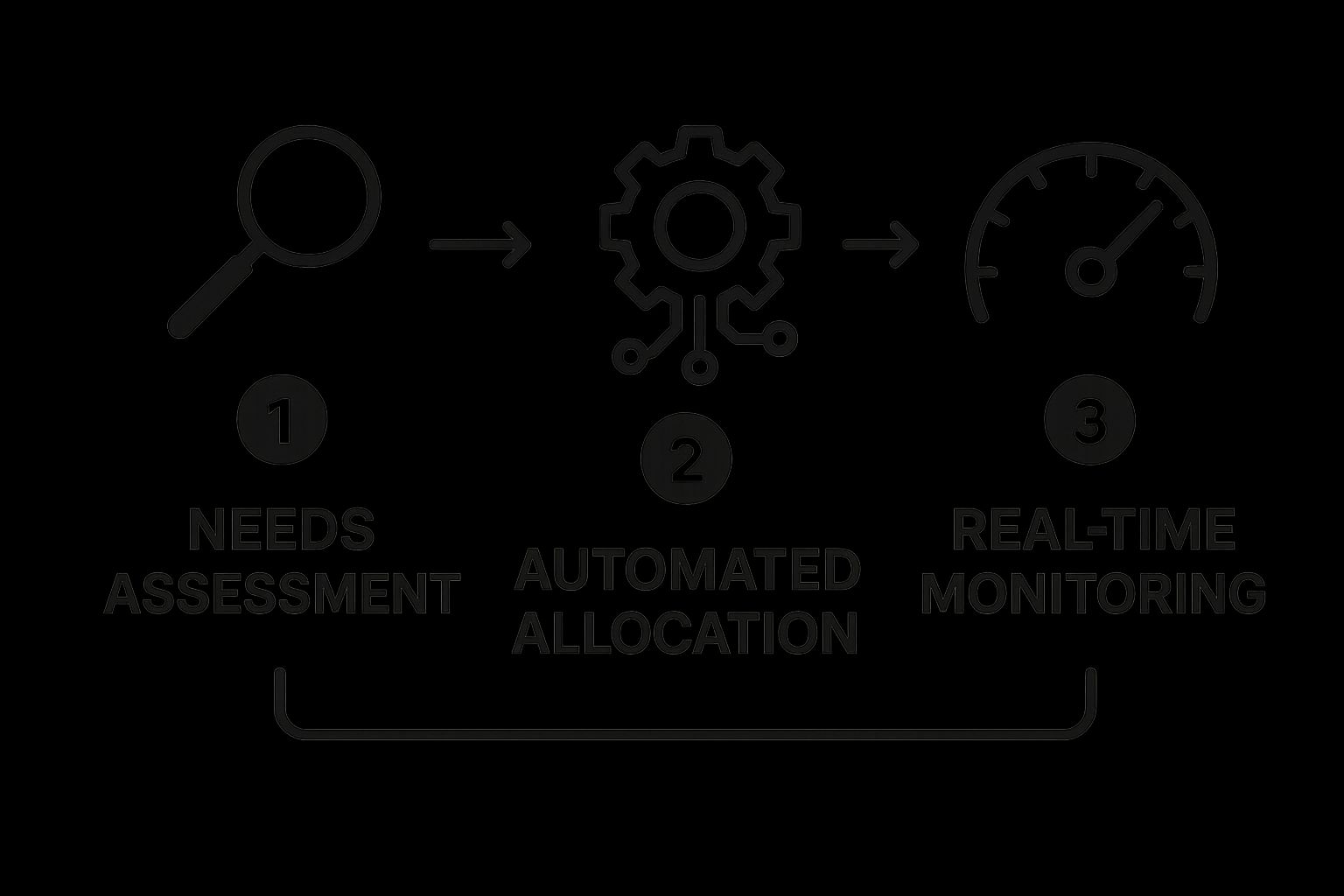
This flow, from assessment all the way to real-time monitoring, creates a continuous improvement loop—the hallmark of truly effective resource management.
The most successful resource allocation strategies are not static; they are living systems. They combine proven frameworks like CPM and Lean with the predictive power of data, creating an agile and resilient operation that can adapt to whatever comes next.
Putting Optimization into Practice with DeskCove
Frameworks and principles give you the blueprint, but real resource allocation optimization starts when you have the right tools to put theory into practice. This is the moment you shift from planning to doing—using hard data to make sharp, confident decisions. DeskCove gives you that crystal-clear picture of where your team’s time and energy are actually going.
This isn’t about looking over shoulders; it’s about gaining the visibility you need to properly support your team and point them at the right targets. With solid employee monitoring and project tracking, you can see the flow of resources in real-time. This data-first approach takes the guesswork out of the equation, letting you spot logjams and hidden opportunities in an instant.
Gaining True Visibility into Workflows
You can't optimize what you can't measure. That’s the first rule. DeskCove’s time tracking and productivity monitoring tools are your eyes on the ground, capturing the raw data needed for smart analysis. You see more than just how long people are working—you see what they’re working on.
This level of detail is a game-changer for understanding how work is distributed. Are some team members consistently buried under one specific project? Are others getting bogged down by low-impact admin tasks? DeskCove helps you answer these questions with objective data, not gut feelings.
This screenshot of the DeskCove dashboard shows exactly what we mean—a clean, at-a-glance view of team activity and where projects stand.

From a single screen, a manager can quickly see which tasks are eating up the most hours and check individual productivity trends. This is the foundation for making smarter allocation choices.
Turning Data into Actionable Decisions
Raw data on its own is just noise. The real magic happens when you turn that data into reports and analysis. DeskCove’s reporting features transform those time and activity logs into actionable insights, making it simple to spot imbalances and shift resources with confidence. This is how you connect the dots between daily tasks and your big-picture goals.
For a deeper dive into how tracking can elevate your team's output, check out our guide on how to boost team efficiency with this top-rated staff tracker. It’s packed with practical steps for using data to drive meaningful change.
The goal is to build a dynamic system where resources flow to the areas of highest impact. With real-time data, you can stop reacting to problems and start making proactive, strategic adjustments that keep projects moving and teams motivated.
This data-backed clarity means you can spot overworked teams before they burn out, find underused talent that could be deployed elsewhere, and make agile pivots to your project plans without missing a beat.
To make this even clearer, let's look at how DeskCove's features directly solve common resource allocation headaches.
DeskCove Features for Resource Optimization
| Challenge | DeskCove Feature | How It Helps |
|---|---|---|
| Lack of visibility into workloads | Real-Time Time Tracking & Activity Monitoring | See exactly what projects and tasks are being worked on, by whom, and for how long. It removes ambiguity about who is truly busy versus who has capacity. |
| Inefficient project timelines | Project & Task Tracking | Break down large projects into smaller tasks and track time against each one. This helps identify which stages are taking longer than expected so you can adjust. |
| Identifying team burnout | Productivity Reports & Dashboards | Visualize individual and team activity levels over time. A sustained spike in hours or a sudden drop in productivity can be an early warning sign of burnout. |
| Making biased allocation decisions | Automated Reporting | Generate objective reports based on pure data. This replaces gut feelings with facts, ensuring you reassign talent based on actual capacity and project needs. |
This table shows it's not just about having features; it's about having the right tools that map directly to the problems you're trying to solve every day.
A Practical Reallocation Scenario
Let’s walk through a common situation. You have a high-priority product launch on the horizon, but the marketing graphics are falling behind schedule. At the same time, another designer is stuck on a project that’s been stalled for weeks, just waiting for client feedback.
Without clear data, a manager might be hesitant to pull the designer off the stalled project. With DeskCove, the decision becomes incredibly straightforward:
- Identify the Bottleneck: The reports clearly show the launch project is racking up hours but still missing key deadlines.
- Spot Underutilized Capacity: You can see the other designer’s activity has dipped. Her time is now mostly spent on non-project tasks while she's in a holding pattern.
- Make the Switch: You confidently reassign the available designer to the urgent launch. Her skills are put to immediate use, pushing the critical project forward without leaving the other work in limbo.
This is what resource allocation optimization looks like in the real world—using live information to make a small change that delivers a huge positive impact. It’s about being nimble, informed, and strategic.
The Real-World Impact of Smarter Allocation
All this talk about frameworks and tools for resource allocation optimization boils down to one simple question: what’s the real payoff? The impact isn’t just about feeling more organized; it’s about generating measurable business results that you can actually take to the bank.
We're not talking about fuzzy promises of “better efficiency.” We’re talking hard numbers and tangible outcomes that directly strengthen your bottom line. It’s about turning a strategic plan into a powerful engine for growth, project after project.
From Theory to Tangible Returns
Getting resource management right fundamentally changes a company’s financial and operational health. When you have the right people on the right tasks at the right time, the benefits ripple out across the entire organization.
The advantages are clear and direct:
- Reduced Project Costs: By cutting down on idle time and making sure tasks go to the most efficient team members, you slash wasted labor expenses and sidestep costly delays.
- Accelerated Delivery Times: Optimized workflows demolish bottlenecks and keep the momentum going. This allows teams to wrap up projects faster and move on to the next big thing.
- Higher Team Productivity: When workloads are balanced and talent is put to good use, employees are naturally more engaged and focused. The result? A significant lift in both output and quality.
- Increased Profit Margins: Faster delivery and lower costs mean every single project becomes more profitable, directly boosting the company's financial success.
This intense focus on operational improvement is a key driver of growth. For example, an analysis of government service efficiency found that major improvements came from better technical efficiency—basically, how well they turned inputs into outputs—not from throwing new technology at the problem. It just goes to show how much you can gain by optimizing what you already have. You can dive into the full study on how technical efficiency drove productivity gains.
Case Study: A Company Reclaiming Control
Let's make this real. Imagine a mid-sized software development agency constantly drowning in project overruns. Their best developers were stretched thin across way too many projects, leading to burnout and blown deadlines, while their junior talent sat on the sidelines, underused.
They decided to implement a data-driven approach to resource allocation. Suddenly, they had a crystal-clear view of everyone’s workload and how each project was tracking. They could see exactly who was over capacity and who had room to spare.
With this newfound clarity, managers stopped assigning tasks based on who seemed free at the moment. Instead, they started reassigning work based on real-time availability and skill sets.
The results were stunning. Within just six months, the agency cut its project overruns by a whopping 30%—all by deploying their people more intelligently. Even better, this operational fix led to a 12% boost in overall profitability. This is the kind of concrete return that proves resource allocation optimization isn't just some internal process—it's a critical strategy for sustainable growth.
Got Questions? We’ve Got Answers.
Even the best-laid plans can bring up a few questions. When it comes to resource allocation optimization, knowing where to start and what to measure can feel a bit overwhelming. Let’s tackle some of the most common questions that pop up.
Where Should a Small Team Start with Optimization?
For smaller teams, the absolute best place to begin is with visibility. Forget about complex software for now; just start by tracking where everyone's time is going. This can be as simple as a shared spreadsheet or a basic project management board.
The initial goal is simple: create a single, clear picture of who is working on what. This first step almost always reveals some quick wins, like realizing one person is buried under three critical projects while another has room to help. Once you have that baseline, you can make smarter decisions about assigning new tasks—and that's the real foundation of resource allocation optimization.
How Do You Choose the Right Optimization Software?
Picking the right tool really comes down to what you need it to do, but there are a few must-haves to look for. Your ideal software should do more than just manage a to-do list; it needs to give you real insight into how work actually gets done.
Look for a platform that includes:
- Real-Time Time Tracking: To see how hours are actually spent, not just how they were planned.
- Project and Task Allocation: To assign work clearly and see how it’s progressing against deadlines.
- Productivity Reporting: To dig into the data, spot trends, and understand your team's true capacity.
A tool that brings all these elements together gives you the hard data you need to shift from just reacting to problems to proactively optimizing your entire workflow.
How Can You Measure the Success of Your Efforts?
Knowing if your resource allocation optimization is working is key. A vague feeling of being "more efficient" just doesn't cut it. To prove the value and keep improving, you need to track concrete numbers that show real progress.
The success of your optimization strategy is ultimately reflected in your project outcomes. Focus on metrics that directly tie back to performance, such as reduced costs, faster completion times, and improved team productivity.
Here are the key performance indicators (KPIs) you should be watching:
- Resource Utilization Rate: This shows you what percentage of your team's available time is spent on productive, billable work. A healthy rate means you're using your talent wisely without burning them out.
- Task Effort Variance: This is the gap between how long you thought a task would take and how long it actually took. If this number is consistently high, it’s a red flag that your initial planning needs a second look.
- Project Completion Rate: A straightforward but powerful metric. If you start seeing more projects finished on time and on budget, you know your resource management is getting better.
By checking in on these numbers regularly, you can see the real-world benefits of your work and make data-driven tweaks to get even better over time.
Ready to stop guessing and start optimizing? DeskCove provides the real-time visibility and powerful reporting you need to master your resource allocation. See exactly where your team's time is going, balance workloads with confidence, and drive your projects to success. Discover how DeskCove can transform your workflow today.