Top 7 Task Prioritization Methods for Remote Teams in 2025

In a fast-paced work environment, a never-ending to-do list can feel like an avalanche. The constant influx of tasks, messages, and deadlines makes it difficult to know where to even begin. Without a clear system, you risk spending your most productive hours on low-impact activities, leading to burnout and missed goals. The solution is not to work longer hours, but to work smarter by focusing on what truly matters.
This guide is designed to bring clarity and control to your workflow. We will explore 7 proven task prioritization methods that you and your team can implement immediately. From the classic Eisenhower Matrix to the focused Ivy Lee Method, each framework offers a unique approach to transforming chaos into a structured, productive, and goal-oriented process.
You will learn the specific mechanics of each method, complete with pros, cons, and actionable tips for implementation, especially within a distributed team environment. By applying these strategies, you can ensure that the right work gets done at the right time, every time. Let's dive into the frameworks that will help you conquer your to-do list and drive meaningful results.
1. Eisenhower Matrix (Urgent-Important Matrix)
The Eisenhower Matrix is a foundational task prioritization method that helps you distinguish between what is truly important and what is simply urgent. Attributed to Dwight D. Eisenhower and popularized by Stephen Covey, this framework organizes tasks into four distinct quadrants based on two key criteria: urgency and importance. This simple grid forces a critical evaluation of your to-do list, moving you from a reactive state to a proactive one.
The matrix helps individuals and teams, especially in remote settings, focus on activities that drive long-term value rather than just fighting fires. For example, a project manager might use it to balance an unexpected client request (urgent) with crucial project milestone planning (important).
How It Works: The Four Quadrants
The core of this method lies in sorting your tasks into one of four boxes:
- Quadrant 1: Urgent & Important (Do First). These are critical tasks that demand immediate attention, like crises, pressing deadlines, or major client issues.
- Quadrant 2: Important & Not Urgent (Schedule). This is the quadrant of strategic growth. It includes long-term planning, relationship building, and preventative maintenance. Spending more time here reduces future emergencies.
- Quadrant 3: Urgent & Not Important (Delegate). These tasks often feel productive but don't contribute to your core goals. Think of some meetings, routine reports, or interruptions that others could handle.
- Quadrant 4: Neither Urgent nor Important (Eliminate). These are time-wasting activities that offer little to no value. The goal is to identify and remove them from your schedule.
The following infographic illustrates the clear, three-step process for applying this matrix to your daily workflow.
This process flow highlights how a simple assessment of urgency and importance leads directly to a specific, decisive action for every task.
Actionable Tips for Implementation
To get the most out of the Eisenhower Matrix, be honest about what is truly urgent versus what just feels that way. A helpful question to ask is, "What are the real consequences if this isn't done today?" Consciously block out calendar time for Quadrant 2 activities to ensure they don't get overlooked. Using digital tools like Trello or Notion can help create dynamic, shareable matrices for your team. You can learn more about how the Eisenhower Matrix fits into a broader productivity framework and explore other effective time management strategies.
2. ABCDE Method
The ABCDE Method is a powerful task prioritization method that forces you to think about the potential consequences of your actions (or inaction). Popularized by productivity expert Brian Tracy, this framework goes beyond simple urgency and importance by assigning a letter value to each task based on its true priority and downstream impact. This simple ranking system brings clarity to a cluttered to-do list, ensuring you focus on what truly moves the needle.
This technique is especially effective for individuals like entrepreneurs or sales professionals who must constantly decide where to invest their limited time for maximum return. For instance, a freelancer can use it to distinguish between a revenue-generating client project (an ‘A’ task) and an optional networking event (a ‘C’ task).
How It Works: The Five Categories
The core of this method involves sorting every task on your list into one of five categories before you begin any work:
- 'A' Tasks (Must-Do). These are your most important tasks with serious positive or negative consequences if you do or don't do them. These are the "frogs" you must eat first.
- 'B' Tasks (Should-Do). These tasks have mild consequences. Someone might be unhappy if you don’t do them, but they are not as critical as your ‘A’ tasks. The rule is to never do a ‘B’ task when an ‘A’ task is left undone.
- 'C' Tasks (Nice-to-Do). These are tasks that have no consequences, whether you do them or not. Think of catching up with a coworker or organizing your desktop files.
- 'D' Tasks (Delegate). These are tasks that can and should be done by someone else, freeing you up to focus on the ‘A’ tasks that only you can do.
- 'E' Tasks (Eliminate). These are tasks you can stop doing altogether with no real impact on your outcomes, such as attending an irrelevant meeting or reading a newsletter you no longer find valuable.
After categorizing your 'A' tasks, you add another layer of priority by numbering them A-1, A-2, A-3, and so on. Your A-1 task becomes your absolute top priority.
Actionable Tips for Implementation
To get the most out of the ABCDE method, start each day by applying this system to your task list before you start working. Be ruthless when identifying your 'C', 'D', and 'E' tasks, as this is where most time is unknowingly wasted. For every item, ask yourself, "What are the real-world consequences if this doesn't get done today?" Limit your 'A' list to no more than 3-5 tasks to maintain focus. This approach, especially when combined with time-blocking, ensures your most critical work gets the prime, high-energy hours it deserves.
3. MIT (Most Important Tasks) Method
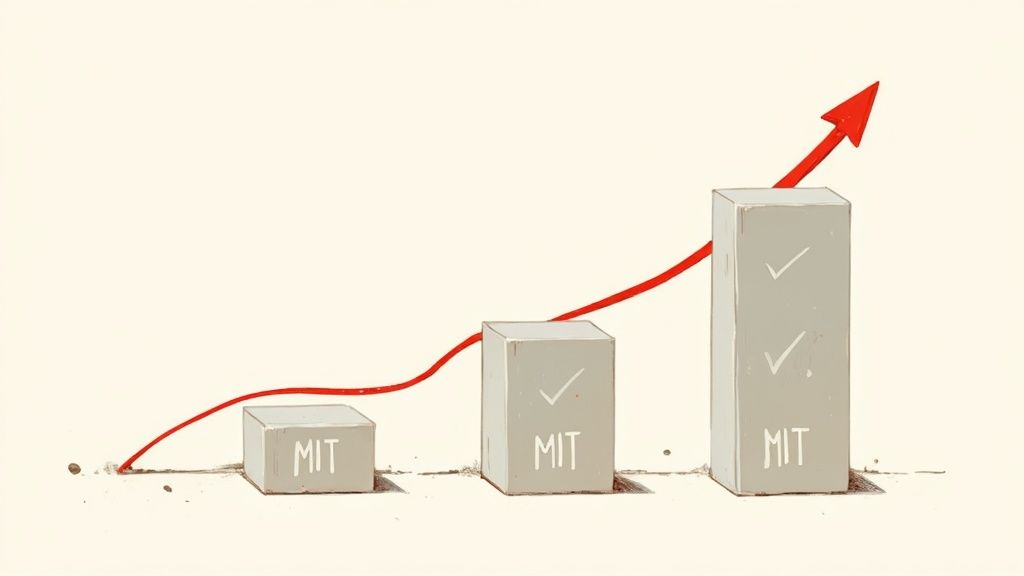
The MIT (Most Important Tasks) Method is a minimalist approach to task prioritization that champions impact over volume. This technique requires you to identify just one to three tasks each day that will create the most significant progress toward your goals. This method shifts your focus from a sprawling, overwhelming to-do list to a highly curated set of high-leverage activities.
The MIT method is particularly effective for individuals and teams who struggle with feeling busy but not productive. For example, a software developer can designate a complex coding feature as their MIT to ensure it gets done before daily meetings and minor bug fixes derail their focus. Similarly, a content creator might identify "finish video script" as their one MIT, guaranteeing that core creative work is prioritized over administrative tasks.
How It Works: Define and Conquer
The process is intentionally simple, designed to eliminate decision fatigue and build momentum. By focusing on a few key deliverables, you ensure that even on the busiest days, you are making meaningful forward progress.
- Identify: At the end of your workday or first thing in the morning, review your goals and upcoming tasks. Ask yourself: "If I could only accomplish three things today, what would they be?"
- Prioritize: Select the 1-3 tasks that will deliver the most value and move you closest to your long-term objectives. These are your MITs.
- Execute: Tackle your MITs first, ideally during your peak energy hours. The goal is to complete them before getting pulled into reactive work like answering emails or attending unscheduled meetings.
- Review: At the end of the day, acknowledge the completion of your MITs. This builds a sense of accomplishment and reinforces the habit, even if other, less important tasks remain unfinished.
Actionable Tips for Implementation
To successfully implement the MIT method, protect your focus with intention. Choose your MITs the night before to wake up with a clear plan and hit the ground running. Block out time in your calendar for these tasks and treat that block as an immovable appointment. Aim to have at least one of your MITs directly support a major long-term goal. This approach is a powerful tool when you need to manage multiple projects and ensure key milestones don't get lost in the daily shuffle.
4. Ivy Lee Method
The Ivy Lee Method is a deceptively simple yet powerful task prioritization method focused on ruthless single-tasking and deliberate daily planning. Developed over a century ago by productivity consultant Ivy Lee for steel magnate Charles M. Schwab, this framework forces you to make tough decisions about your priorities, ensuring you work on what truly matters most each day. Its strength lies in its simplicity, which reduces overwhelm and decision fatigue.
This method is particularly effective for individuals, such as freelancers balancing multiple clients or executives managing high-stakes responsibilities. For instance, a consultant can use it to structure their day around key billable deliverables, ensuring progress on the most critical client work before addressing anything else.
How It Works: The Six-Step Daily Routine
The core of the Ivy Lee Method is a brief, focused planning session at the end of each workday. The process is straightforward and cyclical:
- Step 1: Plan Ahead. At the close of your workday, write down the six most important tasks you need to accomplish tomorrow. Do not list more than six.
- Step 2: Prioritize. Review the list of six and number them from 1 to 6 in order of their genuine importance.
- Step 3: Focus on One. The next day, start with task #1. Work on it, and only it, until it is complete.
- Step 4: Proceed Sequentially. Once task #1 is done, move to task #2. Continue down your list in this manner.
- Step 5: Carry Over. At the end of the day, any unfinished items are moved to the new list of six for the following day.
- Step 6: Repeat Daily. Make this end-of-day planning and sequential execution a consistent habit.
Actionable Tips for Implementation
To make the Ivy Lee Method a core part of your workflow, be disciplined in its application. Take 10-15 minutes at the end of each day to create your list for tomorrow; this non-negotiable step is the foundation of the system. Be realistic about what you can achieve and break down large projects into smaller, completable chunks that can fit on your list. If an urgent task arises, consciously decide if it displaces one of your six items, but maintain the strict limit. Using a physical notepad for this method can create a stronger psychological commitment to your chosen tasks.
5. MoSCoW Method
The MoSCoW method is a powerful prioritization technique used to reach a shared understanding among stakeholders on the importance of deliverables. Developed by Dai Clegg at Oracle in 1994, this framework is widely used in agile project management to categorize requirements into four distinct groups. It excels at managing expectations and focusing resources where they will have the most impact.
This method is particularly effective for product managers planning a feature roadmap or for remote development teams aligning on sprint goals. For instance, a marketing team launching a new campaign might use MoSCoW to decide which elements are non-negotiable (like a landing page) versus desirable additions (like an animated video) if time and budget permit.
How It Works: The Four Categories
The strength of this method lies in its collaborative nature, forcing clear communication about what truly matters. The acronym MoSCoW (with the 'o's added for readability) stands for:
- Must Have (M): These are the critical, non-negotiable requirements for a successful outcome. The project or product is considered a failure if these are not met.
- Should Have (S): These are important but not vital for the current delivery. They are high-priority tasks that should be included if possible, but the project can still succeed without them.
- Could Have (C): These are desirable but not necessary. They are often considered "nice-to-haves" that will be included only if time and resources are plentiful, with minimal impact if left out.
- Won't Have (W): These are tasks or requirements explicitly acknowledged as being out of scope for the current timeframe. They are the least critical and will not be worked on, but they may be reconsidered in the future.
This tiered approach provides a clear hierarchy, helping teams avoid scope creep and make decisive trade-offs when faced with constraints.
Actionable Tips for Implementation
To implement the MoSCoW method effectively, first establish clear criteria for what defines a 'Must Have' with your team. A common rule is to limit 'Must Haves' to about 60% of the total effort to leave room for other priorities. It's crucial to involve all key stakeholders in the categorization process to ensure buy-in and a shared vision. Documenting the rationale behind each decision provides clarity for future reference. For remote teams, using collaborative digital whiteboards to visually sort tasks into MoSCoW categories can significantly enhance alignment and transparency. You can learn more about how this and other Agile-based prioritization methods help streamline development cycles.
6. Value vs. Effort Matrix (Action Priority Matrix)
The Value vs. Effort Matrix is a powerful decision-making tool that helps teams prioritize tasks based on their potential return on investment. Sometimes called the Action Priority Matrix, this framework evaluates activities on two simple axes: the value they will generate and the effort required to complete them. This approach shifts focus from urgency to impact, guiding you to allocate resources where they will be most effective.
This method is especially useful for product managers evaluating new features or marketing teams deciding which campaigns to launch. By plotting potential tasks on this grid, teams can instantly see which initiatives offer the best balance of high impact and low resource consumption, making it one of the most practical task prioritization methods available.
How It Works: The Four Quadrants
The matrix organizes your to-do list into four distinct categories, each with a clear directive:
- Quadrant 1: Quick Wins (High Value, Low Effort). These are your top priorities. Completing them provides significant value quickly, building momentum and demonstrating progress.
- Quadrant 2: Major Projects (High Value, High Effort). These are long-term, strategic initiatives that deliver substantial value but require significant planning and resources.
- Quadrant 3: Fill-Ins (Low Value, Low Effort). These are minor tasks that can be done in spare moments or delegated. While not impactful, they are easy to complete.
- Quadrant 4: Thankless Tasks (Low Value, High Effort). These tasks consume significant resources for little to no return. The goal is to avoid or eliminate them wherever possible.
This visual framework provides an at-a-glance understanding of where your team's energy should be focused for maximum efficiency and results.
Actionable Tips for Implementation
To implement this matrix effectively, start by gathering team input to get accurate estimates for both value and effort. Prioritize Quadrant 1 tasks to secure early successes. For Major Projects in Quadrant 2, break them down into smaller, manageable steps and schedule dedicated time to work on them. Batch or delegate "Fill-In" tasks to handle them efficiently without disrupting high-value work. For more insights on this approach, you can learn more about optimizing resource allocation to ensure your team is always working on what matters most.
7. Eat the Frog Method
The Eat the Frog method is a powerful task prioritization method that directly tackles procrastination. Based on a Mark Twain quote and popularized by author Brian Tracy, the concept is simple: if you have to eat a live frog, it's best to do it first thing in the morning. This "frog" represents your most challenging, most important task, the one you are most likely to put off.
This approach ensures that you use your peak energy and willpower at the start of the day to complete your highest-impact work. For a remote developer, this might mean tackling a complex bug before checking any emails or messages. By getting the most dreaded task out of the way, you build momentum and a sense of accomplishment that carries you through the rest of your day with less stress.
How It Works: Identify and Consume
The core of this method is to identify your single most crucial task for the day and commit to completing it before anything else distracts you. This simple, non-negotiable rule forces focus and prevents less important activities from consuming your most productive hours.
- Step 1: Identify Your Frog. Each evening, review your to-do list and determine the one task that will have the biggest positive impact on your goals. This is your "frog" for the next day.
- Step 2: Prepare to Eat. Get everything ready the night before so you can start immediately in the morning with zero friction.
- Step 3: Eat the Frog. First thing in your workday, before checking emails or attending to other requests, focus exclusively on that one task until it is complete.
- Step 4: Repeat Daily. Make this a consistent habit to build discipline and ensure you are always moving your most important projects forward.
If you have two frogs, Brian Tracy advises eating the "ugliest" one first, meaning the one that is biggest and most important.
Actionable Tips for Implementation
To successfully implement the Eat the Frog method, discipline is key. Protect your "frog time" fiercely by turning off notifications and communicating your focus to your team. If a task feels too large or overwhelming, break it down into smaller, more manageable "frog legs" to make it less intimidating to start. A great way to reinforce this habit is to reward yourself after completing your frog, creating a positive feedback loop. For further reading, Brian Tracy's book, "Eat That Frog!", provides 21 strategies to master this technique.
Task Prioritization Methods Comparison
| Method | Implementation Complexity 🔄 | Resource Requirements 🔄 | Expected Outcomes 📊 | Ideal Use Cases 💡 | Key Advantages ⭐⚡ |
|---|---|---|---|---|---|
| Eisenhower Matrix | Moderate – requires task evaluation by urgency & importance | Low – simple tools suffice | Balanced prioritization, reduced burnout | Professionals with urgent and important competing tasks | Clear action steps, strategic focus, prevents urgency addiction ⭐ |
| ABCDE Method | Moderate – hierarchical ranking discipline | Low – just task list and grading | Clear priority order, reduces procrastination | Goal-oriented individuals, sales, entrepreneurs | Simple letter system, forces consequence thinking, delegation encouraged ⭐ |
| MIT (Most Important Tasks) Method | Low – select 1-3 key tasks daily | Very low – minimal setup needed | High-impact work focus, daily accomplishment | Knowledge workers, creatives, remote workers | Limits overwhelm, increases focus, reduces decision fatigue ⚡ |
| Ivy Lee Method | Low – simple daily list & strict task order | Very low – pen and paper sufficient | Improved focus, reduced decision fatigue | Executives, deep work professionals, overwhelmed workers | Simple to apply, prevents multitasking, manageable workload ⭐ |
| MoSCoW Method | High – stakeholder facilitation & alignment | Moderate – requires group consensus | Clear scope, aligned priorities | Project teams, product management, collaborative work | Prevents scope creep, rapid reprioritization, stakeholder buy-in ⭐ |
| Value vs. Effort Matrix | Moderate – value and effort assessment needed | Moderate – team input advised | Optimized ROI, balanced short and long-term tasks | Team leaders, product managers, strategic planners | Visual prioritization, identifies quick wins, aids resource allocation ⭐⚡ |
| Eat the Frog Method | Low – identify & complete one hardest task first | Very low – planning needed | Reduced procrastination, early momentum boost | Procrastinators, creatives, students | Simple, effective for tough tasks, builds momentum ⚡⭐ |
Choosing and Implementing Your Perfect Prioritization System
Navigating the landscape of task prioritization methods can feel overwhelming, but the journey from reactive chaos to proactive clarity is well worth the effort. We've explored a diverse toolkit, from the strategic foresight of the Eisenhower Matrix to the focused simplicity of the Ivy Lee Method. Each framework, whether it's the agile MoSCoW approach or the impact-focused Value vs. Effort matrix, offers a unique lens through which to view your workload and make deliberate choices.
The central takeaway is this: there is no universal "best" system. The most effective method is the one that aligns with your specific workflow, team dynamics, and personal psychology, and crucially, the one you can commit to consistently. What works for a fast-paced product development team using the Value vs. Effort Matrix might not suit a freelancer who thrives on the daily discipline of the Eat the Frog method. The goal is not to find a perfect, rigid system but to find a flexible, reliable one.
From Theory to Action: Finding Your Fit
The real power of these task prioritization methods emerges not from reading about them, but from implementing them. The key to successful adoption lies in experimentation and adaptation.
- Start Small: Don't try to overhaul your entire team's workflow overnight. Choose one method that resonates with you, like the MIT method, and commit to using it for a full week.
- Track and Reflect: At the end of the trial period, assess what worked and what didn't. Did you feel more focused? Did you make meaningful progress on high-impact projects? Were there specific challenges in applying the system, especially in a remote context?
- Create a Hybrid System: You may discover that a blended approach is your ideal solution. For example, you could use the Eisenhower Matrix for high-level quarterly planning, the MoSCoW method for sprint planning, and the Ivy Lee Method for structuring your individual daily to-do list. This allows you to leverage the strengths of different frameworks at different strategic levels.
For remote teams, this process of refinement is especially critical. Without the ambient awareness of a shared office, it's easy for priorities to become misaligned. A clear, shared prioritization framework acts as a north star, ensuring everyone is pulling in the same direction. This intentional approach is fundamental to building a high-performing distributed team. It's just one piece of the puzzle; for an overarching approach to getting more done, beyond just prioritization, explore these top strategies to improve overall work productivity.
Ultimately, mastering prioritization is about reclaiming control over your time and attention. It’s the foundational skill that separates busy work from impactful results, empowering you and your team to stop fighting fires and start building the future you envision. Choose your starting point, commit to the experiment, and begin your journey toward a more focused, productive, and satisfying way of working.
Ready to gain the clarity needed to apply these methods effectively? DeskCove provides the data-driven insights your team needs to understand where time is actually going, helping you identify high-value tasks and eliminate bottlenecks. Start your free trial of DeskCove today and transform your team’s productivity from the ground up.