10 Meeting Management Best Practices for 2025

In a world of packed calendars and back-to-back calls, inefficient meetings are a silent drain on productivity, budget, and morale. The average professional spends a significant portion of their week in meetings, yet a staggering number of these gatherings lack clear objectives, run over time, and fail to produce tangible outcomes. It's a universal pain point, but it doesn't have to be your reality. By adopting a strategic approach, you can transform meetings from time-wasting obligations into powerful catalysts for progress and decision-making. For comprehensive strategies on integrating all your communication channels to enhance meeting effectiveness, explore the benefits of Unified Communications solutions.
This guide moves beyond generic advice to provide a definitive roundup of 10 proven meeting management best practices. Each one is designed to be immediately actionable, empowering you to reclaim your calendar, foster genuine collaboration, and ensure every minute spent in a meeting drives your team forward. We will cover everything from setting clear objectives and right-sizing your invite list to implementing post-meeting evaluations for continuous improvement. These aren't just tips; they are foundational habits for high-performing teams.
1. Institute Crystal-Clear Meeting Objectives and Agendas
Every productive meeting starts long before anyone joins the call or enters the conference room. The foundational practice of all effective meeting management best practices is to establish and circulate a crystal-clear objective and a structured agenda. This ensures every participant arrives knowing the meeting's "why" and "how," transforming passive attendance into active, focused contribution. A well-defined objective answers the core question: "What decision, plan, or alignment must we achieve by the end of this session?"
This preemptive clarity prevents rambling discussions and scope creep. For instance, Amazon famously requires meeting organizers to circulate a detailed, six-page narrative memo that attendees read at the start of the meeting, ensuring everyone is deeply informed and aligned on the objective. This approach eliminates ambiguity and sets the stage for high-quality discussion and decision-making. The agenda then acts as the roadmap, breaking the objective into manageable, time-boxed topics.
How to Implement This Practice
To make this a standard procedure, integrate agenda creation directly into your team's workflow.
- Share Early: Distribute the agenda at least 24 hours in advance. This gives attendees time to prepare, gather necessary data, and formulate thoughtful contributions.
- Prioritize Ruthlessly: List agenda items in order of importance. This ensures that even if you run short on time, the most critical issues are addressed.
- Allocate Time Wisely: Assign a specific duration to each agenda item and designate a timekeeper. Include a small buffer (around 10%) for unexpected but important discussions.
- Collaborate on the Agenda: Use shared documents (like Google Docs or a Confluence page) to allow key stakeholders to add relevant points or context beforehand. This fosters shared ownership and ensures the agenda is comprehensive.
2. Right-Sizing Participant Lists
One of the most impactful meeting management best practices is to be ruthless about who you invite. Right-sizing the participant list means strategically limiting attendance to only those who are essential to the meeting's objective. This practice prevents bloated meetings where engagement plummets and costs skyrocket due to wasted time. A smaller, more focused group ensures everyone present has a clear role, whether it's contributing expertise or making a key decision.
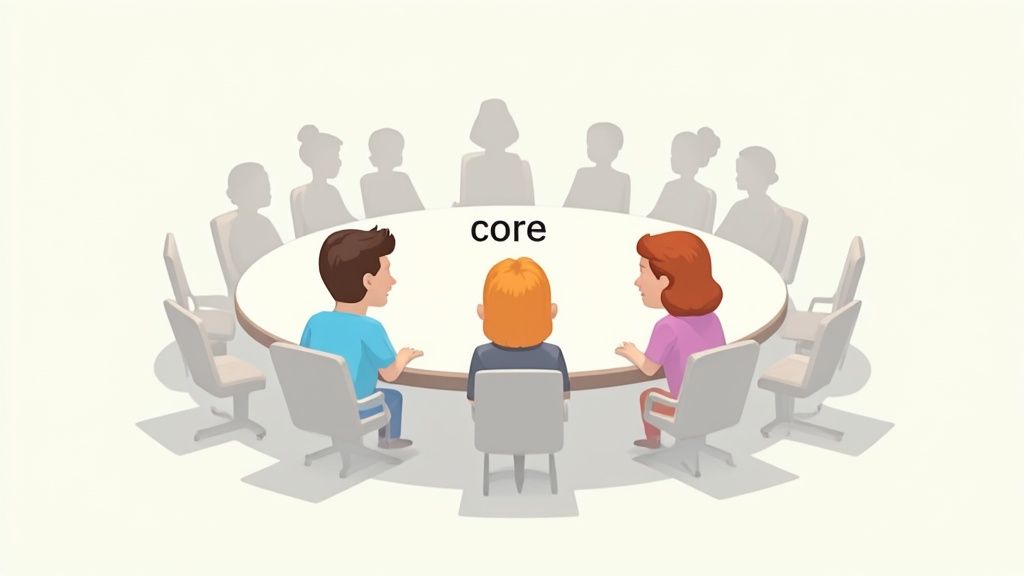
When a meeting grows too large, individual accountability dissolves, and passive listening becomes the norm. Companies like Basecamp champion this principle by keeping most meetings to a small group of 3-5 core team members. The goal is to make every seat at the table count, leading to faster decisions and more productive outcomes.
How to Implement This Practice
Adopt a "less is more" mindset when sending calendar invites to make this a habit.
- Apply the 'Value Test': For every potential attendee, ask: "What unique value will this person add, or what critical information will they gain?" If the answer is unclear, they are likely not essential.
- Classify Participants: Categorize invitees into distinct roles: Decision-Makers (must attend), Contributors (active participants needed for input), and Observers (can be informed asynchronously). Only the first two groups should be required attendees.
- Offer Asynchronous Options: For those in the "Observer" category, provide a meeting recording or detailed minutes instead of an invitation. This keeps them informed without consuming their valuable time.
- Embrace the Core Group Model: Hold a brief meeting with a small, core group to make the primary decision. If wider input is needed, schedule optional breakout sessions for specific topics afterward.
3. Time Boxing and Meeting Duration Limits
One of the most powerful meeting management best practices is the strict enforcement of time limits. Time boxing involves setting a fixed, non-negotiable duration for the entire meeting and for each individual agenda item. This practice instills a sense of urgency and discipline, forcing participants to be concise and stay on topic, thereby respecting everyone's time and maximizing productivity within a constrained period. It prevents the common pitfall of meetings expanding to fill whatever time is allocated.

This principle is widely adopted by highly efficient organizations. For instance, Google defaults its calendar invites to 30 minutes, while daily Scrum stand-ups are famously capped at just 15 minutes to encourage rapid, focused updates. This forces discussions to be direct and purpose-driven, eliminating fluff and ensuring that decisions are made efficiently.
How to Implement This Practice
Integrating time boxing into your meeting culture requires commitment and a few key tools.
- Default to Shorter Meetings: Instead of the standard hour, schedule meetings for 25 or 50 minutes. This provides a mental shift and gives participants a brief window to prepare for their next commitment.
- Assign a Timekeeper: Designate one person whose sole responsibility is to monitor the clock and provide gentle reminders (e.g., "Five minutes left on this topic"). This frees the facilitator to focus on the discussion.
- Use Visible Timers: Display a large, visible timer for all participants, whether in the room or on-screen. This shared awareness of time creates a collective responsibility to remain on schedule. You can explore various time boxing apps that will transform your daily routine to find a tool that suits your team.
- End on Time, No Matter What: Make it a rule to end the meeting at the scheduled time, even if not all topics are covered. This reinforces the importance of the time limit and encourages better agenda planning for the future.
4. Designate a Meeting Facilitator and Decision-Maker
A meeting without a clear leader is like a ship without a rudder; it will drift aimlessly. One of the most impactful meeting management best practices is to assign a designated facilitator responsible for guiding the discussion, maintaining agenda adherence, and driving toward a conclusion. This role prevents meetings from becoming leaderless free-for-alls or being dominated by the most vocal individuals, ensuring every voice is heard and the meeting achieves its objective.
This practice is central to many high-performing methodologies. For instance, Scrum Masters in Agile act as dedicated facilitators, while consulting firms like McKinsey & Company train facilitators on structured decision-making to ensure client meetings are ruthlessly efficient. The facilitator isn't necessarily the most senior person in the room but is empowered to steer the conversation, manage time, and call for a final decision. This clarity of roles is a cornerstone of effective project communication strategies.
How to Implement This Practice
To effectively integrate this role, clearly define the facilitator's responsibilities and authority before the meeting begins.
- State the Leader: Begin every meeting by explicitly stating who the facilitator and the final decision-maker are. This sets clear expectations for all attendees.
- Empower the Facilitator: Give the facilitator the authority to politely interrupt, redirect off-topic discussions, and "park" tangential ideas for a later time.
- Establish Decision-Making Frameworks: Decide in advance how a decision will be made. Will it be by consensus, by the decision-maker after hearing input, or by a vote?
- Rotate the Role: To build leadership skills across the team, rotate the facilitator role among different members for recurring meetings. This fosters a shared sense of responsibility for meeting productivity.
5. Active Listening and Psychological Safety
Beyond a structured agenda, the most impactful meeting management best practices cultivate a specific atmosphere: one of psychological safety. This is an environment where every participant feels secure enough to contribute ideas, challenge assumptions, and voice dissent without fear of retribution or humiliation. It transforms meetings from performative reporting sessions into powerful forums for genuine collaboration and innovation. To foster truly engaging and safe meeting environments, it is paramount for all participants to understand the proven ways to improve workplace communication that underpin this principle.
This concept, famously identified by Google's Project Aristotle as the single most important factor in high-performing teams, is not about being "nice." It's about candor. Pixar’s "Braintrust" meetings are a prime example; they are designed explicitly for frank, constructive criticism to elevate creative work. This requires leaders to model vulnerability and active listening, demonstrating that every voice, especially a dissenting one, is valued.
How to Implement This Practice
Cultivating psychological safety is an active, ongoing process, not a one-time setup.
- Set the Stage Early: Begin meetings by explicitly stating that all perspectives, including challenges and questions, are welcome. This gives everyone permission to speak freely. Consider starting with some well-chosen icebreaker questions to build rapport.
- Practice Active Listening: When someone speaks, paraphrase their point to confirm understanding ("So, if I'm hearing you correctly, your concern is…"). This validates their contribution and ensures clarity.
- Use Round-Robin Participation: For critical topics, go around the room and ask each person for their input. This technique prevents dominant voices from monopolizing the conversation and invites quieter members to contribute.
- Separate Brainstorming from Evaluation: Create distinct phases in your meeting. First, generate as many ideas as possible without judgment. Only after all ideas are on the table do you move to a phase of critical evaluation. This prevents premature criticism from stifling creativity.
6. Clear Action Items and Follow-Up Documentation
A meeting's value diminishes rapidly if its conclusions don't translate into tangible progress. One of the most critical meeting management best practices is to rigorously document clear action items and establish a follow-up process. This practice bridges the gap between discussion and execution, ensuring that every decision, idea, and commitment is captured, assigned, and tracked. A meeting without documented next steps is often just a conversation, not a productive work session.
This systematic approach creates a culture of accountability. When team members know that specific tasks with owners and deadlines will be recorded and circulated, they are more likely to commit to and deliver on their responsibilities. This workflow ensures nothing falls through the cracks and momentum is maintained long after the meeting ends.
How to Implement This Practice
To turn meeting decisions into measurable outcomes, make action item documentation a non-negotiable part of every meeting.
- Assign in Real-Time: Don't wait until after the meeting to assign tasks. As an action item is identified, assign an owner and get their verbal confirmation on the spot.
- Use the SMART Framework: Ensure every action item is Specific, Measurable, Achievable, Relevant, and Time-bound. Instead of "Look into the marketing budget," a better action item is "Analyze Q3 marketing spend and present a budget-saving proposal by Friday."
- Centralize and Distribute Promptly: Document all action items in a shared system like Notion, Confluence, or a project management tool. Distribute a summary of these items within 24 hours of the meeting.
- Create a Review Cadence: Begin subsequent meetings with a quick review of outstanding action items from the previous session. This reinforces accountability and provides a clear starting point for the new discussion.
7. Foster Diverse Perspectives and Cross-Functional Participation
Effective meetings are not echo chambers; they are forums for robust discussion and innovative problem-solving. One of the most impactful meeting management best practices is to intentionally invite diverse perspectives by including cross-functional participants. This approach breaks down departmental silos and ensures that decisions are not made in a vacuum, leading to more comprehensive and resilient outcomes. A meeting that only includes a homogenous group of thinkers risks overlooking critical blind spots and potential opportunities.
This practice is a cornerstone of innovation at leading companies. For instance, Toyota's famous Kaizen (continuous improvement) meetings actively involve floor-level workers alongside engineers and managers, ensuring that solutions are grounded in practical reality. Similarly, Apple’s product development meetings are renowned for including representatives from design, engineering, and marketing from the earliest stages, guaranteeing that the final product is not only functional but also desirable and marketable. By bringing different viewpoints to the table, you enrich the conversation and stress-test ideas from all angles.
How to Implement This Practice
Integrating diverse perspectives requires deliberate planning and facilitation to ensure all voices are heard.
- Map Stakeholders Intentionally: When creating the invite list, think beyond the immediate team. Ask, "Who will be impacted by this decision? Who has a unique viewpoint we haven't considered?" and invite representatives from those groups.
- Rotate Participants: For recurring meetings, consider rotating a "guest" spot among different departments. This builds cross-functional relationships and consistently injects fresh perspectives into routine discussions.
- Create Psychological Safety: Explicitly state that all viewpoints, especially dissenting ones, are welcome. A facilitator can actively solicit opinions from quieter participants or use techniques like the "devil's advocate" to encourage healthy debate.
- Mix Seniority Levels: Invite junior team members to meetings with senior leadership. Their fresh eyes and proximity to day-to-day tasks can provide invaluable insights that leaders might miss.
8. Standing and Motion-Based Meetings
One of the most innovative meeting management best practices involves changing the physical context: get people on their feet. Standing or motion-based meetings leverage a simple psychological principle that our physical state influences our mental state. By removing the comfort of chairs, you naturally inject a sense of urgency and energy into the discussion, which promotes brevity, focus, and faster decision-making. This physical shift discourages passive listening and encourages active participation.
This practice is famously embodied by the daily stand-up in Scrum and Agile methodologies, where teams gather for a quick, 15-minute sync. The goal isn’t discomfort, but efficiency. Because people are less inclined to settle in for a long, drawn-out debate while standing, conversations stay concise and action-oriented. Companies like Zappos and various tech startups have adopted standing meetings to accelerate internal sync-ups and maintain a high-energy, collaborative environment. The result is a meeting that is inherently time-boxed by human endurance.
How to Implement This Practice
Integrating standing meetings requires a thoughtful approach to ensure they are productive and inclusive.
- Choose the Right Meeting Type: This format is ideal for short, tactical meetings like daily status updates, quick problem-solving sessions, or brief project check-ins. Avoid it for deep strategic discussions or complex brainstorming.
- Set Clear Time Limits: Standing naturally encourages brevity, but you should still formally time-box the meeting. Aim for 15-20 minutes maximum to maintain focus and respect everyone's comfort.
- Ensure Accessibility: This is crucial. Always provide options for team members who may be unable to stand for extended periods. Offer high-top stools or ensure the meeting is inclusive for everyone, regardless of physical ability.
- Designate a Standing-Friendly Space: Hold these meetings in an open area or a room without chairs to set a clear expectation. This simple environmental cue reinforces the meeting's purpose and format.
9. Mandate Pre-Meeting Preparation and Materials Review
One of the most powerful meeting management best practices is shifting foundational learning from the meeting itself to the time before it. Mandating pre-meeting preparation and materials review ensures that valuable synchronous time is spent on discussion, debate, and decision-making, not on basic orientation. When participants arrive with a shared context, the quality of conversation elevates dramatically, and resolutions are reached much faster.
This practice is famously championed by Amazon, where meetings often begin with a silent, 15-20 minute period for attendees to read a detailed six-page memo. This ensures everyone is fully briefed and on the same page before a single word is spoken. The goal is to protect expensive meeting time for high-level work, preventing it from being wasted on catching people up. By making preparation a non-negotiable prerequisite, you foster a culture of respect for everyone's time.
How to Implement This Practice
To make pre-reading a cultural norm, you must build it into your meeting workflow and set clear expectations.
- Distribute Materials Early: Send all necessary documents, reports, or links at least 24-48 hours in advance. This gives everyone adequate time to review without feeling rushed.
- Keep It Concise: Respect participants' time by keeping pre-read materials focused. Aim for a 1-2 page executive summary or a maximum of 5-10 pages for more detailed documents. Highlight the most critical sections or specific questions you want them to consider.
- Set Clear Expectations: In the meeting invitation, explicitly state that reviewing the materials is required. You can frame it as, "Please come prepared to discuss the solutions proposed on page 3."
- Assume Preparation: Start the meeting with the assumption that everyone has done the pre-work. Avoid recapping the materials; instead, dive directly into the first key discussion point. This creates a subtle but firm consequence for those who come unprepared.
10. Post-Meeting Evaluation and Continuous Improvement
The most overlooked aspect of effective meeting management is what happens after the meeting series has concluded. The practice of post-meeting evaluation and continuous improvement transforms meetings from static events into a dynamic, evolving process. This involves systematically gathering feedback and data to assess what worked, what didn't, and how to make the next session better. This meta-practice ensures your meeting culture doesn't stagnate but consistently improves in efficiency and impact.
This feedback loop is crucial for optimizing one of the most significant investments a company makes: its employees' time. For example, GitLab, a pioneer in remote work, tracks meeting metrics and publicly shares its findings to refine its communication protocols. By treating meetings as a process to be optimized, they turn anecdotal complaints into actionable data, leading to a more productive and engaged workforce. This approach is a cornerstone of advanced meeting management best practices.
How to Implement This Practice
Integrating a feedback mechanism into your meeting culture requires a deliberate, consistent effort.
- Launch Pulse Surveys: After important meetings, send out a brief 1-3 question survey via tools like Slack or Microsoft Teams. Ask simple questions like, "Did this meeting achieve its stated goal?" and "Was your time well-used?"
- Track Key Metrics: Monitor objective data such as meeting duration versus scheduled time, the percentage of agenda items covered, and the completion rate of action items generated.
- Conduct Quarterly Retrospectives: Dedicate a session each quarter for your team to discuss meeting effectiveness. Use this time to analyze trends, celebrate improvements, and identify persistent pain points.
- Share Findings Transparently: Make meeting effectiveness data accessible to the team. Transparency builds trust and encourages collective ownership of the improvement process.
Comparison of 10 Meeting Management Best Practices
| Practice | 🔄 Implementation Complexity | ⚡ Resource Requirements | ⭐ Effectiveness / Quality | 📊 Expected Outcomes | 💡 Ideal Use Cases |
|---|---|---|---|---|---|
| Clear Meeting Objectives and Agenda | Low–Moderate — requires prep and alignment | Low — time to draft and share agenda | ⭐⭐⭐ — strong clarity & focus | Higher agenda adherence, faster decisions | Planning meetings, decision sessions, recurring status |
| Right-Sizing Participant Lists | Low — requires role assessment per meeting | Low — coordination and communication | ⭐⭐⭐ — improves engagement and velocity | Fewer wasted person-hours, quicker decisions | Operational syncs, decision-critical meetings |
| Time Boxing and Meeting Duration Limits | Low — policy + facilitator discipline | Low — timers or tools; scheduling changes | ⭐⭐⭐ — enforces focus and pace | Shorter meetings, reduced scope creep | Standups, status updates, dense agendas |
| Designated Meeting Facilitator and Decision-Maker | Moderate — role assignment and training | Moderate — facilitator time and authority | ⭐⭐⭐ — ensures structure and accountability | Complex discussions, cross-functional or high-stakes meetings | |
| Active Listening and Psychological Safety | High — cultural change and reinforcement | Moderate — training, consistent practice | ⭐⭐⭐ — improves idea quality and trust | More candid input, reduced groupthink | Brainstorms, retrospectives, innovation workshops |
| Clear Action Items and Follow-Up Documentation | Low–Moderate — discipline and templates | Low–Moderate — documentation tools and follow-up | ⭐⭐⭐ — converts decisions into outcomes | Higher action completion, clearer accountability | Project meetings, decisions requiring execution |
| Diverse Perspectives and Cross-Functional Participation | Moderate–High — stakeholder mapping and invites | Moderate — more participants, coordination time | ⭐⭐⭐ — increases solution robustness | Better decisions, broader buy-in, fewer blind spots | Strategy, product design, cross-department problems |
| Standing and Motion-Based Meetings | Low — format change and logistics | Low — space setup, accessibility accommodations | ⭐⭐ — boosts energy for short meetings | Shorter, more focused syncs; higher alertness | Daily standups, quick status or decision huddles |
| Pre-Meeting Preparation and Materials Review | Low–Moderate — requires culture and deadlines | Low — prep time and document production | ⭐⭐⭐ — enables higher-quality discussion | Faster, deeper decisions; less catch-up time | Memo-driven meetings, board reviews, technical deep-dives |
| Post-Meeting Evaluation and Continuous Improvement | Moderate — metrics, surveys, retrospectives | Moderate — tools and time to analyze | ⭐⭐ — improves meeting quality over time | Fewer ineffective meetings, measurable gains | Organizations aiming to reduce meeting overhead and iterate practices |
From Meetings to Momentum: Your Path Forward
We've explored ten powerful strategies designed to reclaim your calendar and transform meetings from necessary evils into powerful catalysts for progress. From establishing crystal-clear objectives and agendas to right-sizing participant lists and embracing continuous improvement, each practice serves a distinct purpose. Together, they form a comprehensive framework for a more respectful, focused, and intentional meeting culture.
The journey to better meetings isn't about rigid, top-down enforcement. It's a cultural shift built on shared understanding and collective buy-in. The most impactful changes often start small. You don't need to implement all ten of these meeting management best practices overnight. Instead, identify the biggest pain point your team currently faces. Is it meetings that drift aimlessly? Start by mastering the art of the agenda. Do conversations get derailed by a few dominant voices? Appoint a dedicated facilitator to ensure everyone is heard.
Your Actionable Next Steps
To move from theory to practice, consider this simple, iterative approach:
- Select One Practice: Choose a single best practice from this list that addresses your most pressing meeting challenge. Perhaps it's enforcing hard stops with time boxing or ensuring every meeting ends with clear, assigned action items.
- Commit for Two Weeks: Apply this one practice consistently to every meeting for the next two weeks. This timeframe is long enough to build a habit but short enough to feel manageable.
- Gather Feedback: At the end of the two weeks, ask your team for direct feedback. What worked well? What felt awkward? How did it impact the meeting's outcome and their sense of engagement?
- Refine and Repeat: Use the feedback to refine your approach. Once the first practice feels natural, introduce a second one. This incremental method builds momentum and allows your team to adapt without feeling overwhelmed.
The True Value of Mastering Meetings
Adopting these meeting management best practices is more than an exercise in efficiency; it's a direct investment in your team's most valuable assets: their time, energy, and expertise. When meetings are well-run, they stop being a drain and start becoming a source of alignment, innovation, and psychological safety. Decisions are made faster, projects move forward with clarity, and team members feel their contributions are genuinely valued.
Ultimately, mastering meetings empowers your organization to operate at a higher level. It frees up countless hours for deep, focused work, reduces employee frustration, and creates a collaborative environment where great ideas can flourish. The path forward begins not with a complete overhaul, but with a single, intentional step toward making the next meeting better than the last.
Ready to quantify the impact of better meetings on your team's productivity? DeskCove provides the data-driven insights you need to see exactly where time is going and measure the benefits of your new strategies. Discover how to connect your meeting management efforts to real-world performance gains by exploring DeskCove today.