A Practical Project Plan for Agile Projects
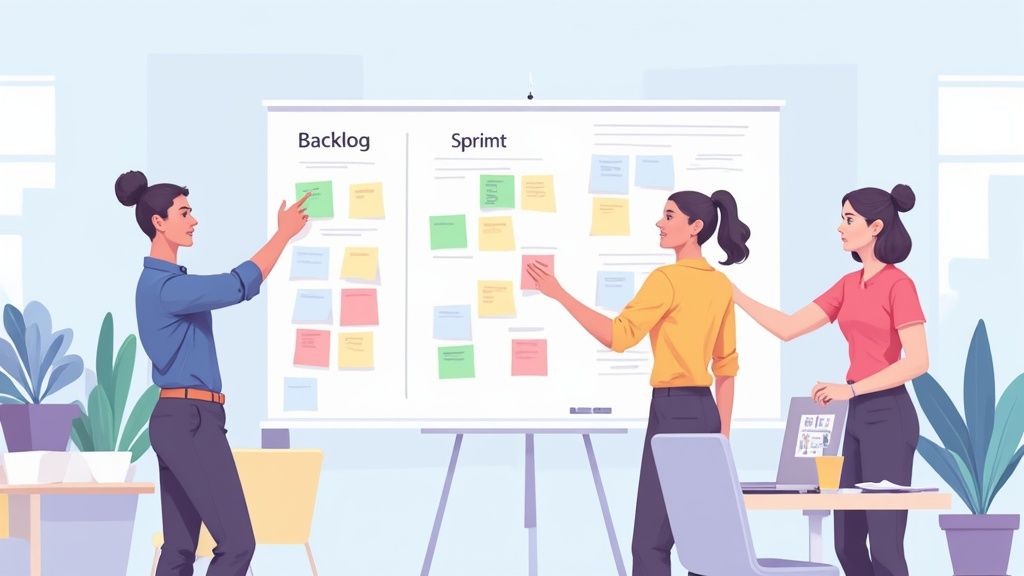
An agile project plan isn't a dusty, document-heavy Gantt chart locked in a drawer. Think of it more as a living, breathing guide that evolves right alongside the project itself. It’s all about delivering value in small, iterative chunks through prioritized backlogs, quick planning cycles (sprints), and a constant stream of feedback.
This entire approach is designed to embrace change, not run from it.
Why Traditional Plans Fail in Agile
Trying to shoehorn a traditional, fixed project plan into an agile environment is like trying to fit a square peg in a round hole. It’s a recipe for pure frustration. The old-school method, which is completely dependent on exhaustive upfront planning and rigid timelines, directly clashes with everything that makes Agile work.
You end up with a brittle plan that’s outdated almost as soon as it's printed. Worse, it actively works against the team's ability to adapt and deliver what the customer actually wants.
This conflict is fundamental. Traditional plans are built on the shaky assumption that we know everything from day one. They demand detailed specs for the entire project before a single line of code is written. In the real world, where market needs pivot and user feedback rolls in constantly, this model just crumbles.
The Shift from Outputs to Outcomes
Making Agile work requires a crucial mental shift: you have to stop focusing on rigid outputs and start caring about flexible outcomes. A traditional plan measures success by ticking off a list of predefined features. An agile plan, on the other hand, measures success by achieving the desired business outcome—even if the path to get there looks different than you first imagined.
This distinction is precisely why so many organizations have made the switch. Agile adoption has exploded far beyond its IT roots. By 2025, an estimated 71% of companies use Agile in their software development lifecycle, with engineering and R&D teams now accounting for 48% of practitioners. This trend shows a clear move toward more adaptive planning across the board. You can dive deeper into these Agile development statistics.
To really understand the difference, let’s break down how these two philosophies approach planning.
Traditional vs Agile Planning At a Glance
| Aspect | Traditional (Waterfall) Plan | Agile Plan |
|---|---|---|
| Philosophy | Predict and control. Assumes all requirements can be known upfront. | Adapt and inspect. Embraces uncertainty and expects change. |
| Structure | Linear and sequential (e.g., design -> build -> test -> deploy). | Iterative and incremental, delivered in short cycles (sprints). |
| Documentation | Heavy and comprehensive upfront. The plan is a contract. | Lightweight and just-in-time. The plan is a guide. |
| Flexibility | Highly resistant to change. Changes are costly and discouraged. | Highly flexible. Change is welcomed to deliver more value. |
| Success Metric | Following the plan perfectly and delivering on schedule/budget. | Delivering a valuable, working product that meets user needs. |
| Team Role | Follows the predefined plan and tasks assigned by a manager. | Self-organizing and empowered to make decisions to meet sprint goals. |
As you can see, these aren't just slightly different methods; they're fundamentally different ways of thinking about how to build things.
The goal isn't to perfectly follow a plan made months ago. The goal is to continuously deliver the most valuable product possible, and that requires a plan that can learn and adapt along with the team.
Ultimately, an effective project plan for agile projects serves as a roadmap, not a contract set in stone. It gives you direction with a clear product vision but empowers the team to discover the best route to the destination. By embracing this flexible mindset, you create a plan that truly supports your team, delights customers, and delivers real business results.
Building Your Foundation with Vision and a Roadmap
Before you write a single line of code or plan the first sprint, your team needs a North Star. A solid project plan for agile projects doesn't kick off with a list of tasks; it starts with everyone agreeing on the "why." This is where a clear product vision and a high-level roadmap become your most valuable tools.
A product vision isn't some dense, jargon-stuffed document. Think of it as a short, inspiring statement that nails down the ultimate purpose of your project. It gets everyone—from the CEO down to the junior developers—on the same page, giving you a guiding light when you hit those inevitable tough decisions.
For instance, a vision for a new mobile banking app could be: "To empower young adults to manage their finances confidently and effortlessly from their phones." This simple sentence will shape every feature debate and prioritization argument from here on out.
Translating Vision into a Strategic Roadmap
With your vision locked in, the next move is to sketch out a product roadmap. Let's be clear: this is not a rigid, date-driven Gantt chart. Instead, picture it as a strategic, big-picture view that shows where you're headed over time.
A true agile roadmap has wiggle room. It leaves space for the learning and pivots that happen in any real-world project, prizing flexibility over locking in deadlines for features that are months away.
A great agile roadmap communicates the strategic themes and major goals you aim to achieve, often mapped across quarters or release cycles. It focuses on the problems you intend to solve for users, not just the features you plan to build.
This approach keeps stakeholders in the loop on the project's direction without getting them lost in the weeds of details that are almost guaranteed to change. If you want to nail this, check out our deep dive on creating a project roadmap for faster success, where we break down how to build these crucial documents.
Key Components of an Agile Roadmap
To keep your roadmap practical and easy to digest, organize it around major themes. These themes are just big-picture focus areas that all tie back to your product vision.
- Strategic Themes: Group related features or goals into broad buckets. For that banking app, a theme might be "Enhanced Security" or "Personalized Budgeting Tools."
- Key Initiatives or Epics: Under each theme, list the major pieces of work. For "Personalized Budgeting Tools," this could include epics like "Automated Spending Categorization" and "Savings Goal Tracker."
- General Timeframes: Ditch the specific dates. Use broad strokes like "Q1," "Q2," or even simpler terms like "Now," "Next," and "Later" to show priority without creating a false sense of certainty.
- Success Metrics: Add a quick note on how you'll know if a theme was successful. For the budgeting tools, a metric could be "Increase user engagement with budgeting features by 25%."
This kind of structure gives you a clear, strategic blueprint that directly informs your sprint-level planning. It makes sure the team is always working on things that matter, building a strong foundation for the entire project.
Bringing Your Product Backlog to Life
Alright, you’ve got the high-level vision and roadmap. Now it's time to get your hands dirty and translate those big ideas into actual work for the team. This is where the product backlog comes into play.
Think of the backlog as the living, breathing heart of your Agile project. It’s a prioritized to-do list for everything—new features, bug fixes, technical debt, you name it. It's the single source of truth that keeps everyone on the same page. The roadmap sets the destination, but the backlog is what paves the road, one task at a time.
This is often where teams get stuck—moving from those grand strategic themes down to granular tasks. The trick is to break down the big stuff (we call these epics) into smaller, bite-sized pieces known as user stories. For a deeper dive on this, our guide on how work breakdown structures simplify project management has some great strategies.
Crafting Crystal-Clear User Stories
A vague user story is a recipe for disaster. You need absolute clarity to make sure the team builds the right thing the first time. The classic format works wonders because it forces you to think from the user's perspective:
As a [type of user], I want [some goal] so that [some reason].
Let’s stick with our mobile banking app example. A user story might look like this: "As a budget-conscious user, I want to receive a push notification when I’m nearing my monthly spending limit so that I can avoid overspending." Simple, clear, and focused on the why.
But the story itself is only half the battle. Each one needs rock-solid acceptance criteria. These are the specific, testable conditions that must be met for the story to be marked "done." They’re your checklist.
For our notification story, the criteria might be:
- The notification triggers when spending hits 90% of the user's set limit.
- Tapping the notification takes the user directly to their spending summary page.
- The user has an option in their settings to customize the notification threshold.
Great user stories and bulletproof acceptance criteria kill ambiguity. They build a shared understanding between the product owner and the developers, and that’s the secret sauce to delivering real value, fast.
Smart Prioritization Beyond "High" and "Low"
So you've got a backlog full of user stories. Fantastic. Now, what do you build first? Just slapping "high" or "low" priority labels on everything is too simplistic. Agile teams need a more nuanced way to make smart trade-offs and deliver the most bang for the buck.
Two of my favorite techniques for this are the MoSCoW method and the Value vs. Effort matrix. They force you to think critically about what truly matters.
MoSCoW Method:
This isn't about the city; it's a framework that sorts backlog items into four clear categories:
- Must-Have: Absolutely non-negotiable. The product simply won't work or be viable without these features.
- Should-Have: These are important and add a ton of value, but they aren't critical for the initial launch. Think of them as the next most important things.
- Could-Have: These are the "nice-to-have" features. If you have extra time and resources, you’ll tackle them. If not, they can wait.
- Won't-Have (this time): These are items that are officially out of scope for the current release. It doesn't mean they're bad ideas, just that they're not happening right now.
Using MoSCoW forces you to have the tough conversations and get real about what's essential. When your backlog is properly prioritized this way, you can be confident every sprint is laser-focused on delivering maximum impact.
Finding Your Rhythm with Release and Sprint Planning
With a prioritized product backlog in hand, it's time to translate that high-level strategy into actual, executable work. A solid project plan for agile projects depends entirely on establishing a steady rhythm of delivery. This is where release and sprint planning come in.
Think of it as building momentum. The goal is to bundle backlog items into meaningful releases that deliver real value to your users. Then, you break down those releases into smaller, manageable cycles called sprints.
This cadence keeps your team focused, prevents burnout, and gives stakeholders forecasts they can actually rely on. A well-planned rhythm is what turns the potential chaos of development into a predictable, productive flow.
This is the fundamental journey from a big-picture roadmap to a refined list of stories, ready for the team to tackle.
As you can see, a clear strategic roadmap is the bedrock for creating and prioritizing the user stories that will ultimately fuel your sprints.
The Sprint Planning Ceremony
Sprint planning is the collaborative meeting where the team decides what can be delivered in the upcoming sprint and figures out how to get it done. It's a focused session where the team pulls prioritized work from the top of the product backlog, agrees on a clear sprint goal, and commits to a sprint backlog.
A successful session really boils down to a few key ingredients:
- A Clear Sprint Goal: This is a simple, one-sentence summary of what the sprint is all about. For instance, "Implement a secure, one-click checkout process for returning customers."
- Capacity Planning: The team needs a realistic grasp of how much work it can take on. This is often based on its historical velocity—the average amount of work it's completed in past sprints.
- Task Breakdowns: The user stories selected for the sprint are broken down into smaller, more granular technical tasks.
To truly find your rhythm, mastering Agile development sprint planning is a non-negotiable skill for the whole team. It’s what gets everyone aligned and confident in the commitment. For a deeper dive into specific strategies, our guide on top Agile sprint planning techniques for perfect team alignment has plenty of actionable advice.
Defining Done and Estimating Effort
Two of the most critical guardrails for a smooth sprint are a rock-solid "Definition of Done" and a consistent way to estimate effort. Without these, you’re just inviting ambiguity and risk into the process.
The Definition of Done (DoD) is a shared, non-negotiable checklist that a user story must meet to be considered complete. This isn't just about writing code; it's a team-wide quality standard.
Your DoD is your team's pact for quality. It might include things like 'code peer-reviewed,' 'unit tests passed,' 'documentation updated,' and 'approved by the Product Owner.' It completely removes the guesswork from the "is it done yet?" conversation.
When it comes to estimation, many teams lean on story points. These are relative units of measure that gauge the effort, complexity, and uncertainty of a task. Instead of asking, "How many hours will this take?" the team asks, "How big is this compared to other things we've done?" This approach embraces the inherent uncertainty of development and helps the team develop a more predictable velocity over time.
Giving Your Team the Right Roles and Culture
Let's be honest: a brilliant plan is completely useless if you don't have a team that can actually run with it. When you’re putting together an agile project plan, you're not just creating a backlog and a timeline. You're building a shared commitment, and that commitment is powered by people.
This means you have to focus on the human element. Everyone needs to know exactly what they’re responsible for, and they need to operate in a culture that’s built for success, not burnout. A great agile team is a cohesive unit, not just a random group of people. When responsibilities are crystal clear, you sidestep common problems like dropped balls and decision paralysis, letting the team move fast and with confidence.
Agile is spreading like wildfire, and not just in IT. While adoption among software developers shot up from 37% to 86% in the five years leading up to 2025, we're seeing other departments get on board. Marketing is at 17% adoption, and HR is at 16%. It’s a clear sign that businesses everywhere are seeing the value in this flexible approach. You can dig deeper into these agile statistics and their organizational impact to see the full picture.
Defining the Core Agile Roles
In most agile setups, especially Scrum, you’ll find three key roles. Each one has a distinct set of responsibilities that keeps the project moving forward. Getting these roles wrong is one of the quickest ways to derail a project, no matter how good your intentions are.
-
The Product Owner: Think of this person as the voice of the customer. They own the product backlog and have the final say on what gets prioritized. Their job is to define user stories and make sure the team is always working on the features that deliver the most bang for the buck.
-
The Scrum Master: This role is more of a coach than a traditional manager. The Scrum Master is a servant-leader who facilitates all the agile ceremonies (like stand-ups and retrospectives) and clears any roadblocks that are slowing the team down. They act as a shield, protecting the team from outside distractions and making sure everyone is sticking to the agile process.
-
The Development Team: This is the cross-functional, self-organizing group of people who have all the skills needed to turn backlog items into a finished piece of the product. They are collectively responsible for the quality of their work and for delivering what they commit to in each sprint.
Building a Culture of Trust and Transparency
Job titles are just one piece of the puzzle. The right culture is what truly brings an agile plan to life. Your team will thrive in an environment of psychological safety—a place where people feel safe enough to ask questions, challenge ideas, and even admit they made a mistake without fearing blame.
An agile plan lives and dies by feedback. To get honest feedback, you need a culture where transparency is the default and trust is the foundation. This allows for open conversations during retrospectives that lead to real, continuous improvement.
This kind of culture isn't accidental; it's actively built through agile ceremonies. Daily stand-ups become quick, collaborative problem-solving huddles, not just status reports for a manager. Sprint retrospectives are treated as blameless forums for figuring out what went well and what could be even better next time. When these events are seen as genuine opportunities for collaboration, they become powerful engines for progress.
Measuring What Matters to Adapt and Improve
So, you’ve got a plan. But how do you know if it’s actually working? A solid project plan for agile projects isn’t a document you create and then file away. It's a living, breathing tool that needs constant attention—meaning you have to measure things, see what's working, and adjust. The real trick is to ignore the vanity metrics and zero in on the KPIs that actually help your team get better.
This isn't about tracking numbers just to have them. It's about using data to spark honest, productive conversations during your sprint reviews and retrospectives. When you get this right, these metrics turn raw observations into concrete, actionable steps for the next sprint.
Key Metrics for Agile Teams
To really keep your finger on the pulse of the project, there are a few core metrics you just can't skip. They give you a clear, data-backed picture of your team’s performance and predictability.
- Velocity: This is the big one. It’s the average amount of work your team knocks out during a sprint, usually measured in story points. Tracking velocity is your best friend when it comes to forecasting. It tells you how much work the team can realistically chew through in future sprints, making your release planning much, much more accurate.
- Burndown Chart: Think of this as your progress-at-a-glance tool. It’s a simple visual that shows how much work is left in the sprint backlog. A steady downward slope? That's a great sign. A line that’s flat or jumping all over the place? That’s your cue that a blocker or some other issue needs immediate attention.
- Cycle Time: Ever wonder how long it really takes to get something done? Cycle time measures the total time a task spends moving from "in progress" to "done." Digging into your cycle time is fantastic for sniffing out bottlenecks in your workflow and finding those golden opportunities to become more efficient.
Using these metrics helps anchor your team's discussions in reality. Instead of just going on gut feelings, you can point to actual data to guide your decisions on what to improve next.
The core idea behind an agile plan is that it’s never static. It's a continuous loop of planning, doing, measuring, and adapting that keeps your project aligned with business goals and getting better over time.
This constant adaptation is a huge part of why Agile is so effective. The numbers back it up, too. Recent studies on Agile's impact on project performance consistently highlight its ability to deliver results. A full 39% of respondents using Agile project management report the highest average project performance, with an overall success rate of about 75.4%—edging out other methods. This just goes to show that a well-executed agile plan is a major contributor to hitting your goals, especially when things are constantly changing.
Ultimately, these measurements aren't just for managers to stare at on a dashboard. They empower the entire team. They create the feedback loop everyone needs to inspect their work, adapt their approach, and continuously fine-tune both the product and the process itself.
Answering Your Agile Project Plan Questions
Even seasoned teams hit a few bumps when putting together an Agile plan. Let's tackle some of the most common questions that pop up, so you can move forward with a bit more clarity.
How Much Detail Does an Agile Plan Really Need?
Think of it like driving at night—you need your headlights to see the road immediately in front of you crystal clear, but the road further ahead can be a bit fuzzier. Your Agile plan should be the same.
Get super detailed for the next sprint or two. Beyond that? Keep it high-level. This "just-in-time" planning saves you from wasting hours mapping out features and tasks that are almost guaranteed to change once you get feedback and learn more.
Can Agile Really Work for Projects with a Hard Deadline?
Absolutely, but it requires a mental shift. When the deadline or budget is locked in, the scope has to be the flexible part.
For fixed-deadline projects, your Agile plan needs to be laser-focused on ruthless prioritization. The goal is to make sure the most critical, highest-value features get shipped within those constraints. It’s less about checking off a pre-written list and more about maximizing the value you deliver. If you're looking for a solid framework, checking out a practical Project Plan Playbook can give you a great starting point for structuring your work.
In Agile, we don't see "scope creep" as a problem; we see it as "responding to change." New ideas and requests aren't disruptions—they're opportunities. We just add them to the backlog, prioritize them against everything else, and keep the team focused on shipping what matters most.
Ready to keep your Agile projects on track and measure what truly matters? DeskCove offers powerful time tracking and productivity monitoring to help your team improve estimates, spot bottlenecks, and deliver value faster. Get started today at https://deskcove.com.