Effective Daily Standup Meeting Template

A solid daily standup meeting template gives you a simple framework to keep your team aligned, focused, and moving forward. It’s usually built around three classic prompts: what you did yesterday, what you’ll do today, and what’s blocking you. A good template makes sure these quick syncs actually add value instead of just becoming another meeting on the calendar.
Why Your Standup Is Not Working
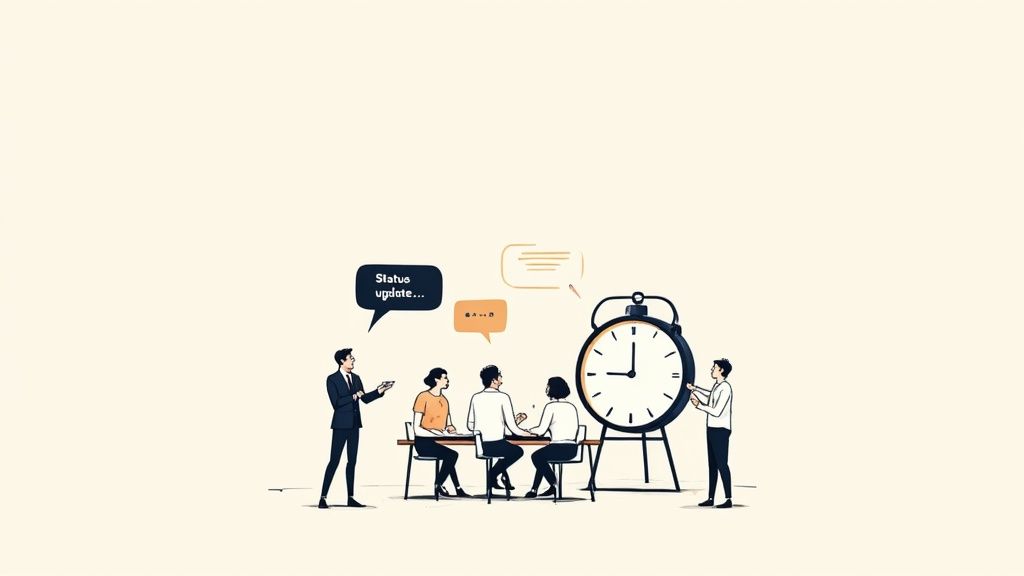
Let’s be real—a lot of daily standups feel like a complete waste of time. They drag on forever, turn into status reports for a manager, and don’t solve any real problems. If that sounds painfully familiar, you're not alone. The old-school format just doesn't cut it anymore in work environments where speed and genuine collaboration are everything.
The daily stand-up meeting is a cornerstone of Agile, and for good reason. It came out of the Scrum framework with those three key questions designed to keep things short and sweet. With 72% of Agile teams using Scrum, this ritual is everywhere, but its original purpose often gets lost along the way. Discover more insights about modernizing stand-ups and why digital tools are key.
Shifting from Reporting to Problem-Solving
The number one reason standups fail? They stop being about peer-to-peer alignment and become all about upward reporting. The moment your team starts directing their updates to the manager instead of each other, the collaborative energy dies. It’s no longer an active problem-solving session; it’s just a passive check-in.
A well-designed daily standup meeting template forces the conversation back to where it belongs: on shared goals, not individual to-do lists. The aim is to create a dynamic where the entire team feels collective ownership over the project's momentum.
The purpose of a standup isn't to prove you were busy. It's to align the team on the day's priorities and clear a path for everyone to succeed.
Transforming Tedious Rituals into High-Value Sessions
When a standup feels like a chore, engagement drops off a cliff. People tune out, just waiting for their turn to talk without really hearing what anyone else is saying. That completely defeats the purpose of spotting dependencies and roadblocks before they become major issues.
To fix this, you have to reframe the standup as a high-value alignment session. Here’s how a structured approach helps get you there:
- It encourages active listening. When updates are tight and tied to project goals, people are more likely to listen for ways they can help or adjust their own plans.
- It empowers the team. A good structure gives everyone a safe platform to flag problems without fearing blame, which builds a culture of proactive support.
- It saves a ton of time. By keeping the meeting hyper-focused, you prevent it from spiraling into long-winded discussions that belong somewhere else. That means more time back for actual deep work.
Ultimately, the right template can transform your standup from a tedious ritual into a powerful tool that drives projects forward with real momentum.
The Core Components of a Great Standup
Before you even touch a daily standup meeting template, you need to get the fundamentals right. Think of these as the foundation. Without them, even the slickest template will crumble, and your standup will devolve into a chaotic, rambling discussion that everyone dreads.
The whole point isn’t just to talk for the sake of it; it's to build clarity and momentum for the day. Each of these components has a specific job to keep the meeting sharp, valuable, and—most importantly—short.
The Role of a Facilitator
Every good standup needs a guide. That's the facilitator. This isn't always the manager or team lead; it can be anyone on the team who is good at steering the conversation. Their main job is to keep things moving, make sure everyone gets their turn, and gently nudge the meeting back on track when it starts to drift.
Think of the facilitator as a friendly traffic cop. If a discussion starts spiraling into a deep technical debate or one person is eating up all the time, the facilitator steps in. A simple, "That sounds important, let's take it offline right after this," is all it takes. This simple act respects everyone's time while making sure the topic doesn't get lost.
Mastering the 15-Minute Timebox
The 15-minute timebox is sacred. It’s not a suggestion. This hard stop forces everyone to be concise and stick to what’s absolutely essential for the team to sync up. If you're consistently blowing past 15 minutes, it’s a red flag that you're trying to solve problems instead of just identifying them.
A standup is a synchronization meeting, not a problem-solving session. The goal is to surface blockers, not fix them on the spot.
A visible timer is your best friend here. It's a neutral, no-nonsense way to remind everyone to keep it brief. It’s a simple trick, but it works wonders in building a team-wide habit of being respectful of each other's schedules.
Identifying Blockers vs. Solving Them
This is probably the most common mistake teams make. A team member's responsibility in the standup is to raise their hand and say, "I'm blocked by X." The team's job is to hear that, and maybe identify who can help. That's it. The actual problem-solving happens after the meeting.
Trying to debug a complex issue with the whole team on the call is the fastest way to derail the entire meeting and waste a ton of collective time. To make this work, your team needs solid communication habits outside of the meeting. You can find some great strategies for this in our guide to meeting management best practices.
While most people prefer the structure of a planned meeting—surveys show 76% of employees want meetings at a specific time—there's a balance. A whopping 65% also say too many meetings kill their productivity. The cost is real, too. Unproductive meetings cost U.S. businesses an estimated $37 billion a year in salary. (See the research on meeting statistics here). This just drives home how critical it is to keep your standups ruthlessly efficient.
Actionable Daily Standup Meeting Templates
Knowing the theory behind a great standup is one thing, but actually running one is a different beast entirely. That's where a good template comes in. Think of it as a simple script that keeps your syncs focused, efficient, and genuinely useful. A solid structure takes the guesswork out of the process and helps your team build the muscle memory for clear, concise communication.
Before we jump into specific formats, it's good to remember what every successful standup is built on.
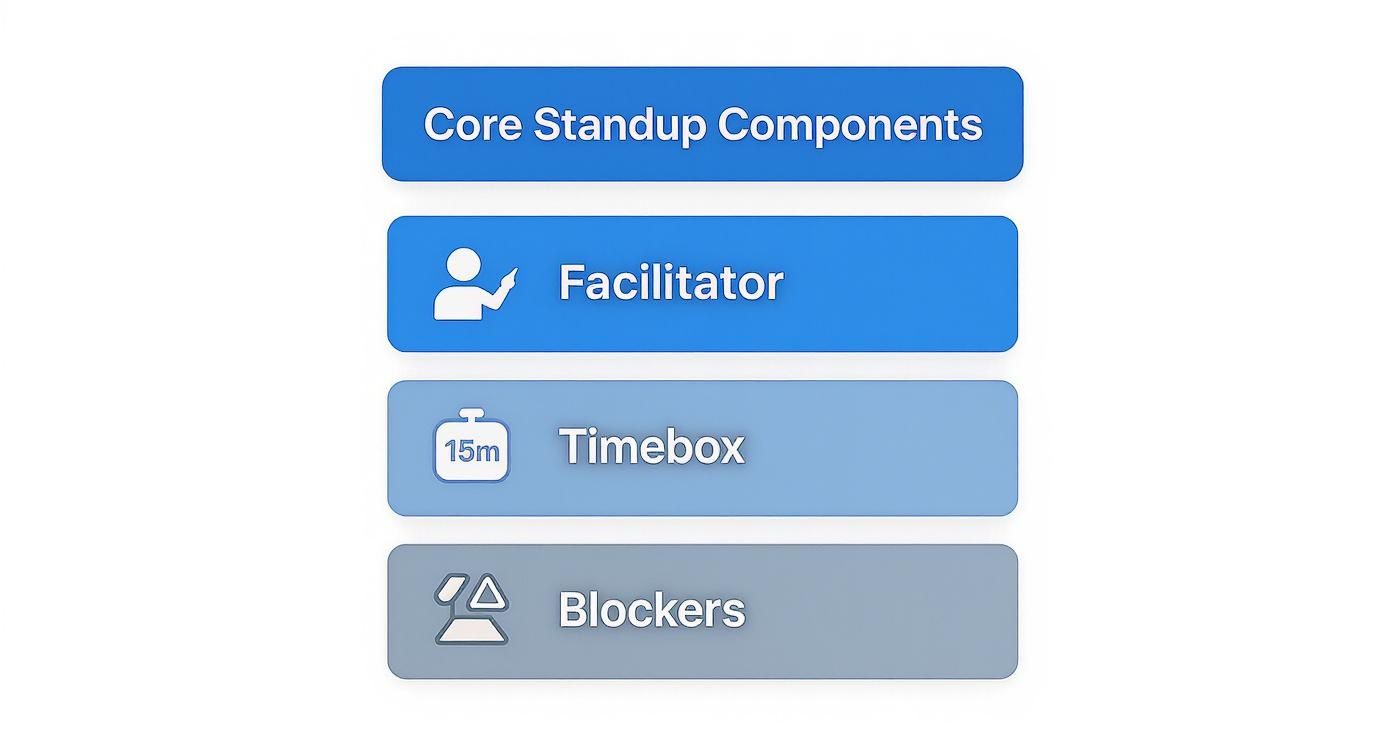
This really nails it. You need someone steering the ship (the facilitator), a hard stop to keep it brief (the timebox), and a clear way to call out for help (the blockers). These are the non-negotiables. Now, let’s see how they work in different team setups.
Template for Co-Located Teams
When everyone's in the same room, a physical task board is your best friend. There's something powerful about seeing progress on a whiteboard with sticky notes; it makes the work feel real and gives everyone a single point of focus.
- Prompt 1: What did you move to 'Done' yesterday? This question is brilliant because it centers the conversation on actual completed work, not just "being busy."
- Prompt 2: What will you move to 'In Progress' today? This signals clear intentions and lets teammates know where they might be able to jump in and collaborate.
- Prompt 3: What's blocking you from moving a card? Framing it this way ties the blocker directly to the workflow, making it specific and much easier to solve.
Sample Update: "Yesterday, I moved the user authentication ticket to 'Done.' Today, I'm grabbing the password reset feature. I'm blocked right now because I'm waiting on the new API credentials from the backend team."
That simple act of moving a physical note gives a little jolt of satisfaction and reinforces that sense of shared progress. Of course, a great board is just one piece of the puzzle; you can learn more about how to craft perfect meeting agendas to streamline your workday.
Template for Synchronous Remote Teams
When your team is spread out but online at the same time, the big challenge is to capture the focus of an in-person huddle over a video call. This template is all about fighting off that dreaded "Zoom fatigue" with sharp, engaging updates.
- Prompt 1: Yesterday's Highlight: What was the most significant thing you accomplished?
- Prompt 2: Today's Priority: What's the one critical task you'll tackle today to push our sprint goal forward?
- Prompt 3: Current Blockers: Any roadblocks slowing you down? Technical, informational, or otherwise?
Pro-Tip: Don't go around the virtual room in the same order every day. Change up who starts the round-robin. It keeps everyone on their toes because they never know when their turn is. A "cameras on" culture also helps immensely with picking up on non-verbal cues and just feeling more connected. If you need a solid framework to prep, this daily meeting preparation template is easily adaptable for any standup.
Template for Asynchronous Teams
For teams scattered across wildly different time zones, a live meeting is usually out of the question. This is where async standups in tools like Slack or Microsoft Teams become an absolute necessity. The whole game here is to make written updates crystal clear and easy to scan.
- Yesterday's Progress: (A quick summary, always with links to tickets or docs)
- Today's Plan: (A bulleted list of your top 1-2 priorities)
- Blockers & Needs: (Tag the specific people you need help from, like "@Maria, could you take a look at this PR?")
Sample Update (Slack):
:white_check_mark: Yesterday: Shipped the final designs for the new dashboard.
:arrow_forward: Today:
- Start wireframing the user profile page.
- Sync with the content team on microcopy.
:rotating_light: Blockers: I need access to the latest user research findings. @David, can you please share the link?
This approach lets everyone check in at the start of their day, which means no more forcing people into super early or late calls. As a bonus, it creates a searchable, written log of what's happening day-to-day.
Adapting Templates for Hybrid Work Realities

Let's be honest: the classic daily standup, with everyone huddled around a single whiteboard, just doesn't cut it anymore. Forcing that old model onto a hybrid team is a recipe for disaster. It creates a communication gap that can easily make remote team members feel like they're on the outside looking in.
The truth is, a one-size-fits-all approach is doomed to fail. Flexible work is here to stay—a recent Gallup report found that a staggering 77% of companies now operate on a remote or hybrid model. We have to adapt our practices to this new reality, moving away from a reliance on everyone being in the same room at the same time. The goal is to avoid "digital presenteeism," where people feel pressured to be constantly online rather than doing deep, productive work.
Choosing the Right Format for Your Team
First things first, you need to decide on the best format for your crew. The choice between synchronous, asynchronous, or a mix of both really boils down to your team's unique setup, especially how spread out you are across different time zones.
- Synchronous (Video Call): This is your best bet for teams with good time zone overlap. It keeps the real-time, conversational vibe of a classic standup, but you need a strong facilitator to keep it tight and ensure everyone—especially remote folks—gets a chance to speak.
- Asynchronous (Written Updates): If your team is scattered across the globe, this is the way to go. Trying to find a meeting time that works for everyone is a nightmare. This format requires everyone to be clear and concise in their writing to prevent any confusion.
- Hybrid Blend: Some of the most effective teams I've seen use a mix. For instance, they might do three async check-ins via Slack or email each week and then hop on two video calls to connect on a deeper level and ensure everyone is aligned.
Whatever you choose, the key is consistency. Getting into a good rhythm is half the battle. Brushing up on general remote work productivity tips can also give your team an extra edge.
Fostering Psychological Safety Across Locations
One of the biggest pitfalls of a hybrid model is the "office-first" bias. Side conversations happen, decisions get made in the hallway, and remote colleagues are left completely out of the loop. A great hybrid standup actively fights against this.
It needs to be a space where every single person feels safe and empowered to speak up, particularly when they're blocked.
The goal of a hybrid standup isn't just to sync on tasks; it's to intentionally bridge the physical distance between team members and reinforce that you are one cohesive unit, regardless of location.
This puts extra responsibility on the facilitator. They have to be vigilant about calling on remote participants and making sure their input is valued just as much as someone's in the office. Mastering asynchronous communication enhances team productivity and builds that inclusive culture. Without this foundation of trust, no daily standup meeting template will ever truly succeed.
Get Real Data Into Your Daily Standup
Let’s be honest, most standups are based on feelings and memory. It’s time to move beyond subjective status updates and start having data-informed strategic conversations. When you bring objective metrics into your syncs, you get a much clearer picture of what's actually happening. Discussions shift from "I think" to "the data shows."
This approach does a few powerful things. It helps confirm progress, shows you where the team's effort is really going, and shines a light on hidden bottlenecks before they turn into full-blown fires.
Instead of guessing why a task is dragging, you can pull up real activity data and have a productive conversation. Imagine a developer says a key feature is delayed. A quick look at their activity summary might reveal they spent 60% of yesterday getting pulled into unplanned support tickets. Right away, the conversation changes from "why are you behind?" to "how can we better protect your focus time?"
Making Data Something You Can Actually Use
The goal here isn't micromanagement; it's about creating transparency and making smarter, evidence-based decisions together. Data gives you a neutral starting point for a conversation, taking the blame out of the equation and focusing everyone on solutions.
You don't need a mountain of metrics to get started. Focus on a few simple, powerful ones:
- Time Allocation: How much time are we spending on planned project work versus ad-hoc requests or administrative stuff?
- Activity Levels: When is the team most productive? Where do the most interruptions happen?
- Task Progress: How does the reported progress line up against the actual time logged on specific project tickets?
A simple project dashboard can give you these insights in a single glance.
This kind of view makes it easy to see where your team's hours are going in real-time, right against the project budgets you've set.
How This Looks in a Real-World Standup
Let's walk through a common scenario. During a standup, a team member mentions they feel overwhelmed and aren't making headway on their main task. Instead of just noting it down as a blocker and moving on, you can pull up a project time report.
Team Lead: "Thanks for sharing that. I'm looking at the project data from yesterday, and it looks like a lot of time was logged under 'Client Support.' Is that what pulled you away from the main feature?"
That simple, data-backed question completely changes the dynamic. It opens the door for a real conversation about workload, shifting priorities, and how the team can rally to support them. A vague feeling of being "stuck" becomes an actionable problem everyone can help solve.
The focus moves from individual performance to systemic issues, which helps build a much more supportive and effective team culture. An easy way to make this a habit is to use a daily standup meeting template that includes a quick "data review" point right at the start.
Common Standup Mistakes to Avoid
Even with the perfect daily standup meeting template, some surprisingly common bad habits can turn a productive huddle into a total waste of time. I've seen it happen countless times. Knowing what these pitfalls look like is the first step to dodging them.
The most common mistake I see is what I call the "status report trap." This is when team members stop talking to each other and start reporting their updates directly to the manager. The whole point of the meeting—peer-to-peer collaboration—just evaporates. It quickly becomes a series of one-on-one reports with an audience, completely missing the goal of alignment and collective problem-solving.
The Problem-Solving Quicksand
Another classic momentum killer is on-the-spot problem-solving. A developer mentions a tricky bug, and suddenly two other engineers jump in, trying to debug it right then and there. While their hearts are in the right place, it completely derails the meeting for everyone else and blows the 15-minute timebox out of the water.
A standup is for identifying blockers, not resolving them. The goal is to flag the issue and figure out who needs to sync up after the meeting to crush it.
This distinction is absolutely crucial. A good facilitator needs to gently but firmly step in. Something as simple as, "That's a great point. Can you two connect on that right after this?" keeps the meeting moving while making sure the problem gets the focused attention it needs.
Re-Engaging a Checked-Out Team
If you look around and see people staring at their phones, multitasking, or giving vague, one-word updates, you have a problem. It's a dead giveaway that the standup has lost its value and feels more like a chore than a strategic huddle.
When you notice this happening, it's time to shake things up. Here are a few things that work wonders:
- Vary the order: Don't go around the room in the same sequence every single day. Mixing it up forces everyone to pay attention so they know when it's their turn.
- Focus on goals: Try shifting the language. Instead of asking "What did you do yesterday?" ask, "How did your work yesterday move us closer to our sprint goal?" This ties individual tasks directly to the bigger picture.
- Celebrate small wins: Take a moment to acknowledge when a major blocker is cleared or a tough task gets shipped. A little positive reinforcement can go a surprisingly long way.
Your Daily Standup Questions Answered
We’ve walked through the templates, the pitfalls to avoid, and how to bring real data into the mix. But a few practical questions always pop up when teams are dialing in their standup rhythm. Let's tackle them head-on.
What Is the Best Time for a Standup?
Most teams default to the beginning of the day, and for good reason—it helps everyone align on what’s ahead. But honestly, the "best" time is whatever works for your team's workflow and time zones.
The specific hour on the clock matters less than one simple rule: hold the meeting consistently every single day. That's how you build the muscle memory and make it a reliable part of the team's routine.
How Do You Handle Someone Who Talks Too Long?
We've all been there. Someone starts diving deep into a technical problem, and suddenly five minutes have evaporated. A good facilitator has to be ready to gently jump in.
Simple phrases like, "That's a really important point. Can you and I sync up right after this to dig into it?" work wonders. It validates their contribution without letting the 15-minute timebox get hijacked.
A pro tip: have a visible timer running during the standup. It’s a simple, non-verbal cue that helps everyone self-regulate and stay concise without the facilitator having to constantly play timekeeper.
Ready to stop guessing and start knowing? DeskCove gives you the hard data you need to turn your standups from subjective status reports into strategic, evidence-based conversations. Start your free DeskCove trial today and see the difference for yourself.