How do you stay focused at work: Tips to beat distractions

Staying focused in today's workplace isn't about sheer willpower. It’s about building a smart system to protect your attention. The real key is to get ahead of the distractions by managing your environment, structuring your day, and guarding your mental energy.
Let's walk through a game plan for taking back control and finally getting your best work done.
Understanding the Pillars of Modern Workplace Focus
The struggle to stay focused is real, especially with digital pings and the blur of remote work. But the data shows we're adapting. A report on workplace trends found something interesting: while the average workday got shorter than pre-remote times, overall productivity actually went up.
This tells us that people, especially remote workers who often gain extra productive minutes a day, are figuring out new ways to concentrate.
To build a focus routine that actually sticks, you need to think about it like a structure supported by four essential pillars. Get these right, and everything else falls into place.
The Four Pillars of Workplace Focus
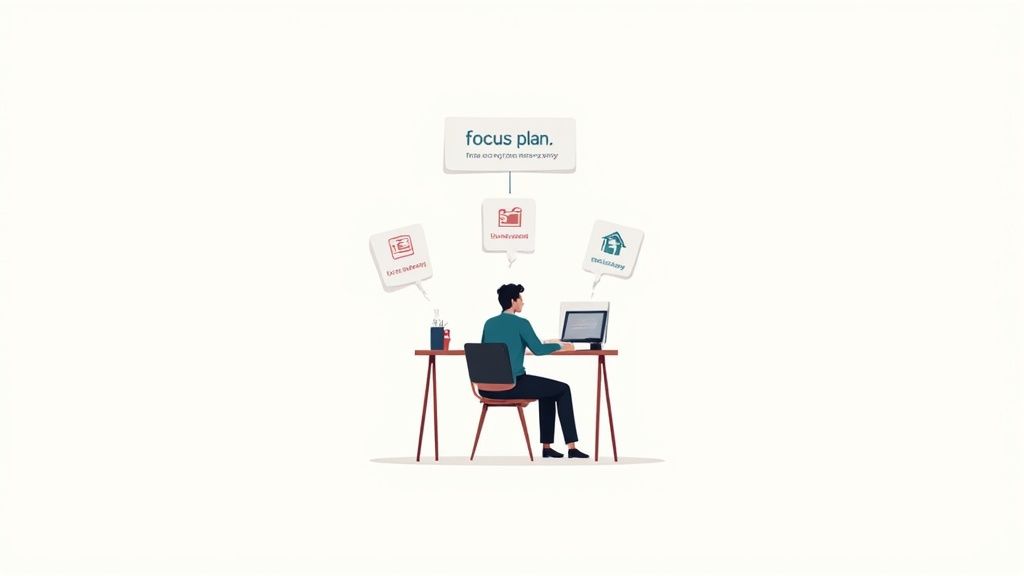
To truly improve your ability to concentrate, you need a balanced approach. Neglecting one area can cause the others to crumble. Here's a quick breakdown of the four pillars you need to manage.
| Pillar | Key Objective | Example Action |
|---|---|---|
| Environment | Minimize external distractions | Declutter your physical and digital workspaces. |
| Task Management | Bring clarity and order to your workload | Use a method like time blocking to assign specific tasks to specific times. |
| Attention | Protect your mental energy from internal noise | Practice single-tasking instead of multitasking. |
| Well-being | Recharge your cognitive resources | Take scheduled short breaks away from your screen. |
By addressing each of these pillars, you shift from just reacting to distractions to building a proactive system designed for deep work. This isn't about finding a single magic "hack," but creating an interconnected strategy that supports your biggest goals. For a deeper dive, you can explore proven tips and strategies to boost energy and focus that tie into your physical well-being.
The goal is to design a workflow where focus becomes the default state, not something you constantly have to fight for. This shift in perspective makes sustained concentration achievable.
Ultimately, mastering focus means taking intentional control over these elements. In the next sections, we'll get into the weeds with actionable steps for each pillar, helping you turn these concepts into a daily reality.
Designing Your Workspace for Deep Concentration
Your ability to focus isn't just about willpower; it's heavily influenced by your surroundings. A messy desk or a screen buzzing with notifications is a constant, low-grade drain on your concentration, chipping away at your mental energy whether you realize it or not.
By consciously engineering your physical and digital spaces, you can make deep work the default setting, not a rare exception. This isn't just about being tidy—it's about reducing the number of tiny decisions your brain has to make. When your space is clear, your mind has a much better chance of following suit.
Taming Your Physical Environment
First things first: carve out a dedicated work zone. Even if it's just a small corner in your living room, this simple act creates a powerful psychological boundary. It sends a clear signal to your brain that when you're in this spot, it's time to lock in and concentrate.
Keep only the absolute essentials on your desk—your computer, a notebook, maybe a pen. Everything else needs a home, preferably out of sight.
This idea of dedicated spaces is gaining traction in office design, too. The Gensler Global Workplace Survey found that as more people return to the office for collaboration, they place a high value on having access to quiet zones for focused work. The most effective employees are those who can easily switch between group settings and private areas. You can dig into more insights from the Gensler workplace report to see how office layouts directly impact focus.
Another game-changer? Noise. A good pair of noise-canceling headphones can create an instant bubble of concentration, no matter how chaotic your environment gets.
Key Takeaway: A well-designed workspace minimizes the friction between you and your tasks. The goal is to make focusing feel effortless by removing the visual and auditory clutter that’s always competing for your attention.
Optimizing Your Digital Workspace
Your digital environment is just as critical, if not more so. A desktop littered with random files or an inbox bursting with unread messages creates a ton of mental noise. Getting a handle on this digital chaos is fundamental to protecting your focus.
Here are a few things you can do right now:
- Silence Non-Essential Notifications: Turn off the pings and pop-ups from email, Slack, and social media. You can’t get into a state of flow if you're constantly being interrupted. Schedule specific times to check these apps instead.
- Organize Your Desktop: A clean desktop is like a clean slate for your mind. Create a simple folder system for your files and stick to it.
- Use Browser Blockers: Tools like StayFocusd or Freedom are brilliant for creating forced periods of deep work by temporarily blocking distracting websites.
If you really want to go deep on this, we've put together a full guide on how to declutter your digital space for a huge productivity boost.
Tools like RescueTime can also give you the hard data on where your digital time is really going.
Seeing a clear breakdown of your digital habits is often the wake-up call you need. The data doesn't lie. Once you identify your biggest time-wasters, you can start making conscious choices to reclaim your focus.
Mastering Your Tasks with Strategic Planning
Ever feel like you’re just reacting to your day instead of running it? That’s what happens when you don’t have a plan. A vague, endless to-do list is a recipe for scattered focus, leaving you busy but not actually effective.
Strategic planning isn’t about making more lists. It’s about creating a clear roadmap for your day, giving every single task a purpose and a place. This is how you shift from constantly putting out fires to making real, meaningful progress on what matters.
Choosing Your Focus Framework
There’s no single "best" way to organize your day; different methods click with different people. The trick is finding a system that fits your natural workflow instead of trying to force a square peg into a round hole.
Several proven techniques are designed specifically to sharpen your focus at work. Finding the right one for you can be a game-changer.
Not sure where to start? Every focus method has its own strengths. Some are great for creatives who need long stretches of uninterrupted time, while others work best for managers juggling multiple projects.
Here's a quick comparison of a few popular techniques to help you find your fit:
Comparing Popular Focus Techniques
| Technique | Best For | Core Principle |
|---|---|---|
| Pomodoro Technique | Creatives, developers, and anyone tackling large, daunting projects. | Work in short, intense 25-minute bursts followed by a 5-minute break. This cycle prevents burnout and maintains high energy levels. |
| Time Blocking | Managers, executives, and people with meeting-heavy schedules. | Assign every task—from deep work to checking emails—a specific time slot in your calendar. This creates a finite plan for your day. |
| Eisenhower Matrix | Leaders, project managers, and anyone feeling overwhelmed by their to-do list. | Categorize tasks based on urgency and importance to prioritize what truly needs your immediate attention and what can wait. |
The key is to experiment. Try one method for a week, see how it feels, and don't be afraid to switch if it isn't clicking. The best strategy is the one you can stick with.
For example, the Pomodoro Technique is brilliant for breaking down massive projects into manageable chunks. If you're staring at a huge report that feels impossible, working in 25-minute sprints makes it feel much less intimidating. Want to give it a try? We have a complete guide on how to maximize productivity with the Pomodoro Technique.
Another powerful approach is time blocking. This is where you literally schedule everything—deep work, email catch-up, even lunch—directly into your calendar. It turns your day into a visual game plan and eliminates the constant "what should I do next?" mental drain.
The most effective strategy is the one you can stick with consistently. Experiment with these methods to see which one brings the most clarity and control to your workflow, making it easier to maintain deep focus.
Prioritizing What Truly Matters
Let's be honest: not all tasks are created equal. A huge part of mastering your workload is learning to separate what feels urgent from what is genuinely important. This is exactly what the Eisenhower Matrix was designed for.
It’s a simple but incredibly effective decision-making tool that helps you sort tasks into four clear categories:
- Urgent & Important: These are your top priorities. Do them now.
- Important, Not Urgent: These are your long-term goals. Schedule time to work on them.
- Urgent, Not Important: These are distractions. Delegate them if you can.
- Not Urgent & Not Important: These are time-wasters. Get rid of them.
Using this framework forces you to be ruthless about what deserves your attention. It helps you identify which activities are actually moving the needle and which are just filling up your day. Once you know your true priorities, you can dedicate your peak energy—usually the first 90 minutes of your workday—to tackling them head-on.
When you feel your focus slipping, the first step is always to identify the source of the distraction. Only then can you find the right solution.
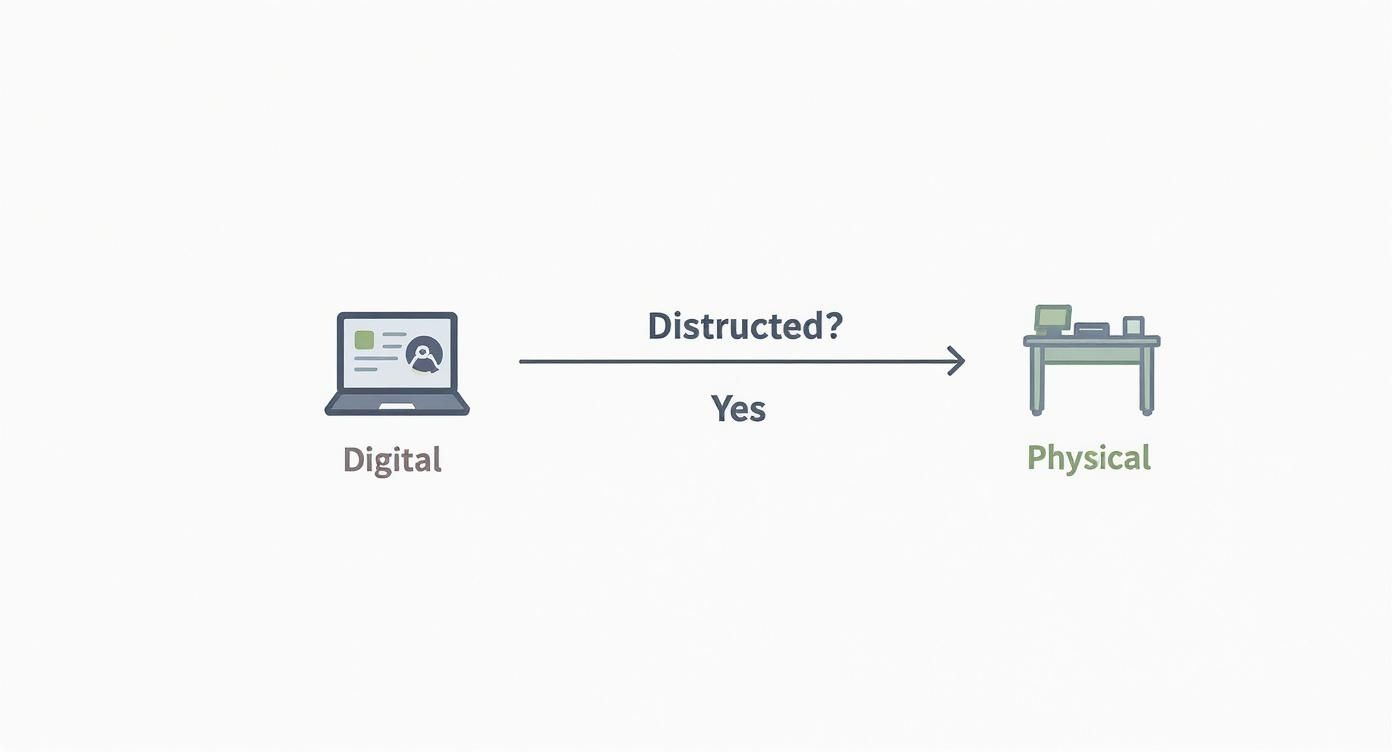
This simple visual reminds us that before we can fix the problem, we need to know if it's coming from our digital world or our physical space. By systematically planning your tasks and prioritizing with intention, you create an unstoppable momentum that keeps you in the driver's seat all day long.
Protecting Your Attention as Your Most Valuable Asset
We’ve all been sold a lie about productivity. It isn’t about cramming more tasks into your day. True, sustainable productivity comes directly from how well you manage your energy and, more importantly, your attention.
It’s time to stop thinking of focus as an infinite resource you can just tap into whenever you want. Instead, treat it like your most valuable—and most fragile—asset.
When you’re feeling scattered, pulled in a dozen different directions, the real problem usually isn't a lack of time. It's that your mental and emotional batteries are completely drained. Protecting your attention is the single most strategic investment you can make in your career.
The Myth of Multitasking
For years, the ability to juggle multiple tasks was worn like a badge of honor. But we now know the truth: multitasking is a productivity-killer. When you try to do multiple things at once, you aren't actually doing them simultaneously. You're forcing your brain to switch contexts at a frantic pace.
This constant gear-shifting creates something called "attention residue." Thoughts about the last thing you were doing linger and bleed into your focus on the new task. The antidote? A full commitment to single-tasking. Dedicate your complete attention to one thing at a time. This is how you build momentum, find your flow, and produce work you're actually proud of.
The real cost of multitasking isn't just lost time; it's a significant drop in the quality of your thinking and the output you produce. By committing to one task, you give your work the full cognitive power it deserves.
The Non-Negotiable Role of Strategic Breaks
Nobody can maintain intense focus for hours on end without a break. It's just not how our brains are wired. Trying to "power through" mental fatigue is a surefire way to burn out and watch your performance nosedive. Strategic breaks aren't a luxury; they're a biological necessity for recharging your cognitive batteries.
And I'm not talking about a two-hour lunch. Even short, deliberate pauses can make a world of difference.
- Take a five-minute walk: Get up, step away from your screen, and move your body. It's a fantastic mental reset.
- Try a quick mindfulness exercise: Just close your eyes for a minute or two and focus on your breathing. It's amazing how quickly this can calm a racing mind.
- Use the 20-20-20 rule: Every 20 minutes, look at something 20 feet away for 20 seconds. This is a simple but powerful way to combat digital eye strain. To really protect your attention, check out a practical guide on how to reduce eye strain, as it's a huge physical barrier to concentration.
Ignoring these small opportunities to recover is a common mistake that quietly sabotages your day. For more ideas, read our guide on overcoming distractions at work.
Prioritizing Mental Well-Being
Your ability to concentrate is built on the foundation of your mental health. When you're wrestling with burnout, stress, or anxiety, focus is one of the first casualties. The data on this is impossible to ignore.
According to research on mental health at work, a staggering number of workers have dealt with at least one mental health challenge, and many have left a job specifically for mental health reasons.
On the flip side, companies that actively support their employees' mental wellness see a boost in engagement—a metric directly linked to better focus and performance.
Using Smart Tools for Better Focus and Accountability
Let’s be honest: willpower alone isn't always enough to win the battle for focus. In a world full of digital noise, the right technology can be your best defense. Instead of just trying harder, you can build systems that actively fence off your attention for deep work. These tools give you the structure and feedback you need to turn good intentions into solid habits.
Think of it this way—you wouldn't build a house without a blueprint and a measuring tape. So why try to build better focus habits without knowing where your time and attention are actually going?
Gaining Clarity Through Data
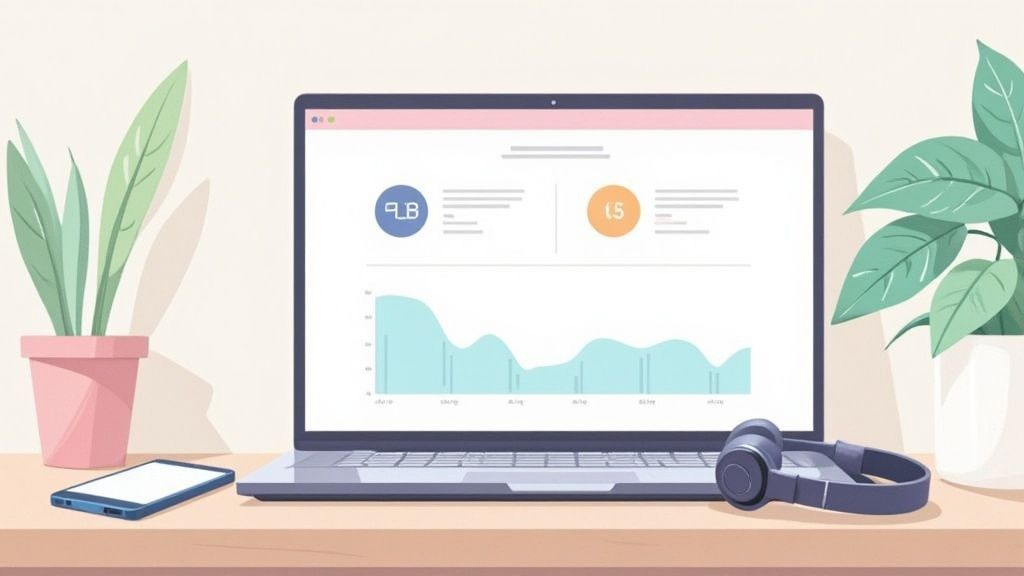
The first step to sharpening your focus is getting a clear, honest picture of your day. Productivity tools that track your activity—like which apps you use and for how long—give you an unbiased look at your work habits. This isn't about micromanagement; it's about self-management.
Most people are shocked to find out that a "quick five-minute" social media check is actually a 30-minute black hole in their schedule. Seeing this kind of data laid out in a report is a real eye-opener. It helps you answer the crucial questions behind how do you stay focused at work:
- When am I really in the zone? Pinpoint your peak energy windows so you can tackle your toughest tasks when your brain is firing on all cylinders.
- What are my biggest time-wasters? Is it a specific news site, a chatty Slack channel, or the constant urge to check email? Naming your distractions is half the battle.
- How much deep work am I actually doing? The data might reveal that only a tiny fraction of your day is spent on the high-value work that moves the needle.
This clarity turns productivity from a fuzzy concept into something you can actually measure and improve.
Building Accountability and Better Habits
Once you see the data, you can start building systems to hold yourself accountable. This is where tools that combine tracking with active focus features really shine. For instance, you can set up "focus sessions" with app and website blockers to physically prevent you from slipping into your known distraction traps.
By turning your focus goals into a measurable process, you create a feedback loop. You can see your progress over time, which reinforces positive habits and gives you the motivation to keep going.
Solutions like DeskCove are built to support this entire process. By logging the time you spend on productive tasks, it offers clear insights into your work patterns without being intrusive. This data isn't just for managers—it's a powerful tool for your own self-improvement.
You can look at your activity logs and see if your planned time blocks actually happened. Did that "one-hour" project really stretch to three? This honest feedback helps you create more realistic schedules and manage your time way more effectively.
Ultimately, using the right tools turns focus from a wish into a skill. They give you the structure to block out the noise, the data to understand your own habits, and the accountability to make real, lasting improvements.
Still Struggling to Focus? Let's Tackle Some Common Problems
Even when you have a solid plan, the reality of the workday can throw you a curveball. Knowing how to handle the most common focus-killers is what separates a productive day from a frustrating one. Let's dig into some of the questions I hear most often and find some practical solutions for those tough situations.
How Can I Handle Constant Interruptions?
Constant interruptions are the arch-nemesis of deep work. The only way to win is by setting and defending clear boundaries.
If you’re in a physical office, a "do not disturb" sign or a good pair of headphones are universal signals that you're in the zone. Don't underestimate how effective these simple cues can be.
For remote teams, your digital status is your best friend. Set your Slack or Teams status to "Focusing" to head off non-urgent pings. It also helps to proactively tell your team your focus schedule, like, "Heads up, I'm going dark on a project until 2 PM." And never be afraid to politely say, "I'm deep in something right now, can I get back to you in an hour?" You're not being rude; you're protecting your most valuable asset—your attention.
What If I Work in a Noisy Open-Plan Office?
Ah, the open-plan office. Great for collaboration, a nightmare for concentration. If your office doesn't have dedicated quiet zones, your best bet is to create your own personal bubble.
Noise-canceling headphones are a non-negotiable investment here. You don't have to blast music; listening to ambient sounds, white noise, or instrumental tracks can effectively drown out the chaos and signal to others that you're unavailable.
Another smart move is to work with the office's natural rhythm, not against it. Try to schedule your most demanding tasks for times when the office is naturally quieter. That could mean coming in a little early, staying a bit late, or using that lunch hour when everyone else is out.
The real problem with focus at work often isn't a lack of individual effort. It's an environment that's actively hostile to concentration. Before you try to fix everything yourself, consider if there are bigger issues at play, like a culture of constant interruptions or an unsustainable workload. Sometimes, the root cause is systemic, not personal.
How Do I Regain Focus After a Distraction?
Getting sidetracked happens to everyone. It’s not about preventing it entirely, but about how fast you can get back on track.
Keep a "distraction notepad" on your desk—physical or digital. When a random thought or to-do pops into your head ("Oh, I need to email Susan!"), just jot it down to handle later. This simple act acknowledges the thought, so your brain can let it go without derailing what you're currently doing.
If you get pulled away completely by a coworker or an urgent message, take just 60 seconds to reset before diving back in. Close your eyes, take a few deep breaths, and mentally clear the slate. Then, quickly glance over what you were just working on to re-engage your brain. That tiny pause makes a huge difference in avoiding the frustration of being interrupted and helps you find your flow again much faster.
By getting a real handle on your work patterns and daily habits, you can build a routine that actually supports focus. DeskCove gives you the data you need to see what's working, hold yourself accountable, and finally turn those focus goals into a consistent reality. Learn more about how DeskCove can help you master your workday.