8 Essential Performance Review Examples for Managers in 2025

Moving beyond the generic "good job" is one of the biggest challenges managers face during review season. The right framework can transform a dreaded administrative task into a powerful tool for motivation, clarity, and genuine professional development. This guide is designed to provide you with the specific language and structure needed to conduct more meaningful, impactful, and fair performance reviews. We're getting straight to the point, offering concrete examples and actionable phrases you can adapt and use immediately.
This is not just another list of bland comments. We will break down eight distinct performance review models, providing strategic insights for each. You will find a comprehensive collection of performance review examples tailored to different scenarios, from holistic 360-degree feedback to data-driven OKR evaluations. The goal is to equip you with the tools to deliver feedback that is specific, evidence-based, and forward-looking. To ensure performance reviews genuinely foster growth, it's beneficial to align feedback with the skills employees need for future advancement. Understanding the top skills for career promotion can help managers frame their comments in a way that prepares team members for their next career step.
Whether you're a new manager looking for a starting point or an experienced leader aiming to refine your approach, this article provides the resources you need. We'll explore various review types, including:
- 360-Degree Feedback
- OKR-Based Reviews
- Continuous Performance Management
- Competency-Based Evaluations
- Self-Directed and Project-Based Reviews
Let's dive into actionable examples that you can use to elevate your team and turn performance conversations into catalysts for success.
1. 360-Degree Feedback Review
A 360-Degree Feedback review is a comprehensive performance evaluation method that moves beyond the traditional top-down manager assessment. It gathers confidential, anonymous feedback from a circle of sources surrounding the employee, including their manager, peers, direct reports, and sometimes even external clients or stakeholders. This multi-rater approach provides a holistic, well-rounded view of an employee's skills, behaviors, and impact on the organization.
The core strength of this method lies in its ability to uncover blind spots. A manager sees one aspect of performance, but peers witness collaboration firsthand, and direct reports experience leadership style directly. By aggregating these perspectives, the 360-Degree review offers a richer, more accurate picture than any single source could provide. This makes it an invaluable tool for leadership development and identifying specific areas for growth.
How 360-Degree Feedback Works
The process is structured to ensure confidentiality and focus on constructive development rather than critique. It typically involves standardized questions tied to specific competencies, such as communication, teamwork, and problem-solving. This structured approach allows for the aggregation of data into a clear, actionable report.
Below is an infographic illustrating the streamlined workflow of a typical 360-degree feedback process, from initial data collection to the final development report.
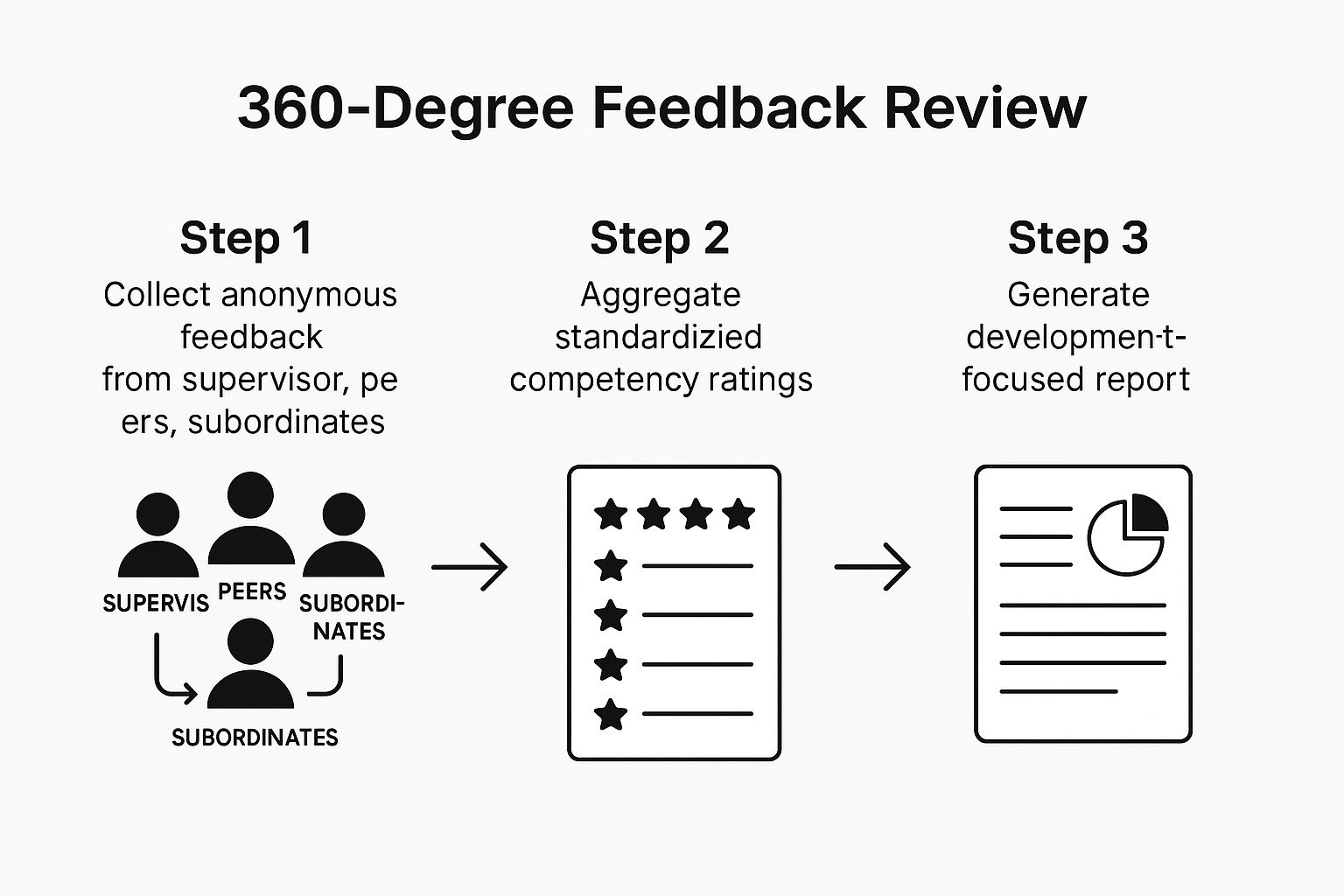
This visual flow underscores the system's methodical progression from broad, multi-source data collection to a focused, individualized development plan.
Actionable Tips for Implementation
To successfully implement a 360-Degree review system, consider these key strategies:
- Prioritize Development: Frame the entire process as a tool for professional growth, not punishment. This positioning is crucial for gaining employee trust and ensuring honest participation.
- Ensure Anonymity: Guaranteeing the confidentiality of all raters is non-negotiable. Use a trusted third-party platform or a secure internal system to protect identities and encourage candid feedback.
- Train Participants: Don't assume everyone knows how to give effective feedback. Provide training on how to be specific, constructive, and objective, focusing on behavior rather than personality.
Companies like General Electric and Microsoft have famously used this method to cultivate strong leadership pipelines, demonstrating its effectiveness in large-scale talent development initiatives. By adopting these performance review examples, you can create a culture of continuous improvement and self-awareness.
2. OKR-Based Performance Review
An OKR-Based Performance Review is a modern, goal-centric evaluation method that aligns individual and team performance directly with overarching company objectives. It uses the Objectives and Key Results (OKRs) framework, a system for setting ambitious goals with measurable results, as the foundation for assessment. This approach shifts the focus from subjective opinions to objective, data-driven conversations about an employee’s contributions and impact.
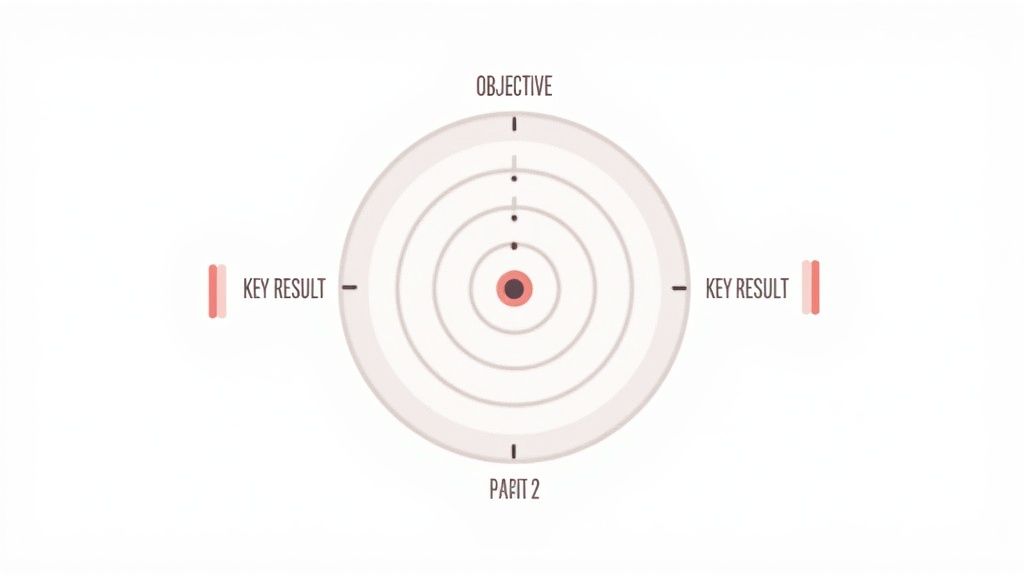
The primary advantage of this model is its inherent transparency and alignment. Employees understand exactly how their work contributes to the bigger picture, which fosters a sense of purpose and engagement. Instead of a backward-looking critique, the OKR review becomes a forward-looking dialogue about achievements, challenges, and future goals, making it a powerful tool for continuous improvement and strategic execution.
How OKR-Based Performance Reviews Work
This system works by setting clear, ambitious goals (Objectives) and defining specific, measurable outcomes (Key Results) at the beginning of a performance cycle, typically a quarter. The performance review then centers on discussing the progress and final achievement of these KRs. The conversation is not just about whether a goal was met but also about the learnings, obstacles, and adjustments made along the way.
The structure ensures that performance discussions are grounded in concrete evidence rather than vague impressions. This method, popularized by companies like Intel and Google, transforms the performance review from a subjective assessment into a strategic conversation. You can learn how to master objectives and key results to improve your business success.
Actionable Tips for Implementation
To effectively implement an OKR-based review system, focus on clarity and culture:
- Decouple from Compensation: Separate discussions about OKR achievement from salary and bonus decisions. This encourages employees to set ambitious "stretch" goals without fear of financial penalty if they fall short, fostering a culture of innovation.
- Aim for 70% Achievement: Treat a 70% completion rate on ambitious OKRs as a success. Consistently hitting 100% may indicate that the goals are not challenging enough.
- Coach, Don't Judge: Train managers to act as coaches, not just evaluators. The review should be a collaborative dialogue focused on problem-solving and future growth.
Companies like Adobe have successfully replaced traditional annual reviews with a similar continuous check-in system inspired by OKR principles. By adopting these performance review examples, organizations can create a more agile, transparent, and goal-oriented performance culture.
3. Continuous Performance Management
Continuous Performance Management is a modern, agile approach that replaces the traditional, often dreaded, annual review. Instead of a single yearly event, it emphasizes ongoing, dynamic conversations, regular feedback, and real-time performance discussions. This system prioritizes coaching, employee development, and a swift response to changing business needs through frequent, meaningful touchpoints between managers and their teams.
The core strength of this method is its proactivity. By fostering a constant dialogue, managers can address issues as they arise, recognize achievements in the moment, and adjust goals in alignment with evolving business priorities. This creates a more supportive, forward-looking culture where performance improvement is a shared, continuous journey rather than a backward-facing judgment. It transforms performance management from a bureaucratic task into a strategic tool for engagement and growth.

How Continuous Performance Management Works
The process is built around a consistent rhythm of communication, such as weekly check-ins, quarterly goal-setting, and ad-hoc feedback. It moves away from ratings and rankings, focusing instead on qualitative, future-focused conversations. Technology often plays a key role, providing platforms for documenting discussions, tracking progress against goals, and facilitating feedback requests.
The video below offers insights into how this shift in mindset can redefine workplace dynamics and employee development.
This ongoing cycle ensures that by the end of the year, there are no surprises, as performance has been discussed and managed collaboratively all along. You can learn more about the specifics of Continuous Performance Management here.
Actionable Tips for Implementation
To successfully adopt a continuous performance management model, focus on these key strategies:
- Establish a Rhythm: Schedule consistent and predictable check-ins, such as weekly or bi-weekly one-on-ones. This regularity makes feedback a normal part of the work week.
- Train Managers to Coach: Shift the role of managers from judges to coaches. Provide training on how to ask powerful questions, listen actively, and give constructive, forward-looking feedback.
- Use Simple Frameworks: Implement lightweight, structured frameworks for conversations to guide discussions and ensure they remain productive and focused on development goals.
- Leverage Technology: Use tools to document conversations, track goals, and facilitate real-time feedback. This creates a seamless record of progress without heavy administrative work.
Companies like Deloitte and Accenture have famously pivoted to this model, eliminating annual rankings to foster a culture of continuous learning and development. By incorporating these performance review examples, you can build a more agile, responsive, and employee-centric organization.
4. Competency-Based Performance Review
A Competency-Based Performance Review is a structured evaluation method that assesses employees against a set of predefined skills, knowledge, and behaviors crucial for success in their role and within the organization. Rather than focusing solely on task completion or goals met, this approach measures how an employee achieves results, providing a clear and consistent framework for performance. It links individual performance directly to the organization's strategic objectives and values.
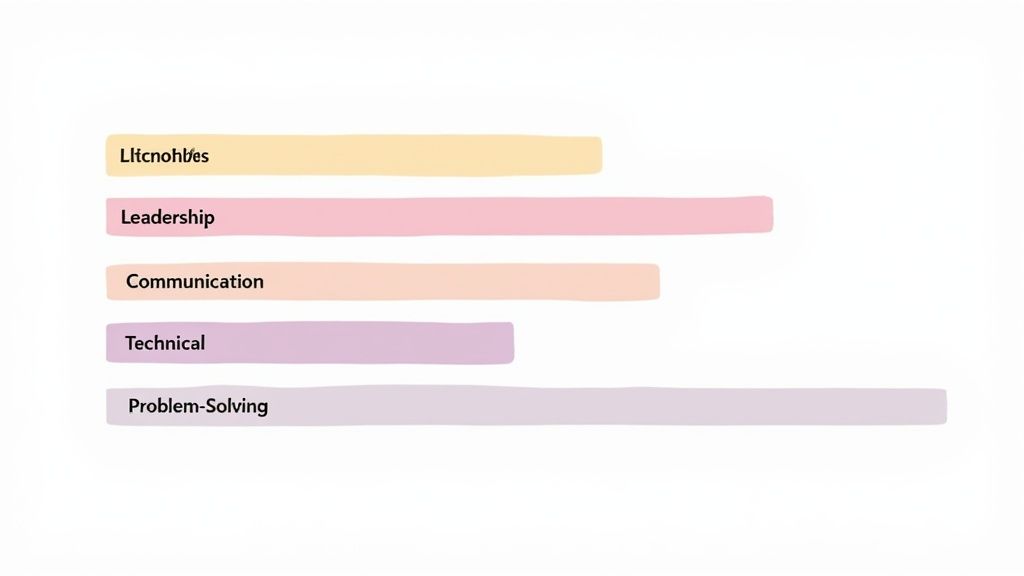
The power of this method lies in its clarity and objectivity. By defining what "good" looks like through specific behavioral indicators, it removes ambiguity from the evaluation process. This not only makes assessments fairer but also creates transparent career development pathways. Employees understand exactly which skills they need to cultivate to advance, making it a powerful tool for talent management and succession planning.
How Competency-Based Reviews Work
The process begins with defining core competencies for the organization and specific competencies for different roles or levels. These competencies, such as "Strategic Thinking" or "Customer Focus," are broken down into observable behaviors. During a review, both the manager and the employee assess performance against these defined behaviors, often using a rating scale.
This systematic approach ensures that all employees are evaluated using the same consistent criteria, reducing bias and promoting fairness. The resulting feedback is highly specific, helping employees create targeted development plans that align with organizational needs. This structure provides some of the most useful performance review examples because the feedback is directly tied to actionable behaviors.
Actionable Tips for Implementation
To build an effective competency-based review system, consider these essential strategies:
- Define Relevant Competencies: Work with subject matter experts and leadership to identify and define the competencies that truly drive success in your organization. Ensure they are aligned with your company's mission and strategic goals.
- Use Behavioral Indicators: For each competency, create clear, specific examples of behaviors for different proficiency levels (e.g., novice, proficient, expert). This helps managers rate performance accurately and consistently.
- Link to Development: Connect the competency framework to learning and development resources. If an employee needs to improve their "Communication" skill, provide them with access to relevant courses, mentors, or project opportunities.
Companies like Unilever and PwC have successfully implemented competency frameworks to develop leaders and ensure professional standards. Unilever's model focuses on leadership skills for growth, while PwC's framework outlines the capabilities professionals need at every stage of their career, demonstrating the system's scalability and strategic impact.
5. Self-Directed Performance Review
A Self-Directed Performance Review is an employee-centric evaluation approach where individuals take the lead in assessing their own performance. This method empowers employees to set their own goals, reflect on their achievements and challenges, and identify specific areas for professional development. The manager's role shifts from a traditional evaluator to that of a coach, guide, and facilitator, fostering a culture of personal ownership and intrinsic motivation.
The primary strength of this model is its ability to build employee engagement and accountability. When individuals are responsible for driving their own review process, they become more invested in the outcomes and their personal growth. It encourages deep self-reflection, which can uncover motivations and aspirations that a top-down review might miss, leading to more meaningful and personalized development plans.
How a Self-Directed Performance Review Works
The process is built on trust and a clear framework that enables employees to conduct a thorough self-assessment. It typically involves structured templates or guiding questions that prompt reflection on successes, obstacles, and future goals, aligned with broader company objectives. The employee then presents this self-evaluation to their manager, sparking a collaborative dialogue focused on support and resource allocation rather than judgment.
The goal is to move the conversation from "How did you do?" to "How can we best support your growth and impact?" This fosters a forward-looking perspective.
Actionable Tips for Implementation
To successfully implement a Self-Directed Performance Review system, consider these key strategies:
- Provide Structured Templates: Equip employees with clear, consistent self-assessment templates. These should guide them to reflect on key performance areas, successes, learnings, and future goals, ensuring their evaluations are comprehensive and aligned with organizational standards.
- Establish Clear Expectations: While the process is employee-driven, it must be anchored to clear company-wide performance standards and expectations. This provides a benchmark for self-assessment and ensures fairness.
- Train for Self-Reflection: Teach employees how to conduct an honest and objective self-review. Workshops on identifying biases, articulating achievements with data, and framing development needs constructively are essential for the process to be effective.
Companies like Buffer and Morning Star Company have pioneered self-management models where employee-driven evaluations are core to their operations. By adopting these performance review examples, organizations can foster a powerful sense of autonomy and personal responsibility.
6. Project-Based Performance Review
A Project-Based Performance Review is an evaluation method that ties an employee’s assessment directly to their contributions and outcomes on specific projects. Instead of focusing on generalized, year-long job responsibilities, this approach measures performance against project-specific goals, deliverables, and team dynamics. It is particularly effective in agile, consulting, creative, and technology environments where work is organized around discrete, time-bound initiatives.
The core strength of this model is its immediacy and relevance. Performance is evaluated in the context of tangible work, making feedback specific, timely, and directly linked to business outcomes. It shifts the conversation from abstract competencies to concrete contributions, providing a clear line of sight between an individual's efforts and the project's success. This makes it a powerful tool for recognizing impact and identifying skill gaps in a dynamic work setting.
How Project-Based Performance Reviews Work
This process is designed to capture performance data as projects conclude, ensuring that feedback is fresh and accurate. The review typically involves input from the project manager, team members, and sometimes the client, focusing on both the "what" (the outcomes) and the "how" (the process and collaboration). It evaluates skills demonstrated within the context of the project's unique challenges.
The system is built on a cycle of setting clear upfront goals, executing the project, and then conducting a post-mortem review that feeds into the employee’s overall performance record. This creates a continuous feedback loop that supports incremental skill development.
Actionable Tips for Implementation
To successfully implement a Project-Based review system, consider these key strategies:
- Establish Clear Success Criteria: Define what success looks like for each project before it begins. Outline key performance indicators (KPIs), deliverables, and behavioral expectations so everyone understands the evaluation benchmarks.
- Capture Individual and Team Contributions: Design the review to assess both personal accountability and collaborative effectiveness. Use a mix of self-assessment, peer feedback, and project lead evaluation to get a complete picture.
- Balance Outcomes with Process: A successful outcome achieved through a dysfunctional process is not a total win. Evaluate not just the final deliverable but also the employee's communication, problem-solving, and teamwork along the way.
Firms like McKinsey & Company and tech companies like Atlassian use project-based evaluations to maintain high standards of delivery and foster a culture of continuous learning. By adopting these performance review examples, organizations can create a more agile and results-oriented appraisal system.
7. Peer Review Performance System
A Peer Review Performance System is a collaborative evaluation approach where colleagues at a similar organizational level assess one another's performance. This method moves away from a purely managerial assessment, leveraging the unique insights of those who work alongside an employee daily. It focuses on gathering feedback about work habits, teamwork, communication, and overall contribution from those with direct, hands-on experience.
The fundamental advantage of this system is its ability to provide a ground-level perspective. While a manager oversees outcomes, peers witness the process, the collaborative spirit, and the day-to-day behaviors that lead to those results. This makes it an incredibly powerful tool for fostering accountability, improving team dynamics, and providing a more complete view of an individual's impact.
How Peer Review Systems Work
The process is designed to be structured and constructive, centering on shared experiences and observable behaviors. It typically uses standardized forms or questions that guide colleagues to provide specific, relevant feedback on areas like reliability, problem-solving, and communication within the team. This structure ensures fairness and helps aggregate feedback into meaningful development points.
For organizations considering a peer-based approach, understanding how to conduct peer reviews effectively is crucial for a fair and impactful system. It helps ensure the feedback is both constructive and well-received.
Actionable Tips for Implementation
To successfully implement a peer review system, consider these essential strategies:
- Establish Clear Guidelines: Provide specific criteria for what constitutes constructive feedback. Focus on observable, work-related behaviors and contributions, not personal opinions, to keep the process objective.
- Ensure Confidentiality: While not always fully anonymous like a 360 review, create a psychologically safe environment where peers feel they can be honest without fear of reprisal. This is key to getting authentic feedback.
- Provide Training: Coach employees on both giving and receiving peer feedback. Training should cover how to be specific, focus on impact, and frame comments constructively to encourage growth. Integrating these reviews with tools like top employee scheduling software can help align feedback with project timelines and workloads.
Tech companies like GitHub and Basecamp have popularized this method to enhance their flat, collaborative cultures, proving its value in fast-paced, team-oriented environments. By incorporating these types of performance review examples, you can foster a culture of mutual respect and shared responsibility.
8. Results-Only Performance Review
A Results-Only Performance Review is an evaluation system that focuses exclusively on measurable outcomes and achievements, deliberately ignoring traditional metrics like hours worked, time in the office, or specific work processes. This approach grants employees maximum autonomy and flexibility, holding them accountable for what they accomplish, not how or when they do it.
The core strength of this model is its direct link between an employee's contributions and business objectives. It strips away subjectivity and focuses squarely on tangible results, making it an excellent fit for roles where output is easily quantifiable. By emphasizing deliverables, it fosters a culture of ownership, empowerment, and accountability, as employees are trusted to manage their own time and methods to meet clear, predefined goals.
How a Results-Only Review Works
The process is built on a foundation of clearly defined, mutually agreed-upon goals and metrics. Instead of assessing behaviors, managers and employees collaborate to set specific, measurable, achievable, relevant, and time-bound (SMART) objectives. The performance conversation then centers on progress against these targets, problem-solving barriers to success, and setting future goals based on past outcomes.
This framework shifts the manager's role from a supervisor to a coach, who provides resources and removes obstacles rather than micromanaging tasks. Performance is judged on the successful delivery of results, which is a key reason this is one of the more straightforward performance review examples to implement in certain environments.
Actionable Tips for Implementation
To successfully implement a Results-Only Performance Review system, consider these key strategies:
- Establish Crystal-Clear Metrics: Define what success looks like for each role using unambiguous quantitative and qualitative measures. These criteria must be agreed upon by both the manager and the employee from the outset.
- Balance Individual and Team Goals: While individual results are paramount, ensure they don't come at the expense of team collaboration. Incorporate metrics that reflect an employee's contribution to collective success.
- Regularly Calibrate Expectations: Business priorities shift, so goals and metrics must be reviewed and adjusted regularly. This ensures the review process remains relevant and fair, accounting for any external factors that might impact performance.
This model was famously pioneered by Best Buy with its Results-Only Work Environment (ROWE) and is a core tenet of Netflix's high-performance culture. It is also the standard in most sales organizations where performance is tied directly to quotas and revenue targets, demonstrating its effectiveness in driving measurable business success.
Performance Review Methods Comparison
| Performance Review Method | Implementation Complexity 🔄 | Resource Requirements ⚡ | Expected Outcomes 📊 | Ideal Use Cases 💡 | Key Advantages ⭐ |
|---|---|---|---|---|---|
| 360-Degree Feedback Review | High: multi-source coordination and admin | High: time-intensive, training | Holistic, unbiased performance insights | Leadership development, comprehensive growth | Well-rounded perspective, bias reduction |
| OKR-Based Performance Review | Moderate: requires cultural shift and training | Moderate: ongoing check-ins | Clear alignment with company goals, measurability | Goal-driven organizations, fast-paced teams | Objective criteria, transparency, agility |
| Continuous Performance Management | Moderate to High: needs manager commitment and training | Moderate: tech tools and coaching | Timely feedback, agile development | Dynamic environments, frequent feedback needs | Increased engagement, reduced admin burden |
| Competency-Based Performance Review | High: develop and maintain frameworks | High: expert involvement, regular updates | Clear standards, targeted development | Structured roles, career progression paths | Consistent, fair assessments |
| Self-Directed Performance Review | Low to Moderate: relies on employee capability | Low to Moderate: training and templates | Increased ownership and self-awareness | Empowered employees, trust-based cultures | Engagement boost, reduces manager workload |
| Project-Based Performance Review | Moderate: project-specific criteria setup | Moderate: documentation and feedback | Outcome-focused, flexible evaluation cycles | Project-driven, consulting, creative sectors | Ties performance to tangible deliverables |
| Peer Review Performance System | Moderate: needs trust and clear guidelines | Moderate: training and moderation | Insights on teamwork and collaboration | Teams with flat structures or strong collaboration | Reduces hierarchy bias, promotes peer learning |
| Results-Only Performance Review | Moderate: metric development and tracking | Moderate to High: data systems | Objective, outcome-centric evaluation | Remote work, sales, metric-driven roles | Clear standards, supports flexible work |
Implementing a Fair and Effective Review System in Your Organization
Driving real change with performance review examples hinges on more than picking a model. It depends on building a feedback culture that is consistent, transparent, and growth-oriented. Use the insights shared throughout this article to tailor a system that fits your team’s unique needs and goals.
Summary of Key Insights
- Combined approaches outperform siloed models
• Blending competency frameworks with continuous feedback delivers both structure and agility - Role-specific comment templates boost relevance
• Customize examples for project managers, freelancers, and remote teams - Data-driven reviews limit bias
• Objective metrics from tools give managers clear evidence
“Effective reviews are anchored in clear expectations, ongoing dialogue, and measurable outcomes.”
Strategic Highlights
- 360-Degree Feedback Review
- Offers diverse perspectives
- Encourages peer accountability and leadership growth
- OKR-Based Performance Review
- Aligns individual results with company goals
- Fosters a results mindset without micromanagement
- Continuous Performance Management
- Moves feedback from an annual event to a regular habit
- Improves responsiveness and fast-tracks development
- Competency-Based Performance Review
- Focuses on skill mastery and behavioral indicators
- Helps identify training needs precisely
“When you combine real-time feedback with clear competency benchmarks, every review becomes a coaching opportunity.”
Actionable Next Steps
- Audit Your Current Process
- Identify gaps in fairness, frequency, and relevance
- Define Clear Competencies and Goals
- Use role profiles to establish what success looks like
- Integrate Continuous Feedback Loops
- Schedule regular touch points rather than one-off meetings
- Leverage Objective Data
- Explore best practices on how to measure work performance to ground discussions in facts
The Value of Mastering These Concepts
- Improved Engagement and Retention
• Clear, fair reviews build trust and reduce turnover - Enhanced Productivity
• Focused feedback drives actionable improvements - Scalable Growth
• A repeatable process lets you ramp up teams faster
Bringing It All Together
Implementing a fair and effective review system is a journey, not a checklist. By combining strategic analysis, tactical insights, and actionable templates from this article, you’ll:
- Create a culture of continuous improvement
- Empower managers with clear, replicable strategies
- Equip employees to own their development
Remember that true impact comes from adapting these performance review examples to your organization’s culture. Start small, iterate often, and watch your team reach new heights of accountability and achievement.
Ready to streamline your performance reviews with objective data and user-friendly dashboards? Discover how DeskCove can enrich your process with actionable productivity insights. Learn more at DeskCove.