Mastering Project Scope Creep Management
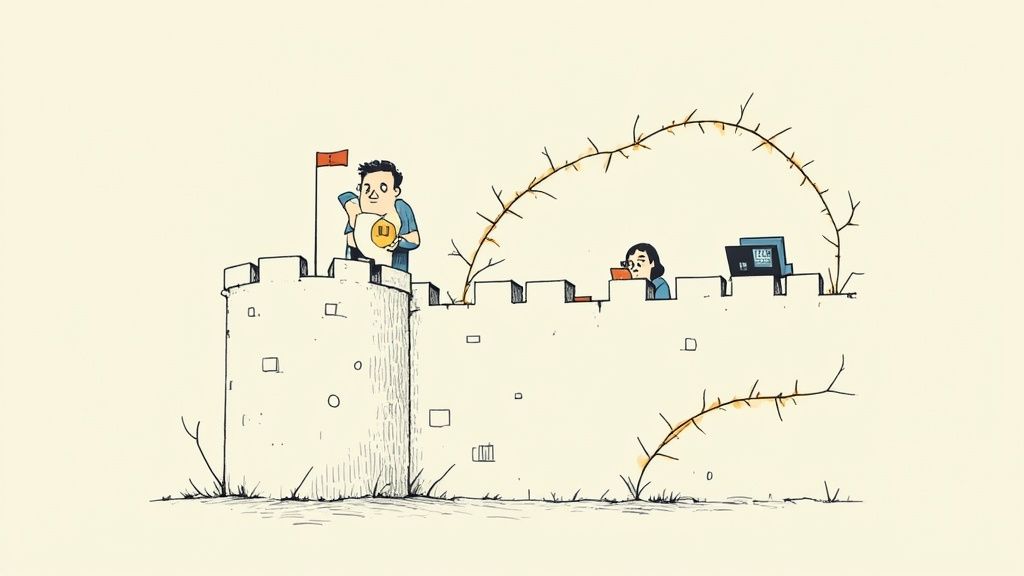
Managing scope creep is really about controlling a project's growth after it's already started. You have to set firm boundaries, create a rock-solid process for any changes, and keep the lines of communication wide open. Without these things, you'll get bogged down by unplanned work that absolutely wrecks your timelines and budgets.
The Hidden Costs of Unchecked Scope Creep

Let's be real—scope creep isn't some minor inconvenience. It's more like a project-killing disease. Before we jump into how to stop it, we need to get a handle on the true damage it causes. This goes way beyond just blowing the budget or missing a deadline; the ripple effects are far more destructive.
When changes aren't controlled, they quietly push projects toward failure. This is an alarmingly common scenario. In fact, global studies have found this uncontrolled expansion of project goals happens in approximately 47% of projects worldwide. That makes it a massive factor in why so many projects miss their deadlines or go over budget. You can dig deeper into these worldwide project management insights from recent studies.
Beyond Budgets and Deadlines
The most obvious victims of scope creep are the project's budget and timeline. Every "small" addition eats up resources—hours, materials, and money—that were never part of the plan. These little additions pile up, leading to serious financial overruns and pushing delivery dates further and further out.
But the damage runs much deeper than that. Think about these hidden consequences:
- Declining Quality: When your team is rushed to squeeze in new features without getting more time, they’re forced to cut corners. Maybe testing gets skipped, or solutions are patched together haphazardly. The result is a final product that's buggy, unstable, or just doesn't meet quality standards.
- Strained Client Relationships: It often starts with trying to please a client by saying yes to a "quick" request. But that can sour the relationship fast. When you finally have to address the impact on cost and time, it leads to difficult conversations, unmet expectations, and a total loss of trust.
- Reduced Team Morale: Nothing burns out a team faster than constantly moving goalposts. When the finish line keeps shifting, motivation plummets. Your team starts to feel like their hard work is being taken for granted, which leads to frustration, burnout, and a pretty toxic project environment.
A project without clear boundaries is like a ship without a rudder. It might move forward, but its destination is left entirely to chance and the changing tides of stakeholder whims.
The Snowball Effect in Action
Picture a straightforward website development project. The client initially asks for a basic five-page informational site. A week into development, they casually suggest, "Could we just add a small blog section?" It sounds simple enough, so the team agrees.
Two weeks later, the next request comes: "The blog is great, but it really needs a comment section." Again, the team adds it. Soon after, another email arrives: "Can we add social media sharing buttons to each post and integrate an email newsletter signup?"
Each of these requests seems minor on its own, but together, they've completely transformed the project's complexity.
The original timeline is now a distant memory. The budget is stretched thin from all the extra development hours. The team is demoralized, working overtime to catch up on work that was never supposed to be part of the plan. This is the classic snowball effect of scope creep, and it perfectly illustrates why proactive project scope creep management isn't just a best practice—it's an essential survival kit for any project manager.
Building Your First Line of Defense Against Scope Creep

The best way to deal with scope creep is to stop it before it even starts. This means building a fortress of clarity around your project from day one. If you don't, you're basically leaving the door wide open for uncontrolled changes to wander in and wreak havoc.
A strong foundation is everything. It all begins with meticulously detailed documents that act as your project's constitution. These aren't just formalities; they're the reference points you'll come back to again and again when new requests inevitably pop up.
Crafting an Ironclad Statement of Work
Your Statement of Work (SOW) is much more than a simple project summary. It's a binding agreement that lays out the entire scope. A vague SOW is a direct invitation for scope creep to take hold, so you need to get granular with the specifics.
Think of it this way: instead of saying "develop a new user dashboard," a rock-solid SOW would say something like, "Develop a user dashboard with three core widgets: 'Recent Activity,' 'Performance Metrics,' and 'Account Settings.' The dashboard will be accessible from the main navigation and will not include real-time chat functionality." See the difference? That level of detail leaves no room for misinterpretation.
The Power of Defining What's Out of Scope
One of the most powerful, yet often forgotten, tools you have is the "Exclusions" section of your SOW. Clearly stating what the project will not include is just as important as defining what it will. This move single-handedly shuts down stakeholder assumptions before they can cause trouble.
For instance, if you're building a mobile app, your exclusions list might include items like:
- No offline mode: The application will require an active internet connection to function.
- No tablet optimization: The initial release is designed exclusively for smartphone devices.
- No third-party payment gateway integrations: All payments will be handled via the existing web portal.
Defining these boundaries prevents that dreaded "Oh, I just assumed it would…" conversation later on. It sets firm guardrails that protect your team and manage client expectations from the very beginning. To learn more about this, check out this great guide on how to define project scope effectively.
Breaking It Down with a Work Breakdown Structure
Once the SOW defines what you're building, the Work Breakdown Structure (WBS) details how you'll actually do it. The WBS deconstructs the project’s big deliverables into smaller, more manageable tasks and work packages. It creates a clear, visual map of everything that needs to get done.
This process is critical because it forces everyone—you and your stakeholders—to think through every single component of the project. If a new request doesn't fit logically anywhere in the WBS, it’s a huge red flag that it’s probably outside the original scope.
To keep your project on track, it's essential to have clear, agreed-upon documentation from the start. Below is a table outlining the key documents that form your first line of defense.
Key Prevention Documents and Their Purpose
| Document | Primary Purpose | Key Elements to Include |
|---|---|---|
| Statement of Work (SOW) | To create a binding agreement on project deliverables, timelines, and responsibilities. | Project objectives, detailed deliverables, timelines, payment terms, and a clear list of exclusions. |
| Work Breakdown Structure (WBS) | To break down large project deliverables into smaller, manageable tasks. | A hierarchical decomposition of all the work to be executed by the project team. |
| Project Charter | To formally authorize the project and provide the project manager with authority. | High-level project goals, key stakeholders, initial risks, and summary budget. |
| Change Control Plan | To define the process for managing and approving changes to the project scope. | Change request forms, evaluation criteria, approval workflow, and communication plan. |
These documents are not just bureaucratic hurdles; they are your best tools for maintaining control and ensuring a successful project outcome.
The Final Step: Formal Sign-Offs
No scope document is truly complete until it has been formally signed off by all key stakeholders. This simple act transforms the document from a plan into a firm commitment. It serves as confirmation that everyone has read, understood, and agreed upon the project's boundaries.
A formal sign-off creates shared accountability. When a new request comes in, you can pull out the signed SOW and ask, "Where does this fit within the scope we all agreed to?" This shifts the conversation from a subjective debate to an objective review of the facts.
Implementing a Practical Change Control Process
Look, even the most watertight project plan is going to spring a leak. Change is inevitable. The real trick isn't stopping change from happening—it's managing it so it doesn't sink the whole project. A practical change control process is your playbook for this. It gives you a structured, predictable way to handle new requests, turning what could be chaos into a managed opportunity.
This isn't about wrapping your project in red tape that grinds everything to a halt. It’s about setting up a simple, transparent system that everyone on the team—and every stakeholder—understands and respects. A good process protects the project's scope, timeline, and budget while still being flexible enough to allow for smart adjustments.
The Core of Change Control: A Simple Request Form
The bedrock of any solid process is a standardized change request form. Think of this simple document as the single, official gateway for any new ideas or requests once the project has kicked off. It does something brilliant: it forces stakeholders to actually think through their ideas and gives your team the consistent info needed to evaluate them properly.
Your form doesn't need to be some monster spreadsheet. It just needs to capture the essentials:
- Request Details: What’s the change? Why is it needed now? Get a clear, concise description.
- Business Justification: How does this actually help the project or the business? What’s the real value here?
- Requestor Information: Who is asking for this, and what's their role in the project?
- Priority Level: Is this a "the-project-fails-without-it" kind of change, or is it more of a "nice-to-have"?
By funneling everything through this form, you immediately put a stop to those informal, "hey, can you just…" requests that are the primary source of undocumented scope creep.
Assigning a Clear Approver
Once a request is officially submitted, it needs a clear destination. Who has the final say? On smaller projects, this might just be the project sponsor or product owner. Easy.
But for larger, more complex initiatives, you’ll probably want to set up a Change Control Board (CCB). This is just a small group of key stakeholders who can look at a request from all angles—the client, the tech lead, the business analyst. Their job is to review the requests and make a smart call based on the project's overall goals, not just one person's opinion. Having a designated approver or a board kills the confusion and ensures decisions are made with care, not on a whim.
This infographic lays out the basic flow. It’s a clean, logical path from a new idea to a final decision.
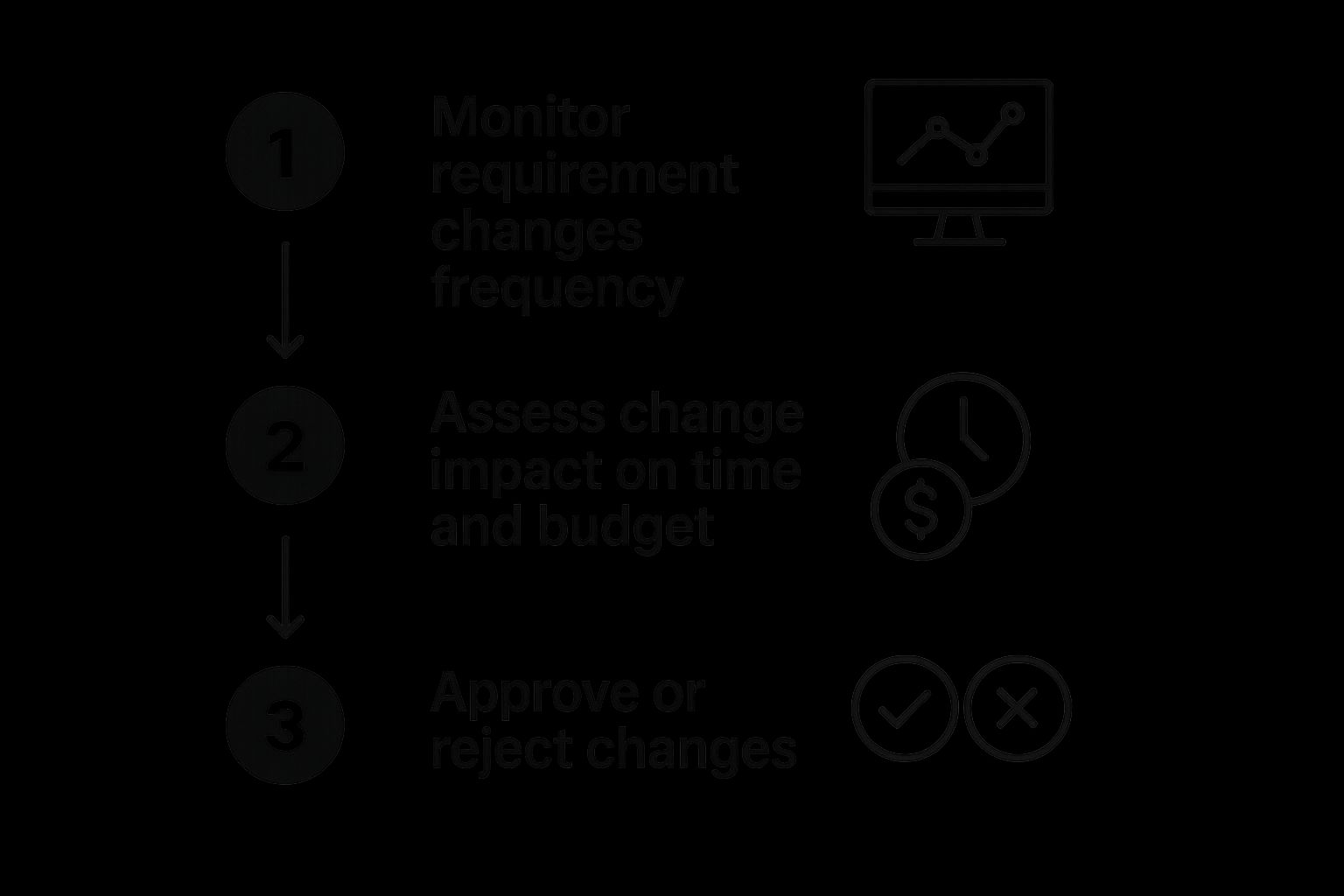
As you can see, a disciplined approach is everything. You monitor the requests, you assess their impact, and you make a formal, documented decision. That’s the core of managing scope creep effectively.
Assessing the True Impact
With a formal request in hand, the next step is a proper impact analysis. This is where your team digs in to figure out the true cost of the change. You need to look at it across three dimensions: time, budget, and quality.
You have to get objective answers to these questions:
- How many extra hours or people will this really take?
- What’s the hard cost of this new work?
- How does this mess with our timeline and our key deadlines?
- Does this introduce any risks to the quality or stability of what we've already built?
This analysis is what arms the approver or the CCB with the data they need to make an intelligent decision. It shifts the conversation from a vague "Can we do this?" to a much more productive "Here is exactly what it will take to do this. Is it worth the trade-off?"
"A change control process transforms scope creep from an enemy into a managed variable. It gives you a lever to control the project's direction, ensuring every adjustment is a conscious choice, not an accident."
Stakeholder engagement and a structured change control process are consistently cited as the most effective ways to fight scope creep. The data is clear: teams that implement a defined process are far better at evaluating and managing new demands without blowing up their budgets and schedules. In fact, organizations that use multiple scope management practices see a measurable drop in scope creep incidents. You can find more insights on improving project outcomes on projectmanagementacademy.net.
Communicating the Process as a Benefit
How you introduce this process to your stakeholders is absolutely critical. You can't just drop a new form on them and expect a warm reception. Frame it as a system designed to protect their investment and guarantee the project's success.
Here's a simple script you can adapt:
"To make sure we deliver the highest possible value and stick to our budget and timeline, we're going to use a straightforward change request process for any new ideas that pop up after we kick things off. This helps us fully evaluate each new request to understand its impact, ensuring we make the best decisions for the project together. It just keeps everything transparent and prevents any surprise delays or costs down the line."
This simple framing positions the process as a collaborative tool, not a bureaucratic roadblock. By putting a lightweight yet firm change control system in place, you create the structure you need to handle the natural evolution of a project without letting it fly off the rails.
Mastering Communication to Manage Expectations

A solid change control process gives you the framework to manage scope, but it's communication that actually makes the system work. More often than not, scope creep doesn’t start with a client trying to get free work. It begins with a simple misunderstanding or a misaligned expectation.
Clear, consistent, and proactive communication is the glue that holds your project boundaries together. This is even more true on remote teams where you can’t rely on a quick hallway chat to stay on the same page.
Your project kickoff meeting is the first—and best—opportunity to draw those firm lines in the sand. This isn't just a meet-and-greet; it’s where you anchor the project's reality for everyone. Take the time to walk stakeholders through the signed Statement of Work (SOW), pointing out what’s "in-scope" and, just as importantly, what’s "out-of-scope." This simple act sets a powerful precedent for every conversation that follows.
Setting the Rhythm of Communication
After that initial kickoff, you need to establish a regular communication cadence to prevent surprises. This rhythm keeps everyone in the loop and gives stakeholders scheduled opportunities to share ideas without derailing the work already in progress. These consistent touchpoints build trust, which makes managing expectations much easier as the project moves forward.
I've found a mix of communication channels works best:
- Weekly Status Reports: A quick email or document summarizing progress against goals, what's coming up next, and any potential risks.
- Bi-Weekly Check-in Calls: Dedicated time for stakeholders to ask questions and for your team to present progress. It keeps everyone aligned on the big picture.
- A Centralized Project Hub: Use a tool where every document, conversation, and update lives. This creates a single source of truth that anyone can refer to.
This structured approach is one of several critical project communication strategies every team must know to keep things running smoothly.
How to Say No Without Damaging Relationships
Let's be honest, one of the toughest parts of managing scope is saying "no" to a client’s request without sounding difficult. The trick is to shift the conversation from a flat-out rejection to a collaborative discussion about priorities and impact.
Instead of a hard "No, we can't do that," try reframing the conversation.
I like to use a "Yes, and…" approach. It acknowledges the value in their idea while gently reintroducing the project's real-world constraints. For example, if a stakeholder asks for a new feature mid-sprint, you could say:
"Yes, that's a fantastic idea that could add a lot of value. And to do it right, we'll need to run it through our change request process to see how it affects our timeline and budget. We can then figure out where to prioritize it for a future phase."
This response validates their input, reinforces the process you agreed on, and protects the current scope—all without creating a conflict. It's a skill worth developing, and investing in effective communication skills training can make a huge difference in how well you navigate these conversations.
The art of project management isn't about preventing all changes. It's about ensuring every change is a conscious, well-informed decision made by the entire team, not just a silent deviation from the plan.
Navigating Difficult Stakeholder Conversations
Learning how to handle tricky conversations is a project manager's superpower. A stakeholder who feels ignored can become a major roadblock, while one who feels heard becomes a partner in finding solutions. The key is to respond constructively, not defensively.
Here’s a quick look at how to turn common problem scenarios into productive conversations.
Navigating Difficult Stakeholder Conversations
| Scenario | Ineffective Response | Effective Response |
|---|---|---|
| The "Idea Machine" adds new features in every meeting. | "We can't keep adding things; we have a plan to follow." | "These are great ideas for V2. Let's add them to our backlog so we don't lose them and can prioritize them after this phase." |
| The Indecisive Committee can't agree on a key decision, stalling progress. | "You all need to figure this out so we can move on." | "To keep us on schedule, we need a final decision by EOD Friday. Here are the pros and cons of each option to help guide the discussion." |
| The Vague Feedback Giver says "I just don't like it" without specifics. | "I need more to go on than that." | "Can you help me understand which specific part isn't working for you? Let's walk through the user journey together." |
By mastering these communication tactics, you shift from being a project administrator to a strategic partner. You'll build trust, maintain control, and guide your project to a successful conclusion with scope creep kept firmly in check.
Using Technology to Monitor and Control Scope
While solid processes and open communication are your first line of defense, the right software is your command center for wrangling scope. In a remote or hybrid setup, technology isn't just a nice-to-have; it's the only way to maintain a single source of truth that keeps everyone on the same page.
Think of modern project management platforms like Asana, Jira, or Monday.com as your best allies in this fight. They do more than just list tasks—they make your project's scope visible, tangible, and trackable in real time. These tools turn your static SOW from a forgotten file into a living dashboard that shows you the project's health, minute by minute.
Leveraging Key Software Features
You don't need to use every single feature a platform offers. The real trick is to focus on the specific functions that act as a security system for your project's boundaries.
Here are the features that give you the most bang for your buck:
- Baseline Tracking: At the very beginning, you can set a "baseline" for the project's scope and schedule. This is basically a snapshot of the original plan. As work moves forward, the software lets you compare your current progress against that baseline, instantly flagging any deviation. Scope creep has nowhere to hide.
- Task Dependencies: This is a simple but powerful one. By linking tasks together (Task B can't start until Task A is done), you create a logical flow. The next time a stakeholder suggests a "quick little addition," the software can visually map out the domino effect on dozens of other tasks and blow the final deadline.
- Centralized Documentation: Forget digging through old emails and chat threads. Your PM tool should be the central hub for all critical documents. Attach the signed SOW and the detailed WBS directly to the project. This ensures everyone is working from the same playbook, and the "I didn't know" excuse goes right out the window.
The biggest win with project management software is that it replaces subjective feelings with hard data. When a debate about scope pops up, you’re no longer arguing about opinions. You’re simply reviewing a clear, undeniable audit trail of every decision and change request.
Creating an Undeniable Audit Trail
This might be the most powerful feature of all: a transparent, automatic audit trail. Every single comment, change request, and approval gets time-stamped and logged without you lifting a finger. This becomes your ultimate defense when someone asks why the project is delayed or over budget.
Picture this: a client completely forgets they asked for three "minor" tweaks two months ago. Instead of relying on your memory, you just pull up the project history. You can show them the exact date of the request, the thread where the team discussed the impact, and the final approval that officially shifted the timeline. It takes all the emotion out of the conversation and brings it back to the agreed-upon process.
Integrating Time Tracking for Full Visibility
If you want an even tighter grip on scope, integrating time tracking is a total game-changer. When your team logs their hours against specific tasks defined in the WBS, you get an incredibly clear picture of where the effort is actually going.
If you suddenly see a bunch of hours piling up on activities that aren't even in the scope, you've just caught scope creep in its earliest, most manageable stage.
This kind of detail gives you invaluable data to work with. To learn more, check out the ultimate guide to project management time tracking software for a deeper dive. By pairing task management with time tracking, you create a feedback loop that constantly checks if your team is working on the right things. This real-time data allows you to have objective, fact-based conversations about any scope adjustments, armed with the evidence you need to protect the project.
Common Questions About Managing Scope Creep
Even with the best game plan, some questions about scope creep always pop up. Let's tackle some of the most common ones I hear from project managers so you can feel more confident in your approach.
What Is The Difference Between Scope Creep And Gold Plating?
It's really easy to mix these two up, but they come from completely different places. Scope creep is almost always an external problem. It’s those “just one more thing” requests from clients or stakeholders that sneak into the project without any formal approval.
Gold plating, on the other hand, is an inside job. This is when your own team members—usually with the best intentions—start adding extra features or polishing things that were never asked for, trying to impress the client. While the motive is different, the result is the same: both burn through time and resources you didn't plan for.
The real distinction is the origin. Scope creep is an external request that bypasses the rules. Gold plating is an internal team decision to add unrequested work.
How Can I Manage Scope Creep In An Agile Project Environment?
Managing scope in Agile feels different, but it’s no less critical. Instead of one massive, rigid scope document upfront, Agile projects live and die by the prioritized product backlog. The absolute key here is to protect the sprint at all costs.
The product owner is the gatekeeper of the backlog. Once a sprint kicks off, that scope is locked in. When new ideas or stakeholder requests come up—and they always do—they aren't just shot down. Instead, they get added to the product backlog. This way, they can be properly vetted and prioritized for a future sprint, not shoehorned into the current one. It’s the perfect way to keep the team focused while still embracing Agile's flexibility.
Is It Ever Acceptable To Allow Scope Creep To Happen?
Let's be clear: uncontrolled scope creep is never okay. However, accommodating a controlled scope change is just smart business. The entire difference boils down to having a formal change control process.
If a client requests something new that adds genuine value, and they formally agree to the updated cost, timeline, and resource needs, that’s not "creep." That’s a planned, approved scope change. The danger is in the steady drip of small, undocumented additions that pile up over time without anyone ever signing off on them.
What's The First Step If I Realize Scope Creep Is Already Happening?
The second you suspect scope creep is happening, your first move is to document everything immediately. Don't wait. Your goal is to get a crystal-clear, objective view of what's going on.
Here’s what to do next:
- Identify the Gaps: Create a detailed list of every single task and feature currently in progress that falls outside the original, agreed-upon scope.
- Quantify the Impact: For each of those out-of-scope items, calculate its effect on the timeline, budget, and team workload. Use real numbers. "This adds 40 hours of development time" is much more powerful than "this will take longer."
- Schedule a Meeting: Once you have the data, get a meeting on the books with the key stakeholders and your project sponsor.
- Present Your Findings: Your job here is to present the facts calmly and objectively. This isn't about blaming anyone. It's about getting everyone back on the same page and formally processing the changes—even if that means putting a change control process in place after the fact.
Effective project scope creep management hinges on setting clear boundaries and having real-time visibility into your team's work. DeskCove gives you the productivity data you need to see exactly where your team’s effort is going, making it simple to spot out-of-scope work before it completely derails your project. Take control of your projects by visiting DeskCove.