How to Prevent Time Card Fraud in Your Business

Let's be honest, time card fraud isn't just about someone making a simple mistake on their timesheet. It's the deliberate act of an employee falsifying their work hours to get paid for time they never actually worked. This inflates payroll costs, sure, but it also chips away at the integrity of your business.
The True Cost of Inaccurate Time Tracking
When you’re looking at your company’s payroll, you probably focus on the big numbers like salaries and taxes. But there's often a hidden expense bleeding money right under your nose: time card fraud.
Think of it less like a major one-time loss and more like a slow, steady leak in your financial plumbing. Each fudged minute or padded hour might seem insignificant on its own, but over time, these little inaccuracies add up to a serious financial drain.
This isn’t just about overpaying for wages, either. The damage ripples through your entire operation, messing with your strategic planning, operational efficiency, and even your company culture. When your time records are off, the very data you need to make smart business decisions becomes completely unreliable.
The Hidden Financial and Operational Burdens
The financial hit from time card fraud goes way beyond just the direct cost of unearned wages. Inaccurate time tracking gives you a completely warped view of your labor costs, which leads to busted project budgets and misleading profit reports. You might be celebrating a project you think is a huge money-maker, when in reality, inflated labor hours are hiding its true cost.
And this problem is getting worse. Take the retail and financial services industries, for example. A 2023 report showed that retail saw a 183% jump in suspected fraud, while financial services were hit with a jaw-dropping 382% surge. Much of this was driven by old tricks like buddy punching and employees tacking on fake overtime.
When time theft goes unchecked, it sends a message that accountability is optional. This erodes trust among honest employees who feel their integrity is undervalued, leading to decreased morale and engagement.
The Impact on Productivity and Morale
Forget the numbers for a second. Inaccurate time tracking is just plain toxic for your work environment. When some people are bending the rules without any consequences, it creates resentment among the employees who are actually being honest and diligent.
This kind of disparity kills team morale and sends productivity into a nosedive as your best people start to disengage.
What’s more, flawed time data makes it impossible to accurately gauge team performance or spot bottlenecks in your workflow. You lose the ability to see which tasks are taking the most time and where you should be putting your resources. Recognizing the real financial drain of time card fraud shows just how important it is to implement broader strategies to reduce operational costs and boost efficiency.
Ultimately, cracking down on time theft isn't just about saving money. It's a critical first step toward building a business with solid financial health, operational integrity, and a fair culture for everyone.
Recognizing Common Time Card Fraud Schemes
Time card fraud isn’t just one single act. Think of it more as a collection of different deceptive tactics that exploit trust, outdated systems, or just plain operational sloppiness. If you want to protect your business, you have to know what you're up against. Understanding the methods employees might use is the very first step toward building a solid defense against these financial drains.
These schemes can be as blatant as coworkers covering for each other or as subtle as an individual fudging a few minutes here and there—time that really adds up. Each method shines a light on a different vulnerability in your timekeeping process.
The image below breaks down the main categories of time card fraud, showing how these deceptive practices are typically carried out.
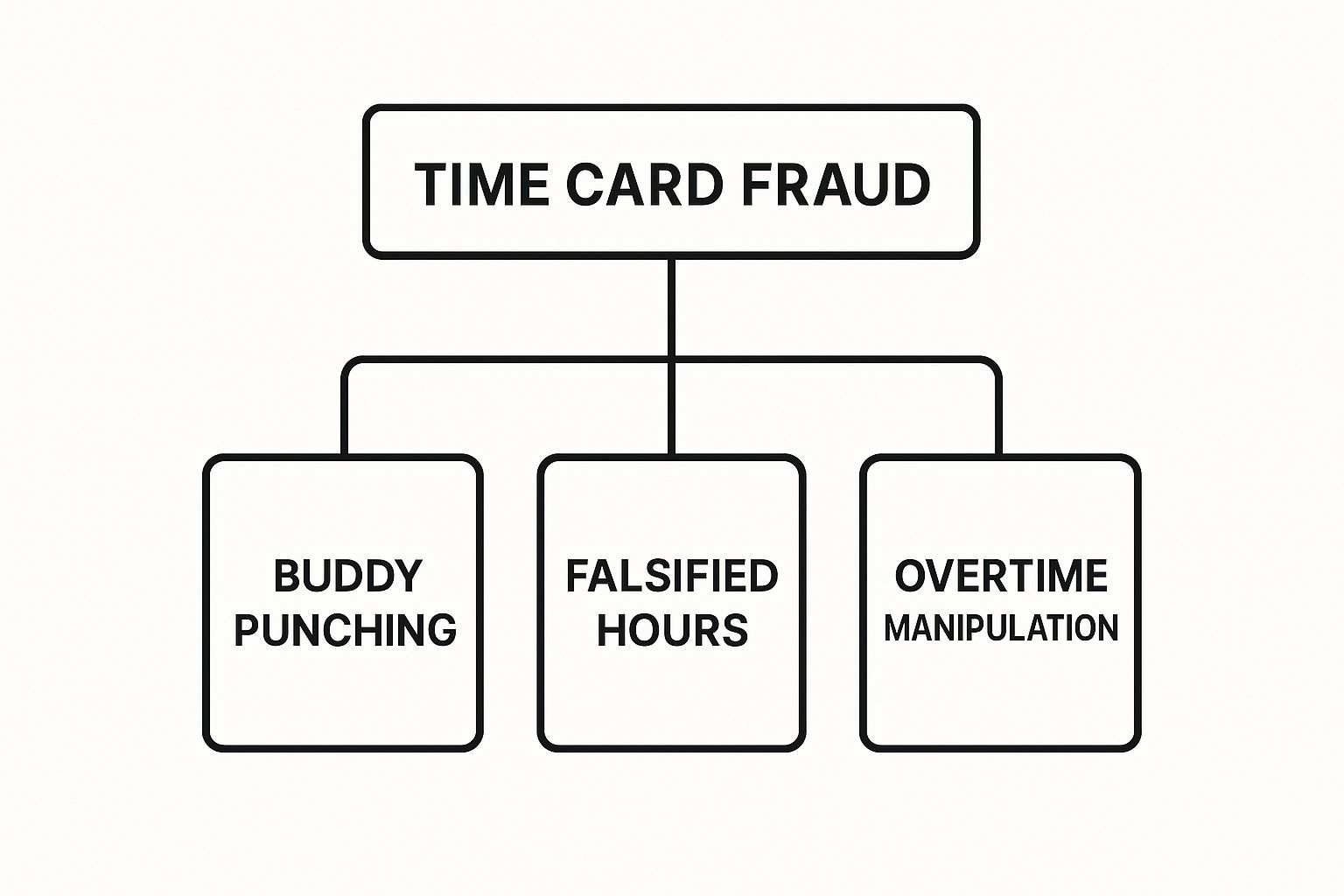
This visual shows how distinct tactics like "buddy punching" and manipulating hours all fall under the larger umbrella of time card fraud, highlighting the most common ways businesses lose money.
To give you a clearer picture, let's break down some of the most common schemes you're likely to encounter. The table below outlines these tactics, what they look like in practice, and the business weaknesses they typically exploit.
Identifying Common Time Card Fraud Tactics
| Fraud Tactic | Description | Vulnerability Exploited |
|---|---|---|
| Buddy Punching | One employee clocks in or out for a colleague who is absent, late, or leaving early. | Lack of identity verification at clock-in/out points (e.g., manual punch cards, shared PINs). |
| Falsifying Hours | Employees inflate their work hours by rounding time, skipping unpaid break clock-outs, or altering manual logs. | Reliance on manual timesheets or honor-based systems without automated checks and balances. |
| Overtime Manipulation | An employee claims overtime for unapproved work or work that was completed during standard hours. | Poor oversight and lack of a formal approval process for all overtime hours. |
| Remote Work Abuse | A remote employee logs a full workday but is only actively engaged for a fraction of that time. | No direct supervision and inadequate tools for verifying remote employee activity and engagement. |
Understanding these specific schemes is the key. Once you can spot the vulnerabilities, you can start putting the right safeguards in place to stop them before they become a major problem.
Buddy Punching: The Collaborative Deception
Buddy punching is probably the most well-known form of time theft. This is when one employee clocks in or out for another who is running late, ducking out early, or just not there at all. It often feels like a harmless favor between friends, but make no mistake—it's direct payroll fraud.
For example, an employee stuck in traffic sends a quick text to a coworker: "Hey, can you punch me in?" Just like that, the company is paying for 15, 30, or even 60 minutes of work that never happened. This scheme is rampant in places still using manual punch cards, basic PINs, or shared logins where there’s no real identity check.
The costs pile up faster than you'd think. If two employees cover for each other for just 15 minutes a day, that adds up to over 10 hours of unearned wages per month for the pair. Scale that across a larger workforce, and the financial hit becomes significant.
Falsifying Hours: Exaggerating Time Worked
Another common scheme is when employees intentionally inflate the hours they’ve worked. This happens in a few ways, from rounding up start and end times to conveniently "forgetting" to clock out for unpaid breaks. It’s a subtle but relentless drain on your company’s resources.
Think about these scenarios:
- Minute Rounding: An employee consistently clocks in a few minutes early and clocks out a few minutes late, tacking on an extra 10-15 minutes of paid time every single day.
- Unrecorded Breaks: A worker takes a 45-minute lunch but only records the official 30-minute break, essentially getting paid for 15 minutes of personal time.
- Manual Log Manipulation: In businesses using paper timesheets or basic spreadsheets, an employee might simply write down an 8:00 AM start time when they really walked in at 8:20 AM.
This type of fraud is particularly dangerous because each instance seems so small. But a pattern of inflated hours across multiple employees can easily lead to thousands of dollars in overpayment every year.
Overtime and Remote Work Manipulation
Gaming the overtime system is a more targeted way to commit time card fraud. An employee might hang around after hours without approval to rack up extra pay or claim overtime for tasks that weren't urgent or were actually finished during their standard shift. This directly pumps up payroll costs at a premium rate.
The shift to remote work has also opened up new avenues for time theft. Without a manager looking over their shoulder, an employee might log a full eight-hour day while only being actively productive for five or six hours. They could be running errands, doing chores, or even working a second job—all while on your company's clock. This really underscores the challenge of verifying work hours when your team is spread out.
How Time Theft Impacts Your Business Culture

The damage from time card fraud goes way beyond the payroll report. Sure, the financial hit is real, but the truly corrosive effects are the ones you can't see on a balance sheet. Left unchecked, time theft will slowly poison your company culture, creating a toxic environment that can take years to undo.
Think about the message it sends when a few employees get away with fudging their hours. Your honest, hardworking people see it, and they start to feel like their integrity doesn't count for much. That's when resentment starts to build.
This slow erosion of trust is the first crack in your company's foundation. From there, a whole cascade of negative consequences begins to unfold.
The Breakdown of Trust and Morale
A workplace where time theft is ignored is a workplace with a serious morale problem. Why would your best people go the extra mile when they see others getting paid for cutting corners? They become disengaged, feeling like the whole system is rigged.
This feeling of being undervalued leads directly to big problems:
- Increased Burnout: Your most dedicated employees often pick up the slack for those coasting by, leading to total exhaustion and frustration.
- Higher Turnover: It’s your most principled and valuable team members who will leave first. They’ll seek out a company that actually values fairness and accountability.
- Decreased Collaboration: Trust is the glue that holds teams together. Once it's gone, collaboration falls apart, and a resentful "every person for themselves" attitude takes root.
Time card fraud cultivates an environment where accountability is seen as optional. This subtle shift can cripple productivity and create deep divisions within your team, turning a collaborative space into one of suspicion and resentment.
Over time, this completely shreds the fabric of your company culture, making it nearly impossible to attract and keep top talent.
Sabotaging Operational Efficiency
Beyond the cultural damage, inaccurate labor data completely wrecks your ability to manage projects and plan for the future. When timesheets are full of phantom hours, you lose all visibility into your real operational costs and team productivity.
This means you start making bad decisions. Project managers are building budgets on distorted data, leading to blown deadlines and cost overruns. You might think a service line is profitable, but hidden labor costs from time card fraud could be masking a major loss. You're essentially flying blind, unable to spot real bottlenecks or put your resources where they're actually needed.
Navigating Legal and Compliance Risks
Finally, turning a blind eye to time theft opens your business up to serious legal and compliance nightmares. Inaccurate time records can easily lead to violations of labor laws, like the Fair Labor Standards Act (FLSA), which can result in huge fines, back-pay settlements, and expensive legal fights.
This ties into a much bigger global issue: payment fraud. In 2021, fraudulent card payments hit a staggering $32 billion worldwide, which was a 10% jump from the year before. You can dig into these trends on Statista.com. This data shows just how vulnerable all payment systems, including payroll, have become.
Ultimately, you have to reframe time theft. It isn't just a minor issue; it's a critical threat to your culture, operations, and legal standing. Recognizing that is the first step toward building a more resilient and trustworthy business.
Proven Strategies to Detect and Prevent Fraud
Knowing the problem is one thing, but building a solid defense is what really protects your business from the slow bleed of time card fraud. An effective strategy isn't about a single tool or rule; it’s a multi-layered approach that weaves together clear policies, proactive monitoring, and a culture of accountability.
This isn't about creating a "big brother" environment. It's about setting up fair, transparent systems that safeguard the company’s bottom line while also protecting the honest majority of your employees. When you build a solid framework, you eliminate the gray areas where fraud loves to hide.
Establish a Clear and Comprehensive Timekeeping Policy
The bedrock of any fraud prevention effort is a formal, written timekeeping policy. Think of it as your company's constitution for time tracking. It should be the single source of truth, leaving zero room for interpretation or excuses. It's your first and strongest line of defense.
A solid policy needs to spell everything out in black and white:
- Clock-in and Clock-out Procedures: Define the exact methods for recording time. Is it a software login? A biometric scanner? Whatever it is, make it official.
- Break and Meal Periods: Clearly state the rules for paid and unpaid breaks, including how they must be logged. No guesswork allowed.
- Overtime Rules: Outline the process for getting overtime approved before it happens. This single step shuts down one of the most common avenues for inflated hours.
- Consequences of Fraud: Be direct. State that falsifying time records is theft and will lead to specific disciplinary actions, right up to termination.
Make sure every single employee reads, understands, and signs off on this policy. That simple act creates a foundation of accountability and ensures nobody can say, "I didn't know."
Conduct Regular Payroll and Time Data Audits
You can’t fix what you can’t see. Regularly auditing your payroll and time data is like a routine health check-up for your business finances. It lets you spot suspicious patterns before they become expensive habits. Don't wait for a red flag to pop up—go looking for them.
During an audit, you're essentially a detective looking for clues. You need to analyze time entries for patterns that just don't feel right and might point to time card fraud.
By regularly reviewing time logs, you can identify outliers—such as employees who consistently clock in at the exact same second every day or have an unusually high number of manual edits. These patterns are often the first sign that something is amiss.
Consistently reviewing this data sends a powerful, unspoken message: "We're paying attention." Often, that's enough of a deterrent. It's also vital to tailor your audits based on employment type, as the risks can differ between a contractor vs. full-time employee staffing model.
Empower Managers with Effective Oversight
Your managers are on the front lines. They know their teams' rhythms and routines better than anyone, which makes them perfectly positioned to spot irregularities. But they can't do it blindfolded; they need the right tools and training to be effective.
Give them access to real-time dashboards where they can review their team's hours, approve timesheets, and flag anything that looks off—immediately. When managers are actively involved in the approval process, it adds a crucial layer of human verification that software alone can't replicate. This is especially true for project-based work, where knowing how to track billable hours properly is key to both profitability and accuracy.
Ultimately, stopping time card fraud is a team effort. It requires combining a strong policy, vigilant auditing, and empowered management to foster a workplace where transparency and accountability are the norm.
Manual vs Automated Time Tracking Systems
Choosing the right system is a critical decision in the fight against time theft. The difference between old-school manual methods and modern automated solutions is night and day when it comes to preventing fraud. Manual systems practically invite errors and manipulation, while automated systems build a fortress of accountability.
| Feature | Manual Systems (e.g., Paper, Spreadsheets) | Automated Systems |
|---|---|---|
| Data Entry | Relies on employee honesty and memory; prone to human error and rounding. | Captures time automatically in real-time; minimizes human error and manipulation. |
| Verification | Difficult to verify; relies heavily on manager memory and trust. | Often includes screenshots, activity levels, or GPS data for easy verification. |
| Buddy Punching Risk | High risk. Easy for a coworker to punch in for an absent colleague. | Low to zero risk, especially with biometric or IP-restricted clock-ins. |
| Audit Trail | Minimal to non-existent. Changes are hard to track and often untraceable. | Creates a detailed, unchangeable audit trail for every entry and modification. |
| Overtime Management | Reactive. Overtime is often discovered only after it has been worked. | Proactive. Can send real-time alerts when employees approach overtime limits. |
| Policy Enforcement | Inconsistent. Depends on manual enforcement by managers. | Automated. Rules for breaks, overtime, and rounding are enforced by the system itself. |
As you can see, automated systems aren't just a convenience—they're a strategic tool. They create a transparent environment where accurate timekeeping is the default, making fraudulent activities significantly harder to attempt and even harder to hide.
Using Technology to Eliminate Time Card Fraud

In the fight against time card fraud, modern technology is your strongest ally. While solid policies and regular audits are a great start, automated time tracking software is what makes your defenses truly solid. These tools get right to the heart of the problem by taking away the chances for manual trickery that older, paper-based systems practically invite.
Think about it: a manual timesheet is basically an honor system with zero real oversight, making it all too easy to bend the rules. Automated software, on the other hand, acts like a neutral digital witness, logging a precise and unbiased record of work as it actually happens.
This data-first approach completely changes the game. You move from simply trusting that hours are accurate to actively verifying them. It gives you undeniable proof of work, making it nearly impossible for anyone to fake their hours and protecting your payroll from unnecessary leaks.
Creating an Indisputable Record of Work
The real power of automated technology is its knack for producing objective, verifiable data. Instead of depending on an employee's memory or messy handwritten notes, these systems capture work activity in real time. The result is a clean, detailed audit trail that leaves no room for argument.
Here are a few key features that build this indisputable record:
- Real-Time Activity Monitoring: These tools track keyboard and mouse usage to generate activity levels, clearly showing when an employee is actively working versus when they're idle. This is a simple way to confirm that logged hours match up with actual effort.
- GPS Location Data: For teams in the field or on-site, geofencing can lock clock-ins to specific job sites. This feature alone can wipe out buddy punching and ensures people are where they claim to be.
- Automatic Screenshots: Optional, randomized screenshots offer visual proof that work-related tasks are being done during paid hours. This adds a powerful layer of accountability, especially for remote teams.
When you combine these features, you get a full, transparent picture of the workday. This not only discourages intentional time card fraud but also helps clear up honest mistakes, giving you a fair and factual basis for any chat about time discrepancies. For a deeper look at this, check out our complete guide on understanding and preventing time card fraud.
The Rise of AI in Proactive Fraud Detection
The next step in stamping out time theft is artificial intelligence. Today's tools are going way beyond just collecting data; they're now using AI to proactively spot suspicious behavior. These smart systems can sift through huge amounts of time data to flag patterns that a human manager would almost certainly miss.
For instance, an AI-powered system can automatically catch things like:
- An employee whose time entries are constantly being manually adjusted.
- Someone clocking in at the exact same second every single day, which might suggest an automated script.
- Weird spikes in overtime that don't line up with any known project deadlines.
AI essentially acts as a vigilant watchdog, constantly scanning for red flags and alerting managers to potential problems as they happen. This lets you get ahead of potential fraud before it turns into a major financial headache.
This tech advancement is arriving right on time. The methods fraudsters use are also getting more sophisticated, with AI being used to create more convincing fakes. Global fraud losses are projected to blow past $1 trillion, and victims rarely get their money back. To learn more about this, you can read up on future fraud trends from DataVisor.
To really beef up your defenses, it helps to understand AI's broader role in security. This AI Fraud Detection Complete Guide offers some great insights into how these advanced systems work. By embracing these tools, you’re not just stopping fraud today—you’re future-proofing your business against the threats of tomorrow.
Got Questions About Time Card Fraud? We've Got Answers.
Bringing in new systems to tackle time card fraud is a smart move, but it's only natural for a few questions to pop up. Let's tackle those concerns head-on. Getting everyone on the same page is the secret to a smooth transition and a workplace built on transparency.
Think of this as your quick-reference guide. We’ll walk through the common hurdles and give you the confidence that you’re building a system that’s fair, clear, and holds everyone accountable.
Is Time Tracking Software Even Legal? Will It Kill Team Morale?
Yes, time tracking software is completely legal in most places, provided you're monitoring work-related activities and you have a clear, written policy that everyone has seen. The real magic is in the rollout. If you frame it as a tool for fairness and productivity—not as a way to micromanage—it can actually boost morale.
Let's be honest, your best employees will probably love it. A good system accurately captures their hard work and ensures everyone is playing by the same rules. It gets rid of that nagging feeling that some people are coasting while others pull all the weight. You can learn more about how to boost productivity with employee time tracking the right way.
Do Small Businesses Really Need to Worry About This?
Absolutely. In fact, small businesses are often hit the hardest. Without the formal controls of a larger company, every dollar lost to fraudulent time entries stings that much more. It might seem small, but those little bits of stolen time add up fast.
Think about it: a few employees padding their timesheets by just 15 minutes a day can easily spiral into thousands of dollars in unearned wages over a year. For a small business, that's cash that could have gone into new equipment, marketing, or hiring another team member.
Putting a simple, affordable solution in place early on isn't an expense—it's one of the smartest investments you can make in your business's health.
What's the Very First Step I Should Take?
Before you even think about software, your most critical first step is to create a formal, written timekeeping policy. This document needs to be crystal clear, leaving zero room for interpretation.
Your policy should spell out things like:
- What officially counts as paid work time.
- The exact procedures for clocking in and out.
- Rules for breaks, lunch, and any overtime.
- The consequences for falsifying time records.
Make sure every single employee reads, understands, and signs off on this policy. That simple action creates a powerful foundation of accountability before you introduce any new technology.
Ready to put time theft behind you and build a more accountable team? DeskCove gives you the tools to guarantee accurate time tracking, boost productivity, and protect your bottom line. See for yourself how our automated system brings fairness and transparency to your business. Visit https://deskcove.com to get started.