7 Actionable Tips for Managing Remote Teams in 2025
The shift to remote work isn't just a trend; it's a fundamental change in how we operate. While the benefits of flexibility and a global talent pool are clear, managing a team you don't see every day presents a unique set of leadership challenges. How do you maintain a strong culture, ensure consistent productivity, and foster genuine connection across different locations and time zones? The key is to consciously evolve from traditional, in-person oversight to a modern leadership model built on trust, intentional communication, and the strategic use of technology.
This guide moves beyond generic advice to provide specific, actionable tips for managing remote teams effectively. Instead of simply listing what to do, we will explore the practical "how" behind each strategy. You will learn to establish crystal-clear communication protocols, cultivate a vibrant remote culture, and set expectations that drive results without micromanagement. We will cover everything from selecting the right collaboration tools to fostering a healthy work-life balance that prevents burnout. These proven strategies will equip you with the frameworks necessary to not just manage, but truly lead a high-performing, engaged, and successful distributed team.
1. Establish Clear Communication Protocols
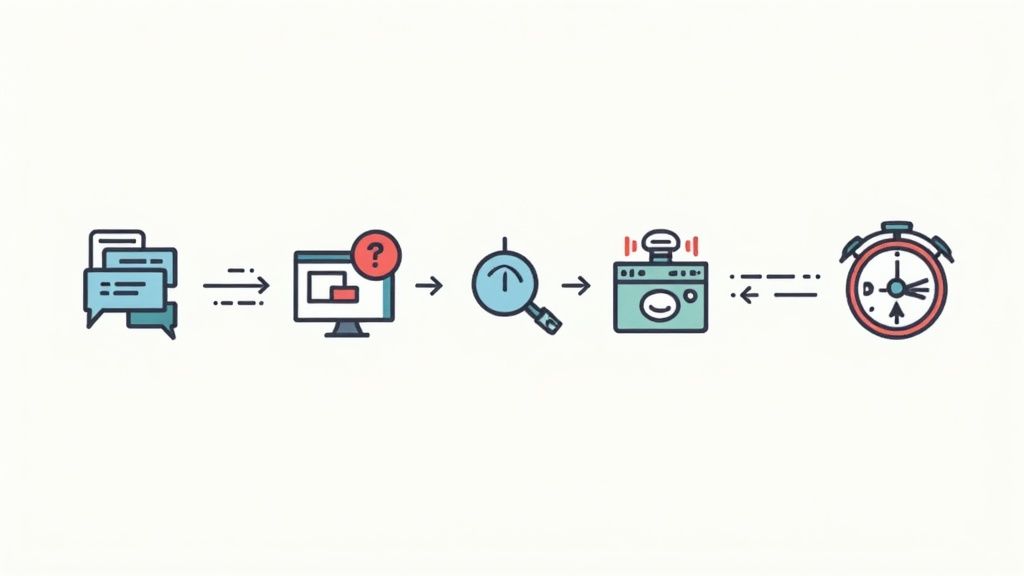
Effective remote team management begins with a well-defined communication framework. Without the natural rhythm of an office, interactions can become chaotic, leading to information silos, missed deadlines, and employee burnout. Establishing clear communication protocols means creating a structured guide that dictates how, when, and where your team communicates for different purposes.
This isn't about micromanagement; it's about creating clarity and predictability. A robust protocol removes the guesswork, ensuring that urgent messages are seen promptly, deep-focus work is protected, and every team member understands the expectations for response times and channel usage.
Why It's a Crucial Tip for Managing Remote Teams
In a remote setting, you can't rely on body language or quick desk-side chats. A formal protocol prevents misinterpretations and ensures everyone has access to the same information. Companies like GitLab and Zapier, which coordinate teams across numerous countries primarily through asynchronous communication, have proven this model's success. Their protocols are the backbone of their global operations.
For a deeper dive into fostering effective dialogue, consider these strategies for improving team communication.
How to Implement Communication Protocols
Getting started is simpler than it sounds. Focus on creating a central document, often called a "Communication Charter," that outlines your team's approach.
-
Assign Tools to Tasks: Clearly define which platform to use for specific interactions.
- Slack/Microsoft Teams: For quick, informal updates and urgent questions.
- Email: For formal, external communication or detailed internal announcements.
- Project Management Tool (e.g., Asana, Trello): For all task-related updates and progress tracking.
- Video Calls (e.g., Zoom, Google Meet): For complex discussions, brainstorming, and one-on-one meetings.
-
Set Response Time Expectations: Define what "timely" means. For instance, specify a 3-hour response window for Slack mentions during work hours and a 24-hour window for non-urgent emails.
-
Establish 'Focus Time' Rules: Implement "no-meeting" blocks or encourage the use of status updates to signal when a team member is in a deep work session and should not be disturbed. This simple step is one of the most effective tips for managing remote teams because it protects productivity.
2. Foster Team Culture and Connection
Remote work can easily lead to feelings of isolation, making it difficult to build the trust and camaraderie that fuels collaboration. Fostering team culture means intentionally creating opportunities for connection that go beyond work tasks. It’s about building shared values, celebrating wins together, and cultivating a sense of belonging, no matter where your team members are located.
This isn't just about fun and games; it's a strategic imperative. A strong, positive remote culture reduces employee turnover, boosts morale, and improves overall team performance. It transforms a group of individuals into a cohesive unit that is more engaged, motivated, and aligned with company goals.

Why It's a Crucial Tip for Managing Remote Teams
In a physical office, culture develops organically through shared lunches and water cooler chats. Remotely, these interactions must be manufactured. Companies like Shopify have mastered this with a digital-first culture that includes online game tournaments, while others are known for virtual team activities. These initiatives are vital because they build the social fabric that helps teams navigate challenges and collaborate more effectively.
A deliberate focus on culture is essential for adapting to modern work environments and ensuring long-term success.
How to Implement a Strong Remote Culture
Building connection from a distance requires a proactive and creative approach. Start by integrating relationship-building activities directly into your team's regular workflow.
-
Create Dedicated Social Spaces: Establish non-work-related channels in your communication tool (e.g., Slack, Teams) for shared interests.
- #pets: A place for team members to share photos of their furry friends.
- #hobbies: For discussions about everything from gardening to gaming.
- #kudos: A channel dedicated to peer-to-peer recognition and celebrating achievements.
-
Prioritize Human Connection in Meetings: Don't jump straight into business. Start video calls with a few minutes of casual, personal check-ins to replicate the informal chat that happens before an in-person meeting.
-
Organize Virtual Team-Building Events: Schedule regular, low-pressure activities that allow people to interact on a personal level.
- Host virtual lunch-and-learns where a team member shares a skill or passion.
- Implement "coffee chats," where team members are randomly paired for a brief, informal video call.
- Send company swag or care packages to help everyone feel like a valued part of the team.
3. Use Project Management and Collaboration Tools
A remote team without a centralized project management tool is like a construction crew without blueprints. Implementing robust digital platforms is essential for tracking tasks, sharing files, and maintaining project momentum across distributed locations. These tools serve as the digital backbone of your operations, providing a single source of truth that offers clarity on who is doing what, by when.
This approach moves beyond simple to-do lists; it creates a transparent, accountable, and collaborative environment. A well-chosen platform centralizes communication around specific tasks, eliminating the need to hunt through emails or chat logs for critical information. It ensures everyone, from team leads to individual contributors, has real-time visibility into project progress.

Why It's a Crucial Tip for Managing Remote Teams
In a physical office, progress is often visible through meetings and overhearing conversations. Remotely, this visibility vanishes. Project management tools recreate this awareness digitally, preventing tasks from falling through the cracks. For example, Atlassian leverages its own products, Jira and Confluence, to coordinate thousands of remote employees, proving the model's scalability. Similarly, companies like Asana were built around the principle of using their own platforms to manage complex global workflows and track ambitious goals.
For those looking to explore their options, many platforms offer unique benefits. To get a better sense of the landscape, you can review some of the top remote work productivity tools available today.
How to Implement Project Management Tools
Successfully integrating a new tool requires a thoughtful strategy, not just a software subscription. Focus on seamless adoption and consistent usage across the team.
-
Start Lean and Integrate Later: Begin with one primary tool for core project management (like Asana, Trello, or Jira). Avoid overwhelming your team with too many platforms at once. Choose tools that can integrate with your existing systems, such as Slack or Google Workspace, to create a unified workflow.
-
Provide Comprehensive Training: Don't assume everyone will intuitively understand the tool. Host dedicated training sessions, create a "Tool Usage Guide" document, and offer ongoing support. This investment ensures the platform is used correctly and to its full potential.
-
Establish Clear Conventions: Create and enforce standards to maintain organization. This includes establishing consistent naming conventions for projects and tasks, creating templates for recurring project types, and defining how files should be structured and stored. This is one of the most effective tips for managing remote teams as it prevents digital clutter.
-
Audit Your Tool Stack Regularly: Periodically review your software subscriptions. Are they still serving their purpose? Are there redundancies? Eliminating unused or overlapping tools saves money and reduces complexity for your team.
4. Set Clear Goals and Expectations
In a remote environment, you can't manage by presence; you must manage by results. This shift requires establishing specific, measurable, and time-bound objectives for both individual contributors and the team as a whole. Setting clear goals replaces the traditional oversight model with an outcome-based approach, focusing on tangible achievements rather than just logged hours.
This strategy is about providing autonomy with accountability. When expectations for work quality, deadlines, and deliverables are explicit, team members have the clarity and freedom to determine how they achieve their goals. This empowers them to work in a way that best suits their style, boosting both productivity and job satisfaction.

Why It's a Crucial Tip for Managing Remote Teams
Without the physical cues of an office, employees can feel disconnected from the company's mission and unsure if their work is making an impact. Clear goals provide that essential line of sight, linking daily tasks to broader business objectives. This is exemplified by companies like Google, which uses the OKR (Objectives and Key Results) system to align its vast remote and hybrid workforce. Similarly, Salesforce's V2MOM (Vision, Values, Methods, Obstacles, Measures) framework gives every employee a clear understanding of their role in the company's success.
This method is one of the most effective tips for managing remote teams because it fosters a culture of trust and high performance, where an employee's contribution is measured by the quality of their output.
How to Implement Clear Goals and Expectations
Adopting an outcome-focused management style involves creating a shared understanding of success and making progress visible. Start by building a documented framework for setting and tracking objectives.
-
Adopt a Goal-Setting Framework: Choose a system like OKRs or V2MOM. The key is to define a high-level objective and pair it with measurable key results that indicate progress.
-
Document and Centralize: Store all goals and expectations in an accessible, central location like a company wiki or project management tool. This document should be the single source of truth for what needs to be achieved.
-
Break Down Large Goals: Deconstruct large quarterly objectives into smaller, manageable weekly or bi-weekly milestones. This makes progress feel more achievable and helps identify potential roadblocks early.
-
Visualize Progress: Use visual dashboards in your project management software to display progress toward goals. This transparency keeps everyone aligned and motivated, creating a sense of shared purpose.
-
Celebrate Milestones: Actively recognize and celebrate when individuals or the team hit key milestones. This reinforces positive momentum and shows that their hard work is valued.
5. Provide Regular Feedback and Recognition
In a remote environment, the absence of daily, in-person interactions means that opportunities for spontaneous feedback and casual praise disappear. Implementing a systematic approach to feedback and recognition is therefore not just a nice-to-have, it's an essential mechanism for employee engagement, motivation, and professional growth. This means creating intentional processes for both constructive guidance and celebrating achievements.
This isn't about constant surveillance or forced positivity. It's about building a culture where team members feel seen, valued, and clear on their performance and development path. A structured feedback loop prevents employees from feeling isolated or uncertain about their contributions, which is a common challenge in remote work.
Why It's a Crucial Tip for Managing Remote Teams
Without regular feedback, minor issues can escalate into significant problems, and top performers can become disengaged from a lack of acknowledgment. Companies that master this have a distinct advantage. Zapier, for instance, uses a peer nomination system for monthly recognition, while HubSpot's quarterly reviews ensure feedback is timely and forward-looking. These practices prove that distance doesn't have to create a recognition deficit.
For leaders looking to refine their approach, it's beneficial to explore strategies for getting better feedback from employees.
How to Implement Regular Feedback and Recognition
Building a robust system requires a mix of formal and informal practices. The goal is to make feedback a continuous, natural part of your remote workflow.
-
Structure Your Feedback: Use a clear and actionable model. The SBI (Situation-Behavior-Impact) framework is highly effective for delivering specific, objective feedback. Describe the situation, the specific behavior observed, and the resulting impact on the team or project.
-
Create Dedicated Recognition Channels: Establish a specific place for praise. This could be a dedicated Slack channel (e.g., #kudos or #wins), a virtual "kudos board" on a tool like Miro, or a set agenda item at the beginning of team meetings.
-
Schedule Consistent One-on-Ones: These meetings are the most important venue for ongoing, two-way feedback. Use them to discuss performance, challenges, and career goals, ensuring they are a safe space for candid conversation.
-
Make it Timely: One of the most vital tips for managing remote teams is to provide feedback as close to the event as possible, ideally within 24-48 hours. This ensures the context is fresh and the guidance is immediately applicable.
6. Support Work-Life Balance and Flexibility
One of the most significant pitfalls of remote work is the blurring of lines between professional and personal life. Supporting work-life balance and flexibility means actively creating policies that respect employee boundaries, prevent burnout, and acknowledge that a home office doesn't equate to 24/7 availability. It’s a foundational element for long-term remote success.
This isn't just about offering occasional flexibility; it’s about building a culture where employees feel empowered to disconnect and manage their schedules effectively. A team that feels respected and trusted is more engaged, productive, and loyal, making this one of the most impactful tips for managing remote teams.
Why It's a Crucial Tip for Managing Remote Teams
Without intentional policies, remote teams are highly susceptible to burnout. The "always on" mentality can quickly erode employee wellbeing and productivity. Companies that champion flexibility, like Shopify with its "async first" model and Microsoft with its successful four-day work week experiment in Japan, demonstrate that prioritizing balance leads to better outcomes, including increased productivity and higher employee satisfaction.
Salesforce's robust wellbeing support for its remote workforce further proves that investing in employee balance pays dividends in retention and performance. This approach transforms flexibility from a perk into a core operational strategy.
How to Implement Work-Life Balance and Flexibility
Building a supportive environment requires deliberate action and clear policies. Start by embedding these practices into your team's daily operations.
-
Establish Core Collaboration Hours: Instead of a rigid 9-to-5, define a shorter window (e.g., 11 AM to 3 PM EST) when the entire team is expected to be online for synchronous collaboration. Outside these hours, team members have the autonomy to structure their day as they see fit.
-
Lead by Example: Managers must model healthy boundaries. Avoid sending emails or messages late at night or on weekends. When you take time off, fully disconnect and communicate that expectation to your team.
-
Provide Practical Support: Offer stipends for ergonomic home office setups or subscriptions to mental health and wellness apps. These tangible benefits show you are invested in your team's overall wellbeing.
-
Encourage Status Indicators: Normalize the use of Slack or Teams statuses like "Deep Focus," "On a Break," or "Signing Off." This creates a non-verbal way for team members to communicate their availability and protect their personal time without feeling guilty.
7. Ensure Proper Technology and Security Infrastructure
A successful remote team is built on a foundation of reliable and secure technology. Simply sending employees home with a laptop is not enough; you must establish a robust digital infrastructure that supports productivity, collaboration, and data protection. This involves providing the right hardware, software, and connectivity while implementing stringent cybersecurity measures to safeguard company assets.
This foundation is the digital equivalent of a physical office. It ensures that every team member, regardless of their location, has consistent, secure, and efficient access to the tools and information they need. Neglecting this infrastructure introduces risks, from productivity-killing technical glitches to catastrophic security breaches that can cripple a business.
Why It's a Crucial Tip for Managing Remote Teams
In a remote environment, the network is the office. If the tools fail or are compromised, work grinds to a halt. Companies like Okta and CrowdStrike have built their entire business models around enabling secure remote access and protecting decentralized workforces. Their success underscores the critical need for a deliberate approach to remote technology and security.
This isn't just about avoiding downtime; it's about building trust and enabling seamless operations. When your team has the right tools and feels confident that their work is secure, they can focus entirely on their roles.
How to Implement a Strong Tech and Security Infrastructure
Building a secure and reliable digital workspace requires a multi-layered approach that covers equipment, access control, and employee training.
-
Standardize Hardware and Software: Provide company-issued and managed devices (laptops, monitors) to ensure consistency and control over security settings. Use a standardized software stack so the entire team operates on the same approved and updated applications.
-
Implement Robust Security Protocols:
- Multi-Factor Authentication (MFA): Make MFA mandatory for all critical systems, including email, project management tools, and cloud storage.
- Virtual Private Network (VPN): Require employees to use a VPN to create a secure, encrypted connection to company resources, especially when using public Wi-Fi.
- Endpoint Protection: Install advanced antivirus and anti-malware software on all company devices to protect against threats.
-
Provide Ongoing Security Training: Regularly educate your team on identifying phishing scams, creating strong passwords, and following secure data handling practices. This is one of the most vital tips for managing remote teams, as human error is often the weakest link in the security chain.
7 Key Tips for Managing Remote Teams Comparison
| Strategy | Implementation Complexity 🔄 | Resource Requirements ⚡ | Expected Outcomes 📊 | Ideal Use Cases 💡 | Key Advantages ⭐ |
|---|---|---|---|---|---|
| Establish Clear Communication Protocols | Medium – requires planning and ongoing updates | Moderate – time investment and tool setup | Reduced miscommunication; improved productivity | Teams needing structured, efficient communication | Clarity, accountability, consistent interaction |
| Foster Team Culture and Connection | Medium – ongoing effort for authentic engagement | Moderate – time and creative resources | Higher engagement; stronger relationships | Remote teams facing isolation and low morale | Enhanced collaboration; psychological safety |
| Use Project Management and Collaboration Tools | Medium to High – tool integration and training | High – licenses, training, and audits | Increased transparency; better project tracking | Distributed teams managing complex projects | Centralized information; data-driven insights |
| Set Clear Goals and Expectations | Medium – requires upfront planning | Low to Moderate – documentation and reviews | Clear success metrics; improved autonomy and motivation | Teams needing outcome focus and alignment | Reduced ambiguity; motivated goal achievement |
| Provide Regular Feedback and Recognition | Medium – structured processes and training | Moderate – manager time and tools | Continuous improvement; higher engagement | Teams needing motivation and performance tracking | Builds trust; supports professional growth |
| Support Work-Life Balance and Flexibility | Low to Medium – policy creation and enforcement | Moderate – wellness programs and stipends | Reduced burnout; improved wellbeing | Remote teams with diverse personal needs | Better retention; increased productivity |
| Ensure Proper Technology and Security Infrastructure | High – technical setup and ongoing maintenance | High – investment in hardware, software, training | Secure environment; minimized disruptions | Teams handling sensitive data or regulatory needs | Data protection; consistent secure access |
Building Your Blueprint for Remote Success
Navigating the landscape of remote work is not about finding a single, magic-bullet solution. Instead, it's about building a dynamic and responsive framework tailored to your team's unique needs. The journey to mastering the management of a distributed workforce is an ongoing process of adaptation, learning, and refinement. The tips for managing remote teams we've explored are not just isolated tactics; they are the interconnected pillars that support a thriving, high-performance remote environment.
From establishing crystal-clear communication protocols that serve as the lifeblood of your team to intentionally fostering a vibrant and inclusive remote culture, each strategy plays a crucial role. By leveraging the right collaboration tools, you create a central hub for productivity. By setting unambiguous goals and providing consistent feedback, you empower your team with a sense of purpose and direction. Ultimately, the synthesis of these elements creates a system where trust, transparency, and autonomy can flourish.
Key Takeaways for Immediate Impact
The transition from managing in-person to managing remotely requires a fundamental shift in mindset: from monitoring activity to measuring outcomes. The most successful remote leaders champion flexibility, prioritize employee well-being, and build systems that enable their teams to do their best work, regardless of location. The core principles to remember are:
- Clarity Over Proximity: In the absence of physical presence, clarity becomes your most valuable asset. Over-communicate expectations, document processes, and ensure everyone understands their role and objectives.
- Trust as the Default: Build your management philosophy on a foundation of trust. Empower your employees with the autonomy to manage their schedules and tasks, focusing on the quality and timeliness of their results.
- Intentional Connection: Remote culture doesn't happen by accident. You must deliberately create opportunities for social interaction, recognition, and team bonding to combat isolation and build strong professional relationships.
Your Actionable Next Steps
Mastering these concepts transforms remote work from a logistical challenge into a strategic advantage, unlocking access to global talent and boosting employee satisfaction. Don't feel pressured to implement everything at once. Start by identifying the one or two areas that could have the most immediate positive impact on your team. Perhaps it's formalizing your communication channels or launching a new employee recognition program. For a comprehensive guide on building a resilient and productive remote workforce, consider exploring effective remote team management strategies to deepen your understanding. By taking small, consistent steps, you can build a robust blueprint that ensures your remote team is not just surviving, but truly thriving in the future of work.
Ready to enhance accountability and gain clearer insights without compromising trust? DeskCove provides ethical, data-driven tools that help you understand productivity trends and support your team's performance. Discover how DeskCove can complement your management strategy and empower your remote success.