Track Billable Hours to Boost Profitability

Before you can even think about hitting "start" on a timer, you need a solid game plan. This is less about just counting minutes and more about defining what work actually drives revenue for your business.
So many agencies and freelancers I've seen stumble right out of the gate on this one. They fail to draw a clear line between client-focused tasks and their own internal overhead, which almost always leads to chronic under-billing. It's a classic mistake.
Laying the Groundwork for Accurate Time Tracking
The first real step is creating a clear and consistent policy that gets your whole team on the same page. This document needs to spell out, in no uncertain terms, what's billable and what isn't. You want to remove any guesswork so everyone logs their time the exact same way.
Defining Billable vs. Non-Billable Work
So, what actually counts as billable? The specifics will vary depending on your services, but it generally boils down to direct client work and any communication that moves a project forward.
- Billable Tasks: Think of things like client calls, strategy sessions, design revisions, writing content, or doing project-specific research. These are the activities directly tied to a client's project.
- Non-Billable Tasks: This bucket covers all the internal stuff that keeps your business running. We're talking about general admin work, internal team meetings, your own marketing efforts, and putting together proposals for new business.
The core principle is simple: if the task is a necessary part of delivering the final product or service to a specific client, it's billable. If it's just part of your general cost of doing business, it's non-billable overhead.
If you really want to get this foundation right, it pays to dive deeper into strategies to master remote work time tracking and build a system that works from day one.
The High Cost of Inaccurate Tracking
Let's be blunt: failing to capture billable time accurately will cost you money. A lot of it. This isn't a small problem—it's widespread across professional services.
Take the legal field, for example. A Legal Trends Report found that attorneys average just 2.9 billable hours per day. That’s only 37% of a standard workday. It's a huge gap between time worked and time billed, often stemming from internal chaos or fuzzy tracking policies. In that world, time is often billed in precise 6-minute increments, which just goes to show how critical precision is.
By setting up a clear framework from the very beginning, you're building a system that's designed for profitability. You empower your team to capture the full value they're delivering, transforming time tracking from a dreaded chore into a powerful tool for your financial health.
Choosing the Right Tools for the Job
Let's be honest: messy spreadsheets and forgotten sticky notes are costing you money. Moving away from those unreliable methods is the first real step toward reclaiming lost revenue. The right software completely changes how you track billable hours, turning a tedious chore into a seamless—and profitable—part of your workflow. But with so many options out there, finding the perfect fit can feel like a job in itself.
The trick is to focus on what you actually need. A solo consultant doesn't need the same beast of a platform as a growing marketing agency with a dozen employees. Your choice has to align with your daily tasks, your team's size, and where you see your business going.
Just look at the financial impact of making this switch.
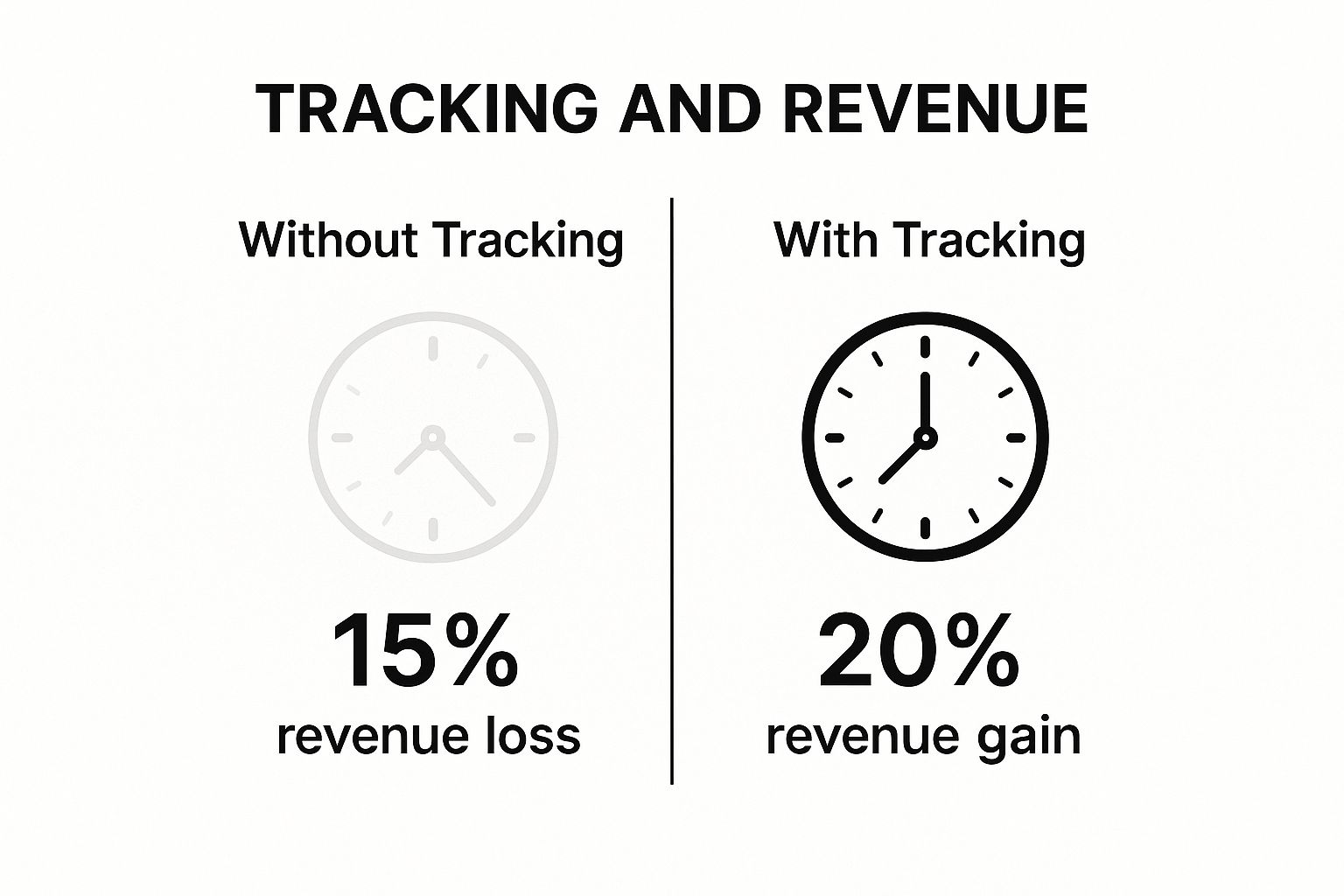
The data doesn't lie. Failing to track hours properly results in an average revenue loss of 15%. On the flip side, implementing a good system can boost revenue by 20%. That’s a 35% swing, which highlights just how critical picking the right tool really is.
Before you start shopping around, it helps to understand the landscape. There are a few common ways people track their time, each with its own set of trade-offs.
Comparing Popular Time Tracking Methods
| Tracking Method | Best For | Pros | Cons |
|---|---|---|---|
| Manual Spreadsheets | Solo freelancers on a tight budget | – Free to use – Highly customizable – No learning curve |
– Prone to human error – Time-consuming – No automation or reporting – Difficult to scale |
| Project Management Tools | Teams already using a PM platform with a built-in timer | – Centralizes project and time data – Improves team visibility – Often part of an existing subscription |
– Time tracking features can be basic – May lack robust reporting – Can be overkill for simple needs |
| Dedicated Time Tracking Software | Businesses of any size serious about accuracy and profitability | – Automated timers and background tracking – Powerful reporting and analytics – Seamless invoicing integrations – Designed specifically for this task |
– A separate monthly subscription cost – Can have a slight learning curve |
Ultimately, dedicated software provides the most value by eliminating guesswork and administrative headaches, but knowing the other options helps frame your decision.
Must-Have Features for Effective Tracking
When you start evaluating different software, it's easy to get distracted by flashy add-ons you'll never use. Ignore the noise. Instead, focus on the core functionality that directly impacts your bottom line.
- Automated Time Capture: Look for tools with simple start-stop timers or, even better, background tracking. Manual entry is a recipe for forgotten time and lost income. Automation ensures every billable second gets recorded.
- Insightful Reporting: Your tool isn't just a clock; it's a source of business intelligence. You need clear, customizable reports that show you billable vs. non-billable hours, project profitability, and team productivity at a glance.
- Direct Invoicing Integrations: The ability to generate an invoice directly from your logged hours is a massive time-saver. A smooth workflow from time entry to a paid invoice is absolutely essential for healthy cash flow.
For a deeper dive into specific software options, exploring a curated list of the best time tracking apps can give you some great side-by-side comparisons to help you find the ideal solution.
Matching the Tool to Your Workflow
Remember, the "best" tool is completely subjective. It all comes down to your business model.
Let’s look at a freelance designer. They would likely want a lightweight, mobile-friendly app. Their main needs are a simple timer, the ability to assign hours to different client projects, and a straightforward invoicing feature. Anything more complex would just slow them down.
Now, consider a marketing agency. They need a far more comprehensive solution. Their ideal tool would probably include project management features, team-wide visibility, and maybe even resource allocation. The ability to track hours from multiple team members on a single project is crucial for calculating true profitability and managing workloads.
The right tool doesn't just record time; it adapts to your workflow and provides the specific insights you need to grow. Choosing a platform that aligns with your operational reality is the most important decision you'll make in this process.
Building Habits for Flawless Time Capture
Having the right tools is a great start, but consistent execution is where profitability is really forged. It all comes down to building daily habits to make sure every single billable minute gets captured. This isn't about setting rigid, painful rules; it's about creating a smart, sustainable routine until time tracking becomes second nature.
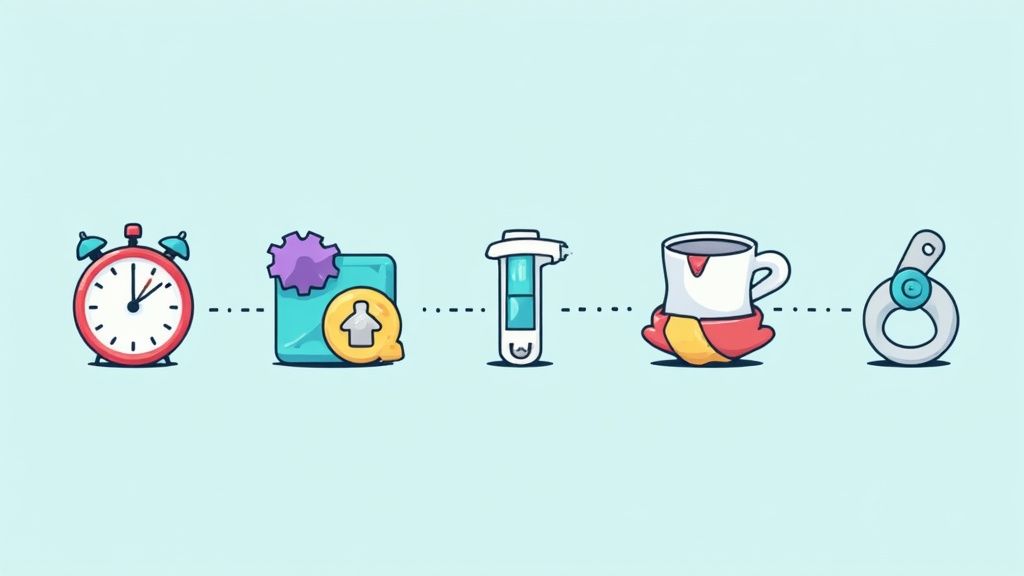
This process turns your time data from a simple log into a powerful source of business intelligence. And it all begins with one simple choice: when you’ll track your time.
Real-Time Tracking vs. Batching
One of the oldest debates in time tracking is whether to log hours as you work or save it all for the end of the day. Batching might feel more efficient in the moment, but it's a trap. Studies have shown that trying to piece together your day after the fact can lead to an accuracy loss of 10% for that day's entries alone.
The most effective habit is to track time in real-time. The moment you start a task, start a timer. When you jump to something else, switch the timer. This simple act eliminates guesswork and guarantees you’re capturing everything.
Batching just opens the door for "guesstimates," which almost always leads to lost revenue. Think about it: that quick 15-minute client call might feel too small to log hours later, but those moments add up fast over a month. Real-time tracking catches them all without you even thinking about it. It’s a core discipline when you seriously want to track billable hours without leakage.
Writing Clear and Concise Descriptions
Your time entries aren't just for you; they’re for your client. Vague descriptions like "Project Work" or "Client Call" don't just look lazy—they breed mistrust and can spark invoice disputes. Get into the habit of writing clear, client-friendly descriptions for every single entry.
Put yourself in your client's shoes. They want to see the value you're providing.
- Weak Description: "Design work"
- Strong Description: "Designed initial wireframes for the new homepage based on client feedback from our kickoff call."
This level of detail accomplishes two critical things:
- Builds Trust: It shows the client exactly what they are paying for, justifying every line on your invoice.
- Provides Data: It gives you granular insight into how long specific sub-tasks really take, which is gold for improving future project estimates.
Handling Tricky Tracking Scenarios
Real work is messy. Interruptions happen. You’ll find yourself juggling multiple projects or getting pulled into a five-minute impromptu call. Building habits to handle these common situations is absolutely critical.
A simple approach I've found effective is to use a "default" timer. If you're deep in Project A and get an urgent call for Project B, just pause the first timer and start the second. Once the call is over, switch back. For those unexpected small tasks, you can even keep a dedicated "miscellaneous" timer for each client that you can sort out later.
These aren't complicated strategies. They are simple, repeatable habits that make tracking billable hours flawless and, most importantly, profitable. The goal is to make time capture an automatic part of your workflow, not an afterthought.
Turning Your Time Logs into Paid Invoices
Your time logs are just data until you turn them into paid invoices. This is where the rubber meets the road—the moment your hard work finally translates into revenue. Getting this part right with a smooth, professional billing workflow is critical for building client trust and keeping your cash flow healthy.
It's all about converting those detailed time entries into a clear, easy-to-understand invoice that communicates your value and leaves no room for questions.

Think of your invoice as the bridge between tracking hours and getting paid. A professional, well-structured invoice does more than just ask for money; it reinforces the value you delivered and practically eliminates the chance of disputes.
Creating Clear, Dispute-Proof Invoices
A good invoice should never leave the client scratching their head. It needs to be an itemized, transparent record of the work you did, pulled directly from the time data you've been so carefully collecting. Vague line items are the number one reason payments get delayed.
To build trust and get paid faster, make sure every single invoice you send includes these key details:
- A Detailed Breakdown of Tasks: Instead of one line for "Project Work," break it down. List each specific task using the same client-friendly descriptions you used when logging the time.
- Time Spent Per Task: Show the exact hours and minutes you dedicated to each activity. This justifies the total bill and subtly demonstrates your efficiency.
- Dates of Work: Including the dates when the work happened adds another layer of transparency. It helps clients line up your invoice with their own project timelines.
- Clear Payment Terms: Don't bury your due date in the fine print. Make it obvious, whether it’s "Due upon receipt," "Net 15," or "Net 30."
If you want a head start, you can download a free blank invoice template for easy billing that already has these essential fields built-in.
The goal of a great invoice is to preemptively answer every question a client might have. When clients understand exactly what they are paying for, they pay faster and with more confidence.
Setting Fair Terms and Handling Overdue Payments
Your payment terms are a core part of your business policy, not something to be sprung on a client with the first invoice. Be upfront about them from the very start of a project. While "Net 30" is pretty standard, shorter terms like "Net 15" can make a huge difference to your cash flow, especially if you're a freelancer or a small business.
Sooner or later, you'll run into an overdue payment. It happens. When it does, the key is to have a professional, systematic approach. A polite email reminder a day or two after the due date is the perfect first step. If you don't hear back, follow up with a phone call.
Always maintain a firm but courteous tone—often, a simple oversight is to blame. Communicating professionally protects the client relationship while still making sure you get paid for the value you've delivered.
Using Your Data to Drive Business Growth
Your time tracking data is so much more than a record for invoicing—it's a treasure trove of insights that can genuinely shape the future of your business. When you consistently track billable hours, you're not just logging time; you're building a detailed roadmap for strategic growth.
This data is the key to moving beyond gut feelings and making smart, profitable decisions. It allows you to see your business with incredible clarity, shining a light on hidden inefficiencies and your biggest opportunities. You can finally start answering the tough questions about where your team's effort really generates the most value.
Analyzing Project and Client Profitability
First things first, you need to dive into your project profitability reports. Which services are your actual money-makers, and which ones are secretly draining your resources? Your time logs will tell the story, showing you exactly how many hours went into that "simple" website redesign or that "quick" marketing campaign.
This analysis often uncovers some surprising truths. You might discover that a high-ticket service you assumed was a winner is actually an enormous time sink. Meanwhile, smaller, recurring tasks could be providing a much better, more consistent return on your team's effort.
Getting this kind of clarity is invaluable for a few reasons:
- Pinpoint Your Best Clients: You can easily see which clients value your work, approve things efficiently, and are genuinely profitable to serve.
- Refine Your Service Menu: It helps you decide which services to promote more heavily and which ones to either re-price or even phase out entirely.
- Quote with Confidence: You can price future projects with real confidence, knowing exactly what it takes to deliver great work.
Key Metrics to Monitor for Sustainable Growth
Beyond individual projects, you need a high-level view of your operational health. Watching a few key performance indicators (KPIs) is the best way to get that. These metrics give you a pulse on your team's efficiency and your company's financial performance.
By understanding exactly where your team's time goes, you can optimize your operations and unlock sustainable growth. This is where simple time tracking evolves into powerful business intelligence.
Keep a close eye on your team's utilization rate (the percentage of their time spent on billable work) and your billable-to-non-billable ratio. These numbers tell a compelling story about your operational efficiency. Digging into this data is a core part of what is known as workforce analytics, which helps you make smarter decisions about staffing, resource allocation, and workflow improvements.
Of course, revenue is only half the story. To get a complete financial picture, you also need a firm handle on your expenses. It's worth exploring some complementary small business expense tracking tips to see the full picture.
This data-driven approach is standard practice in high-stakes industries. For example, top U.S. law firms recently saw their average billing rates jump by 10%, a move driven entirely by data on firm size, practice area, and client demand. The biggest firms now charge almost double the hourly rates of smaller competitors. It's not uncommon for top partners in complex fields like M&A to bill as high as $1,680 per hour, showing just how directly data on service value and demand can influence pricing.
Moving Beyond the Billable Hour
Let’s be honest: while mastering how you track billable hours is a must, it’s not the only way to build a profitable business. For many of us in service industries, the billable hour can sometimes feel like you’re getting paid for the effort, not the incredible outcome you deliver. This is exactly why so many businesses are starting to look at modern alternatives that actually strengthen client relationships and build more predictable revenue.
Thinking about a shift in your pricing strategy is a big deal, I get it. But it's a move that can directly tie your success to your clients' success. When you start focusing on the value you create instead of the minutes you clock, the entire dynamic of your client partnerships changes for the better.
Exploring Modern Pricing Models
Client expectations are changing, and our pricing structures need to keep up. The demand for transparency and predictable budgets has never been higher, pushing businesses away from relying solely on time-based billing. This isn't just a passing trend; it’s a smart, strategic response to what the market is asking for.
We're seeing this shift happen everywhere, especially in professional services. A major survey of Australian law firms, for instance, showed a massive change in thinking. A whopping 90% of firms now offer fixed fees as an alternative to the billable hour. On top of that, 77% use capped fees and 52% work on retainers, all in an effort to avoid "bill shock" and prove the value they provide. You can dig deeper into this industry-wide move toward predictable legal costs and find some really interesting insights.
So, what are the most popular alternatives you could consider? Let’s break them down.
- Fixed-Fee Projects: This is straightforward. You charge one flat price for a project with a clearly defined scope. It’s perfect for services with concrete deliverables, like designing a new logo or building a standard website. The client gets price certainty, and you get rewarded for being efficient.
- Value-Based Pricing: This one is the most advanced, but also the most powerful. Here, you price your work based on the perceived value or outcome it will generate for the client—not your time. For example, if you know your marketing campaign is projected to bring in $100,000 in new revenue for a client, you might charge a percentage of that value.
- Monthly Retainers: With a retainer, clients pay you a recurring monthly fee for ongoing access to your services. This model is ideal for continuous work like social media management, content creation, or SEO. It gives you predictable income and makes budgeting a breeze for your clients.
The right model really depends on your business, the services you offer, and the kinds of clients you work with. There’s no single "correct" answer, and many successful businesses actually use a hybrid approach, offering different models for different services.
Deciding When to Evolve
How do you know if it's the right time to start moving beyond the billable hour? Just look for the signs.
Are clients constantly questioning your invoices? Do you feel like your most valuable, strategic work is being undervalued simply because it doesn’t take as long as some of the more manual tasks? Are you leaving money on the table because you've gotten faster and more efficient at what you do?
If you found yourself nodding "yes" to any of these, it might be time to start experimenting. You don't have to flip your entire business model upside down overnight. Try offering a fixed-fee option on your next proposal for a well-defined project. See how the client reacts. Adopting this kind of forward-looking perspective will help you evolve your business to focus on outcomes, not just hours.
Ready to gain complete clarity on your team's time and productivity? DeskCove offers powerful, automated time tracking to help you manage remote teams, improve efficiency, and make data-driven decisions. Start optimizing your workflow today by visiting https://deskcove.com.