Top 5 Problems with Time management & How to Fix Them

In our fast-paced, always-on work culture, especially with the rise of remote environments, it's easy to feel constantly busy but never truly productive. The common instinct is to work longer hours or push harder, but this rarely solves the core issue. The real culprit isn't a lack of effort; it's often rooted in underlying problems with time management that sabotage even the best intentions. From the endless lure of digital distractions to the silent pressure of perfectionism, these challenges are universal yet frequently misdiagnosed.
This guide moves beyond generic advice to diagnose the seven most common time management pitfalls that derail professionals and remote teams. Instead of simply identifying the issues, we provide a practical, actionable toolkit to overcome them. You will learn specific strategies and frameworks to address procrastination, poor prioritization, overcommitment, and more. The goal is to help you transform a chaotic schedule into a streamlined system for achieving your most important objectives. By understanding these specific obstacles, you can finally stop working harder and start working smarter, reclaiming control over your time and productivity.
1. Procrastination
Procrastination is more than just laziness; it's a complex psychological habit of delaying important tasks, often in favor of more enjoyable or less demanding activities. This behavior stems from various emotional triggers, such as anxiety about the task, fear of failure, or perfectionism. It creates a vicious cycle of stress, rushed work, and diminished quality, making it one of the most significant problems with time management, especially for remote workers who have less direct supervision.

This habit isn't just about postponing a single task, like a project manager delaying a difficult client call. It compounds, leading to overwhelming backlogs and chronic stress. Addressing it requires understanding its root cause and implementing structured, actionable strategies.
Actionable Fixes for Procrastination
Instead of trying to fight the urge to procrastinate with willpower alone, use proven techniques to make tasks less intimidating and easier to start.
-
Break It Down: A large project, like "Develop Q4 Marketing Strategy," is daunting. Break it into smaller, specific steps: "Research 3 competitor campaigns," "Outline key initiatives," and "Draft initial budget." This clarity reduces overwhelm and provides a clear starting point.
-
Use the Two-Minute Rule: Popularized by productivity expert David Allen, this rule states: if a task takes less than two minutes to complete, do it immediately. Answering a quick email or confirming a meeting time avoids letting small items pile up.
-
Implement Time-Boxing: Techniques like the Pomodoro Method, involve working in focused 25-minute intervals separated by short breaks. This structured approach makes it easier to start a task, as the commitment is only for a short period.
-
Create Artificial Deadlines: Don't wait for the official due date. If a report is due Friday, set a personal goal to have the first draft done by Tuesday. This builds in a buffer and reduces the last-minute panic that often fuels poor-quality work.
By integrating these specific tactics, you can dismantle the emotional barriers that lead to procrastination and build momentum, turning avoidance into accomplishment.
2. Poor Prioritization
Poor prioritization is the failure to distinguish between urgent and important tasks, leading to a misallocation of time and energy. This common problem with time management causes professionals to focus on low-impact, "busy" work while high-value responsibilities that drive meaningful progress are neglected. It’s rooted in reacting to immediate demands rather than proactively managing long-term goals, resulting in a feeling of being constantly busy but never truly productive.
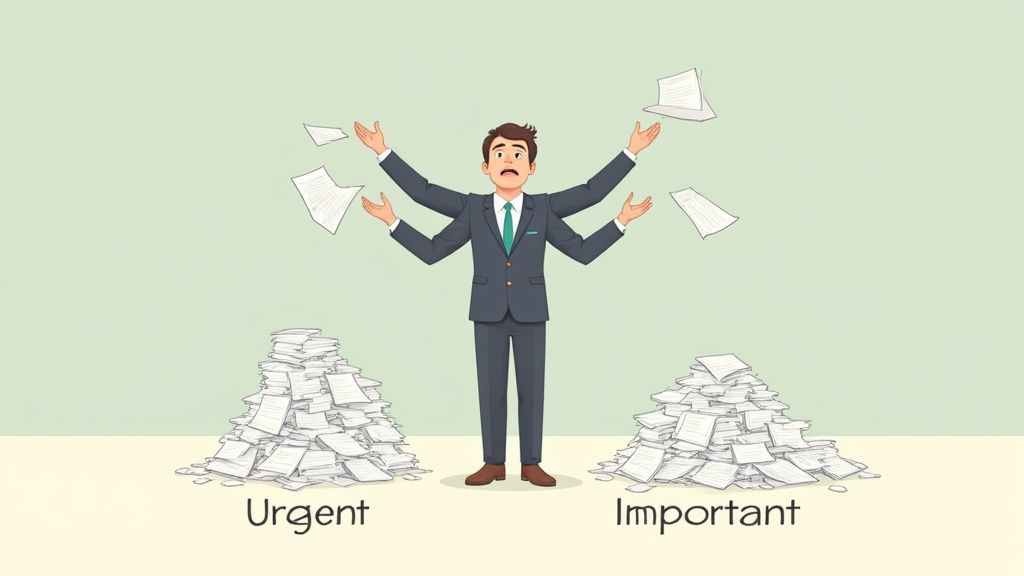
This issue manifests when a manager spends an entire day answering non-critical emails instead of developing a strategic plan, or when a remote worker focuses on easy administrative tasks over a critical project milestone. Without a clear system for organizing tasks, the urgent will always overshadow the important, leading to missed deadlines and unrealized potential.
Actionable Fixes for Poor Prioritization
To regain control, you must shift from a reactive to a proactive mindset. Use established frameworks to evaluate tasks objectively and align your daily actions with your most significant goals.
-
Use the Eisenhower Matrix: Popularized by Stephen Covey, this matrix helps you categorize tasks into four quadrants based on urgency and importance. "Important and Urgent" tasks are done immediately, "Important but Not Urgent" are scheduled, "Urgent but Not Important" are delegated, and "Not Urgent and Not Important" are eliminated. This provides immediate clarity on where to focus your effort.
-
Apply the 80/20 Rule (Pareto Principle): Identify the 20% of your activities that generate 80% of your results. For a sales manager, this might be coaching top performers rather than perfecting internal reports. By dedicating your best energy to these high-impact tasks first, you maximize your output.
-
Set "Big 3" Daily Priorities: Before starting your workday, define the three most important things you must accomplish. This simple technique forces you to make conscious decisions about your priorities and provides a clear focus, preventing you from getting sidetracked by minor distractions.
-
Time-Block Your Calendar: Schedule specific blocks of time for your "Important but Not Urgent" tasks, such as strategic planning or professional development. Treating these activities like unbreakable appointments ensures they receive the attention they deserve instead of being constantly pushed aside for more immediate demands.
By implementing these structured methods, you can cut through the noise of daily demands and ensure your time and energy are invested where they matter most.
3. Overcommitment and Saying Yes Too Often
Overcommitment is the habit of accepting more responsibilities, projects, or social obligations than can realistically be managed. This tendency often stems from a desire to be helpful, a fear of missing out (FOMO), or an inability to accurately estimate the time a task will require. It is a critical issue among the common problems with time management, as it guarantees a schedule filled beyond capacity, leading to stress, burnout, and declining work quality.
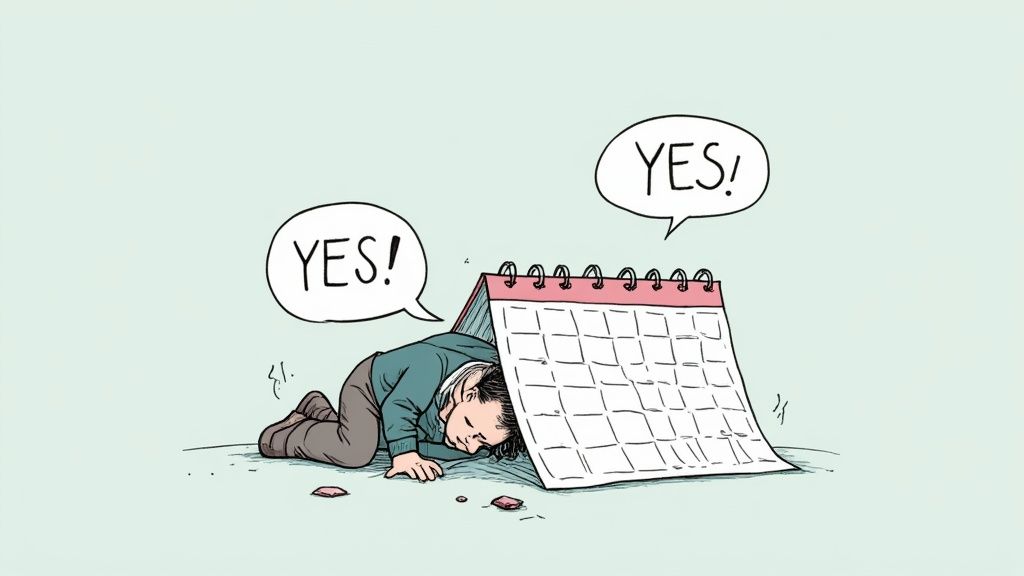
This pattern affects professionals across the board, from a freelancer accepting too many clients at once to a manager volunteering for multiple new initiatives while their core responsibilities suffer. The result is a constant state of being rushed and stretched thin, where nothing gets the attention it truly deserves. Overcoming this requires a strategic shift from being reactive to being intentionally selective.
Actionable Fixes for Overcommitment
Instead of defaulting to "yes" and dealing with the consequences later, adopt proactive strategies to protect your time and energy, ensuring you only commit to what truly matters.
-
Use a Delaying Tactic: When a new request comes in, avoid an immediate answer. Use a neutral phrase like, "Let me check my calendar and current workload, and I'll get back to you." This creates a crucial pause, allowing you to assess the request logically instead of reacting emotionally.
-
Adopt a "Hell Yes or No" Filter: Popularized by Derek Sivers, this simple philosophy helps you evaluate opportunities. If your gut reaction to a new project or commitment isn't an enthusiastic "Hell yes!" then it should be a polite "No." This prevents your schedule from filling with lukewarm obligations.
-
Implement a 'One In, One Out' Policy: Before taking on a significant new commitment (like joining a committee or leading a new project), you must first remove an existing one of similar weight. This forces a conscious trade-off and keeps your overall workload balanced and manageable.
-
Set and Communicate Clear Boundaries: Define your work hours, response times, and the scope of your responsibilities. Communicate these boundaries clearly and politely to colleagues and clients. For example, "I focus on deep work from 9-11 AM and will respond to non-urgent emails after that."
By implementing these filters and boundaries, you can transform your schedule from an overstuffed list of obligations into a curated set of high-impact priorities, directly tackling one of the most draining problems with time management.
4. Digital Distractions and Technology Overuse
Digital distractions are a defining problem with time management in the modern era. Constant pings from emails, social media notifications, and app alerts fragment our attention and create an environment where deep, focused work is nearly impossible. This isn't just a minor annoyance; it's a systemic issue that extends task completion times, diminishes the quality of our work, and fosters addictive technology habits that bleed into our personal lives.
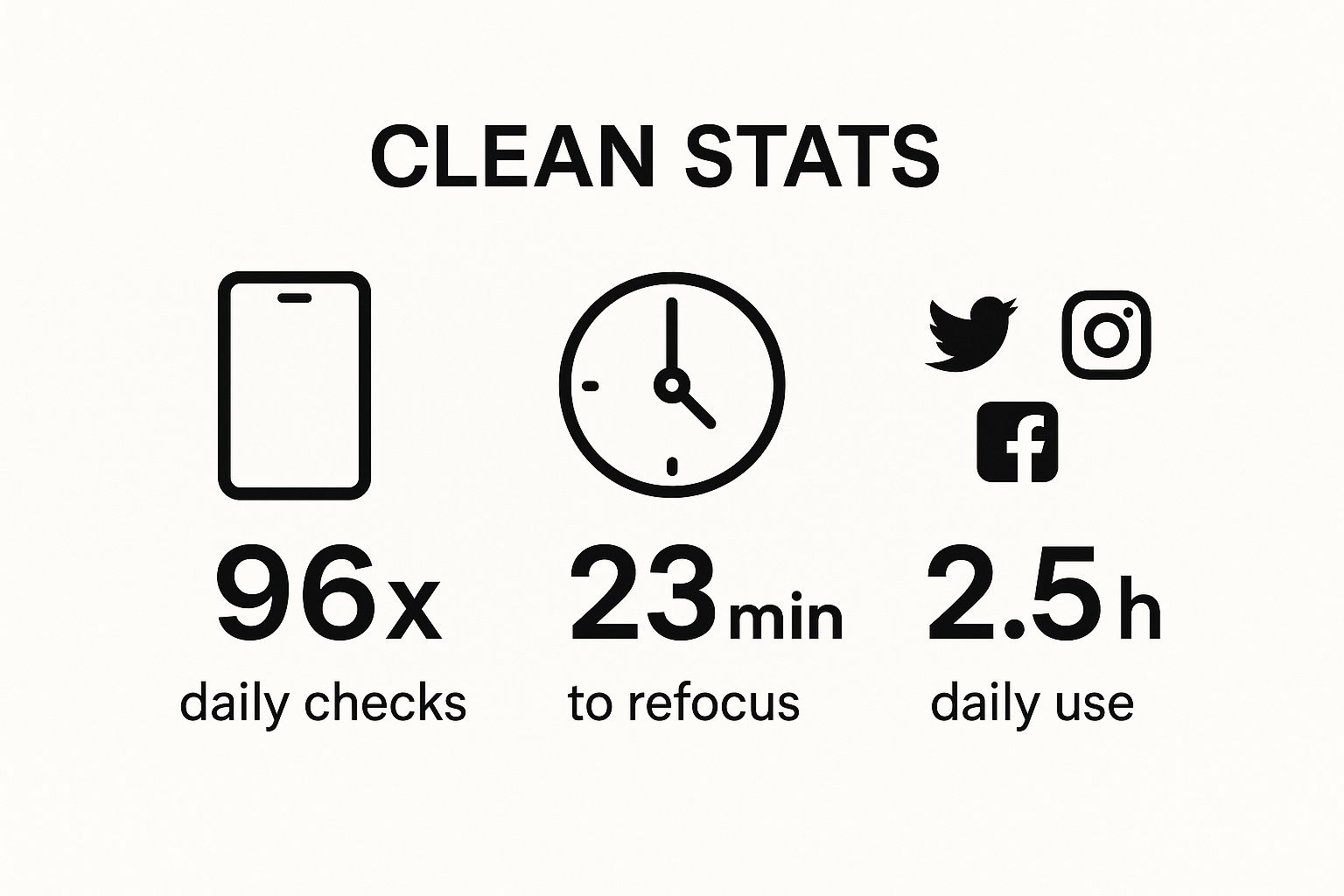
The constant lure of digital devices creates a state of "continuous partial attention," where we are never fully present for any single task. A project manager attending a virtual meeting while simultaneously answering Slack messages and checking emails is a prime example of how this behavior erodes productivity. Overcoming these distractions requires a conscious, strategic effort to reclaim control over our technology and attention.
Actionable Fixes for Digital Distractions
Instead of blaming a lack of willpower, implement a system that makes distractions harder to access and focused work easier to achieve.
-
Turn Off Non-Essential Notifications: The single most effective step is to disable all notifications that aren't mission-critical. Go into your phone and desktop settings and turn off banners, sounds, and badge alerts for social media, news, and email apps. This puts you in control, allowing you to check for updates on your own schedule.
-
Schedule "Digital Check-Ins": Rather than reacting to every notification, set specific times for checking email and social media. For example, dedicate 15-minute blocks at 10 AM, 1 PM, and 4 PM. This batching technique, championed by experts like Cal Newport, prevents constant context-switching and preserves your focus.
-
Create a No-Phone Zone: Designate a physical space or time where your phone is not allowed. A simple but powerful strategy is to leave your phone in another room while you engage in a focused work session. This creates a physical barrier that makes mindless scrolling impossible. To further learn how to tackle distractions at work, you can explore more advanced strategies.
-
Use Technology to Fight Technology: Employ app-blocking software during your designated work blocks. These tools can temporarily block access to distracting websites and applications, creating an enforced environment for deep work and helping you build better digital habits over time.
5. Perfectionism and Over-Planning
Perfectionism is often disguised as a commitment to quality, but it frequently becomes a significant roadblock to productivity. This problem with time management involves setting impossibly high standards and over-planning to the point of "analysis paralysis," where the fear of making a mistake prevents any real work from starting. It's a subtle form of self-sabotage that prioritizes flawless preparation over practical progress, ultimately leading to missed deadlines and burnout.
This habit manifests in various ways, like a writer endlessly editing the first paragraph instead of finishing the draft, or a project manager creating a hundred-page plan for a project that never launches. The core issue is that planning and refining feel productive, but they become a sophisticated form of procrastination that stops you from delivering value.
Actionable Fixes for Perfectionism and Over-Planning
To overcome perfectionism, shift your focus from achieving an unattainable ideal to making consistent, iterative progress. Embracing "good enough" is not about lowering your standards; it's about delivering work and improving it based on real-world feedback.
-
Apply the 80/20 Rule: Also known as the Pareto Principle, this concept suggests that 80% of your results come from 20% of your efforts. Identify the most critical tasks that will deliver the most significant impact and focus your energy there, rather than perfecting every minor detail.
-
Set "Good Enough" Benchmarks: Not every task requires A+ effort. A quick internal email doesn't need the same level of polish as a major client proposal. Define what "done" looks like for different tasks and move on once you meet that pre-defined standard.
-
Time-Box Your Planning Phase: Allocate a specific, non-negotiable amount of time for research, outlining, and planning. If you have a one-week project, dedicate the first day to planning and then commit to starting execution on day two, regardless of whether the plan feels "perfect."
-
Ship and Iterate: Adopt the mindset popularized by tech leaders like Reid Hoffman: "If you're not embarrassed by your first product, you launched too late." Launching an imperfect version allows you to gather feedback and make targeted improvements, which is far more efficient than guessing what a perfect version might look like.
By implementing these strategies, you can break free from the paralysis of perfectionism and transform planning from a barrier into a tool for effective action.
6. Lack of Clear Goals and Direction
Working without clear goals is like sailing a ship with no destination; you are active, but you aren't making meaningful progress. This lack of direction is a fundamental problem with time management, causing you to spend energy on low-impact tasks simply because they are in front of you. It stems from an absence of a well-defined vision, leading to scattered efforts and an inability to prioritize what truly matters, a challenge that affects everyone from entrepreneurs chasing every opportunity to employees unsure of their career path.
This issue goes beyond daily to-do lists. An entrepreneur without a clear business vision may pursue dozens of revenue streams, diluting their focus and resources. Similarly, a recent graduate might take random jobs without considering how they align with a long-term career. Without a defined "end in mind," a concept popularized by Stephen Covey, time is spent reacting to circumstances rather than proactively shaping them.
Actionable Fixes for a Lack of Direction
Instead of letting the day's demands dictate your priorities, build a framework that connects your daily actions to your long-term vision.
-
Set SMART Goals: Vague goals like "grow the business" are useless for guiding action. Use the SMART criteria: Specific, Measureable, Achievable, Relevant, and Time-bound. A better goal is: "Increase qualified B2B leads by 15% in Q3 by launching a targeted LinkedIn ad campaign with a $2,000 budget." For more guidance on this, learn more about how to set these 10 career goals for a thriving professional life.
-
Break Down Your Vision: A five-year vision can feel overwhelming. Deconstruct it into actionable milestones. If your goal is to become a department head, break it down into annual goals (e.g., "Lead a high-impact project this year"), quarterly objectives ("Complete a project management certification"), and weekly tasks ("Schedule a coffee chat with a senior leader").
-
Conduct Regular Goal Reviews: Goals are not set in stone. Circumstances change, and priorities shift. Schedule a monthly or quarterly review to assess your progress, re-evaluate the relevance of your goals, and make necessary adjustments. This ensures you remain aligned with your overarching vision.
-
Connect Daily Tasks to a Larger Purpose: Before starting a task, ask, "How does this move me closer to my quarterly objective or annual goal?" This simple question helps filter out busywork and ensures you are investing your time in activities that deliver real value.
By establishing and regularly refining your goals, you create a powerful filter for decision-making, transforming aimless activity into focused, intentional progress.
7. Poor Energy and Attention Management
Effective time management isn't just about managing the clock; it's about managing your energy. Poor energy and attention management is the failure to align your most demanding tasks with your peak mental and physical periods. This common problem with time management ignores the natural rhythms of focus, creativity, and cognitive clarity, leading to burnout and diminished productivity, even if you have a perfectly structured schedule.
This issue manifests when a night owl schedules a critical strategy session at 8 AM or a project manager tries to do deep creative work in the late afternoon when their focus is waning. It’s the cycle of skipping lunch to power through, only to find the afternoon's output is sluggish and error-prone. True productivity, as highlighted by experts like Tony Schwartz, comes from working in sync with your body's energy, not against it.
Actionable Fixes for Poor Energy and Attention Management
Instead of forcing productivity when you're drained, learn to work with your natural energy cycles to maximize your effectiveness.
-
Track Your Energy Levels: For one week, note your focus, motivation, and energy on an hourly basis. You'll likely discover a predictable pattern, such as a peak focus window from 10 AM to noon and a creative surge in the evening. This data is the foundation for smarter scheduling.
-
Schedule High-Impact Tasks for Peak Hours: Once you identify your peak energy windows, protect them fiercely. Schedule your most important tasks, like strategic planning or complex problem-solving, during these times. Reserve low-energy periods for administrative work like answering emails or organizing files. This strategic alignment is a core principle of effective time budgeting.
-
Prioritize Rest and Recovery: Consistent, high-quality sleep is non-negotiable for cognitive function. Aim for 7-9 hours per night. Beyond adequate sleep and stress management, your physical well-being, particularly gut health, significantly influences your energy levels and cognitive function. Exploring ways to improve gut health naturally can be a powerful step towards more sustained energy and better attention.
-
Use Strategic Breaks to Recharge: Our brains aren't designed for eight hours of continuous focus. Implement structured breaks, like the Pomodoro Technique's 5-minute rests, to prevent mental fatigue. A short walk, some stretching, or even just stepping away from your screen can reset your focus and replenish your energy for the next task.
By shifting your focus from managing time to managing energy, you can achieve more in less time while reducing stress and avoiding burnout.
7 Key Time Management Problems Comparison
| Issue | Implementation Complexity 🔄 | Resource Requirements ⚡ | Expected Outcomes 📊 | Ideal Use Cases 💡 | Key Advantages ⭐ |
|---|---|---|---|---|---|
| Procrastination | Medium – requires habit change and strategies like Pomodoro | Low – mainly time & self-discipline | Reduced stress, improved deadline management | Individuals struggling with delaying tasks and motivation | Increases task completion, reduces guilt and anxiety |
| Poor Prioritization | Medium – involves learning prioritization frameworks | Low to Medium – time for planning tools | Better focus on critical tasks, improved productivity | Professionals/managers overwhelmed by urgent, low-impact work | Effective time allocation, reduces firefighting mode |
| Overcommitment and Saying Yes Too Often | Low to Medium – practice boundary setting and audit commitments | Low – requires awareness and assertiveness | Less burnout, higher quality work, balanced workload | People-pleasers and multitaskers prone to overload | Enhances focus, protects personal time, improves quality |
| Digital Distractions and Technology Overuse | Medium – requires use of tools and strict habits | Medium – app blockers, device settings | Enhanced focus, reduced interruptions | Knowledge workers facing frequent digital interruptions | Improves attention span, reduces task switching losses |
| Perfectionism and Over-Planning | Medium to High – demands mindset shift and time-boxing | Low to Medium – time management tools | Faster completion, less stress, better output | Creatives and planners stuck in endless refinement | Encourages progress over perfection, increases output |
| Lack of Clear Goals and Direction | Medium – needs goal-setting frameworks and regular reviews | Low to Medium – time for reflection and planning | Increased motivation, purposeful effort | Individuals lacking direction or long-term vision | Aligns daily actions with meaningful objectives |
| Poor Energy and Attention Management | Medium – requires tracking and lifestyle adjustments | Medium – may need sleep, nutrition, exercise changes | Improved focus and productivity, sustained energy | Those with fluctuating energy or focus throughout the day | Maximizes peak performance, reduces fatigue |
Take Control of Your Time, Starting Now
Recognizing the patterns that sabotage your schedule is the first, most powerful step toward reclaiming your day. As we've explored, the most common problems with time management aren't isolated incidents. They are interconnected habits that create a cycle of stress, overwhelm, and inefficiency. Procrastination often stems from a lack of clear goals, while poor prioritization is made worse by constant digital distractions. The key isn't to find a single, magical solution, but to build a personalized system of strategies that addresses your specific weak points.
The journey from chronic busyness to intentional productivity begins with a commitment to self-awareness. You cannot fix a problem you don’t fully understand. Whether your primary challenge is overcommitment, perfectionism, or simply managing your energy levels, the solutions lie in conscious, consistent effort. Start small. Choose one or two strategies from this guide that resonate most with your situation. Perhaps it's implementing the Eisenhower Matrix to combat poor prioritization or using time-blocking to create focused work sessions and fend off distractions.
Shifting from Reactive to Proactive
Mastering your time is about more than just checking off tasks; it's about creating the mental and professional space for high-impact work. When you proactively manage your schedule, you stop reacting to urgent but unimportant demands and start investing your energy in what truly drives progress. For managers and team leaders, this shift is critical. Modeling good time management habits and providing your team with the right tools and frameworks creates a culture of focus and efficiency. This empowers everyone to contribute their best work without succumbing to burnout.
To further enhance this process, consider how much time is lost to manual, repetitive work. To free up creativity and boost profitability, investing in workflow automation software can eliminate many of the routine tasks that drain your team's valuable time and focus. This strategic move allows you to direct human ingenuity toward complex problem-solving and innovation rather than administrative overhead. By diagnosing your core issues and applying targeted solutions, you transform time from an adversary into your greatest ally, paving the way for sustainable growth and a healthier work-life balance. The change starts not tomorrow, but with the very next choice you make.
Ready to diagnose and solve your team's time management challenges with data-driven insights? See exactly where your time goes and build more effective work habits with DeskCove. Start your free trial of DeskCove today and turn productivity insights into actionable results.