Overcoming Time Management Challenges: Tips & Strategies

Ever feel like you're just staring at a to-do list that refuses to shrink? It’s a feeling most of us know all too well. The real problem behind most time management challenges isn't that we're running out of hours. It's that we haven't built a solid system to deal with all the digital noise, sudden priority shifts, and the general chaos of modern work.
Why Time Management Feels So Hard
Does your day ever feel like a constant, losing battle against the clock? You might start off with a clear plan, but before you know it, you're juggling a dozen unexpected tasks and drowning in a sea of notifications. This cycle is why so many of us feel busy all day long but walk away feeling like we got nothing important done.
This is especially true for remote teams. The traditional lines between your work life and home life get blurry fast, making it incredibly difficult to truly switch off. Every email, Slack message, and last-minute meeting invite pulls you in a different direction, forcing you into a reactive mode where you're always putting out fires instead of making progress.
The Root Causes of Productivity Struggles
Several key culprits are usually behind this constant struggle. The first step to getting your schedule back under control is simply knowing what you're up against. These issues turn what should be productive hours into a major source of stress.
Think about this: the average US worker spends a jaw-dropping 51% of every workday on tasks that add little to no real value. That shows a huge disconnect between just being occupied and actually being effective.
This isn't just a personal failing; it's a systemic issue. When you don't have a clear framework for your day, it's all too easy to slip into bad habits. The most common time management traps include:
- Unstructured Workflows: Without a concrete plan, you’re basically inviting chaos in. This makes it almost impossible to focus on what really moves the needle.
- Constant Interruptions: Every digital ping and "quick question" shatters your concentration, making that deep, focused work we all need seem like a distant dream.
- Procrastination and Overwhelm: When a big project doesn't have clear, small steps, it’s natural to feel intimidated. This often leads to putting things off, which only ramps up the anxiety.
Once you can spot these root causes in your own workday, you can start building practical strategies to take command of your time again.
The True Cost of Unstructured Workdays
Trying to work without a plan is a bit like trying to build IKEA furniture without the instructions. You might get something done, but it’s going to be chaotic, stressful, and probably won't look like the picture on the box. The real problem with unstructured workdays goes way beyond missing a few deadlines; it creates a sneaky cycle of inefficiency that drains your most valuable assets—your mental energy and focus.
When your day is a free-for-all, you're constantly forced to decide what to do next. This is a one-way ticket to decision fatigue, that worn-out feeling you get when your brain is just done making good choices. Instead of moving forward on big, important projects, you get stuck in reactive mode, jumping from one "urgent" email to the next. This scattered approach is one of the most common remote work traps, and it takes a direct toll on the quality of your work.
The Power of a Daily Plan
Even a simple plan for your day acts as a mental anchor. It takes the heavy lifting of constant prioritization off your shoulders, freeing up brainpower for the deep, focused work that actually matters. A structured day means you are in charge of your priorities, not your inbox or Slack notifications.
This proactive approach is essential for taking back control, especially when you don't have a manager looking over your shoulder. The best part? It doesn’t require a massive overhaul of your life. In fact, research shows that while nearly 80% of people don’t have a formal system for managing tasks, spending just 10 minutes on a daily plan can save up to two hours of wasted time. You can learn more about these powerful time management findings and see how small habits lead to huge results.
An unstructured day leaves you vulnerable to the "tyranny of the urgent," where minor, immediate tasks overshadow major, long-term goals. A plan is your best defense, ensuring your effort is aligned with what truly matters.
At the end of the day, structure brings clarity. It turns a vague to-do list into a clear roadmap for the day, which cuts down on that feeling of being overwhelmed and makes it easier to just start. It’s the foundation for getting past chronic procrastination and delivering high-quality work, day in and day out.
Conquering the Constant Stream of Interruptions
Every notification, email, or tap on the shoulder is a sledgehammer to your focus. These constant interruptions are more than just annoying—they're a primary reason so many of us struggle with time management. Each time your attention gets pulled away, you don't just lose a few seconds. You lose precious momentum.
This is a real phenomenon called attention residue. It’s where part of your brain stays stuck on the last thing that distracted you, even after you’ve tried to get back to your main task. This mental fog makes deep, concentrated work nearly impossible and is exactly why multitasking is a myth. You're not really doing multiple things well; you're just switching between them poorly.
Neutralizing Digital and Physical Distractions
To get back in control, you need to build a protective bubble around your focus time. It’s a sobering thought, but the average worker is interrupted every 3 minutes and 5 seconds, and it can take over 23 minutes to fully get back on track. Globally, these distractions chew up an estimated 28% of our productive time. You can see more on this in these time management statistics from Prosperity for America.
Fighting back requires a game plan. Start by figuring out where your interruptions come from—is it the endless digital pings or people stopping by your desk? Knowing the source is the first step. For a deeper dive, you can explore more strategies for handling distractions at work in our detailed guide.
The infographic below really drives home how setting clear, structured goals can dramatically improve your ability to get things done, which all hinges on having focused, uninterrupted work sessions.
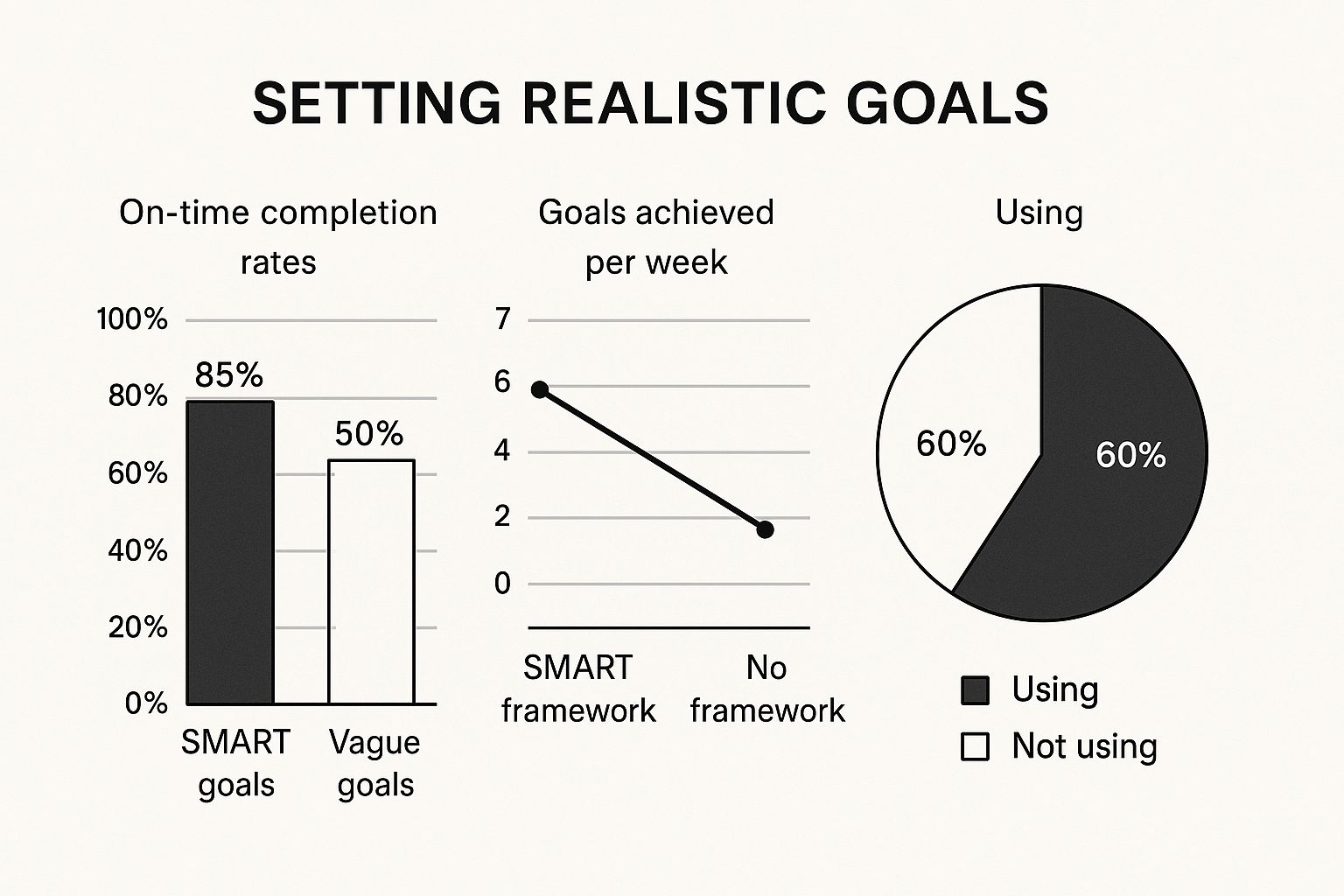
As the data shows, having a solid framework like SMART goals makes a huge difference in both on-time completion and the number of goals you actually achieve. It’s all about being deliberate.
To help you get a handle on the most common time sinks, we've put together a table breaking down these productivity drains and offering simple, actionable ways to solve them.
Common Productivity Drains and Their Solutions
A practical breakdown of the most frequent time wasters and simple, actionable strategies to counteract each one effectively.
| Time Management Challenge | Description | Actionable Solution |
|---|---|---|
| Digital Notifications | Constant pings from emails, chats, and social media pull your focus away from important tasks. | Turn off non-essential notifications. Schedule specific times to check email and messages (e.g., once per hour). |
| Context Switching | Jumping between unrelated tasks without finishing any of them, leading to mental fatigue and inefficiency. | Use timeboxing to dedicate a specific block of time to a single task. Finish one thing before moving to the next. |
| Unplanned Meetings | Colleagues "just popping in" for a quick chat that derails your workflow and concentration. | Block out "focus time" on your calendar and communicate it to your team. Suggest scheduling a proper meeting for non-urgent matters. |
| Physical Environment | A cluttered desk or a noisy environment can create subtle but persistent distractions. | Tidy your workspace at the end of each day. Use noise-canceling headphones if you're in a loud office. |
| Lack of Clear Priorities | Starting the day without a clear plan, leading to reactive work on whatever feels urgent instead of what's important. | Spend the first 15 minutes of your day identifying your top 3 priorities. Tackle the most challenging one first. |
By addressing these common drains head-on, you can reclaim significant chunks of your day and dedicate them to the work that truly matters.
Battle-Tested Strategies for Deep Work
Now, let's turn theory into practice. Adopting proven techniques designed to protect your focus is the next step. These methods help you intentionally set aside time for uninterrupted work, making deep concentration a regular part of your day.
The key to overcoming interruptions isn't about finding more time; it's about making the time you have more effective. By creating intentional focus blocks, you are telling your brain—and your colleagues—that this time is non-negotiable.
Here are a few powerful techniques to get you started:
- The Pomodoro Technique: Work in focused 25-minute sprints followed by a five-minute break. This brilliantly simple method trains your brain to concentrate for short bursts and helps keep burnout at bay.
- Timeboxing: Assign a fixed time period—a "box"—to each activity on your calendar. This creates a clear schedule and stops tasks from expanding to fill whatever time you have available (also known as Parkinson's Law).
- Focus Blocks: Schedule non-negotiable blocks of time in your calendar specifically for deep work. Treat these appointments with yourself as seriously as you would a meeting with your boss. They are just as important.
Escaping the Inefficient Communication Trap
Does a day packed with back-to-back meetings and a relentless flood of emails sound familiar? This constant barrage of communication feels like a trap, and it's one of the biggest—and most overlooked—time management challenges out there. It creates a culture where everyone is expected to be available right now, completely sabotaging our ability to do any deep, focused work.
The real issue is the unspoken rule that you have to be accessible at all times. This leads to pointless meetings that lack a clear agenda and a never-ending stream of messages demanding an immediate response. Instead of pushing projects forward, this communication overload just drains our mental energy and kills productivity.
Reclaiming Your Calendar and Focus
Getting out of this cycle means making a deliberate shift in how your team communicates. It starts by asking a simple question for every meeting or message: "Is this really necessary right now?" Not every question needs an instant reply, and not every update justifies a 30-minute call.
The scale of this problem is staggering. Studies show that employees spend around 57% of their time just on communication tasks like emails and meetings. That can add up to almost five hours a day, leading 68% of workers to feel they can't concentrate on their actual jobs. You can dive deeper into these productivity insights from Flowlu.
The goal isn't to stop communicating; it's to make communication more intentional and effective. This means prioritizing clarity and purpose over speed and availability.
To get back in the driver's seat, teams have to set new ground rules that respect everyone's time. This strategic change gives people the power to protect their focus while still making sure important information gets shared.
Actionable Strategies for Better Communication
Putting concrete strategies in place is the only way to break free. A fantastic starting point is to require a clear purpose and agenda for every single meeting. If a meeting doesn't have a defined goal and a desired outcome, it should probably just be an email.
Here are a few practical steps you can take right away:
- Embrace Asynchronous Work: Encourage communication that doesn’t demand an immediate answer. This lets team members respond when it actually fits into their workflow, protecting those crucial blocks of uninterrupted time. You can learn how asynchronous communication enhances team productivity in our guide.
- Establish Communication Protocols: Create simple, team-wide guidelines. For instance, use chat for quick, urgent questions, but stick to email for detailed updates that aren't time-sensitive. This removes the mental guesswork of figuring out which tool to use for what.
- Schedule "No-Meeting" Blocks: Block off specific times—or even entire days—where internal meetings are off-limits. This is a guaranteed way to give everyone protected time for deep, concentrated work.
How to Build Your Personal Productivity System
Now that you've identified the common time management challenges that can derail your day, the next move is to build a solid defense. There’s no magic bullet for productivity; the best system is always the one you actually stick with. It all starts with understanding your own unique work rhythms.
Think of yourself as a detective investigating your own productivity. Start tracking your energy levels throughout the day. When do you feel sharp and ready for deep, focused work? When does that mid-afternoon slump usually hit? Pinpointing these natural peaks and valleys is the foundation for building a schedule that works with you, not against you.
Choosing Your Core Method
Once you have a better feel for your personal work style, it's time to experiment with some established productivity frameworks. Don't feel like you have to adopt one system completely. Instead, look at these methods like a menu of options and pick the elements that solve your biggest problems.
Here are a few proven methods to get you started:
- Time Blocking: This is where you schedule your entire day in advance, assigning specific "blocks" of time for every single task. It's fantastic for preventing context switching and protecting your precious focus.
- Getting Things Done (GTD): Perfect if you feel overwhelmed by mental clutter. GTD is all about capturing your tasks and ideas in an external system, which frees up your mind to actually focus on getting things done.
- Eat That Frog: This one is simple but incredibly powerful. The idea is to identify your most important (and probably most dreaded) task for the day and tackle it first thing. This creates a huge wave of momentum and ensures you make progress where it counts.
The most effective approach is often a hybrid one. You might use Time Blocking for your core work hours but apply the "Eat That Frog" principle to kickstart your mornings. The goal is customization, not rigid rules.
Leveraging Technology Wisely
A great personal system isn't just about methods; it's also about the tools you use. The key is to pick technology that reduces complexity, not adds to it. Automated time trackers like DeskCove, for instance, can give you invaluable, objective insights into where your hours are really going, revealing patterns you might not notice on your own.
For anyone struggling with the digital noise of the modern workday, exploring dedicated social media time management strategies can be a game-changer.
Ultimately, you want to create a flexible framework that can adapt as your priorities and projects change. For a deeper dive, check out our complete guide to building a time management system for maximizing efficiency and productivity.
Frequently Asked Questions
Struggling with productivity is universal, and a few questions pop up time and time again. Let's tackle some of the most common ones with practical advice you can start using today.
What Is the Most Effective Way to Beat Procrastination?
The best way to finally stop procrastinating is to make the first step so easy it feels ridiculous not to do it. This is where the "Two-Minute Rule" shines. If a task takes less than two minutes, just do it now instead of putting it off.
For those bigger, scarier projects, the secret is to chop them down into tiny, bite-sized actions. Don't add "write report" to your to-do list. Instead, the very first step could be, "open a new document and write a single headline." This simple move lowers the mental hurdle, sidesteps that initial wave of resistance, and creates the momentum you need to keep the ball rolling.
How Can I Manage My Time with a Team on Different Schedules?
When your team is spread across different time zones or works flexible hours, you have to ditch the idea of a traditional nine-to-five. Success hinges on rock-solid communication rules and leaning heavily on asynchronous tools. It's about creating a system that respects everyone's deep-work time.
Start by setting a few "core hours" when everyone agrees to be online for any urgent, real-time collaboration. For everything else, project management platforms and detailed, clear comments are your best friends. This way, projects keep moving forward without everyone needing to be in the same meeting at the same time, solving one of the biggest remote time management challenges.
How Do I Say No to More Work Without Harming My Reputation?
Learning to say "no" is a superpower, not a sign of weakness. The trick is to do it professionally by communicating your current priorities, not just shutting down the request. Instead of a flat-out refusal, frame your answer around your existing workload and deadlines.
A strategic 'no' protects your ability to deliver high-quality work on your most important tasks. It demonstrates responsibility and an understanding of your own capacity, which is a sign of a reliable professional.
Try saying something like, "Right now, my main focus is getting Project X finished for its deadline this week. I could probably jump on this new task next Monday. If it's more urgent, maybe we can see who else has some bandwidth?" This shows you're being thoughtful and responsible, not just unavailable.
Which Time Management Technique Is Best for Beginners?
The Pomodoro Technique is a fantastic place to start if you're new to structured time management. Its beauty is in its simplicity. You work in focused 25-minute sprints, then take a short five-minute break.
This rhythm helps train your focus, gives your day a predictable flow, and makes huge tasks feel much less intimidating. Every "pomodoro" you complete is a small victory, which builds your confidence and helps you create a consistently productive habit.
Ready to conquer your team's time management challenges and get crystal-clear insights into where the day really goes? DeskCove gives you the automated tools you need to understand productivity, helping you build smarter, more focused workflows. Start your free trial and see the difference at https://deskcove.com.