8 Employee Performance Metrics Examples for 2025

In today's complex work environment, particularly with the rise of remote and hybrid teams, outdated methods for evaluating performance are falling short. To cultivate a truly high-performing team, managers and team leads need a more holistic and nuanced understanding of what success actually entails. Simply counting hours or tasks completed no longer provides the full picture. A balanced approach is essential, combining quantitative output with qualitative assessments to drive meaningful improvement and recognize valuable contributions.
This guide delivers precisely that, offering a detailed list of actionable employee performance metrics examples that move beyond surface-level tracking. We will explore 8 critical categories, from traditional output and efficiency to nuanced areas like peer feedback and professional development. For each metric, you'll find a breakdown of its strategic value, practical implementation tips, and specific considerations for remote work contexts. You will learn not just what to measure but how to measure it effectively, enabling you to build a system that accurately reflects true performance and propels your organization's growth. Forget generic advice; get ready for replicable strategies you can apply immediately.
1. Quantitative Work Output Metrics
Quantitative work output metrics are the bedrock of performance management, offering a direct, numerical measure of an employee's tangible results. These metrics focus on the volume of work completed within a specific timeframe, providing objective, easily comparable data. They answer the fundamental question: "How much did this employee produce?"
This category includes a wide array of measurable activities, making it one of the most versatile employee performance metrics examples. For instance, a sales team tracks the number of deals closed per quarter, while a customer support team measures tickets resolved per day. Similarly, a content team might count articles published, and a manufacturing plant monitors units assembled per shift.
Strategic Analysis & Application
The primary strength of these metrics lies in their objectivity. They remove subjectivity from performance conversations, grounding discussions in concrete data. This clarity helps in identifying top performers, pinpointing those who need support, and setting clear, attainable goals across the team.
However, relying solely on quantity can be misleading. An employee might resolve many support tickets quickly but with low customer satisfaction, or a developer might write thousands of lines of code that are inefficient and buggy. This is the classic "quantity vs. quality" dilemma.
Key Insight: Purely quantitative metrics are most effective when the task's outcome quality is inherently consistent or when paired with a corresponding quality metric. For example, tracking "units produced" works well when all units must pass a strict quality control check.
Actionable Takeaways for Implementation
To use these metrics effectively, especially with remote teams where output is a primary indicator of engagement, follow a balanced approach.
- Combine with Quality: Pair every quantitative metric with a qualitative one. If you track "articles written," also measure "reader engagement time" or "editorial score." If tracking "sales calls made," also track "conversion rate."
- Set Contextual Benchmarks: Don't use a one-size-fits-all target. Set goals based on historical data, industry standards, and individual roles. A senior developer’s output goals should differ from a junior developer's.
- Automate Tracking: Utilize project management or CRM software to automatically track these numbers. This reduces the administrative burden and provides real-time data for both managers and employees to monitor progress.
2. Quality of Work Metrics
While quantity measures "how much," quality of work metrics evaluate "how well" an employee performs their tasks. These metrics assess the standard, accuracy, and excellence of an employee’s deliverables, ensuring that high output doesn't sacrifice value. They answer the crucial question: "Does this employee's work meet our standards?"

This category focuses on the caliber of the final product. For example, a customer service team tracks Customer Satisfaction (CSAT) scores and First-Call Resolution rates. A software development team monitors bug rates per feature, while a manufacturing line measures product defect rates. These are essential employee performance metrics examples because they directly correlate with customer satisfaction and brand reputation.
Strategic Analysis & Application
The core value of quality metrics is their ability to safeguard and enhance business standards. They shift the focus from mere activity to meaningful, effective outcomes. This is particularly vital in roles where the cost of a mistake is high, such as in healthcare (patient outcomes) or finance (audit accuracy).
However, measuring quality can be more complex and subjective than counting units. A design's "quality" is harder to define numerically than the number of designs created. Without clear, agreed-upon standards, these metrics can lead to inconsistent evaluations and employee frustration.
Key Insight: Quality metrics are most powerful when defined by objective, customer-centric criteria. Instead of a manager subjectively rating a project, use direct customer feedback, error rates, or adherence to a pre-defined quality rubric.
Actionable Takeaways for Implementation
To implement quality metrics fairly, especially in a remote setting where direct oversight is limited, focus on clarity and consistency.
- Define Quality Explicitly: Create clear, documented standards for what constitutes "high-quality" work. Use checklists, rubrics, or style guides so everyone understands the expectations. For example, define an "A-grade" support ticket response.
- Use Objective Data: Whenever possible, tie quality to hard numbers. Track Net Promoter Score (NPS), code review pass rates, or the number of revisions required on a project. This minimizes subjectivity.
- Implement Peer Reviews: For creative or complex roles, use a structured peer review system. This distributes the evaluation process and provides diverse feedback, helping to calibrate quality standards across the team.
3. Efficiency and Productivity Metrics
Efficiency and productivity metrics move beyond simply "how much" was done to answer "how well" it was done. These metrics measure how effectively employees use their time and resources to produce results. They focus on the crucial ratio of output (results) to input (time, cost, effort), providing insight into workflow optimization and resourcefulness. They help answer the core question: "Is this employee achieving results in a smart, cost-effective, and timely manner?"
This category is essential for identifying bottlenecks and opportunities for process improvement. For example, a project manager might track the actual project completion time against the estimated time, while a call center measures the average handle time for customer issues. Similarly, a marketing team calculates the cost per lead, and an IT department monitors the mean time to resolution (MTTR) for technical tickets.
Strategic Analysis & Application
The strength of efficiency metrics lies in their ability to highlight process waste and celebrate ingenuity. They shift the focus from pure volume to intelligent work, recognizing employees who find smarter, faster, or cheaper ways to achieve goals. This makes them one of the most powerful employee performance metrics examples for fostering a culture of continuous improvement.
However, an overemphasis on efficiency can backfire. Pushing for faster call resolution times could lead to rushed service and poor customer satisfaction. Likewise, pressuring a team to reduce cost per unit might tempt them to cut corners on quality control. Efficiency must be balanced with quality and effectiveness to be meaningful.
Key Insight: Efficiency metrics are most valuable when they reveal opportunities for systemic improvement, not just individual speed. They should spark conversations about better tools, refined processes, and removing organizational roadblocks.
Actionable Takeaways for Implementation
To implement efficiency metrics without compromising quality, managers should focus on holistic improvement. This is particularly vital for remote teams, where efficient workflows are key to autonomy and success.
- Establish Baselines First: Before launching any improvement initiative, track current performance for a set period to establish a clear baseline. This provides a concrete starting point to measure progress against.
- Contextualize Complexity: A complex IT ticket will naturally take longer to resolve than a simple password reset. When comparing efficiency, always factor in the complexity and scope of the tasks involved.
- Balance with Quality: Pair efficiency metrics with quality or satisfaction scores. For instance, track "average handle time" alongside "customer satisfaction score" (CSAT) to ensure speed doesn't harm the customer experience.
The following infographic illustrates a common process flow for measuring efficiency.
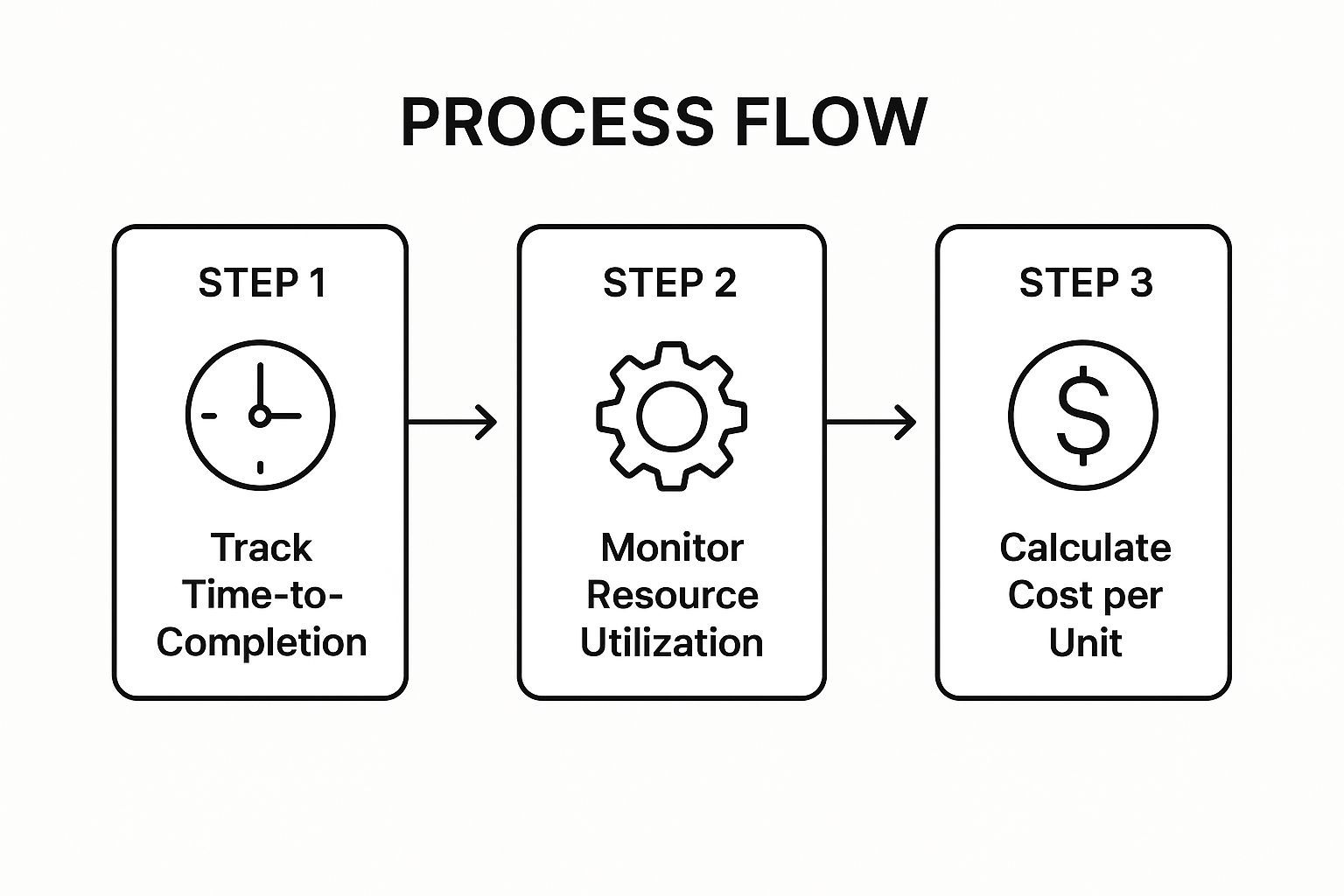
This flow shows how tracking time, resources, and cost sequentially provides a comprehensive view of overall operational efficiency.
4. Goal Achievement and KPI Attainment
Goal achievement and KPI attainment metrics shift the focus from activity to impact, evaluating employees based on their progress toward specific, predetermined objectives. Rooted in frameworks like Management by Objectives (MBO) and Objectives and Key Results (OKRs), this approach directly links individual contributions to broader organizational strategy. It answers the critical question: "Is this employee delivering the results that matter most to the business?"
This category is one of the most powerful employee performance metrics examples because it provides clear direction and purpose. For instance, a marketing team is measured on lead generation and conversion rate KPIs, while a product team's success is tied to launching features on schedule and hitting user adoption targets. Similarly, an HR department might be evaluated on meeting recruitment timelines and employee retention goals.
Strategic Analysis & Application
The core strength of this metric is its strategic alignment. It ensures every employee understands how their daily work contributes to the company's success, fostering a sense of ownership and engagement. This method provides a clear framework for performance discussions, focusing on outcomes rather than just effort or hours worked.
However, its effectiveness hinges on how well the goals are defined. Poorly set goals can lead to unintended consequences, such as employees focusing on narrow targets at the expense of collaboration or long-term value creation. For example, a sales representative might push for deals that have a high churn rate just to meet a quarterly revenue target.
Key Insight: Goal achievement metrics are most effective when objectives are mutually agreed upon, not just dictated. This collaborative process ensures goals are both ambitious and realistic, creating buy-in from the outset.
Actionable Takeaways for Implementation
To implement goal-based metrics successfully, especially in a dynamic remote environment where priorities can shift, a structured yet flexible approach is key.
- Involve Employees in Goal-Setting: Collaborate with team members to define their objectives. This ensures they understand the expectations and feel a greater sense of accountability for the outcomes.
- Balance Goal Types: Create a mix of individual, team, and cross-functional goals. This encourages collaboration and prevents employees from working in silos, ensuring their personal targets don't conflict with team success.
- Utilize a Framework: Adopt a proven methodology like OKRs to structure your goals. To streamline the process of setting and tracking objectives and key results, consider utilizing a dedicated tool like an OKR generator.
5. Customer Satisfaction and Net Promoter Score (NPS)
Customer satisfaction metrics link employee performance directly to the customer experience, evaluating how effectively an individual or team creates positive, lasting impressions. These metrics, such as Net Promoter Score (NPS) and Customer Satisfaction Score (CSAT), measure how well employees meet customer needs, resolve issues, and foster loyalty. They answer the critical question: "How happy are our customers with this employee's service?"

This category of employee performance metrics examples is essential for any customer-facing role. For example, a support agent is tracked by CSAT scores after ticket resolution, an account manager is measured on the quarterly NPS from their client portfolio, and a retail associate is evaluated on post-purchase satisfaction surveys. These metrics provide direct feedback on an employee's impact on business growth and customer retention.
Strategic Analysis & Application
The power of these metrics is their direct connection to business outcomes. High customer satisfaction correlates with increased loyalty, repeat business, and positive word-of-mouth marketing. By tracking these scores, managers can identify which employees excel at building customer relationships and which may need additional training in communication or problem-solving.
However, these metrics can be influenced by factors outside an employee's control, like product flaws or company policy. A single low score from an unhappy customer can disproportionately affect an employee's average, making it crucial to look at trends rather than isolated incidents.
Key Insight: Customer satisfaction metrics are most powerful when used to coach and develop employees, not just to penalize them. The verbatim feedback collected alongside scores often contains the most valuable information for process improvement and individual growth.
Actionable Takeaways for Implementation
To implement customer satisfaction metrics effectively, focus on fairness, context, and continuous improvement. This is especially vital for remote teams where direct observation of customer interactions is limited.
- Survey Immediately: Send satisfaction surveys (CSAT, NPS) immediately after an interaction to capture fresh, accurate feedback. The longer you wait, the less reliable the response.
- Focus on Trends: Analyze scores over time to identify patterns. A consistent dip might signal a systemic issue, while a steady increase demonstrates an employee's growth.
- Share Verbatim Feedback: Provide employees with the actual comments from customers (anonymized if necessary). This qualitative data offers specific, actionable learning opportunities that a simple score cannot.
6. Peer Review and 360-Degree Feedback Scores
Peer review and 360-degree feedback scores move beyond the traditional top-down evaluation, gathering performance assessments from multiple sources. This multi-rater approach incorporates input from colleagues, direct reports, supervisors, and sometimes even external stakeholders, providing a holistic view of an employee's impact. It aims to answer the question: "How is this employee's performance perceived by those they work with every day?"
This method captures crucial soft skills and behavioral competencies that a manager alone might not observe. For example, consulting firms use 360-degree reviews for partner evaluations, assessing collaboration and client management. Similarly, tech companies incorporate peer feedback into promotion cycles to evaluate teamwork and influence, making this one of the most insightful employee performance metrics examples for team-based environments.
Strategic Analysis & Application
The core value of 360-degree feedback is its ability to uncover blind spots. An employee may excel at individual tasks but create friction within the team, a dynamic that this metric brings to light. It provides a well-rounded picture of an individual's strengths and areas for development, especially in leadership, communication, and collaboration.
However, its effectiveness is highly dependent on the company culture and implementation process. Without a high degree of psychological safety and trust, feedback can become political or overly cautious, diminishing its value. If not managed carefully, it can lead to anxiety and a focus on appeasing colleagues rather than driving results.
Key Insight: 360-degree feedback is most powerful as a developmental tool rather than a direct evaluative one. Use its insights to guide coaching, personal development plans, and leadership training, not as the sole determinant for compensation or promotion decisions.
Actionable Takeaways for Implementation
To implement this metric successfully, particularly in remote settings where interpersonal dynamics are less visible, focus on creating a structured and safe process.
- Train Participants: Provide clear training on how to give constructive, specific, and behavior-focused feedback. Teach participants to avoid personal judgments and focus on observable actions and their impact.
- Ensure Confidentiality: Use an anonymous system to encourage honest and candid responses. Assure participants that their feedback will be aggregated and presented confidentially to protect their identity.
- Combine with Other Metrics: Always use 360-degree scores as part of a balanced performance scorecard. Combine them with quantitative output and qualitative assessment metrics to get a complete and fair picture of performance.
7. Professional Development and Skills Growth Metrics
Professional development metrics measure an employee's commitment to continuous learning and skill enhancement, reflecting their growth mindset and adaptability. These metrics track participation in training, certifications earned, and the application of new competencies to their role, answering the key question: "Is this employee growing and evolving with the business?"
This category of employee performance metrics examples is crucial for building a future-proof workforce. Examples include IT professionals earning new technology certifications, sales teams completing advanced product training, or developers attending conferences and sharing key learnings. The focus is on deliberate, measurable upskilling that aligns with organizational goals.
Strategic Analysis & Application
The strength of these metrics is their forward-looking nature. Instead of only measuring past performance, they gauge an employee's potential and readiness for future challenges, which is vital for succession planning and innovation. A team that actively develops its skills is more agile and resilient to market changes.
However, the primary challenge is measuring true impact. An employee might complete numerous courses without applying the knowledge effectively. Simply tracking course completions can lead to a "check-the-box" mentality, where the activity is valued more than the actual skill acquisition and application.
Key Insight: Development metrics are most powerful when they link learning activities directly to performance outcomes. The goal is not just to track training but to measure how that training translates into improved efficiency, quality, or innovation in their day-to-day work.
Actionable Takeaways for Implementation
To implement these metrics effectively, especially in a remote environment where proactive learning is key, focus on creating a structured yet flexible development culture.
- Create Individual Plans: Work with each employee to create an Individual Development Plan (IDP) with clear objectives. To effectively measure professional development, utilizing a comprehensive a skills gap analysis template and guide is essential for identifying areas of growth and targeted training.
- Measure Application, Not Just Completion: Go beyond tracking certificates. Use project-based assessments, peer reviews, or performance data to see if the new skills are being used. You can incorporate these observations into structured feedback using these performance review examples.
- Allocate Dedicated Resources: Provide a clear budget and dedicated time for learning. This signals that the organization genuinely values professional growth, encouraging employees to invest in their development without feeling overwhelmed by their regular duties.
8. Attendance, Punctuality, and Reliability Metrics
Attendance, punctuality, and reliability metrics are foundational indicators of an employee's dependability and commitment. These metrics track an employee's adherence to work schedules by measuring absenteeism, tardiness, and overall consistency. They provide a clear, objective view of whether an employee is present and available to contribute to team goals, answering the core question: "Can this employee be counted on?"
These metrics are critical across various industries and serve as powerful employee performance metrics examples. For instance, a manufacturing facility relies on strict attendance to keep production lines running, a call center monitors schedule adherence to ensure customer service availability, and a project-based team tracks deadline compliance to maintain project velocity. In each case, reliability is a direct predictor of both individual and team success.
Strategic Analysis & Application
The strength of these metrics is their simplicity and direct correlation with operational stability. Consistent attendance and punctuality are leading indicators of employee engagement and accountability. A sudden dip in reliability can often signal underlying issues like burnout, disengagement, or personal challenges, allowing managers to intervene proactively.
However, a purely rigid application can be counterproductive, especially in remote or flexible work environments. Punishing an employee for a single instance of lateness without context can damage morale. The focus should be on patterns of behavior rather than isolated incidents. The goal is to ensure work gets done and deadlines are met, not just to monitor clock-in times.
Key Insight: Reliability metrics are most effective when viewed as a measure of an employee's respect for their team and commitments, not just compliance with a schedule. Their value lies in identifying patterns that impact team productivity and workflow.
Actionable Takeaways for Implementation
To implement attendance and reliability metrics without creating a culture of micromanagement, a nuanced approach is necessary. This is especially true for remote teams where trust is paramount.
- Define Clear Policies: Clearly distinguish between excused and unexcused absences and establish a transparent process for reporting time off or schedule changes. This removes ambiguity.
- Focus on Patterns: Instead of reacting to a single late arrival, look for recurring patterns of absenteeism or tardiness. These patterns are more indicative of a performance or engagement issue that needs to be addressed.
- Automate for Objectivity: Use tools to track these metrics automatically. Modern employee attendance tracking software can provide objective data, reducing manual effort and potential bias.
- Recognize Consistency: Acknowledge and reward employees who demonstrate outstanding reliability. Positive reinforcement is often more effective than punitive measures for building a dependable team.
Employee Performance Metrics Comparison Table
| Metric Type | Implementation Complexity 🔄 | Resource Requirements ⚡ | Expected Outcomes 📊 | Ideal Use Cases 💡 | Key Advantages ⭐ |
|---|---|---|---|---|---|
| Quantitative Work Output Metrics | Low – automated tracking and dashboards | Low – data from existing systems | Clear, objective productivity data | Roles with defined repetitive outputs: sales, manufacturing, support | Objective, easy to track, facilitates data-driven decisions |
| Quality of Work Metrics | Medium – needs quality assurance systems | Medium – requires reviews and audits | High standards, reduced errors, improved customer satisfaction | Accuracy-critical roles: healthcare, software, creative professions | Ensures excellence, reduces rework, improves brand reputation |
| Efficiency and Productivity Metrics | Medium to high – tracking time/resource ratios | Medium to high – requires process tools | Insights into workflow, resource use, cost-effectiveness | Operations, project management, logistics, manufacturing | Identifies process bottlenecks, supports resource planning |
| Goal Achievement and KPI Attainment | Medium – requires goal-setting and regular tracking | Medium – time investment for alignment | Alignment with company strategy, clear targets | All professional roles, especially management, sales, marketing | Aligns individual and organizational goals, motivates staff |
| Customer Satisfaction & NPS | Medium – needs survey systems and data analysis | Medium – survey tools and feedback loops | Customer loyalty & retention, quality customer experience | Customer-facing roles: sales, service, account management | Direct customer feedback, promotes customer-centric culture |
| Peer Review & 360-Degree Feedback | High – multi-source feedback and thorough analysis | High – time for administration and training | Holistic performance view, interpersonal skills | Leadership, collaborative/team-based roles | Reduces bias, reveals blind spots, aids leadership development |
| Professional Development & Skills | Medium – tracking learning activities and certifications | Medium – learning management systems | Employee growth and adaptability | All roles, especially fast-evolving industries | Encourages continuous learning, improves engagement |
| Attendance, Punctuality & Reliability | Low – simple objective tracking | Low – attendance/time tracking systems | Reliability, team coordination, operational stability | Shift-based, operational roles requiring consistent coverage | Easy to track, early warning for disengagement |
Implementing a Balanced and Actionable Performance Strategy
Moving from theory to practice is the most critical step in performance management. As we've explored through these detailed employee performance metrics examples, the goal is not to track every possible data point. Instead, the objective is to build a holistic, balanced, and actionable framework that reflects the true value an employee brings to the organization. A singular focus on quantitative output can overlook quality, while an overemphasis on subjective feedback can lack objective grounding.
The most effective performance strategies recognize that an employee's contribution is multifaceted. It's a blend of what they produce (output), how well they produce it (quality), how efficiently they work (productivity), and how they collaborate and grow (behavioral and developmental metrics). Relying on just one or two of these categories creates a blind spot that can lead to misaligned incentives, employee disengagement, and a skewed understanding of team performance.
From Metrics to Management: Key Strategic Takeaways
To transform this list of examples into a powerful management tool, focus on these core principles:
- Context is King: The right metrics are role-specific and goal-aligned. A sales representative’s key metrics (like sales volume and customer acquisition cost) will differ vastly from a software developer’s (like code quality and cycle time). Never apply a one-size-fits-all template.
- Blend the Quantitative and Qualitative: Combine objective, hard data like
Net Promoter ScoreorTask Completion Ratewith qualitative insights from360-Degree Feedback. This creates a balanced view that captures both the "what" and the "how" of performance, providing a more complete and fair assessment. - Prioritize Leading Indicators: While lagging indicators like annual sales figures are important, leading indicators such as
Professional Development Goal AchievementorPeer Review Scoresoffer predictive insights. These metrics help you coach employees and adjust strategies before performance issues become significant problems. - Empower, Don't Micromanage: The purpose of tracking metrics is to empower employees with clarity and data, not to surveil them. Frame performance data as a tool for self-improvement and professional growth. This shifts the dynamic from top-down monitoring to a collaborative partnership focused on success.
Your Actionable Next Steps
Building a robust performance system is an iterative process. Start small, gather feedback, and refine your approach over time. Here’s a simple, three-step plan to get started:
- Select 2-3 Core Metrics Per Role: For each key position in your team, choose a primary quantitative metric, a primary quality metric, and one behavioral or efficiency metric. This focused approach prevents data overload and ensures you are tracking what truly matters.
- Establish Clear Baselines and Goals: Once you've chosen your metrics, work with each employee to establish a clear baseline and set realistic, aspirational goals. This collaborative process ensures buy-in and makes the performance review process transparent and predictable.
- Automate Data Collection Where Possible: Manual tracking is time-consuming and prone to error. For remote and hybrid teams, leveraging technology to automate the collection of productivity and efficiency data is essential. This frees up managers to focus on high-value activities like coaching, strategic planning, and removing roadblocks for their team.
By thoughtfully selecting and implementing a balanced set of employee performance metrics, you create a culture of transparency, accountability, and continuous improvement. This data-informed approach not only clarifies expectations but also provides the insights needed to build a high-performing organization where every team member is empowered to achieve their full potential.
Ready to automate your productivity tracking and gain clear insights into your team's efficiency? DeskCove provides the essential tools to seamlessly monitor activity levels, project time, and overall productivity, making it easier than ever to implement the quantitative employee performance metrics examples discussed in this guide. Discover how you can build a more transparent and data-driven culture by visiting DeskCove today.