Master Calculating Billable Hours

Figuring out your billable hours seems easy on the surface: just track the time you spend on client work and multiply it by your hourly rate. Simple, right? The real trick, and where so many people get it wrong, is nailing down exactly what counts as "billable" in the first place.
Defining Your Billable Activities

Before you even think about starting a timer, you have to get crystal clear on what a billable hour actually means for your business. It all boils down to one question: are you doing this work specifically for a paying client's project? If the answer is yes, it’s almost always billable.
Think of it this way—if that client hadn't hired you, you wouldn't be doing this task. This covers the obvious stuff like writing code, designing a logo, or joining a project sync-up. But it also includes the less glamorous—but equally vital—work like project-specific research, client phone calls, and working through revisions.
On the flip side, non-billable time is everything else you do to keep your business running. This is where freelancers and agencies often trip up, blurring the lines and leaving money on the table.
Distinguishing Between Billable and Non-Billable Work
Drawing a sharp line between these two categories is the single most important thing you can do for accurate billing. A classic example that trips people up is business development. Let's say your agency spends ten hours putting together a killer proposal and pitch for a potential client. That time is non-billable. It's the cost of winning new work.
But the moment that client signs on the dotted line, the clock starts. Time spent on initial concepts, creating mockups, and going back and forth on feedback immediately becomes billable. The work has officially shifted from a sales effort to project delivery.
Here are a few more real-world examples to make the distinction clear:
- Client Project Management: Billable. You're organizing tasks and coordinating the team for a specific client.
- Internal Team Meetings: Non-billable. Your weekly huddle to discuss company goals is an internal cost.
- Client-Specific Research: Billable. Digging into a client’s competitors for their marketing strategy is direct project work.
- General Professional Development: Non-billable. That online course you’re taking to sharpen your skills is an investment in yourself, not billable to a client.
The core principle is client-centricity. If the task directly benefits a paying client and is part of the agreed-upon scope of work, you should bill for it. This transparency builds trust and prevents disputes down the road.
To help your team stay consistent, a quick-reference guide can be incredibly useful.
Billable vs. Non-Billable Task Quick Guide
Use this table as a quick reference to classify common professional activities and maintain billing consistency across your team.
| Activity Category | Example Billable Task | Example Non-Billable Task |
|---|---|---|
| Communication | Responding to client emails about project feedback | Internal team chat about the company holiday party |
| Meetings | Project kickoff call with the client | Weekly internal all-hands meeting |
| Project Work | Writing copy for a client's website | Updating your own company's portfolio website |
| Research | Analyzing a client's competitor landscape | Reading industry news to stay up-to-date |
| Administration | Preparing and sending a client invoice | Organizing your internal file system |
| Business Development | A paid discovery session or strategy workshop | Creating a proposal for a prospective client |
Having this distinction clear from the start makes everything that follows—from tracking to invoicing—much smoother.
Getting this right is fundamental to your profitability. Knowing how to properly categorize your work ensures the data you use for billing is both accurate and fair. In fact, learning how to manage your non-billable time to boost profitability is a key strategy for protecting your bottom line.
How to Calculate Billable Hours Correctly
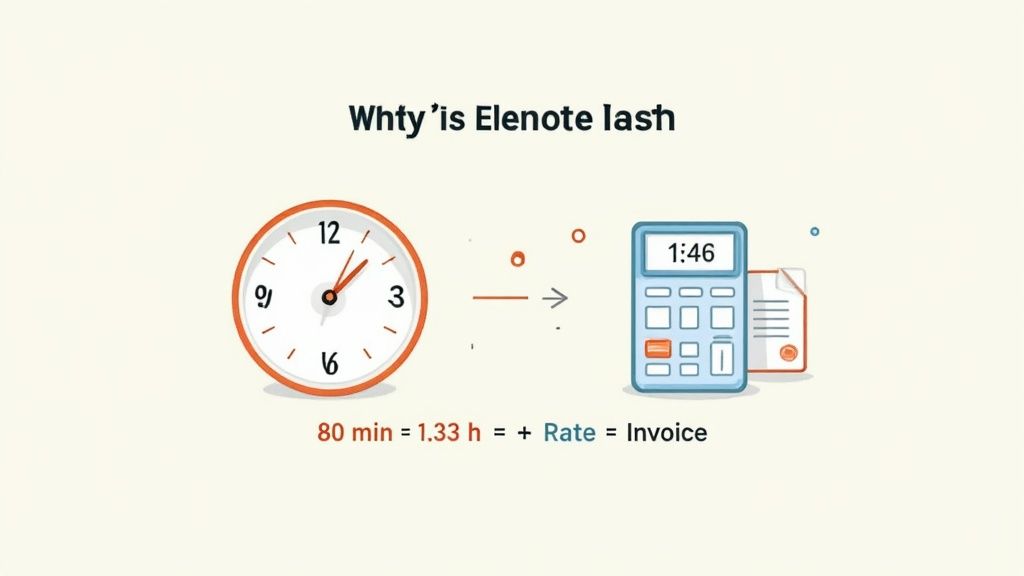
Alright, you’ve done the hard work of tracking your time and separating what’s billable from what’s not. Now comes the crucial part: turning those tracked hours and minutes into cold, hard numbers for your invoice. This is where a lot of people, especially if they're new to this, start to feel a little unsure. The process itself is pretty simple, but getting it right is everything.
Calculating your billable hours isn't just about noting when you started and stopped. The real trick is converting your total worked minutes into a decimal that plays nicely with your hourly rate. Nail this conversion, and you've got the foundation for a professional invoice that clients won't question.
Master Billing Increments
Look, most professionals don't bill by the exact minute—that would be a nightmare for everyone involved. Instead, we use standardized billing increments to keep things simple and consistent. This is standard practice everywhere, from big law firms to freelance marketing consultants.
You’ll typically see two common increments:
- 6-minute increments (0.1 of an hour): This is the gold standard in legal and consulting circles. It’s granular enough to be super accurate without you having to log every single minute.
- 15-minute increments (0.25 of an hour): This one’s a favorite for creative agencies and freelancers. It's incredibly straightforward to calculate and just makes sense to clients.
The key is to pick one and stick with it. Make sure you clearly state your billing increment in your client agreement or contract to head off any potential confusion down the road.
The Core Calculation Formula
Converting your time from minutes to a billable decimal is easier than it sounds. All you need is a simple division.
Formula: Total Minutes Worked / 60 = Billable Hours (in decimal form)
Let’s run through a quick, real-world example. Say you're a consultant and just wrapped up a client strategy call that lasted an hour and 20 minutes (that's 80 minutes total).
- Calculation: 80 minutes / 60 = 1.333…
You'd round that to two decimal places, giving you 1.33 billable hours. That decimal is the number you'll plug into your invoice. It’s how you get paid fairly for every chunk of the hour you worked.
Here's a pro tip: always round up based on your chosen increment. If you use 6-minute intervals, a 7-minute phone call rounds up to 12 minutes, which is 0.2 hours, not 0.12. Having a clear rounding policy is your best defense against client disputes.
From Hours to Invoice Total
Once you have your billable hours in decimal form, the final step is a breeze. This is where you connect your time directly to your revenue.
The formula couldn't be simpler:
Formula: Total Billable Hours × Your Hourly Rate = Total Amount Due
Let’s stick with our 80-minute strategy call. If your hourly rate is $150, the math looks like this:
- Invoice Calculation: 1.33 hours × $150/hour = $199.50
That’s the number you put on the invoice for that line item. Getting these calculations right is vital, especially in fields where rates are on the rise. For example, recent reports show law firm billing rates jumped 6.5%—the fastest growth in over a decade—with clients barely pushing back. You can dig into these legal market trends to see just how critical precise billing becomes when big money is on the line.
Adopt Better Time Tracking Habits

Perfect calculations are built on a foundation of accurate data. And that data comes from solid habits, not guesswork.
If there's one habit that will make the biggest impact, it's this: track your time as you work. Trying to piece together your day from memory hours later is a surefire way to lose revenue and send out questionable invoices.
A simple timer is so much more reliable. Start the clock when you begin a client task. Stop it when you switch projects or take a break. This real-time approach catches all those little moments—a quick phone call, a 15-minute research rabbit hole—that really add up. To get this habit locked in, it helps to incorporate effective time management tools right into your daily workflow.
Write Time Entries That Justify Your Bill
Capturing the minutes is only half the battle; the quality of your time entries is what truly matters. Vague descriptions like "Project Work" or "Client Call" don't do much to show the value you're providing. Your goal should be to write clear, descriptive entries that tell the story of your work.
Think of each entry as a mini-progress report. Instead of just "Email," try something like, "Emailed client with draft logo concepts for initial feedback." That level of detail justifies your bill and reinforces the effort you're putting into their project. It answers client questions before they're even asked and builds a strong foundation of trust.
This is a critical practice across all professional services, where unbilled time can be a massive problem. For example, lawyers on average only bill for about 2.9 hours of an 8-hour workday. That’s a huge gap between work performed and revenue captured, often stemming from poor tracking habits.
Implement a Consistent Team-Wide System
When you're working with a team, consistency is everything. If every person tracks time differently—or worse, not at all—you've got guaranteed revenue leaks. A unified system isn't just nice to have; it's non-negotiable.
This means everyone on the team uses the same tools and follows the same rules for logging hours against specific projects and tasks.
Adopting a standardized approach ensures that your billing data is clean, reliable, and consistent. It empowers you to confidently answer any client questions about an invoice because you have detailed, accurate records to back it up.
This isn't just about plugging financial leaks. It's about building a more professional and accountable operation from the ground up. If you need some direction, our guide on how to track billable hours provides actionable steps for creating a system that actually works for your team.
The right habits can turn time tracking from a dreaded chore into one of your most powerful business tools.
Find the Right Billing and Invoicing Software
Let's be honest: relying on spreadsheets for billing is an open invitation for costly errors and wasted time. While manual tracking might feel like a simple solution when you're starting out, it quickly snowballs into a massive administrative headache that chips away at your profitability.
The modern fix, thankfully, is dedicated time tracking and invoicing software.
These tools are built to automate the whole process, from clicking a timer when you start a task to firing off a professional invoice when you're done. This isn't just about saving a few hours—it's about dramatically improving your billing accuracy, making sure you get paid for every single minute you work.
Essential Features to Look For
When you start looking around, you'll see everything from simple timers to full-blown project management suites. No matter how complex the tool, there are a few core features that are non-negotiable if you're serious about calculating billable hours properly.
You'll want a tool that offers:
- One-Click Timers: The ability to instantly start and stop a timer as you jump between tasks is the foundation of accurate, real-time tracking.
- Project-Based Reporting: You need to see, at a glance, how many hours have been logged against a specific client or project. This is critical for monitoring budgets and profitability.
- Automated Invoice Creation: The best software lets you turn your tracked hours into a polished, detailed invoice with just a few clicks, pulling in all the necessary data automatically.
- Detailed Time Entries: Your team needs to be able to add clear descriptions to each time log. This isn't just for your records; it justifies the value of the work to your clients.
Just take a look at this screenshot from a Wikipedia comparison page. It gives you a sense of the sheer variety of features available across different time-tracking platforms.

The big takeaway here is that these tools are not one-size-fits-all. Some excel at simple timekeeping, while others offer complex features like multiple billing rates and mobile access. It really underscores how important it is to match the software to what you actually need.
Unlocking Deeper Business Insights
Beyond just making your billing easier, the right software becomes an incredibly powerful source of business intelligence. It gives you the hard data you need to finally understand where your team's time is really going.
This kind of visibility lets you accurately gauge project profitability and pinpoint which clients are your most lucrative.
The real power of using dedicated software isn't just about saving time on admin work. It's about unlocking valuable data that helps you make smarter decisions about your pricing, resource allocation, and overall business strategy.
This data-driven approach can completely change how you run your operations. You can spot inefficiencies before they become major problems, adjust project scopes before they go over budget, and have confident, transparent conversations with clients backed by detailed reports.
If you want to dig deeper into this, you can learn more about how online invoicing can boost efficiency and save time in our detailed guide. Ultimately, choosing the right tool isn’t just an operational upgrade; it's a strategic investment in your company's financial health.
Explore Alternatives to Hourly Billing
While it's crucial to get your billable hour calculations right, it’s just as important to know when to ditch the clock altogether. The traditional hourly model isn't a one-size-fits-all solution, and a growing number of professionals are moving to pricing models that actually reflect the value they deliver, not just the time they spend.
This shift does two great things: it creates more predictable revenue for you and provides clearer, more transparent value for your clients. Knowing your options gives you the power to pitch the right pricing for the right project.
When Hourly Billing Falls Short
Let's be honest, the hourly model can create some tension. Clients get nervous about scope creep and surprise invoices, while you can feel punished for being too good at your job. If you solve a tough problem in two hours that would take a less experienced person ten, should you really earn less?
This is exactly why value-based pricing is gaining so much steam. It changes the entire conversation from "How many hours will this take?" to "What is this outcome worth to your business?"
Popular Alternatives to Charging by the Hour
Looking beyond the hourly rate lets you tailor your pricing to the project and what your client truly needs. Here are a few popular ways to price your work that focus on results, not minutes on a stopwatch.
- Fixed-Fee Projects: You and the client agree on one single, upfront price for a well-defined scope of work. This is perfect for projects with clear deliverables, like a new website design or a complete set of marketing brochures. Clients absolutely love the cost certainty, and you get rewarded for working efficiently.
- Monthly Retainers: This is your bread and butter for long-term partnerships. Clients pay a flat fee every month for ongoing access to your services, whether it's for content marketing, social media management, or IT support. The big win for you? Stable, predictable income you can count on.
- Value-Based Rates: This is the most advanced—and potentially lucrative—model. Here, your fee is directly tied to the value or ROI you generate for the client. Think of a consultant charging a percentage of the new revenue they help bring in. It requires a deep dive into the client's business goals, but it offers the highest earning potential by far.
Moving away from hourly billing aligns your incentives with your client's success. When they win, you win. This partnership mindset transforms the client relationship from a transactional one to a strategic alliance.
This isn’t just a trend in creative fields; it’s happening everywhere. The legal profession, long built on the billable hour, is seeing a major shift. In Australia, for instance, many law firms are adopting fixed and capped fees because clients are demanding more cost transparency. It’s all part of a larger industry move toward value-based models to keep clients happy.
You can read more about these emerging trends in professional services billing. By offering these alternatives, you’re not just changing your pricing—you’re positioning yourself as a forward-thinking partner who is invested in getting real results.
Even with the best system in place, tricky situations and questions about billable hours are bound to pop up. Learning to handle the common “what ifs” with confidence is key to keeping your billing accurate and your client relationships strong.
Let's walk through some of the most frequent questions I've seen come up over the years.
How Should I Handle Very Short Tasks?
This one comes up all the time. What do you do with those tiny tasks, like a quick two-minute email reply or a five-minute file check? It feels silly to bill for the exact time, but letting it slide means you're just giving away your expertise for free.
This is exactly where your agreed-upon billing increment comes into play. Most professionals set a minimum, like six minutes (0.1 hours) or fifteen minutes (0.25 hours). That two-minute email? It simply gets billed as one increment. The trick is being completely transparent about this policy in your client agreement from the very beginning to avoid any confusion later on.
What If a Client Disputes My Bill?
A bill dispute can feel a little stressful, but it's usually just a matter of miscommunication. If a client questions your hours, the first thing to do is stay calm and professional. Avoid getting defensive—instead, come prepared.
This is precisely why detailed time entries are an absolute must. You should be able to provide the client with a clear, descriptive log of the work you did during the hours in question. An entry like "Revised homepage copy based on client feedback from Tuesday's call" is infinitely more helpful than a vague "Website work." An open conversation, backed by solid documentation, usually resolves most disputes quickly.
Should Travel Time Be Billable?
The short answer here is: it all depends on your contract. There really isn't a single industry standard for billing travel time. Some consultants bill their full hourly rate for traveling to a client's site, arguing that it's time they can't spend on other billable projects. Others offer a reduced rate, maybe 50%, as a professional courtesy.
Whatever route you decide to take, it must be clearly outlined in your initial agreement. Leaving any ambiguity around travel time is just asking for a misunderstanding down the road.
The ultimate solution to almost every billing question is proactive communication. Defining your policies on increments, travel, and other potential gray areas in your contract is the best way to protect your time and maintain client trust.
Frequently Asked Questions
Here's a quick reference table to help you navigate some of these common billing challenges.
| Question | Answer |
|---|---|
| How do I bill for a 5-minute task? | Bill your minimum increment (e.g., 0.1 or 0.25 hours), making sure this policy is defined in your client agreement. |
| A client is questioning my hours. Now what? | Stay professional. Provide them with detailed time logs that clearly describe the work completed and open up a conversation. |
| Is travel time to a client's office billable? | It can be, but you must define the policy (full rate, reduced rate, or not billable) in your contract beforehand. |
These situations are manageable as long as you think ahead and communicate clearly.
Stop losing revenue to guesswork and manual errors. DeskCove provides automatic time tracking and detailed productivity reports, so you can capture every billable minute with complete accuracy.