10 Time Management Activities to Boost Productivity in 2025
In a world of constant digital noise and competing priorities, mastering your schedule is no longer a soft skill; it's a critical component of professional success. Whether you're a project manager steering a remote team, a freelancer juggling multiple clients, or anyone looking to achieve more without burning out, the right techniques are essential. Effective time management isn't about working longer hours; it's about working smarter and with greater intention. For those navigating particularly demanding schedules, exploring some practical time management tips for busy schedules can provide an excellent foundation for building better habits.
This guide moves beyond generic advice to provide a deep dive into 10 proven time management activities. Each one is a structured system you can implement today to reduce overwhelm, sharpen your focus, and drive meaningful results. We'll explore the "why" behind each method and, more importantly, the "how," with actionable steps and real-world scenarios to guide you. From the focus-boosting Pomodoro Technique to the strategic clarity of the Eisenhower Matrix, you'll find a toolkit designed for immediate application. Get ready to transform your relationship with time and gain control over your most valuable asset.
1. Pomodoro Technique
The Pomodoro Technique is a cyclical time management activity designed to sharpen focus and prevent burnout. Developed by Francesco Cirillo in the late 1980s, it structures work into short, focused intervals called "Pomodoros," traditionally 25 minutes long, separated by brief breaks. This method combats the human brain's tendency to lose focus, creating a rhythm of intense work followed by intentional rest.
After completing one 25-minute Pomodoro, you take a five-minute break. Once four Pomodoros are finished, a longer break of 15-30 minutes is taken. This structure is highly effective for tasks requiring deep concentration, like a software developer debugging code or a freelance writer drafting an article. By breaking down large tasks into manageable, timed chunks, it makes daunting projects feel more approachable and less likely to cause procrastination.
Implementation and Best Practices
To make this technique work for you or your team, consider these actionable tips:
- Protect Your Intervals: Treat each 25-minute block as a non-negotiable, focused sprint. Silence notifications, close unnecessary tabs, and communicate your unavailability to colleagues.
- Adjust Your Timing: The classic 25/5-minute split is a starting point, not a strict rule. For highly creative or complex tasks, you might find a 50/10-minute cycle more effective. Experiment to discover your optimal work-to-rest ratio.
- Use Breaks Wisely: A break should be a true mental reset. Avoid checking emails or scrolling through social media. Instead, stretch, walk around, or grab a glass of water to properly recharge.
Key Insight: The true power of the Pomodoro Technique lies not just in the focused work intervals, but in the discipline of taking restorative breaks. This prevents the mental fatigue that leads to diminished productivity over a long workday.
2. Getting Things Done (GTD)
Getting Things Done (GTD) is a comprehensive productivity framework designed to capture, clarify, and organize tasks, freeing up mental space for focused execution. Developed by David Allen, this method is built on the principle of moving all commitments and ideas out of your mind and into an external, trusted system. By doing so, you eliminate the mental clutter that causes stress and distraction, allowing you to focus completely on the task at hand.
The core of GTD involves a five-step workflow: capture, clarify, organize, reflect, and engage. It’s a powerful methodology for knowledge workers, entrepreneurs, and project managers who juggle numerous projects and responsibilities. For example, a consultant managing multiple client accounts can use GTD to ensure no deliverable is missed, while an executive can use it to maintain a clear overview of strategic initiatives without losing track of day-to-day operational tasks. This system creates a reliable workflow for managing the constant influx of information and demands.
Implementation and Best Practices
To successfully implement GTD as one of your core time management activities, follow these practical tips:
- Capture Everything: Use a trusted tool like a digital app or a simple notebook to capture every single task, idea, or commitment. Don’t filter anything; the goal is to get it all out of your head.
- Define Clear Next Actions: For every item you capture, define the very next physical action required to move it forward. Instead of "plan event," write "email venue for availability."
- Conduct a Weekly Review: This is the cornerstone of the GTD system. Set aside time each week to review all your open loops, projects, and lists. This ensures your system remains current and trustworthy.
Key Insight: The strength of the GTD method lies in its ability to transform vague anxieties about "all the things you have to do" into a structured inventory of clear, actionable steps. This externalization of tasks frees your mind to focus on creative problem-solving and execution rather than just remembering.
3. Time Blocking
Time Blocking is a powerful time management activity where you divide your entire day into specific blocks of time, with each block dedicated to accomplishing a particular task or a batch of similar tasks. Instead of working from a reactive to-do list, this method proactively assigns every minute of your workday a purpose, ensuring that high-priority work gets the protected, focused time it deserves.
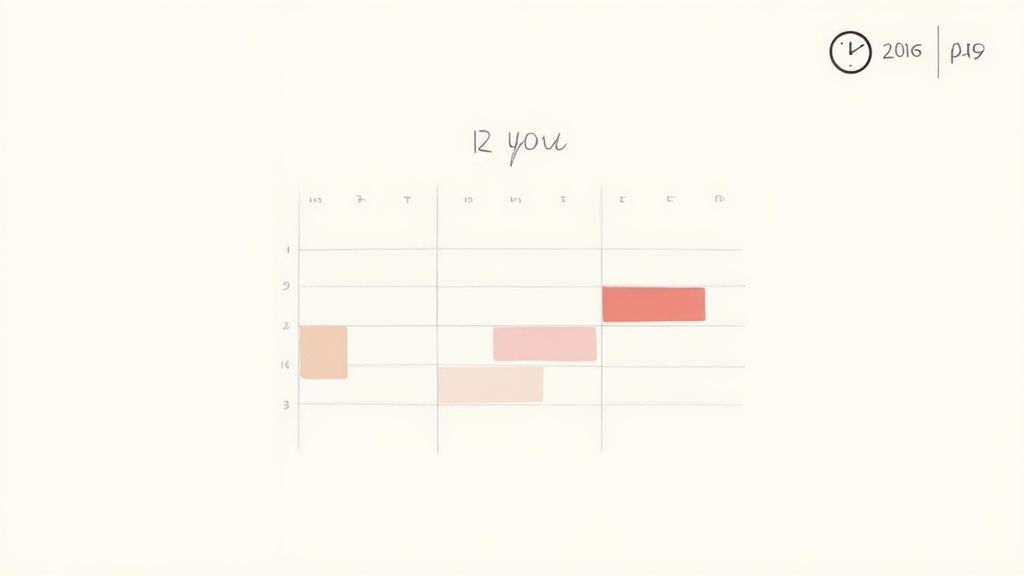
Popularized by authors like Cal Newport in his book Deep Work, this technique is used by highly productive individuals, from executives scheduling meeting-free focus time to healthcare professionals who must balance patient care with administrative duties. By creating a concrete schedule, you eliminate the decision fatigue of figuring out what to work on next, which is a common productivity drain for freelancers and remote teams. This structured approach helps transform abstract goals into a tangible, actionable plan.
Implementation and Best Practices
To successfully implement time blocking for yourself or your team, focus on these practical strategies:
- Schedule High-Impact Work First: Identify your peak energy hours (often the morning) and dedicate these blocks to your most demanding or creative tasks. Reserve lower-energy periods for administrative work like answering emails.
- Theme Your Days: Group similar tasks together into dedicated days. For instance, Mondays could be for planning and meetings, Tuesdays and Thursdays for deep work, and Fridays for wrapping up projects and administrative cleanup.
- Incorporate Buffer Time: Avoid scheduling back-to-back blocks. Add 15-minute buffers between tasks to allow for overruns, context-switching, or taking a short break. This makes your schedule more resilient and realistic. To enhance this process, you can find a variety of time boxing apps on deskcove.com that will help you.
- Color-Code Your Calendar: Use different colors in your digital calendar to visually distinguish between types of activities, such as deep work, meetings, client calls, and personal breaks. This gives you an at-a-glance overview of your day.
Key Insight: Time Blocking's main advantage is its intentionality. By deciding in advance what you will work on and when, you take control of your schedule rather than letting your schedule control you, significantly reducing reactive work and procrastination.
4. The Eisenhower Matrix
The Eisenhower Matrix is a powerful prioritization framework that helps you distinguish between tasks that are merely urgent and those that are truly important. Attributed to Dwight D. Eisenhower and popularized by Stephen Covey, this model organizes tasks into four quadrants: Do (urgent and important), Schedule (important but not urgent), Delegate (urgent but not important), and Eliminate (neither urgent nor important). This structure forces a deliberate evaluation of your to-do list, moving you from a reactive to a proactive mindset.
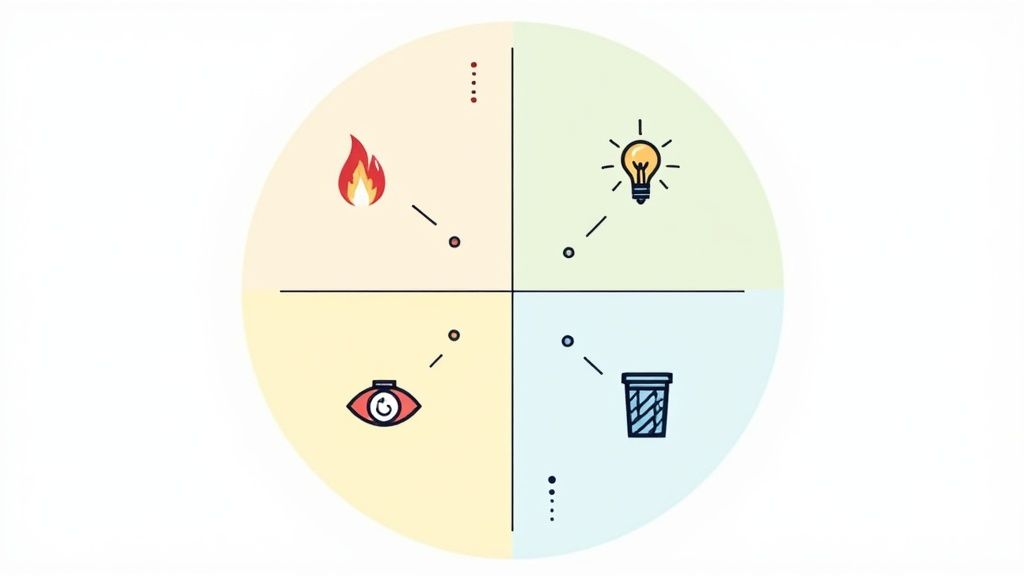
It’s particularly useful for project managers juggling competing initiatives or business leaders needing to focus on strategic goals over daily fire-fighting. By categorizing activities, you can allocate your energy where it yields the most significant results, such as scheduling deep work for a critical product feature (Quadrant 2) instead of getting bogged down by a minor, non-critical client request (Quadrant 3). This method is one of several effective task prioritization methods that can bring clarity to a complex workload.
Implementation and Best Practices
To effectively use this matrix as one of your core time management activities, follow these guidelines:
- Prioritize Quadrant 2: The "Important/Not Urgent" quadrant is where strategic growth happens. Proactively schedule dedicated, uninterrupted time for these tasks, like long-term planning or skill development.
- Delegate or Automate Quadrant 3: Urgent but unimportant tasks are prime candidates for delegation or automation. Ask yourself if you are the only person who can handle it. If not, pass it on.
- Review and Adapt Regularly: Your priorities will shift. Make it a habit to review and re-categorize your matrix at the beginning of each week to ensure it aligns with your current goals.
Key Insight: The Eisenhower Matrix’s greatest strength is its ability to reveal how much time is spent on low-value, urgent tasks. True productivity comes from intentionally shifting focus to Quadrant 2 activities, which drive long-term success and prevent future crises.
5. The 2-Minute Rule
The 2-Minute Rule is a powerful time management activity that tackles task accumulation head-on. Popularized by David Allen in his "Getting Things Done" system, the principle is simple: if a task takes less than two minutes to complete, do it immediately instead of deferring it. This prevents small, seemingly insignificant jobs from piling up and becoming a source of mental clutter and procrastination.
This method builds momentum and reduces the cognitive load of tracking numerous minor to-dos. It's especially effective for administrative or organizational tasks. For instance, a project manager can immediately file a signed contract, or a freelancer can respond to a quick client clarification email right away. By handling these micro-tasks on the spot, you clear your plate for more demanding, high-impact work, creating a more streamlined and productive workflow.
Implementation and Best Practices
To integrate this rule without disrupting your focus, consider these actionable tips:
- Define Your Threshold: While two minutes is the guideline, be realistic about your time estimates. Track a few tasks to see what genuinely fits this timeframe and adjust your personal rule accordingly.
- Batch Similar Tasks: Instead of interrupting deep work, create specific "2-minute blocks" in your schedule. Use these periods to rapidly clear out a series of quick tasks like scheduling meetings or organizing digital files.
- Use It for Decluttering: Apply the rule to your physical and digital workspaces. If organizing a few desktop files or tidying your desk takes less than two minutes, do it immediately to maintain an orderly environment.
Key Insight: The 2-Minute Rule is not about interrupting deep work for every minor task. Its value lies in creating a habit of immediate action during transitional or low-focus periods, which prevents small responsibilities from overwhelming your primary to-do list.
6. Eat the Frog
"Eat the Frog" is a powerful time management activity based on the principle of tackling your most challenging and important task first thing in the morning. Popularized by author Brian Tracy, the "frog" is that one task you are most likely to procrastinate on, but which also has the greatest positive impact on your work. By completing it before anything else, you build momentum and ensure the rest of your day feels more manageable and productive.
This strategy is particularly effective because willpower and focus are typically at their peak at the start of the day. For example, a sales professional might make their most daunting cold calls first, or a software developer could start their day by tackling a complex, high-priority bug. This approach guarantees progress on high-value work, preventing it from being pushed aside by smaller, less critical tasks that tend to fill the day.
Implementation and Best Practices
To successfully incorporate this activity into your daily routine, follow these actionable tips:
- Identify Your Frog Nightly: Before you finish work for the day, determine your most important task for tomorrow. This removes the guesswork and decision fatigue in the morning.
- Protect Your Morning: Schedule your "frog-eating" time and defend it fiercely. Avoid checking emails, messages, or social media until the task is complete to prevent distractions from derailing your focus.
- Break Down Large Frogs: If your most important task is too large to complete in one session, break it down into smaller, more manageable steps. Your goal is to eat the first "piece" of the frog.
Key Insight: The "Eat the Frog" method is fundamentally a strategy for prioritizing impact over urgency. By conquering your biggest challenge first, you create a psychological win that fuels motivation and productivity for the rest of your day.
7. Weekly Planning and Review
Weekly Planning and Review is a structured practice of dedicating time to reflect on the past week and prepare for the next. This cyclical activity, a cornerstone of systems like David Allen's Getting Things Done (GTD), creates a powerful rhythm of reflection and intention. It ensures your daily actions remain aligned with your larger goals, allowing for consistent progress and proactive course correction instead of reactive fire-fighting.
This method involves looking back at accomplishments, challenges, and lessons learned, then using those insights to set clear priorities for the upcoming week. For example, an agile team uses this cadence for sprint retrospectives and planning, while an entrepreneur might review key business metrics to adjust their focus. By creating this dedicated space for strategic thinking, you move from simply being busy to being intentionally productive, a key aspect of effective time budgeting for optimal productivity.
Implementation and Best Practices
To integrate this powerful habit into your workflow, consider these actionable tips:
- Schedule a Non-Negotiable Time: Block out a specific time each week, such as Friday afternoon or Sunday evening, and treat it like any other critical appointment. Consistency is key to making this one of the most effective time management activities you can adopt.
- Use a Consistent Template: Create a simple checklist or document to guide your review. Include sections for wins, challenges, lessons learned, and a review of your calendar, task lists, and long-term goals.
- Focus on Priorities, Not Just Tasks: After reviewing the past, identify the top 3-5 most important outcomes you need to achieve in the coming week. This shifts your focus from a long to-do list to high-impact results.
Key Insight: The power of the Weekly Planning and Review lies in its dual function as both a rear-view mirror and a GPS. It provides the clarity to understand where you've been and the focused direction needed to get where you want to go, preventing a drift into unproductive work.
8. Energy Management
Energy Management is a time management activity that prioritizes your fluctuating energy levels over the fixed progression of the clock. Popularized by Jim Loehr and Tony Schwartz, this approach posits that optimal performance depends not just on how you manage your 60-minute hours, but on how you manage your physical, mental, and emotional energy within those hours. Rather than forcing deep work when you're drained, you align your most demanding tasks with your natural high-energy periods.
This method is incredibly effective for remote workers with flexible schedules or creative professionals whose output depends on inspiration. For example, a writer might reserve their peak morning hours for drafting new content and save administrative tasks like emailing for their post-lunch energy slump. While we often focus on techniques for managing our time, it's equally important to understand the differences between energy management and time management and how they contribute to overall productivity.
Implementation and Best Practices
To integrate Energy Management into your workflow, consider these actionable strategies:
- Conduct an Energy Audit: Track your energy levels for a week to identify your personal patterns. Note when you feel most focused, creative, or fatigued. This data is the foundation of your new schedule.
- Match Tasks to Energy: Schedule high-stakes, cognitively demanding work during your peak energy windows. Reserve low-energy periods for routine tasks like organizing files, responding to simple emails, or planning.
- Prioritize Strategic Renewal: Actively schedule activities that recharge your energy, such as a short walk, a brief meditation, or a healthy snack. These are not lazy breaks; they are essential for sustained performance.
Key Insight: The fundamental shift in Energy Management is viewing energy, not time, as your most valuable resource. By protecting and strategically spending your energy, you achieve higher-quality output and prevent the burnout that comes from fighting your body's natural rhythms.
9. The 80/20 Rule (Pareto Principle)
The 80/20 Rule, also known as the Pareto Principle, is a powerful time management activity that helps prioritize tasks by focusing on impact. It posits that for many outcomes, roughly 80% of consequences come from 20% of the causes. In a work context, this means a small fraction of your efforts, clients, or tasks will generate the vast majority of your valuable results.

This principle encourages a strategic shift away from being "busy" towards being effective. For example, a sales professional might find that 20% of their clients account for 80% of revenue. Similarly, a software development team may discover that 80% of users engage with just 20% of the product's features. By identifying this vital 20%, you can direct your energy where it matters most, radically improving productivity and outcomes.
Implementation and Best Practices
To effectively apply the 80/20 rule to your workflow or team projects, consider these actionable tips:
- Identify Your High-Impact 20%: Regularly analyze your activities. Track which tasks, projects, or clients deliver the most significant results, whether measured by revenue, progress toward goals, or user satisfaction.
- Delegate or Eliminate the Low-Impact 80%: Once you've identified the less critical tasks, question their necessity. Can they be automated, delegated to a team member, or eliminated entirely? Freeing up this time is crucial.
- Combine with Other Frameworks: For maximum clarity, pair the 80/20 Rule with a prioritization tool like the Eisenhower Matrix. First, identify your vital 20% of tasks, then use the matrix to decide which of those are urgent and important.
Key Insight: The 80/20 Rule is not about working less; it's about focusing your effort on what truly drives results. Its power lies in forcing you to make conscious decisions about where to invest your most valuable resource: your time.
10. Batching and Themed Days
Batching and Themed Days is a powerful time management activity that reduces the mental cost of context switching. This technique involves grouping similar tasks together to be completed in a single block (batching) or dedicating entire days to specific types of work (themed days). By focusing on one kind of activity, you minimize the ramp-up time required to re-engage your brain, allowing you to achieve a deeper state of flow and higher efficiency.
This method is highly effective for roles with diverse responsibilities. For instance, a CEO might implement a "Meeting-Free Wednesday" for deep strategic work, while a content creator batches all their video filming into one day. Similarly, a project manager could dedicate Mondays to planning and client communication, freeing up the rest of the week for team management and execution. This approach creates a predictable structure that streamlines workflow and protects critical focus time.
Implementation and Best Practices
To make this technique work for you or your team, consider these actionable tips:
- Group by Context: Batch tasks that require the same tools, mindset, or location. For example, group all your financial tasks like invoicing and expense reporting into a single "finance block."
- Establish a Themed Schedule: Designate days for specific functions. A common split is "Meeting Monday" for alignment, "Deep Work Tuesday/Wednesday," "Admin Thursday," and "Planning Friday" to wrap up the week.
- Protect Your Blocks: Clearly communicate your themed schedule to your team. Set your status to "Do Not Disturb" during focused batches to prevent interruptions that break your momentum.
Key Insight: The core benefit of batching and themed days is the conservation of mental energy. By eliminating constant task-switching, you reduce cognitive friction and unlock a higher capacity for high-quality, focused output on your most important priorities.
Top 10 Time Management Techniques Comparison
| Method | 🔄 Implementation complexity | ⚡ Resource requirements | 📊 Expected outcomes | 💡 Ideal use cases | ⭐ Key advantages |
|---|---|---|---|---|---|
| Pomodoro Technique | Low — timer-based, easy setup | Minimal — timer or app | Improved focus, reduced fatigue in short bursts | Short tasks, study sprints, coding sessions | Easy to adopt; regular breaks reduce burnout |
| Getting Things Done (GTD) | High — multi-step system, learning curve | Medium–high — tools, time for capture & reviews | Comprehensive task clarity; reduced mental clutter | Complex projects, executives, multitasking roles | Scalable capture & reliable workflow for trust |
| Time Blocking | Medium — requires planning & discipline | Low–medium — calendar tools | Protected focus time; fewer interruptions | Deep work, packed schedules, executives | Clear daily structure; lowers decision fatigue |
| Eisenhower Matrix | Low — simple quadrant sorting | Minimal — template or notes | Better prioritization; clearer delegation | Quick prioritization, team alignment, PMs | Simple way to shift focus to important tasks |
| The 2-Minute Rule | Very low — single decision heuristic | Minimal — judgment & timing | Fewer small-task backlogs; increased momentum | Admin tasks, inbox clearing, quick wins | Immediate action reduces friction for small tasks |
| Eat the Frog | Low — pick hardest task first thing | Minimal — planning & willpower | Early accomplishment; decreased procrastination | High-priority difficult tasks; mornings | Tackles hardest work early to build momentum |
| Weekly Planning & Review | Medium — regular scheduled practice | Medium — 30–60 min weekly commitment | Better alignment; timely course correction | Project teams, entrepreneurs, GTD users | Creates rhythm and prevents drift from goals |
| Energy Management | Medium — requires tracking & self-awareness | Low–medium — simple tracking tools | Higher-quality output; sustainable productivity | Creatives, remote workers, flexible schedules | Matches tasks to energy; reduces burnout risk |
| 80/20 Rule (Pareto) | Medium — analysis and prioritization needed | Medium — data collection & review | Focus on high-impact activities; better ROI | Sales, product prioritization, strategic planning | Maximizes impact by focusing on top contributors |
| Batching & Themed Days | Medium — planning and consistency required | Low–medium — scheduling & communication | Reduced context-switching; improved flow | Content creators, marketers, admin-heavy roles | Increases efficiency and predictable workflow |
Building Your Personal Productivity Engine
Navigating the demands of modern work, whether as a project manager, freelancer, or leader of a remote team, requires more than just a to-do list. It demands a dynamic, personalized system for managing your most valuable resource: time. We've explored ten distinct time management activities, from the focused sprints of the Pomodoro Technique to the high-level prioritization of the Eisenhower Matrix and the strategic efficiency of the 80/20 Rule. These aren't mutually exclusive rules; they are the essential components you can use to construct your own unique productivity engine.
The journey to mastering your schedule is one of active experimentation, not passive adoption. A freelancer might find that combining the "Eat the Frog" method with Time Blocking creates an unstoppable morning routine for deep work. A project manager could leverage the Getting Things Done (GTD) framework for capturing all incoming requests, while using Weekly Planning and Review sessions to align their team's efforts and priorities for the upcoming sprint. The true power lies in the synthesis of these strategies.
From Theory to Tangible Results
The critical takeaway is this: true productivity isn't about finding a single magic bullet. It's about building a customized toolkit that adapts to your workflow, energy cycles, and professional goals. The most effective professionals don't just follow a method; they architect a system.
Consider these actionable next steps to move from reading to doing:
- Select Your "Starter Stack": Don't try to implement all ten activities at once. Choose two or three that resonate most with your current challenges. For instance, pair the simplicity of the 2-Minute Rule with the structure of Batching to immediately clear out small tasks and streamline your workflow.
- Conduct a One-Week Sprint: Commit to consistently applying your chosen techniques for one full business week. Treat it like a mini-project. Observe what works, what creates friction, and how it impacts your focus and output.
- Measure and Adapt: You cannot improve what you do not measure. At the end of the week, reflect. Did Time Blocking give you more control, or did it feel too rigid? Did Energy Management help you avoid the afternoon slump? Use these insights to refine your approach for the following week, perhaps swapping one technique for another.
The True Goal: Intentionality Over Activity
Ultimately, engaging in these time management activities is about reclaiming control and working with intention. It's the difference between being busy and being productive, between reacting to your day and directing it. By thoughtfully selecting and combining frameworks like the Pareto Principle and themed workdays, you shift from a reactive state to a proactive one. This strategic approach empowers you to dedicate your best energy to high-impact work, leading not only to better project outcomes and business growth but also to a more sustainable and fulfilling work-life balance. Start small, remain consistent, and begin building the powerful productivity engine that is uniquely yours.
Ready to move from guessing to knowing where your time goes? DeskCove provides the clarity you need to apply these time management activities with precision, offering automatic time tracking and productivity insights that help you and your team build a more effective workflow. See exactly how your strategies are paying off and optimize your efforts by trying DeskCove today.