10 Essential Project Estimation Techniques for 2025

Inaccurate project estimates are a fast track to derailed budgets, missed deadlines, and eroded stakeholder trust. The core issue often isn't a lack of effort but a reliance on a single, ill-suited method. Guesswork or gut feelings simply don't scale, and a one-size-fits-all approach ignores the unique complexities of each project.
The landscape of project management is diverse, and your estimation toolkit should be too. From the collaborative consensus of Agile teams to the statistical rigor required for large-scale engineering projects, the right technique exists for every scenario. Understanding how these methods influence project outcomes is crucial. For real-world insights into how project estimates directly influence budgeting and potential pitfalls, you might find valuable information in this guide on mobile app development costs.
This guide moves beyond generic advice to provide a detailed breakdown of 10 powerful project estimation techniques. We'll explore their specific mechanics, weigh their pros and cons, and provide actionable tips for implementation. You will learn how to select and apply the perfect strategy to deliver projects on time and within budget, ensuring predictable success and maintaining stakeholder confidence. Let's dive in.
1. Planning Poker (Scrum Poker)
Planning Poker, also known as Scrum Poker, is a gamified, consensus-based project estimation technique popular in Agile and Scrum frameworks. It leverages the collective wisdom of the entire team to estimate the effort required for development tasks. Instead of assigning time values, teams often use story points, which are abstract units representing a combination of complexity, risk, and effort.

The process is collaborative. A moderator or Product Owner presents a task, and team members privately select a numbered card (often following a modified Fibonacci sequence like 1, 2, 3, 5, 8, 13) that reflects their estimate. Cards are revealed simultaneously to avoid the anchoring bias, where one person's estimate influences the group. If estimates vary widely, the highest and lowest estimators explain their reasoning, followed by a discussion and re-vote until the team reaches a consensus.
Why It's Effective
This technique is powerful because it encourages discussion and surfaces diverse perspectives. A developer might identify technical complexities a tester overlooked, while a designer might point out UX challenges. By discussing outliers, the team achieves a shared understanding of the work. For agile teams, the accuracy of this method relies heavily on crafting well-defined user stories with acceptance criteria, which provide the necessary clarity for estimation. Renowned tech companies like Google and Adobe have used this method to foster collaborative estimation and improve sprint planning accuracy.
Actionable Tips for Implementation
- Establish a Baseline: Before starting, estimate a small, well-understood story to serve as a reference point for the team.
- Time-Box Discussions: Keep discussions focused by setting a timer (e.g., 2-3 minutes) for each estimation round to prevent debates from dragging on.
- Product Owner's Role: The Product Owner should be present to clarify requirements but should not participate in the voting to avoid influencing the team's estimate.
- Track Velocity: Monitor the team's velocity (the number of story points completed per sprint) to refine future forecasts and improve predictability. This is a core component for teams undergoing an Agile transformation.
2. Three-Point Estimation (PERT)
Three-Point Estimation is a statistical technique that improves upon single-point estimates by accounting for uncertainty and risk. Developed from the Program Evaluation and Review Technique (PERT), it requires subject matter experts to provide three estimates for a task: Optimistic (O), Most Likely (M), and Pessimistic (P). These values are then used in a weighted average formula, most commonly (O + 4M + P) / 6, to produce a more realistic and defensible forecast.
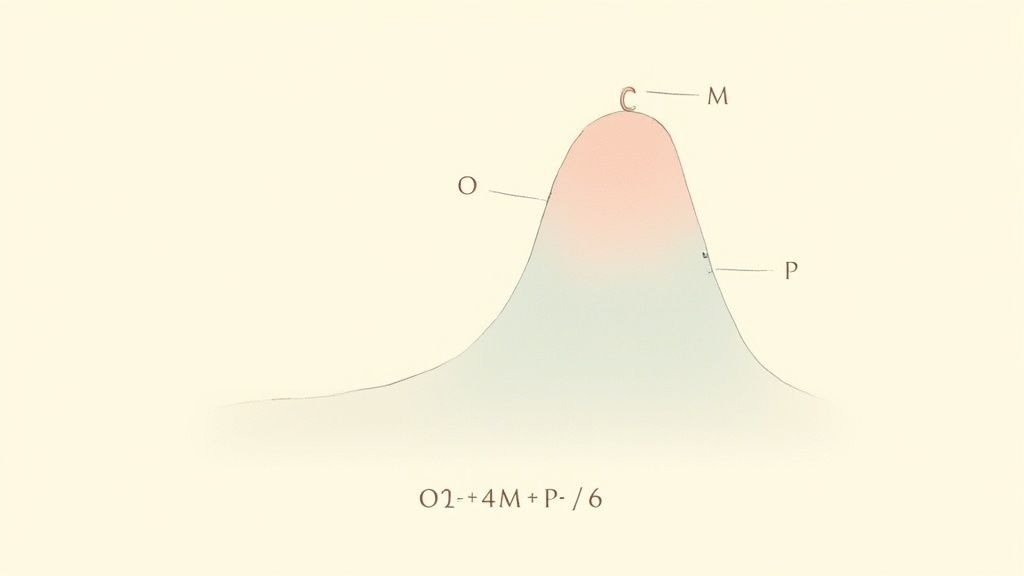
This method moves the conversation from a single, often optimistic, number to a range of possibilities. It forces teams to consider potential risks (Pessimistic scenario) and opportunities (Optimistic scenario) explicitly. Organizations like NASA and the U.S. Department of Defense have long used PERT for complex, high-stakes projects like space missions and defense systems, where managing uncertainty is paramount. It's one of the most reliable project estimation techniques for large-scale, traditional project management.
Why It's Effective
The power of Three-Point Estimation lies in its ability to quantify risk and create a probabilistic model rather than a deterministic one. It reduces the impact of cognitive biases, such as overconfidence, by forcing estimators to consider a spectrum of outcomes. This approach provides a more accurate forecast and a standard deviation, allowing managers to communicate confidence levels (e.g., "we are 95% confident the project will finish by this date"). The technique is fundamental to anyone looking to master project cost estimating and budget control.
Actionable Tips for Implementation
- Define Your Scenarios: Clearly define what "Optimistic," "Most Likely," and "Pessimistic" mean. For instance, an Optimistic estimate should be achievable around 10% of the time, not a one-in-a-million fantasy.
- Use Historical Data: Calibrate your O, M, and P estimates using data from similar past projects to ground them in reality.
- Combine with WBS: Apply three-point estimates to individual tasks within a Work Breakdown Structure (WBS) and roll them up for a more accurate overall project estimate.
- Focus on High-Risk Items: Initially apply this technique to tasks on the critical path or those with the highest degree of uncertainty to get the most value.
3. Analogous (Comparative) Estimation
Analogous Estimation, often called comparative or top-down estimation, is a project estimation technique that uses historical data from similar past projects to predict the duration or cost of a current project. It relies on expert judgment and organizational records to draw parallels between previous work and the new initiative, making it a quick way to generate an initial estimate with limited information. This method is particularly useful in the early stages of a project when detailed requirements are not yet available.
The process involves identifying one or more completed projects that are comparable in scope, complexity, and technology. Project managers then use the actual metrics from these past projects, such as total effort or cost, as a baseline. This baseline is adjusted to account for known differences in the new project, providing a high-level forecast. For example, a construction company might estimate the cost of a new office building by referencing the final cost of a similar-sized building they completed last year, adjusting for material price changes.
Why It's Effective
This technique is valued for its speed and low cost, making it ideal for initial feasibility studies or when a rough order of magnitude (ROM) estimate is needed quickly. It leverages an organization's collective experience, turning past project performance into a valuable asset for future planning. By using real-world data, it grounds estimates in historical reality rather than pure speculation. Organizations with mature project management offices (PMOs), which often maintain detailed project archives, find this method particularly reliable for early-stage forecasting and portfolio planning.
Actionable Tips for Implementation
- Maintain Detailed Archives: Keep a well-organized repository of past projects, including final scope, actual costs, and duration, to serve as a reliable data source.
- Adjust for Differences: Never use historical data as-is. Always adjust for variances in project size, team skill, technology, and complexity.
- Use Multiple Analogies: Triangulate your estimate by referencing several comparable past projects instead of relying on just one to improve accuracy.
- Document Your Assumptions: Clearly record which past projects were used and what adjustments were made. This transparency is crucial for stakeholder buy-in and future reference.
4. Parametric Estimation
In the roster of project estimation techniques, Parametric Estimation stands out as a quantitative method that uses statistical relationships between historical data and key project parameters such as lines of code, square footage or number of users. By applying mathematical models like COCOMO or Function Point Analysis teams can predict project duration and cost with greater objectivity than expert judgment alone.
The typical workflow starts with identifying relevant parameters and gathering 20 to 30 historical data points. Next, a regression or cost model is calibrated to reflect organizational performance and validated against known outcomes, making it ideal for organizations with robust historical datasets and clear parameter definitions. This method scales for complex initiatives and integrates multiple variables for deeper insights.
Why It’s Effective
Parametric Estimation leverages actual performance data to reduce bias and improve consistency. Models can be updated as new results emerge ensuring estimates remain accurate. Many aerospace, defense and software firms achieve rapid forecasts and benchmark projects across portfolios using these methods.
Actionable Tips for Implementation
- Collect a minimum of 20-30 reliable historical data points
- Clearly define and measure each parameter for consistency
- Recalibrate models regularly against actual outcomes
- Use multiple parameters for higher precision
- Report estimates as confidence intervals rather than single values
- Document all model assumptions and known limitations
5. Bottom-Up Estimation
Bottom-up estimation is a detailed project estimation technique where individual tasks or work packages at the lowest level of the project scope are estimated first. These granular estimates are then aggregated, or “rolled up,” to produce a comprehensive total for the entire project. This method builds the estimate from the ground up, ensuring no component is overlooked.
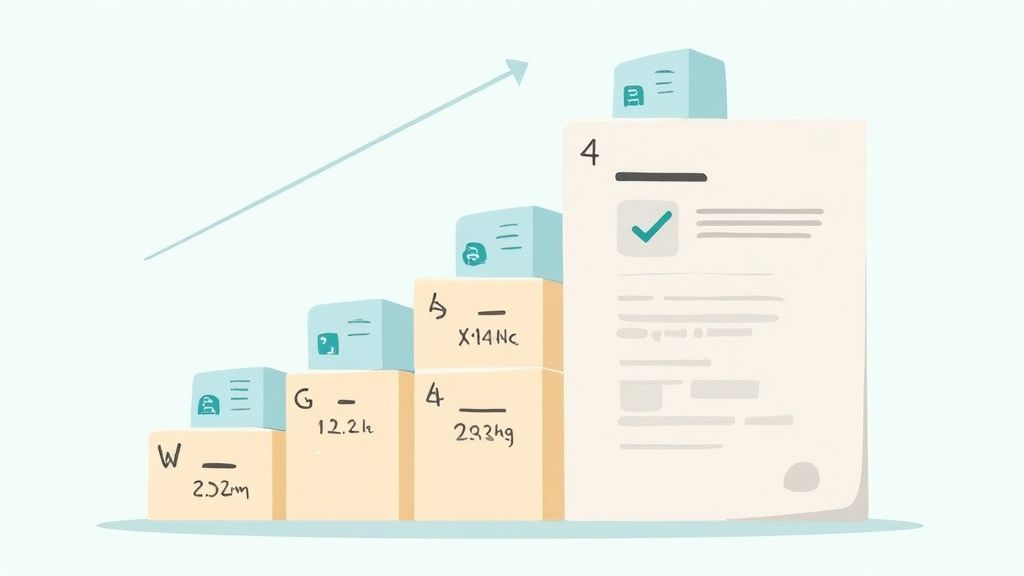
The process begins by decomposing the project into the smallest manageable components. Experts or the team members responsible for each component then estimate the effort required. These individual estimates are summed to calculate the final project estimate. This approach is common in construction projects with detailed architectural blueprints and complex IT infrastructure deployments where every single hardware and software component must be accounted for.
Why It's Effective
This technique is highly accurate because it leaves little room for ambiguity. By estimating at the most detailed level, teams ensure that all work is identified and accounted for, reducing the risk of unexpected tasks later. The granularity also improves accountability, as the individuals performing the work are directly involved in the estimation process. Its effectiveness hinges on a well-defined project scope, often detailed in a work breakdown structure that can simplify project management.
Actionable Tips for Implementation
- Define Granular Tasks: Start with a well-defined Work Breakdown Structure (WBS), breaking tasks into manageable chunks, ideally between 8 and 40 hours of effort.
- Involve Domain Experts: Have specialists or team members who will perform the work provide the estimates for their respective areas to increase accuracy.
- Add Buffers: Incorporate contingency buffers for unforeseen risks and dependencies at both the task and project levels.
- Validate Aggregated Estimates: Review the total estimate with project leads and management to ensure it aligns with overall project goals and resource availability.
6. Top-Down Estimation
Top-Down Estimation is a macroscopic project estimation technique that begins with an overall project budget or timeline and breaks it down into smaller work packages. This method is often used when high-level constraints, such as a fixed budget or a non-negotiable deadline, are established by senior management or clients at the outset. The total estimate is allocated downward to lower-level components based on expert judgment or historical data from similar projects.
The process involves starting with the "big picture" and progressively decomposing it. For example, a $500,000 budget for an enterprise software implementation might be allocated as follows: 40% for development, 20% for design, 15% for testing, 15% for project management, and 10% for deployment. Each of these high-level allocations is then further divided among more granular tasks and activities, guiding the project's scope and resource distribution.
Why It's Effective
This technique is effective for rapid, early-stage estimation when detailed information is not yet available. It provides a quick framework for strategic decision-making, budget allocation, and determining project feasibility. Government contracts with predetermined funding ceilings and large-scale corporate initiatives with executive-set timelines often rely on this approach to align project goals with organizational strategy from the start. Top-down estimation ensures that the project plan is immediately anchored to its primary financial or time constraints.
Actionable Tips for Implementation
- Combine with Bottom-Up Validation: Use the top-down estimate as an initial target but validate it with bottom-up estimates from the team to identify potential discrepancies early on.
- Build in Contingency: When allocating the budget downwards, incorporate contingency reserves into major work packages to manage unforeseen risks and scope changes.
- Document Assumptions: Clearly document the logic and assumptions behind your allocation percentages. This transparency is crucial for stakeholder alignment and future adjustments.
- Involve Experienced Managers: Rely on the judgment of senior managers or team leads who have experience with similarly scoped projects to ensure the allocations are realistic.
7. Delphi Technique
The Delphi Technique is an iterative forecasting method using structured questionnaires and controlled feedback to obtain expert consensus estimates. Developed by the RAND Corporation in the 1950s by Olaf Helmer and Norman Dalkey, it has since been adopted by defense and technology roadmap teams to project R & D timelines and strategic planning horizons.
Experts independently respond to a clearly defined estimation question, then results are aggregated anonymously. Summaries of the group’s responses and rationales are shared back with the panel, and another round of estimates follows. This cycle repeats until estimates converge or consensus is reached. Anonymity and controlled feedback help eliminate dominant voices and reduce groupthink.
Why It’s Effective
- Handles Uncertain Scopes: Ideal for complex projects without reliable historical data
- Reduces Bias: Anonymous feedback prevents anchoring and conformity pressure
- Fosters Distributed Collaboration: Remote experts can participate equally
This technique is especially useful when forecasting risk probabilities, technology roadmaps, or long-term research schedules.
Actionable Tips for Implementation
- Select Diverse Experts: Recruit 5-10 practitioners with varied backgrounds
- Define Estimation Items Clearly: Specify objectives and context up front
- Share Historical Context: Provide past metrics or case studies for reference
- Report Aggregate Results: Summarize scores and anonymized rationales each round
- Limit Rounds: Stop iterating once estimates stabilize to avoid fatigue
- Document Rationales: Capture expert reasoning for audit and learning
- Use Online Tools: Leverage platforms like SurveyMonkey or dedicated Delphi software
By following these steps, project managers and product owners can add rigor to their project estimation techniques and improve forecast accuracy.
8. Wideband Delphi
The Wideband Delphi technique is a structured, consensus-based estimation method that refines the classic Delphi method for collaborative forecasting. Popularized by software engineering pioneer Barry Boehm, it blends individual expert judgment with structured group discussion to produce more accurate and reliable estimates, particularly for complex software projects. It is one of the most respected project estimation techniques for its ability to mitigate bias.
The process involves a facilitator and a team of experts. Each expert anonymously provides their initial estimate for a task or project. The facilitator collects these estimates, charts them to show the distribution, and shares the anonymized results with the group. The team then discusses the results, especially the reasoning behind the highest and lowest estimates. This cycle of anonymous estimation, discussion, and re-estimation continues until the team's estimates converge to an acceptable range.
Why It's Effective
Wideband Delphi's strength lies in its structured approach to harnessing collective intelligence while minimizing social pressures like the bandwagon effect or the influence of a single dominant personality. The anonymous first round ensures that initial estimates are based purely on individual expertise. The subsequent facilitated discussion allows the team to share critical insights, uncover hidden assumptions, and build a comprehensive understanding of the work required. This makes it highly effective for complex system integration planning and technology feasibility assessments.
Actionable Tips for Implementation
- Brief Participants Thoroughly: Before the session, ensure all experts receive the same detailed information about the project or tasks to be estimated.
- Use Structured Worksheets: Provide a standardized worksheet for experts to break down tasks and document their estimates, assumptions, and potential risks.
- Keep Initial Estimates Anonymous: Collect the first round of estimates privately to ensure unbiased individual input before any group discussion.
- Visualize the Results: Display the range of estimates on a chart or histogram. This visual aid helps the team quickly identify the degree of consensus and locate outliers.
- Facilitate Outlier Discussion: Encourage the experts with the highest and lowest estimates to explain their reasoning, as their perspectives often reveal crucial information.
- Time-Box Discussions: Keep the estimation process efficient by limiting the time allocated for discussion in each round.
9. Use Case Points (UCP)
Use Case Points (UCP) is a software-specific estimation technique that forecasts project effort based on the system's functional requirements, as described by use cases. Introduced by Gustav Karner in 1993, this method quantifies the size and complexity of a system by analyzing its actors (users or other systems) and the use cases they interact with. It provides a structured way to turn functional specifications into a quantifiable effort estimate.
The UCP calculation involves several steps. First, it classifies actors and use cases as simple, average, or complex and assigns them weights. These are combined to find the Unadjusted Use Case Points (UUCP). Next, the estimate is adjusted using a Technical Complexity Factor (TCF) and an Environmental Complexity Factor (ECF), which account for non-functional requirements like system performance, team experience, and toolsets. The final UCP value is then converted into person-hours.
Why It's Effective
This technique is effective for object-oriented software projects, particularly those using UML, because it directly links estimates to the system’s functional requirements. It moves beyond simple code-based metrics to consider the project’s technical and environmental context, offering a more holistic view of the effort required. By systematically assessing complexity factors, UCP provides a repeatable and transparent estimation process, making it valuable for large-scale enterprise application development and systems where detailed functional analysis is critical from the outset.
Actionable Tips for Implementation
- Standardize Use Cases: Use templates to ensure all use case descriptions are detailed, consistent, and well-structured, including all actors and system interactions.
- Calibrate Adjustment Factors: Use historical data from previous projects to calibrate the Technical and Environmental Complexity Factors for your organization, improving accuracy over time.
- Validate with Experts: Combine the formula-based UCP estimate with expert judgment to validate the results and account for nuances the model might miss.
- Track and Refine: Continuously track actual project hours against UCP estimates to refine your conversion factor (person-hours per UCP) for future projects.
10. Cone of Uncertainty (Estimation Cone)
The Cone of Uncertainty is not a direct estimation technique but a framework that visualizes how project estimation accuracy improves over time. Popularized by Steve McConnell, it illustrates that estimates are inherently unreliable early in a project’s lifecycle and gradually become more precise as more information is known and key decisions are made. Initially, estimates can have a wide variance, but this range narrows, or "tightens," as the project moves from initial concept toward completion.
The model shows that at the very start of a project, an estimate might be off by as much as four times the final actual cost or time. As requirements are defined, designs are finalized, and implementation begins, the uncertainty decreases significantly. This concept is fundamental in large-scale endeavors like NASA's mission planning and Department of Defense acquisition projects, where acknowledging and managing initial uncertainty is critical for long-term success.
Why It's Effective
This framework is highly effective for managing stakeholder expectations. It provides a visual and intuitive way to communicate why early, precise commitments are risky and often inaccurate. Instead of providing a single-point estimate, teams can present a range that reflects the current level of uncertainty, building trust and transparency. It encourages an iterative approach to planning and estimation, where forecasts are revisited and refined at key project milestones or phase gates, making it one of the most realistic project estimation techniques for complex, long-term initiatives.
Actionable Tips for Implementation
- Communicate Ranges: Always present initial estimates as a range (e.g., "between 6 and 10 months") to reflect the uncertainty, and explain to stakeholders where you are in the cone.
- Refine at Phase Gates: Establish clear project phases (e.g., discovery, design, development) and re-estimate at the end of each phase before committing to the next one.
- Adjust Contingency: Use the width of the cone to justify and allocate contingency reserves. Wider cones require larger buffers for time and budget.
- Defer Commitments: Avoid making fixed-price or fixed-date commitments until the project has progressed far enough for the cone to narrow to an acceptable level of risk.
10-Method Project Estimation Comparison
| Method | Implementation Complexity (🔄) | Resource Requirements / Speed (⚡) | Expected Outcomes / Impact (📊) | Ideal Use Cases (💡) | Key Advantages (⭐) |
|---|---|---|---|---|---|
| Planning Poker (Scrum Poker) | 🔄🔄 Low–Medium — simple facilitation, synchronous | ⚡⚡ Moderate — whole-team time, cards/tools | 📊 Relative story-point estimates; ⭐⭐⭐⭐ — good for velocity and backlog sizing | 💡 Agile sprint planning, relative sizing, stable teams | ⭐ Reduces bias; team alignment; relatively quick |
| Three-Point Estimation (PERT) | 🔄🔄🔄 Medium–High — requires formulas and distributions | ⚡ Low — analyst time for three estimates per item | 📊 Probabilistic duration with ranges; ⭐⭐⭐⭐ — strong for risk analysis | 💡 Complex schedules, critical-path items, Monte Carlo inputs | ⭐ Explicitly accounts for uncertainty; statistically founded |
| Analogous (Comparative) Estimation | 🔄 Low — top-down comparison to past projects | ⚡⚡⚡ Fast — quick, low effort if data exists | 📊 Rough order-of-magnitude (ROM); ⭐⭐ — lower accuracy if dissimilar | 💡 Early-stage estimates, feasibility studies, budget proposals | ⭐ Quick and inexpensive; leverages historical data |
| Parametric Estimation | 🔄🔄🔄 High — needs models and statistical setup | ⚡⚡ Moderate — upfront data work, efficient at scale | 📊 Data-driven estimates with confidence intervals; ⭐⭐⭐⭐ — higher accuracy with good data | 💡 Programs with repeatable metrics (LOC, sqft, users) | ⭐ Repeatable, scalable, objective; measurable accuracy |
| Bottom-Up Estimation | 🔄🔄🔄🔄 Very High — task-level WBS and aggregation | ⚡ Low — time- and labor-intensive | 📊 Detailed, high-accuracy baseline; ⭐⭐⭐⭐⭐ when requirements are detailed | 💡 Large/complex projects, fixed-price contracts, detailed phases | ⭐ Most accurate; comprehensive coverage and ownership |
| Top-Down Estimation | 🔄 Low — allocate from overall budget/timeline | ⚡⚡⚡ Very fast — quick allocations | 📊 Broad allocations with low granularity; ⭐⭐ — less precise | 💡 Portfolio planning, initial budgeting, time-constrained planning | ⭐ Fast alignment to budgets; useful for high-level planning |
| Delphi Technique | 🔄🔄🔄 Medium–High — iterative surveys and facilitation | ⚡ Low — time-consuming, expert time costly | 📊 Expert consensus with documented rationale; ⭐⭐⭐⭐ — good for novel problems | 💡 Forecasting, R&D timelines, high-uncertainty decisions | ⭐ Reduces groupthink; structured anonymous input |
| Wideband Delphi | 🔄🔄 Medium — hybrid rounds plus facilitated discussion | ⚡⚡ Moderate — workshops and facilitator needed | 📊 Faster expert consensus with discussion; ⭐⭐⭐⭐ — practical for software | 💡 Software estimation workshops, complex integrations | ⭐ Combines anonymity with collaborative insight; faster than Delphi |
| Use Case Points (UCP) | 🔄🔄🔄 Medium–High — requires detailed use cases and calibration | ⚡⚡ Moderate — needs modeling and historical rates | 📊 Effort in person-hours tied to functionality; ⭐⭐⭐ — effective for use-case driven dev | 💡 UML/use-case-based software projects, enterprise apps | ⭐ Focuses on business functionality; objective calculation method |
| Cone of Uncertainty | 🔄 Low — conceptual/visual framework | ⚡⚡⚡ Fast — simple to present and adopt | 📊 Shows estimate accuracy over time; ⭐⭐⭐ — guides expectations and contingencies | 💡 Stakeholder communication, phase-gate planning, contingency justification | ⭐ Visualizes uncertainty; supports progressive refinement and reserves |
From Estimating to Executing: Turning Numbers into Results
We've explored a comprehensive suite of project estimation techniques, from the collaborative dynamics of Planning Poker to the statistical rigor of Three-Point Estimation. Each method offers a unique lens through which to view project timelines, resources, and complexity. Analogous and Parametric estimation leverage historical data for quick, data-driven forecasts, while Bottom-Up estimation provides granular accuracy at the cost of initial effort.
The journey from a vague project idea to a confident, executable plan is paved with these methodologies. The Delphi and Wideband Delphi techniques harness collective expert wisdom to cut through ambiguity, and understanding the Cone of Uncertainty reminds us that estimation is an evolving process, not a one-time event. Mastering these approaches is not about finding a single, perfect formula; it's about building a versatile strategic toolkit. The real skill lies in knowing when to apply a swift Top-Down estimate versus when a project demands the detailed scrutiny of a Bottom-Up analysis.
The Art of Blending and Refining
The most successful project managers rarely rely on a single technique in isolation. They become adept at blending methods to create a more robust and reliable forecast. For instance, you might use a Top-Down approach to establish a high-level budget and timeline for stakeholders, then employ a detailed Bottom-Up estimate with your team to validate and refine those initial numbers.
This hybrid approach creates a powerful system of checks and balances. Here are a few practical combinations:
- Analogous + Bottom-Up: Use a past, similar project (Analogous) to create a baseline. Then, break down the current project into its smallest components (Bottom-Up) to see how closely it aligns with the initial comparison, identifying key differences early.
- Three-Point + Planning Poker: Have your team use Planning Poker to estimate individual user stories. For larger, more complex epics, apply the Three-Point (PERT) formula to account for best-case, worst-case, and most likely scenarios, giving you a more nuanced view of risk.
- Delphi + Parametric: Engage experts using the Delphi technique to identify the key variables and drivers of a project. Then, use those identified variables to build a Parametric model that can scale and adapt as project scope changes.
Turning Estimates into Actionable Intelligence
Ultimately, an estimate is just a number until it's validated against reality. This is where the crucial feedback loop comes into play. Your estimates, no matter how carefully crafted, are hypotheses. The real work begins when you start tracking actual time and effort against those initial predictions. This continuous cycle of estimating, executing, tracking, and refining is what separates amateur forecasting from professional project management.
By systematically comparing your estimates to actual performance data, you don't just complete the current project more effectively; you sharpen your sword for the next one. You begin to understand your team's unique velocity, identify common bottlenecks, and calibrate your future use of these project estimation techniques with empirical evidence. This transforms estimation from a mandatory chore into a powerful engine for continuous improvement, predictability, and, ultimately, project success. Start today by selecting two or three techniques that fit your team's context and commit to tracking the results.
Ready to close the gap between your estimates and reality? DeskCove provides the crucial data you need by tracking the actual time your team spends on tasks. By integrating real-world performance data, you can validate your forecasts, refine your estimation models, and make every future project more predictable. Sign up for DeskCove today and turn your estimates into a strategic advantage.