A Modern Remote Work Policy Template for Your Team

Think of a formal remote work policy template as the blueprint for managing your team, no matter where they log in from. It’s the official playbook that lays out the rules, expectations, and guidelines so everyone is on the same page. This single document brings consistency, legal footing, and operational clarity to your entire distributed workforce.
Why Your Business Needs a Clear Remote Work Policy

Shifting to a remote or hybrid model isn't a temporary fix anymore—it's a core business strategy. If you’re operating without a formal policy, you’re essentially running on assumptions. That’s a recipe for confusion, feelings of unfairness, and a dip in productivity.
A well-crafted remote work policy cuts through the noise. It becomes the single source of truth for your team, setting crystal-clear expectations around performance, communication, and availability. This clarity reduces friction and frees up your team to do their best work instead of trying to figure out unwritten rules. It’s the bedrock for building the trust, accountability, and autonomy your people need to thrive.
Attract and Retain Top Talent
In today’s job market, flexibility isn’t just a nice-to-have; it’s a non-negotiable for attracting and keeping the best people. The demand for remote work is massive—recent surveys show that 91% of employees globally prefer to work either fully or mostly from home. That number alone shows just how crucial a formal policy is for your hiring and retention strategy.
When you present a clear, supportive remote work policy, you're sending a powerful message to potential hires: "We're a forward-thinking employer, and we care about your well-being."
A remote work policy is more than a set of rules; it's a public declaration of your company's trust in its people. It signals that you value outcomes over physical presence, empowering your team to deliver their best work from anywhere.
Mitigate Risks and Ensure Consistency
A formal policy doesn't just empower your team; it also protects your business. It gives managers a consistent framework to apply rules fairly across the board, which dramatically reduces the risk of someone feeling singled out or claiming unfair treatment. It also helps you get ahead of the many common work-from-home challenges before they snowball into bigger problems.
By clearly defining security protocols, rules for using company equipment, and communication standards, your policy creates a stable and secure foundation for your operations. This proactive approach ensures that as your company scales, your remote work practices remain compliant, secure, and perfectly aligned with your business goals.
Building the Core of Your Remote Work Policy

Alright, you've got the 'why' sorted. Now it's time to get into the nitty-gritty—the 'how'. This is where your remote work policy template really comes to life. These core components will become the operational backbone for your distributed team, making sure everyone knows the rules of the road right from the start.
A good policy isn't just a list of 'don'ts'. It’s an empowering document that clarifies who can work remotely, what’s expected of them, and how the company has their back. Without this solid foundation, you’re just inviting confusion and inconsistency down the line.
Defining Eligibility and Expectations
Let’s be real: not every role is cut out for full-time remote work, and your policy needs to be upfront about that. The first thing to do is define crystal-clear eligibility criteria.
Is it based on the job function itself? Performance history? Or a mix of both? For example, a sales role that demands constant face-to-face client meetings might be a better fit for a hybrid model, whereas a software developer could easily be 100% remote.
Just as crucial is setting clear expectations around work hours and availability. If your team is spread across different time zones, you need to establish core collaboration hours. These are the windows when everyone agrees to be online for meetings and quick chats, which is a lifesaver for preventing burnout and making sure important conversations don't get lost in translation.
Speaking of alignment, it's a smart move to include guidelines for seamless collaboration. This often means leaning on tools that provide efficient calendar synchronization and meeting management, keeping everyone in sync no matter where they are.
Communication Protocols and Security Measures
Clear communication is the absolute lifeblood of any remote team. Your policy should get specific about which tools to use for what. Think of it as a playbook for your team's interactions.
- Slack or Microsoft Teams: Perfect for those daily check-ins and quick, informal questions.
- Zoom or Google Meet: Your go-to for scheduled team meetings and one-on-ones.
- Email: Best reserved for more formal announcements and communicating with people outside the company.
This kind of structure stops important messages from vanishing into the wrong channel.
Now, let's talk security. Protecting company data is a huge deal when people are working from home, coffee shops, or anywhere else. Your policy should mandate the use of VPNs, require strong and unique passwords for all work accounts, and spell out exactly how to handle sensitive information.
Your security policy needs to be simple and non-negotiable. Clearly state that company devices are for business use only and lay out the consequences for not following data protection rules. This isn't about being punitive; it's about protecting both the employee and the company.
Equipment, Support, and Performance
Finally, let's tackle the practical side of the remote setup. Your policy must be explicit about what the company provides versus what the employee is responsible for. Are you shipping out laptops, or are you offering a stipend for home office gear? Get specific about what's covered to avoid any gray areas.
You also need a clear, easy-to-follow process for tech support. If a company laptop suddenly dies, who does the employee call? What’s the expected response time? A defined protocol here saves a ton of time and frustration for everyone.
Performance management needs a shift in mindset, too. Instead of focusing on hours clocked, the evaluation should pivot to outcomes and results achieved. This builds a culture of trust and empowers your team.
Of course, productivity still matters. Getting a handle on best practices for time tracking for remote employees can help managers ensure fairness and accountability without slipping into micromanagement.
With these core elements in place, it helps to see them all laid out. Here’s a quick breakdown of the essential clauses you'll want to include.
Key Clauses for Your Remote Work Policy
This table outlines the essential components of a robust remote work policy, explaining the purpose and key considerations for each clause to ensure clarity and effectiveness.
| Policy Clause | Purpose and Key Considerations |
|---|---|
| Eligibility Criteria | Defines which roles or employees are eligible for remote work. Consider job function, performance metrics, and tenure. |
| Work Hours & Availability | Sets expectations for working hours, including core collaboration times for teams across different time zones. |
| Communication Protocols | Specifies the primary tools (e.g., Slack, Zoom, Email) for different types of communication to ensure consistency. |
| Data Security & Confidentiality | Outlines mandatory security practices like VPN usage, password policies, and handling of sensitive company information. |
| Equipment & Technology | Clarifies what the company provides (e.g., laptop, stipend) and what the employee is responsible for. |
| Technical Support | Establishes a clear process for resolving technical issues, including contact points and expected response times. |
| Performance Management | Describes how performance will be measured, focusing on results and outcomes rather than hours worked. |
| Workspace Requirements | Suggests guidelines for a safe and productive home office environment, touching on ergonomics and internet connectivity. |
Having these clauses clearly defined and communicated is the key to creating a remote work policy that not only protects the company but also empowers your team to do their best work, no matter where they are.
Adapting Your Policy for a Global Team

When your team starts spanning multiple countries, a single, rigid remote work policy is almost guaranteed to fail. What works perfectly in one country can be impractical—or even illegal—in another. That’s why adapting your remote work policy template for a global workforce isn't just a good idea; it’s an absolute necessity for compliance and fairness.
The biggest hurdles you'll face are often legal and financial. Employment laws, tax obligations, and statutory benefits like paid time off can vary dramatically from one country to the next. For instance, an employee in Germany has completely different legal protections and holiday entitlements than one in the United States. Ignoring these regional nuances can land you in hot water with compliance issues and hefty fines.
Your policy has to be flexible enough to handle these differences. A smart approach is to create a core global policy that outlines the company's universal principles and values. Then, you can supplement it with country-specific addendums that detail local legal requirements and benefits.
Navigating Time Zones and Cultural Norms
Beyond the legal complexities, you have the day-to-day practical challenges of running a global team. Managing multiple time zones requires a thoughtful approach to avoid burning people out and to make sure collaboration actually happens.
Don't mistake "flexible hours" for "always available." Your policy should protect your team's work-life balance by defining core collaboration hours and setting clear expectations about response times outside of standard working hours for each region.
Communication styles also differ profoundly across cultures. What’s seen as direct and efficient in one culture might be perceived as abrupt or rude in another. Recognizing these differences is the first step toward building a truly inclusive environment. If you want to dive deeper, learning how to start mastering cultural barriers for global success can significantly boost your team’s cohesion.
Building an Equitable Global Framework
Crafting a fair policy for a diverse, international team means being intentional about equity. This goes beyond just adhering to local laws; it's about building a cohesive company culture that respects and even celebrates regional differences.
Here’s how you can strike that balance:
- Standardize When Possible: Use your core policy to keep things like your company's mission, performance metrics, and security protocols consistent for everyone.
- Localize When Necessary: Customize elements like public holidays, standard working hours, and expense reimbursement policies to align with local laws and customs.
- Gather Regional Input: Don't draft this in a vacuum. Involve team members from different regions when you're writing or updating the policy to make sure it’s practical and culturally sensitive.
This balanced approach acknowledges the diverse needs of a global team. It’s no surprise that many countries are becoming hubs for remote talent. Nations like Spain, Portugal, Canada, New Zealand, and Japan are ranked among the best for remote work environments, attracting a mobile workforce. In fact, recent data shows that millennials make up half of the workers who have moved internationally for remote roles, underscoring just how important a well-adapted global policy is.
Ultimately, your goal is to create a framework that supports every single employee, no matter where they are in the world.
Navigating Return-to-Office in Your Policy
Let's be honest: the shift from fully remote to a hybrid model can feel like walking a tightrope. One wrong move and you risk alienating your team and eroding all the trust you've built. That's why weaving return-to-office (RTO) guidelines into your remote work policy template has to be done strategically.
The most important piece of advice I can give is this: frame RTO as a collaborative evolution, not a top-down mandate. Start by openly communicating the "why" behind the shift. Is the goal to spark innovation through in-person brainstorming? Strengthen team cohesion? Provide better hands-on mentorship for junior employees? When your reasoning is clear and tied to business outcomes, it feels intentional, not arbitrary.
This isn't just a hunch; the data backs it up. We're seeing a massive shift in the working world, with around 70% of companies now having formal RTO policies. A staggering 93% of business leaders believe their teams should be in the office at least part of the week.
But here's the catch: forcing the issue is risky. A recent survey found that a striking 41% of employees would start job hunting if faced with a full five-day mandate. You can discover more insights about this evolving workplace dynamic to see just how critical a thoughtful approach is.
Structuring a Fair Hybrid Arrangement
To find a sustainable middle ground, you need to build flexibility into the structure. Ditch the rigid, one-size-fits-all rules, because different roles have different needs. A client-facing team, for instance, probably gets more value from in-office time than a development team that thrives on deep, uninterrupted focus.
Here are a few practical ways I've seen companies successfully structure their RTO guidelines:
- Core In-Office Days: Designate specific days—say, Tuesday and Thursday—when everyone comes in. This concentrates collaborative energy and maximizes the value of the commute without requiring it five days a week.
- Team-Led Schedules: This is a big one for autonomy. Empower individual teams to set their own in-office rhythm. This ensures the schedule actually supports their unique workflows, not hinders them.
- The Office as a "Hub": Instead of making the office the default place for daily tasks, position it as a destination for specific, high-value activities. Think project kickoffs, all-hands meetings, and team-building events.
The real goal of an RTO policy isn't just to fill seats in a building; it's to intentionally design how and where your team does its best work. Frame the office as a tool for connection and collaboration, not a prerequisite for productivity.
Communicating Your RTO Policy Effectively
How you roll out the new guidelines is just as critical as the rules themselves. If you want to prevent your top talent from heading for the door, lead with transparency and empathy.
Start the conversation early—long before the policy is finalized. Create genuine channels for feedback, like Q&A sessions, anonymous surveys, and one-on-one check-ins with managers to hear individual concerns.
You need to acknowledge that this is an adjustment for everyone. Signal that the policy is a living document, one that will be refined based on what works for the team and the business. This kind of collaborative approach goes a long way in preserving the flexibility employees now cherish while still meeting the company's need for in-person connection.
How to Implement and Communicate Your New Policy
You’ve done the hard work and created a solid remote work policy. That's a huge step, but it’s only half the battle. A brilliant policy does absolutely nothing if it just sits unread in a company folder. The real magic happens during the rollout—a thoughtful, transparent process that gets your entire team on board and primed for success.
The objective isn't just to dump a list of new rules on people. It's about building understanding and getting genuine buy-in. If you communicate it poorly, you risk creating anxiety and confusion, which can chip away at the very trust you're trying to build. This process is all about turning a document into a shared mindset for how your company operates.
Kicking Off a Smooth Transition
First things first, you need a plan for the announcement. Don't just attach the policy to an email and hit send. That’s a recipe for confusion. Instead, schedule a dedicated all-hands meeting (virtual, of course) to walk everyone through the new guidelines. This creates a forum for immediate questions and shows your team you actually care about their perspective.
During the meeting, spend time on the "why" behind each major part of the policy. People are much more likely to embrace change when they understand the reasoning, whether it's about tightening security, boosting productivity, or staying compliant. Once the meeting is over, make sure the policy is dead simple to find. Using the right document management software is key here, as it guarantees everyone can pull up the latest version whenever they need it.
This visual breaks down a simple but effective way to introduce a new remote or RTO policy, focusing on clear communication and finding a fair balance.
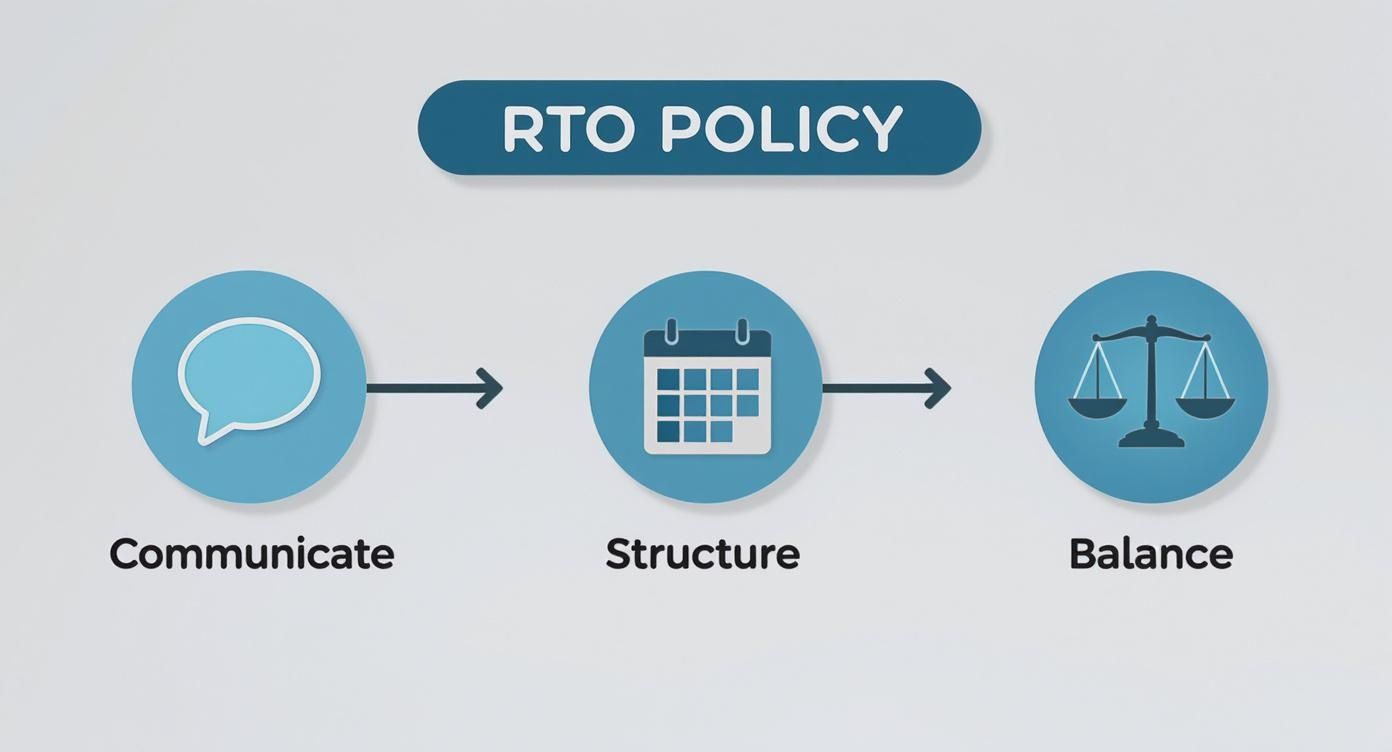
The main takeaway is that each step is built on the one before it, ensuring the final structure is grounded in transparent communication from the start.
Equipping Managers and Gathering Feedback
Your managers are on the front lines of making this policy work. They’re the ones who will field daily questions and handle specific team scenarios. It’s absolutely critical to arm them with the training they need to lead distributed teams well.
Host dedicated training sessions for your leadership that dig into:
- Managing by outcomes, not just by who has a green status dot.
- Running inclusive virtual meetings where every voice is heard.
- Spotting the signs of burnout and actively supporting team well-being.
Finally, make sure you have a clear feedback loop. Your remote work policy template shouldn't be set in stone; it's a living document that needs to breathe.
A great policy evolves with your team. Make it clear that you will review the guidelines quarterly or semi-annually based on feedback from employees and managers. This shows you're committed to creating a system that truly works for everyone.
Use anonymous surveys and one-on-one check-ins to get honest opinions. This cycle of continuous improvement is what will keep your policy relevant, fair, and supportive of a great remote culture for years to come.
Common Questions About Remote Work Policies
Even the most thorough remote work policy will spark a few questions. That's a good thing—it means your team is actually reading it. Getting ahead of these common queries builds trust and turns your policy from a static document into a practical guide everyone can rely on.
Here are some of the questions that pop up most often.
How Often Should We Update Our Remote Work Policy?
Think of your policy as a living document, not something you carve in stone. A formal review once a year is a good rule of thumb to make sure it’s still relevant and effective.
But you have to be ready to act faster. If new employment laws pop up in a state where you hire, your business pivots, or you’re getting consistent feedback from the team, those are all great reasons to revisit the policy ahead of schedule.
Your policy is a tool to support your team, not just a list of rules. Use employee surveys to find out what's working and what isn't. This lets you evolve the policy to actually help people, not just govern them.
Who Is Responsible For Home Office Expenses?
This is a big one, and you need to be crystal clear. Companies handle this in a few different ways, and your policy must spell out exactly where you stand to avoid any confusion or resentment down the line.
Some common approaches include:
- A one-time stipend to help new hires get their home office set up comfortably and ergonomically.
- A monthly allowance to cover ongoing costs like high-speed internet or other utilities.
- A reimbursement plan where team members can submit receipts for approved business expenses.
You also need to be upfront about equipment. Do you provide laptops and monitors, or do you have a BYOD (Bring Your Own Device) policy? If it’s the latter, you absolutely must include detailed security requirements to protect company data on personal devices.
How Can We Track Productivity Without Micromanaging?
This is a trap many managers fall into. The secret is to shift your focus from activity to outcomes. The best remote teams run on trust and accountability, not digital babysitting. Watching a status indicator is a terrible way to measure actual work.
Forget about tracking keyboard clicks. Instead, set clear, measurable goals for projects and tasks. Use project management software so everyone can see progress, and stick to regular check-ins—like daily stand-ups or weekly syncs—to keep the team aligned. This approach gives your people the autonomy to manage their own time while ensuring the work gets done right.
Can Different Teams Have Different Remote Work Rules?
Yes, but you have to handle it carefully to keep things fair. It makes perfect sense that a sales role might need more face-to-face client time than a backend developer who needs long stretches of uninterrupted focus.
The trick is to base any differences on the objective needs of the job, not on a manager’s personal preference. Your core policy—the stuff about security, communication tools, and company-wide values—should apply to everyone. From there, you can allow for department-specific guidelines that make sense for their workflow. Just be transparent about why these differences exist to maintain trust across the company.
A solid policy is your foundation, but you still need the right tools to ensure everyone stays productive. DeskCove offers simple, effective time tracking and monitoring that gives you the insights you need without the guesswork. See how you can improve your remote work management.