7 Top Work Schedule Examples for Teams in 2025

The traditional 9-to-5 is no longer the only option for modern businesses. As teams become more distributed and the focus on work-life balance intensifies, selecting the right work schedule is a critical strategic decision. A well-designed schedule can dramatically boost productivity, improve employee retention, and enhance overall well-being. This guide moves beyond theory to provide a deep dive into seven diverse work schedule examples, breaking down the tactical advantages and potential challenges of each.
We will analyze popular models like the four-day work week, flextime, and hybrid arrangements. For each example, we'll offer a strategic breakdown, highlight actionable takeaways, and provide replicable methods you can adapt for your small business, remote team, or freelance career. You'll gain practical insights to implement a structure that drives results and fosters a healthier, more engaged work environment. To help bring these concepts to life, using a personalized schedule builder can be a valuable tool for creating and visualizing the ideal daily, weekly, or monthly routines for your team. Let's explore the schedules that can redefine how your team works.
1. Four-Day Work Week (4/10 Schedule)
The four-day work week, often structured as a 4/10 schedule, is a compressed model where employees work four 10-hour days instead of the traditional five 8-hour days. This approach maintains a 40-hour work week but provides employees with an extra day off, typically resulting in a three-day weekend. This model has surged in popularity as companies seek to boost productivity, improve employee well-being, and gain a competitive edge in talent acquisition.
By consolidating work hours into fewer days, the 4/10 schedule aims to increase focus and efficiency during workdays while offering a more substantial period for rest, personal pursuits, and family time. Companies like Buffer, Kickstarter, and even government bodies in Iceland have successfully piloted or fully adopted this model, reporting higher employee satisfaction and reduced burnout without sacrificing output.
Strategic Breakdown & Analysis
The primary strategy behind the 4/10 schedule is to trade longer workdays for a longer weekend. This fundamentally reshapes the work-life balance equation, giving employees a full day back for personal errands, hobbies, or rest. The longer workday necessitates deep focus and efficient time management, often leading to more productive work sessions and fewer context-switching distractions that plague a standard five-day week.
To visualize the core components of this schedule, here is a quick reference summary.
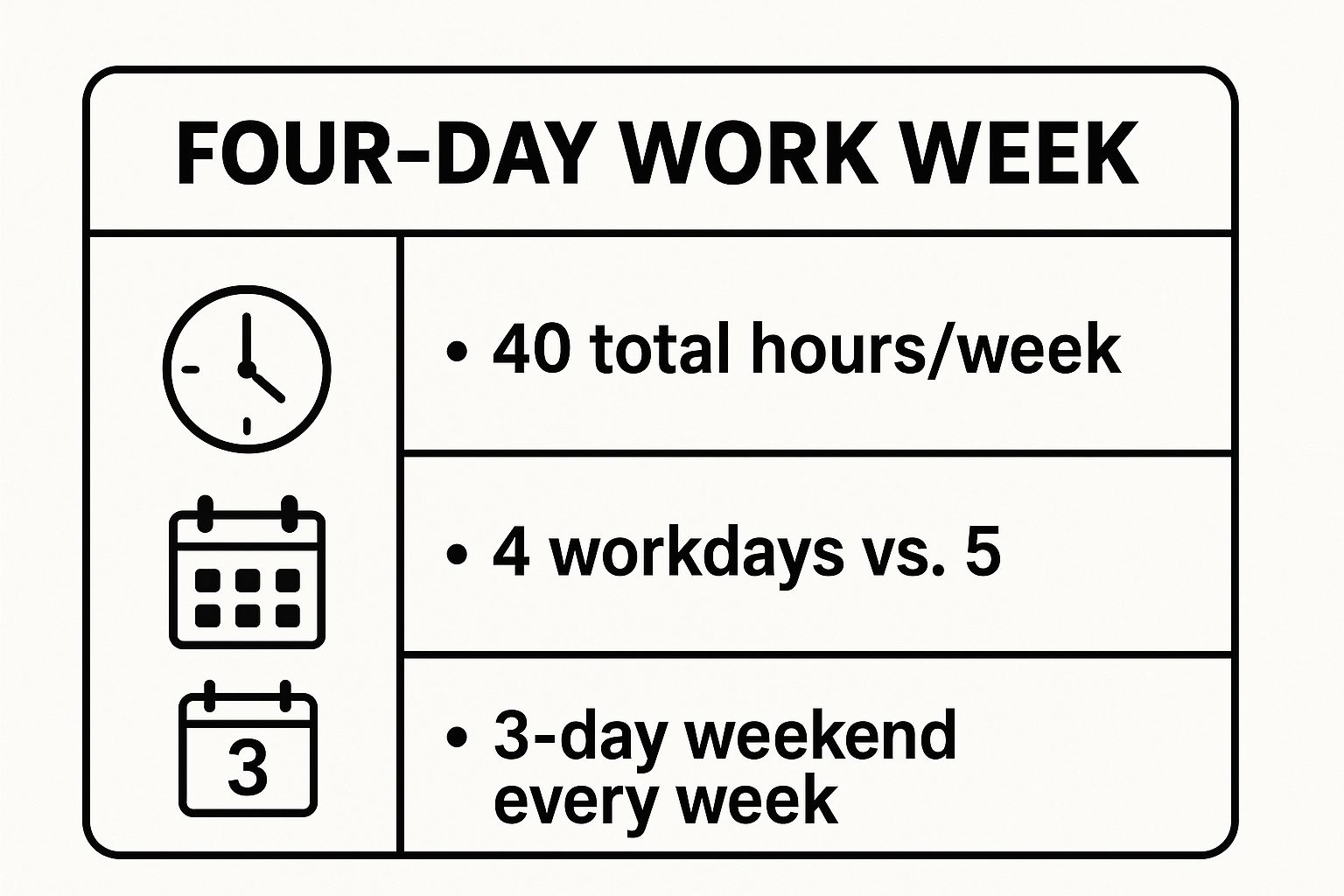
This visual breakdown highlights how the 40-hour work week is maintained while fundamentally restructuring the work-life dynamic.
Actionable Takeaways & Implementation
For businesses considering this powerful work schedule example, a phased approach is crucial for success.
- Launch a Pilot Program: Start with a specific team or department to test the 4/10 model. This allows you to gather data, identify potential challenges, and refine processes before a company-wide rollout.
- Establish Clear Protocols: Define communication expectations, especially for the team's day off. Ensure clients and other departments understand the new availability schedule to prevent service disruptions.
- Monitor Key Metrics: Track productivity, employee engagement, and burnout levels. Use surveys and performance data to measure the impact of the schedule change and make informed adjustments.
2. Flexible Work Hours (Flextime)
Flexible work hours, commonly known as flextime, offer an alternative to the rigid 9-to-5 schedule. This arrangement allows employees to set their own arrival and departure times within agreed-upon limits, as long as they complete their total required hours and are present during a designated "core" period for collaboration. This model empowers employees with autonomy over their schedules, accommodating personal needs like appointments or family commitments without sacrificing work responsibilities.
The core idea of flextime is to focus on output rather than the specific hours worked. It has been a staple in progressive workplaces for decades, from German companies in the 1960s to modern tech giants, because it acknowledges that productivity isn't one-size-fits-all. By giving employees control over their work-life integration, businesses can foster a culture of trust and responsibility, which often leads to higher morale and retention rates.
Strategic Breakdown & Analysis
The strategy behind flextime is to grant autonomy in exchange for accountability. It allows employees to align their work schedules with their personal peak productivity times, whether they are early birds or night owls. The "core hours" component is the critical safeguard that ensures team cohesion and communication are not compromised, creating a balanced system that benefits both the individual and the organization.
To understand the key components of this powerful work schedule example, here is a quick reference summary.

This visual guide illustrates how flextime provides a structured yet adaptable framework, ensuring collaboration while empowering individual work styles.
Actionable Takeaways & Implementation
For organizations looking to implement this schedule, a clear and well-communicated framework is essential for a smooth transition. To boost productivity with a flexibility schedule in your workplace, consider a strategic rollout.
- Define Core Hours: Establish a mandatory window (e.g., 10 a.m. to 2 p.m.) when all team members must be online and available for meetings and collaborative tasks. This ensures team synergy remains strong.
- Utilize Scheduling Tools: Implement shared calendars or scheduling software to provide visibility into when team members are working. This transparency prevents confusion and streamlines coordination.
- Set Clear Communication Norms: Create guidelines for response times to messages and emails sent outside of core hours. This manages expectations and prevents pressure on employees to be "always on."
3. Remote Work Schedule
The remote work schedule is an arrangement where employees perform their duties from a location outside of a traditional office, such as a home office or co-working space. This model offers maximum geographic flexibility, unshackling work from a physical headquarters. Accelerated by global events and enabled by technology, it has become a cornerstone of modern work culture, embraced by companies like GitLab and Automattic that operate with fully distributed teams.
This approach prioritizes autonomy and trust, allowing employees to integrate work into their lives rather than structuring their lives around work. It fundamentally shifts the measure of performance from physical presence to tangible output and results. Companies adopting this model often benefit from a wider talent pool, reduced overhead costs, and increased employee satisfaction, making it one of the most transformative work schedule examples.

Strategic Breakdown & Analysis
The core strategy of a remote work schedule is to decouple productivity from a specific location. It operates on the principle that great work can happen anywhere, provided employees have the right tools, support, and clear objectives. This model hinges on asynchronous communication, robust digital infrastructure, and a culture of explicit documentation to ensure everyone stays aligned, regardless of their time zone.
By removing the commute and the constraints of a physical office, the remote model empowers employees to design a work environment that best suits their needs. The focus shifts from "hours clocked" to "goals achieved," promoting a results-driven culture. This requires a high degree of trust and personal accountability, but the payoff is often a more engaged and empowered workforce. For a deeper dive into the specifics, you can learn more about embracing this flexible employment model.
Actionable Takeaways & Implementation
For organizations transitioning to or optimizing a remote work schedule, deliberate planning is key to harnessing its full potential.
- Invest in a Digital Toolkit: Equip your team with essential collaboration tools, including project management software, communication platforms, and reliable video conferencing software.
- Establish Clear Communication Norms: Create guidelines for response times, meeting etiquette, and the primary channels for different types of communication. This prevents confusion and ensures information flows smoothly.
- Promote Work-Life Boundaries: Encourage employees to set clear start and end times, create dedicated workspaces, and take regular breaks. Actively discourage an "always-on" culture to prevent burnout.
4. Shift Work Schedule
The shift work schedule is an essential model for industries that require continuous, 24/7 operation. This approach divides the day into multiple work periods, or "shifts," ensuring that a business is always staffed and operational. Unlike a standard 9-to-5, shift work can include day, evening, night, and rotating schedules, with employees working set blocks of hours that cover the entire 24-hour cycle. This model is the backbone of critical sectors like healthcare, manufacturing, and public safety.
From hospitals providing round-the-clock patient care to manufacturing plants maximizing production capacity, the shift work model is indispensable. The structure allows organizations to meet constant demand, provide essential services without interruption, and optimize the use of expensive equipment and facilities. Its successful implementation hinges on careful planning, clear communication, and a strong focus on employee well-being to mitigate the challenges of non-traditional hours.
Strategic Breakdown & Analysis
The core strategy of shift work is to achieve continuous operational coverage by staggering employee start and end times. This method maximizes productivity and service availability beyond the limits of a traditional workday. Different patterns, such as the DuPont or Pitman schedules, offer various rotations to balance operational needs with employee rest, aiming to prevent fatigue while ensuring every hour is covered. This makes it a powerful work schedule example for operations that cannot afford downtime.
To better understand the fundamentals of this schedule, here is a breakdown of how it operates.
This video explains the health and logistical considerations vital for successfully managing shift-based roles.
Actionable Takeaways & Implementation
For organizations implementing or optimizing a shift work schedule, prioritizing employee health and operational clarity is key.
- Design Fair and Predictable Rotations: Develop a rotating schedule that is transparent and gives employees ample notice to plan their personal lives. Whenever possible, rotate shifts forward (day to evening to night) as it aligns better with the body's natural circadian rhythms.
- Prioritize Employee Well-being: The demands of non-traditional hours can be taxing. Offer resources like employee assistance programs, promote healthy sleep hygiene, and ensure break areas are comfortable and well-lit, especially for night shifts.
- Establish Clear Handoff Procedures: Create standardized protocols for shift changes to ensure a seamless transfer of information and responsibilities. This minimizes errors and maintains operational continuity between outgoing and incoming teams. For a deeper dive, you can explore more about understanding shift work patterns.
5. Compressed Work Week (9/80 Schedule)
The 9/80 schedule is a compressed work week model where employees work 80 hours over nine days instead of the standard ten days in a two-week period. This typically involves working eight 9-hour days and one 8-hour day, which grants employees a three-day weekend every other week. This predictable, recurring extra day off offers a powerful boost to work-life balance while maintaining full-time hours.
This schedule has been widely adopted by organizations that require consistent operational coverage but want to offer employees enhanced flexibility. Many U.S. federal government agencies, defense contractors, and large corporations in the engineering and software sectors have successfully implemented the 9/80 model. They report it as a key benefit for talent retention and a way to reduce employee stress by providing regular, extended breaks from work.
Strategic Breakdown & Analysis
The core strategy of the 9/80 schedule is to create a predictable and repeating pattern of longer weekends without reducing total work hours. Unlike a four-day work week that requires 10-hour days, the 9-hour days are often seen as more manageable, making the transition less disruptive. The schedule gives employees a full day for appointments, errands, and personal time, which can lead to increased focus and productivity during workdays.
By staggering which Friday employees have off, companies can maintain full operational coverage five days a week. This makes the 9/80 one of the most practical compressed work schedule examples for businesses that cannot afford to shut down completely for an extra day each week. This approach balances operational continuity with a significant employee perk.
Actionable Takeaways & Implementation
For teams and businesses looking to adopt this schedule, careful planning is essential for a smooth rollout.
- Create Staggered Teams: Divide employees into two groups (e.g., Team A and Team B). Team A has the first Friday off, and Team B has the second Friday off. This ensures your business remains fully operational every day.
- Utilize Scheduling Software: Implement robust scheduling software to track hours and manage the alternating schedules. This prevents confusion and ensures accurate payroll and time-off calculations.
- Communicate Clearly: Proactively inform clients, vendors, and partners about the new schedule. Update email signatures and out-of-office messages to reflect individual availability and provide alternative contacts for urgent matters.
6. Job Sharing
Job sharing is an innovative work arrangement where two or more part-time employees collaboratively share the responsibilities of a single full-time position. In this model, the role’s hours, tasks, and duties are divided between the partners, who collectively ensure complete coverage and continuous performance. This approach provides a powerful solution for retaining experienced talent who require more flexibility than a traditional 40-hour week allows.
This work schedule example is particularly effective in roles demanding a broad skill set or high levels of sustained energy. Academic institutions, healthcare organizations, and professional services firms have successfully implemented job sharing to enhance role coverage, bring diverse perspectives to a single position, and improve work-life balance for their employees. It allows organizations to access two unique pools of talent and experience for the price of one full-time hire.
Strategic Breakdown & Analysis
The core strategy of job sharing is to maintain the output and responsibilities of a full-time role while leveraging the flexibility and combined expertise of part-time professionals. This model fundamentally decouples the job from a single individual, creating a more resilient and dynamic position. It allows for continuous coverage, as one partner can often cover for the other during absences, and combines complementary skills to create a more effective "whole" than one person might be alone.
The success of job sharing hinges on partnership and communication. The goal is to create a seamless experience for colleagues, clients, and managers, where the role is perceived as a unified entity despite being filled by two people. This requires a strategic approach to task division, handoffs, and shared accountability to ensure consistency and prevent information silos.
Actionable Takeaways & Implementation
For businesses exploring job sharing as one of their work schedule examples, a structured and thoughtful implementation is key to its success.
- Select Compatible Partners: The most critical step is pairing individuals with complementary skills and a shared work ethic. Look for strong communicators who are collaborative by nature.
- Define Responsibilities Clearly: Create a detailed agreement that outlines individual duties, shared tasks, and the process for decision-making. Explicitly define how handoffs will occur to ensure smooth transitions.
- Establish Communication Protocols: Use shared digital workspaces, calendars, and regular overlap meetings (even if brief) to maintain alignment. Consistent communication is the bedrock of a successful job-sharing arrangement.
7. Hybrid Work Model
The hybrid work model is a flexible arrangement that blends in-office and remote work, becoming a cornerstone of modern business operations post-pandemic. Typically, employees work from the office two or three days a week and from home for the remainder, creating a balance between collaborative in-person time and the focused autonomy of remote work. This approach aims to capture the "best of both worlds," offering flexibility while maintaining a strong company culture and team cohesion.
This model has been widely adopted by tech giants and Fortune 500 companies alike, including Microsoft, Google, and Salesforce. They leverage it as a strategic tool to attract and retain top talent, enhance employee satisfaction, and adapt to the evolving expectations of the global workforce. By offering this flexibility, organizations acknowledge that productivity is not tied to a specific location, leading to increased trust and empowerment.
Strategic Breakdown & Analysis
The core strategy of the hybrid model is to optimize work environments for specific tasks. The office becomes a hub for collaboration, innovation, and culture-building activities, while home is reserved for deep, focused work. This intentional design prevents the office from being just a place to send emails and allows remote days to be free from the distractions of a busy workplace, making it one of the most dynamic work schedule examples.
A successful hybrid setup requires a deliberate approach to scheduling and technology. For tools and strategies that facilitate a blended workforce, learn how Aonmeetings supports hybrid work environments. The goal is to create an equitable experience where remote and in-office employees have equal access to opportunities and information, preventing a two-tiered system from forming.
Actionable Takeaways & Implementation
For businesses looking to implement a sustainable hybrid work model, a structured and intentional rollout is key.
- Establish Core Collaboration Days: Designate specific days when all team members are expected to be in the office. This maximizes the value of in-person time for brainstorming, team meetings, and strategic planning sessions.
- Invest in Seamless Technology: Equip your team with the right collaboration tools, such as high-quality video conferencing, shared digital whiteboards, and instant messaging platforms, to bridge the gap between remote and in-office employees.
- Train Managers for Hybrid Leadership: Leading a hybrid team requires a unique skill set. Train managers on how to foster inclusivity, measure performance based on output rather than presence, and maintain strong communication across different work locations.
7 Work Schedule Models Compared
| Work Model | 🔄 Implementation Complexity | ⚡ Resource Requirements | 📊 Expected Outcomes | 💡 Ideal Use Cases | ⭐ Key Advantages |
|---|---|---|---|---|---|
| Four-Day Work Week (4/10) | Moderate: requires schedule restructuring and coverage plans | Moderate: adjustments in shifts, possible overtime | Increased productivity, improved retention, work-life balance | Knowledge workers, creative industries, flexible customer roles | Longer weekends, lower overhead, focused work periods |
| Flexible Work Hours (Flextime) | Low to Moderate: set core hours and track time | Low: scheduling software and coordination | Higher satisfaction, reduced commute stress, better integration | Professional services, minimal real-time collaboration roles | Employee autonomy, increased productivity during peak hours |
| Remote Work Schedule | Moderate to High: needs tech setup and new communication rhythms | Moderate to High: investment in technology | Improved work-life balance, access to global talent, cost savings | Knowledge work, software development, digital roles | Location independence, autonomy, reduced office expenses |
| Shift Work Schedule | High: complex rotation and coverage planning | High: 24/7 staffing, shift premiums | Continuous operations, higher utilization | Healthcare, manufacturing, security, transportation | 24/7 operations, extra pay, accommodates diverse lifestyles |
| Compressed Work Week (9/80) | Moderate to High: payroll complexity, scheduling coordination | Moderate: tracking extended hours, coverage issues | Regular long weekends, better balance, increased satisfaction | Government, engineering, project-based roles | Predictable schedule, reduced commuting, extended time off |
| Job Sharing | High: needs strong coordination, communication mechanisms | Moderate: increased training and management effort | Shared expertise with flexibility, reduced workload | Professional roles needing continuity, creative and diverse input | Flexibility, backup coverage, diverse perspectives |
| Hybrid Work Model | High: managing split environments and team coordination | High: office and tech investment for seamless flow | Balance of collaboration and remote work, reduced real estate cost | Knowledge work, creative industries, consulting | Flexibility, collaboration, lower commute, broad talent access |
Implementing Your Ideal Schedule: Key Takeaways and Next Steps
We've explored a diverse landscape of work schedule examples, from the compressed intensity of the 9/80 model to the liberating autonomy of flextime. Moving from theory to practice, however, requires more than just picking a template. The central lesson is that the perfect schedule is not a static document; it's a dynamic framework built on trust, clear communication, and strategic alignment with your business goals.
The journey to an optimized work structure is a strategic initiative, not just an HR policy update. Each model, whether it’s a four-day work week, a job-sharing arrangement, or a fully remote setup, carries distinct operational implications. Success hinges on your ability to translate these concepts into a practical, repeatable system that empowers your team while driving business results. Remember, the goal isn't just to offer flexibility, but to create an environment where productivity and employee well-being can thrive in tandem.
Your Action Plan for Implementation
To transition from inspiration to implementation, follow these critical steps:
- Assess and Align: Start by analyzing your team's specific needs, roles, and workflows. A schedule that works for a creative agency may not suit a customer support team. The key is to match the schedule's structure to the work's demands.
- Communicate with Clarity: Before launching any new system, establish crystal-clear guidelines. Define core hours, communication protocols, and performance expectations. This proactive communication prevents ambiguity and ensures everyone understands the new rules of engagement.
- Launch a Pilot Program: Instead of a company-wide overhaul, test your chosen schedule with a single department or a small, cross-functional team. This allows you to identify potential challenges and gather real-world data in a controlled environment.
- Gather Continuous Feedback: An effective schedule is one that evolves. Use regular check-ins, surveys, and one-on-one meetings to understand what’s working and what isn't. To ensure the long-term success of your chosen schedule, it's crucial to continuously gather feedback and measure its impact on your team. For instance, understanding reasons for employee departures through effective exit survey examples can provide invaluable insights into how your scheduling policies affect retention.
The Foundation of a Modern Work Structure
Ultimately, the most successful work schedule examples are built on a foundation of measurable outcomes, not just logged hours. This is especially true for remote, hybrid, and flexible models where visibility into daily tasks can be a challenge. Embracing modern tools is no longer optional; it’s essential for maintaining accountability and fairness across your entire organization.
By thoughtfully selecting and implementing a work schedule tailored to your unique context, you do more than just manage time. You build a more resilient, engaged, and productive workforce ready to meet the demands of the modern business world. The right schedule becomes a strategic asset, boosting morale, attracting top talent, and directly contributing to your bottom line.
Ready to implement a flexible work schedule with confidence? DeskCove provides the automatic time tracking and productivity monitoring tools you need to ensure accountability and measure results, no matter where your team works. See how DeskCove can help you build a more effective and empowered team today.