Solving Problems in Time Management for Good

Look, the real reason most time management strategies fall apart has nothing to do with personal failure. It's about trying to navigate today's hyper-connected, chaotic work world with a map from a bygone era. You end up feeling lost, overwhelmed, and constantly behind.
The core issue isn't a lack of effort; it's that most people were never given a system built for the demands of modern work.
Why Your Time Management System Is Failing You
If you feel like you’re always playing catch-up, it’s not because you lack willpower. The truth is, the methods many of us were taught—or just picked up along the way—simply weren't designed for the relentless flood of information we face every single day.
This fundamental mismatch creates a huge amount of friction between what we intend to do and what we actually get done.
The modern remote workplace is an absolute minefield of notifications, emails, and unscheduled video calls. Without a solid system to filter out all that noise, even the most focused person is going to struggle. Trying to manage this constant digital bombardment with a simple to-do list is like trying to hold back a tidal wave with a bucket. It's just not going to cut it.
The Systemic Failure of Ad-Hoc Methods
One of the biggest culprits is the simple lack of a structured system for organizing work. It's shocking, but studies show a staggering 82% of people don't use any formal time management system, even though proven frameworks are out there for the taking. This reliance on just "winging it" creates a vicious cycle of reactive work, where your day is spent putting out fires instead of making real progress on what matters. You can explore detailed productivity statistics to see just how widespread this trend is.
This lack of structure isn't just a personal headache; it has massive economic consequences. For instance, workplace distractions alone are estimated to cost the global economy $588 billion every year. This isn't just about you feeling overwhelmed—it's a systemic problem that hits businesses and entire economies right where it hurts.
Below is a quick breakdown of how these seemingly small issues add up to big problems.
The Hidden Costs of Poor Time Management
| Problem Area | Impact on Productivity | Economic Cost |
|---|---|---|
| Constant Distractions | Interrupts deep work, increases errors, and leads to mental fatigue. | Significant financial loss due to lost focus and rework. |
| Lack of Prioritization | Urgent but unimportant tasks consume the day, pushing strategic goals aside. | Missed opportunities and stalled long-term growth. |
| Disorganized Workflow | Time is wasted searching for information, leading to bottlenecks and delays. | Increased operational costs and lower overall efficiency. |
| Procrastination | Key projects are perpetually delayed, causing missed deadlines and stress. | Revenue delays and potential damage to client relationships. |
As you can see, what starts as a personal struggle quickly snowballs into a major operational and financial drag.
Your time management isn't failing because you're lazy; it's failing because it was never designed to succeed in the first place. The key is to stop trying harder with a broken system and start building a better one.
Ultimately, disorganized workflows and the constant barrage of distractions are the true villains here. This guide is your roadmap to move beyond flimsy, surface-level tips and finally build a resilient system that gives you back your focus and control.
The Truth About Procrastination and Multitasking
When it comes to time management, two habits are particularly destructive: procrastination and multitasking. We tend to write them off as simple character flaws—laziness or a lack of discipline—but the real story is much more complex. Getting to the bottom of these behaviors is the first real step toward beating them.

Let's get one thing straight: procrastination isn't about being lazy. It's an emotional reaction. We put off tasks not because we can't do them, but because they trigger feelings of anxiety, boredom, or just plain overwhelm. This is why you might find yourself clearing out your inbox for an hour instead of tackling that one big report. Your brain is chasing the quick win, the instant relief of completing small tasks, to sidestep the discomfort of a much larger, more intimidating one.
This cycle of avoidance is a massive roadblock to managing your time well. In fact, some surveys show that around 88% of employees admit to procrastinating for at least one hour every single day. Think about that. Those daily delays add up, seriously damaging workplace efficiency over the week. You can read more about these time management statistics to see just how deep the impact goes.
The Myth of Multitasking
On the other side of the productivity coin is multitasking, which many people wear like a badge of honor in a busy work environment. The problem is, our brains just aren't wired for it. True multitasking doesn't exist; what we're actually doing is context-switching—flicking our attention back and forth between different things at high speed.
Imagine your brain is a computer processor. If you open one program, it runs like a dream. But try to run twenty demanding applications at once, and what happens? Everything slows down, starts glitching, and eventually crashes. That’s exactly what your focus does when you try to draft an email, listen to a meeting, and reply to Slack messages all at the same time.
Every time you jump from one task to another, your brain has to shut down one set of rules and load up a completely new one. That switch isn't instantaneous, and it comes at a steep cognitive price.
The constant mental gear-shifting from multitasking doesn't make you more efficient—it fragments your attention, increases the likelihood of errors, and drains your mental energy faster than focused, single-task work.
This habit isn't just inefficient; it's a productivity killer. A little bit of the last task—what experts call "attention residue"—clings to your brain, making it harder to give your full concentration to the next thing. This leaves you in a state of continuous partial attention, where you're never fully present with anything you're doing. The result? Lower quality work, missed details, and that frustrating feeling of being busy all day without actually being productive.
Ultimately, the key is to see these habits for what they truly are: procrastination as emotional avoidance, and multitasking as cognitive overload. Once you do that, you can start building a system that actually works.
Managing Digital Overload in the Modern Workplace
Let's be honest, the modern workday doesn't really have an "off" switch anymore. The same digital tools that promise efficiency have quietly created an "infinite workday," blurring the lines between our professional and personal lives until they're nearly invisible. This constant connectivity has become one of the biggest time management hurdles we face today.

Think of it like a leaky faucet. A single email after 6 p.m. or a quick Slack message on a Sunday might not seem like a big deal. But over time, that constant drip, drip, drip of notifications drains your mental energy and makes it impossible to truly disconnect. That's digital overload in a nutshell.
This digital flood isn't just an after-hours problem, either. During the day, the sheer volume of emails, unplanned video calls, and instant messages can feel more stressful than the actual work. For remote teams, this environment makes deep, focused work a fantasy, paving a direct path to burnout.
The True Source of Digital Exhaustion
The real issue isn't just the number of messages; it's the complexity and the expectation of an instant response. A recent global survey from Microsoft found that 48% of employees and 52% of leaders feel more overwhelmed by their digital communications than by their actual workload.
This is fueled by a "triple peak" work pattern—a flurry of activity in the morning, another in the afternoon, and a third late at night. The 9-to-5 is officially dead.
This constant stream of communication keeps your brain in a reactive state. Instead of proactively setting your agenda, you're just putting out fires as they pop up in your inbox. Getting a handle on this starts when you declutter your digital space fast, which helps create a calmer, more focused environment.
The constant pressure to be available and responsive turns your day into a series of interruptions, not accomplishments. It's the digital equivalent of trying to work in an office where someone taps you on the shoulder every five minutes.
The Impact on Deep Work
This always-on environment is especially toxic for deep work—that state of distraction-free concentration needed for cognitively demanding tasks. Meaningful progress, creative breakthroughs, and strategic planning all hinge on our ability to sustain focus. Digital overload makes that next to impossible.
Here’s how the vicious cycle plays out:
- Constant Alerts: Notifications from a dozen different apps shatter your attention all day long.
- Reactive Workflow: Your to-do list gets hijacked by whatever message just came in, not by your actual priorities.
- Mental Fatigue: The cognitive whiplash from constantly switching between tasks leads to exhaustion.
- Burnout: Without any real time to disconnect, your mental and emotional batteries never get a chance to recharge.
Taming this digital chaos is non-negotiable for effective time management. It means setting firm boundaries, being ruthless with your notifications, and fiercely protecting blocks of uninterrupted time for the work that truly matters.
Escaping the Cycle of Unproductive Meetings
Take a look at your calendar. Is it a solid block of back-to-back meetings? If so, you're not alone. In too many companies, meetings have become the knee-jerk reaction to every problem, question, or idea. The trouble is, they are often the single biggest productivity killer we face.
These endless meetings represent a massive, frustrating black hole in time management, sucking up energy that should be going into focused, meaningful work.
Think of it like a ship leaving port with no destination, no map, and no rudder. It just drifts. That’s exactly what happens in a meeting with a vague agenda, no clear goal, and a list of attendees who aren't quite sure why they were invited. Without any real direction, conversations meander, decisions get pushed to next time, and everyone signs off feeling like their time was completely wasted.
This isn't just about bad meetings; it's a symptom of a much deeper problem: poor planning. When a team’s priorities aren't crystal clear, they get stuck in a cycle of rework, missed deadlines, and endless "clarification" meetings. It's a vortex of inefficiency that's incredibly difficult to escape.
The True Cost of Inefficient Meetings
The drain isn't just on your schedule—it’s a huge financial burden. Unproductive meetings cost businesses an estimated $37 billion in lost value every single year. Why? Because every minute spent in a pointless meeting is a minute not spent on tasks that generate revenue, drive innovation, or solve real customer problems.
It gets worse. Studies have found that 57% of an employee's time is already eaten up by communication like emails, chats, and—you guessed it—meetings. That adds up to nearly five hours every single day. This constant overload is a major reason why 68% of workers feel they don't have enough time to actually do their core jobs.
A poorly planned meeting doesn't just waste an hour for everyone involved. It steals momentum, breaks concentration, and fosters a culture where being busy is mistaken for being productive.
Fixing your meeting culture is one of the most powerful moves you can make to reclaim your team's time. It starts with a simple shift: treat meetings as a last resort, not a first step. A crucial piece of this is learning how to craft perfect meeting agendas to streamline your workday. A good agenda forces you to define the purpose and desired outcome before you ever send an invite.
A well-run meeting needs a clear purpose, a concise agenda, and only the people who absolutely need to be there. Once you establish these ground rules, meetings can stop being time sinks and start being powerful tools for collaboration. That's how you finally break the cycle.
Actionable Solutions to Common Time Management Problems
Knowing what’s holding you back is one thing; actually fixing it is another. To get a real handle on your time, you need a toolkit of proven strategies. Forget generic advice—the real trick is adopting specific frameworks that directly attack the root causes of procrastination, distraction, and messy priorities. It's all about matching the right tool to the right problem.
Think of these techniques less as rigid rules and more as flexible blueprints for building a workday that works for you. For some, a great first step is exploring the transformative power of virtual assistants, which can take a mountain of tasks off your plate so you can focus on what truly matters.
Let's dive into a couple of powerful methods to help you take back your schedule.
Tame Your Priorities with the Eisenhower Matrix
One of the biggest time-sinks is simply working hard on the wrong things. The Eisenhower Matrix cuts right through that confusion. It forces you to sort tasks based on just two criteria: urgency and importance. This simple act creates four quadrants that bring instant clarity to your to-do list.
- Urgent & Important (Do First): These are your fires to put out. Think client emergencies, looming project deadlines—anything critical that needs immediate attention.
- Important & Not Urgent (Schedule): This is where real growth happens. It's your long-term planning, skill development, and strategic thinking. Block out time for these tasks, or they'll eventually become tomorrow's emergencies.
- Urgent & Not Important (Delegate): These are the sneaky interruptions that feel important but don't actually move you toward your goals. This is prime territory for delegation—things like scheduling meetings or handling routine emails.
- Not Urgent & Not Important (Eliminate): These are the time-wasters. That's it. Get them off your list and out of your head entirely.
Master Deep Focus with the Pomodoro Technique
If constant pings and notifications are your kryptonite, the Pomodoro Technique is your shield. This method is brilliantly simple: you break your workday into focused, 25-minute sprints separated by short breaks. It works because it creates a manageable sense of urgency, making it much easier to dive in and stay on task.
The whole idea is that a short burst of intense, single-task focus is far more effective than hours of multitasking and half-hearted effort. Those breaks aren't just a suggestion; they're critical for resetting your brain and preventing burnout.
This approach is perfect for chipping away at big, intimidating projects or for anyone feeling overwhelmed by digital noise. When you commit to just one thing for 25 minutes, you build momentum and train your focus muscle to ignore interruptions.
Choosing Your Time Management Framework
With so many techniques out there, it can be tough to know where to start. Each one is designed to tackle a different core problem, from unclear priorities to constant digital distractions.
The table below breaks down a few popular methods to help you find the one that best fits your specific challenges.
| Technique | Core Principle | Best For Solving |
|---|---|---|
| Eisenhower Matrix | Prioritize tasks by urgency and importance to focus on what truly matters. | Feeling busy but not productive; working on the wrong things. |
| Pomodoro Technique | Work in short, focused bursts (e.g., 25 minutes) with scheduled breaks. | Procrastination, frequent distractions, and mental fatigue. |
| Time Blocking | Schedule every part of your day into specific "blocks" of time for tasks. | Lack of structure, unstructured days, and multitasking habits. |
| Getting Things Done (GTD) | Capture all tasks and ideas in an external system to clear your mind for focus. | Feeling overwhelmed, mental clutter, and forgetting tasks. |
Ultimately, the best framework is the one you'll actually stick with. Don't be afraid to experiment with different methods or even combine elements from several to create a system that's uniquely yours.
The infographic below offers a look at the tools people use to support these frameworks, comparing them based on time saved, user satisfaction, and how widely they’re used.
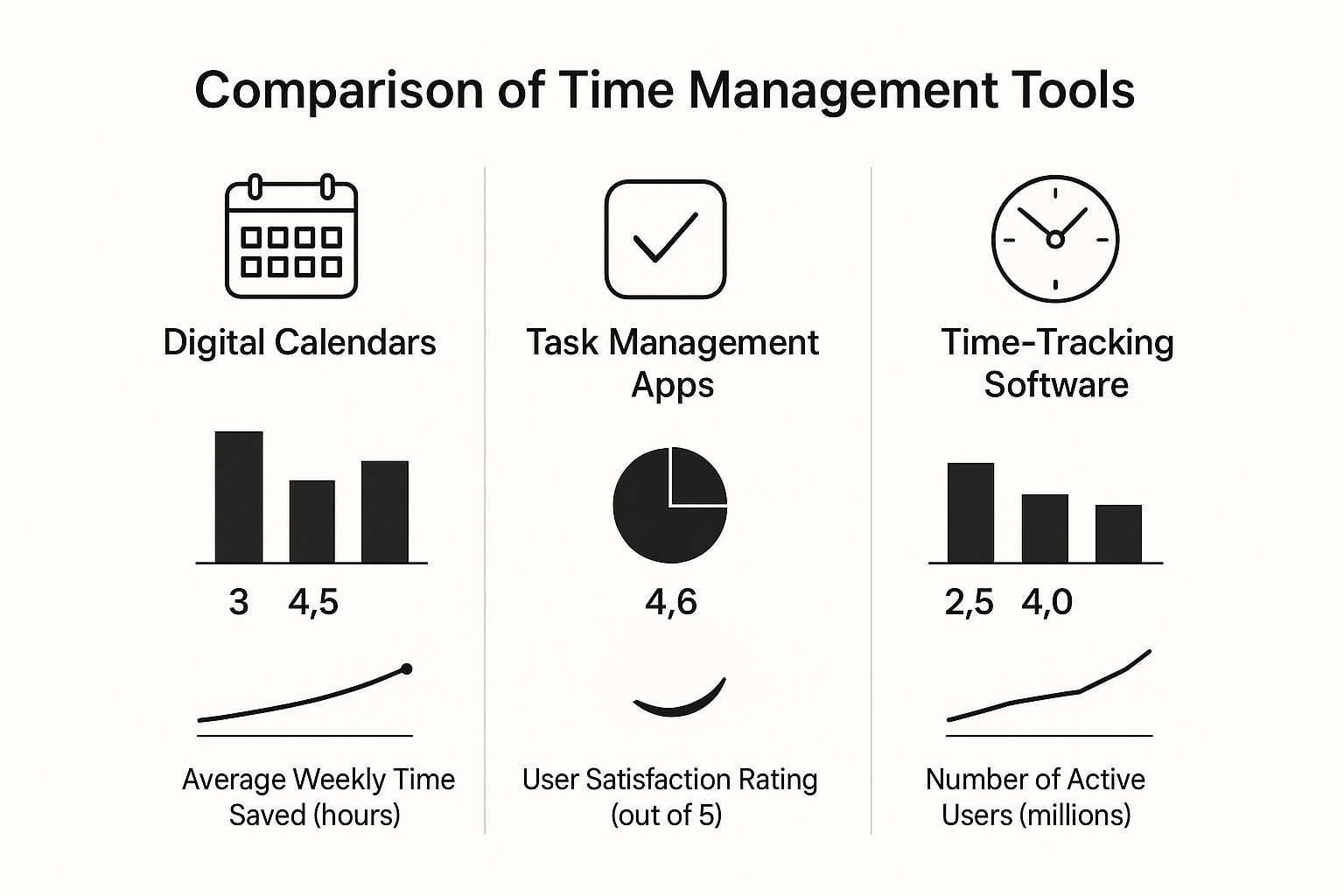
It’s interesting to see that while almost everyone uses a digital calendar, specialized task management apps deliver much higher satisfaction and save users more time each week. This really underscores the value of using a dedicated tool within a structured system.
Building a Time Management System for Remote Work
The freedom that comes with remote work often has a hidden cost: a constant struggle with time management. Without the clear-cut separation of an office, work has a sneaky way of bleeding into personal time. This creates a low-grade, ever-present stress and a feeling of "digital presenteeism," where you’re always online but never truly productive. The only way to combat this and really thrive is to build a deliberate system.
It all starts with creating clear boundaries, both in your physical space and in your digital life. Find a dedicated spot for work—even if it's just a corner of a room—to signal to your brain that it's go-time. Just as important are the little rituals you create to bookend your day, like a quick morning walk before you log on or shutting your computer down at a set time every single evening.
Establishing Clear Communication Protocols
One of the biggest time-sucks for remote workers is constant interruptions, and that’s usually a communication problem. Many of us feel pressured to be "always on," ready to reply to a message the second it arrives. You can reclaim huge chunks of your day for deep, focused work simply by setting clear expectations with your team about your working hours and realistic response times for non-urgent requests.
This is especially critical when you realize the average employee now spends a staggering 23 hours a week in meetings. That leaves very little time for actual work. It's no wonder that this meeting overload is a huge factor in burnout, which now impacts over 25% of global workers.
A sustainable remote work system isn't about working harder. It’s about building an intentional structure that fiercely protects your focus, energy, and personal time from the endless digital workplace.
Leveraging Technology Intelligently
Technology should be your ally in efficiency, not the primary source of your distractions. To really build a structured remote workday that works for you, focus on making tech serve your goals.
- Automate repetitive tasks to free up your mental bandwidth for more important things.
- Turn off non-essential notifications to give yourself a fighting chance at deep work.
- Use scheduling tools to physically block out "focus time" on your calendar so others know you're unavailable.
Building these routines can feel tough at first, which is where tools like these powerful habit tracking apps can make a real difference. For a deeper dive into this entire topic, check out our complete guide on effective time management for remote workers. Ultimately, success comes from building a system that makes good habits the easiest path to follow.
Time Management Questions We Hear All the Time
Even with the best intentions, diving into time management brings up some common roadblocks. Here are some of the questions we hear most often, along with practical answers to get you unstuck.
How Can I Actually Stick to a Time Management System?
This is the big one. Consistency feels like the hardest part, but the secret isn't a massive, overnight change. It’s about starting small and piggybacking on habits you already have.
Don't try to completely reinvent your workday from scratch. Instead, pick just one new technique—maybe the Pomodoro method—and commit to trying it for a single hour each day. Link it to an existing routine, like firing up your first Pomodoro session right after you grab your morning coffee. This makes it so much easier to remember until it becomes second nature.
What's the Very First Thing I Should Do to Fix My Time Management?
Before you can fix anything, you need to know what’s actually broken. The most powerful first step is to run a simple time audit for about three to five days.
Just track what you’re doing throughout the day. No judgment, no immediate changes—just observation. This simple act pulls back the curtain on where your time is really going, shining a spotlight on your biggest time-wasters and most common interruptions.
A time audit is like a diagnostic for your productivity. You can't solve a problem you don't understand, and this exercise gives you the hard data you need to make changes that actually work.
How Do I Deal with Unexpected Tasks That Blow Up My Schedule?
Life happens, and work is full of surprises. A rigid schedule is a fragile schedule. The goal isn’t to eliminate the unexpected but to plan for it.
The best way to do this is to build buffer time directly into your day. If you’re a fan of time blocking, for example, intentionally leave one or two 30-minute blocks completely empty. Think of them as dedicated landing zones for the unexpected.
When an urgent task pops up, you have a flexible slot to handle it without torpedoing your entire day's plan. It turns an interruption from a crisis into just another part of your workflow.
Ready to finally get a handle on the problems in time management? DeskCove delivers powerful, straightforward time tracking that helps your team stay focused and on task. See how it works and start building a more efficient workflow today at https://deskcove.com.