10 Sprint Planning Best Practices for Remote Teams in 2025

In today's remote and hybrid work environments, effective sprint planning is more than just a ceremony; it's the bedrock of a predictable, high-performing agile team. The old ways of gathering around a whiteboard don't always translate to distributed teams, where miscommunication, overcommitment, and unclear goals can quickly derail a sprint before it even begins. This guide cuts through the noise, offering ten battle-tested sprint planning best practices specifically adapted for modern collaboration challenges.
By implementing these actionable strategies, you can transform your planning sessions from chaotic chores into focused, energizing meetings that set your team up for success. We'll move beyond theory and provide concrete steps for everything from defining clear sprint goals to establishing team capacity and right-sizing user stories. For remote teams, leveraging the right technology is also paramount for seamless collaboration. Explore some of the best remote team communication tools to ensure your distributed planning sessions are as productive as in-person ones.
Ultimately, this article provides a clear roadmap to help you refine your process, foster alignment, and deliver value consistently, sprint after sprint.
1. Clearly Define Sprint Goals
Effective sprint planning best practices begin with a foundational element: a clear, compelling sprint goal. More than just a list of tasks, a sprint goal is a concise, measurable outcome that provides a shared objective for the team. It answers the critical question, "Why are we building this increment?" This unifying purpose guides decision-making throughout the sprint, ensuring every team member understands how their individual work contributes to a larger, tangible result.

When a team commits to a sprint goal instead of a collection of disconnected user stories, they gain flexibility. If unforeseen challenges arise, the team can collaborate to find alternative ways to achieve the goal, rather than rigidly adhering to the original task list. This approach fosters creativity, ownership, and a results-oriented mindset.
How to Implement Goal-Driven Sprints
To make this practice actionable, integrate goal-setting directly into your sprint planning ceremony. Rather than just selecting items from the backlog, start by discussing what valuable outcome you want to deliver by the end of the sprint.
Actionable Tips:
- Collaborate on Creation: The Product Owner may propose a goal, but the entire development team should discuss, refine, and commit to it together. This shared ownership is crucial.
- Apply the SMART Framework: Ensure your sprint goals are Specific, Measurable, Achievable, Relevant, and Time-bound.
- Stay Focused: Limit the scope to 1-3 primary goals per sprint. Trying to achieve too much dilutes focus and increases the risk of not completing the most critical work.
- Write User-Centric Goals: Frame goals from the user's perspective when possible. For example, instead of "Complete tickets X, Y, and Z," a better goal is "Enable users to reset their passwords without contacting customer support."
2. Right-Size User Stories Before Sprint Planning
A major bottleneck in sprint planning occurs when the team spends the entire session breaking down large, ambiguous work items. One of the most effective sprint planning best practices is to handle this work beforehand in backlog refinement (or grooming) sessions. The goal is to ensure that user stories entering the planning meeting are well-understood, estimated, and small enough to be completed within a single sprint.
When stories are "sprint-ready," the planning ceremony shifts from a lengthy, tedious decomposition exercise to a strategic discussion about achieving the sprint goal. Teams have integrated continuous backlog refinement into their workflows, ensuring a steady stream of prepared work. This proactive approach respects everyone's time, improves forecasting accuracy, and allows the team to focus on commitment and collaboration rather than clarification.
How to Implement Backlog Refinement
Backlog refinement should be a recurring, collaborative activity, not a last-minute scramble. By making it a standard part of your process, you ensure the product backlog remains a healthy, prioritized, and actionable roadmap of work.
Actionable Tips:
- Schedule Regular Sessions: Dedicate a specific time slot for backlog refinement each week. A common practice is one hour per week, separate from other sprint ceremonies.
- Define "Ready": Create a clear "Definition of Ready" that a user story must meet before it can be considered for a sprint. This checklist often includes criteria like clear acceptance criteria, a shared understanding, and an initial estimate.
- Involve the Right People: While the Product Owner leads refinement, involving at least a few members of the development team is crucial. Their technical perspective helps identify dependencies, risks, and potential roadblocks early on.
- Use Story Splitting Techniques: Employ methods like the SPIDR (Spikes, Paths, Interfaces, Data, Rules) framework to break down large epics or user stories into smaller, manageable, and vertically-sliced pieces of value.
3. Time-Box Sprint Planning Meetings
One of the most effective sprint planning best practices is to enforce a strict time-box for the planning ceremony itself. A time-boxed meeting has a fixed, maximum duration that is not extended. This constraint creates focus, discourages tangents, and forces the team to prioritize discussions, ensuring the meeting remains productive and efficient. Rather than getting lost in minor details, the team concentrates on defining the sprint goal and selecting the work required to achieve it.

This practice prevents sprint planning from becoming an exhaustive, open-ended debate. The recommended duration is typically two hours per week of sprint length, so a two-week sprint would have a four-hour planning session. This structure respects everyone's time and keeps the energy levels high, which is especially critical for remote and hybrid teams where meeting fatigue is a real concern.
How to Implement Time-Boxed Planning
To make this practice work, the team must collectively agree to respect the time constraints. The Scrum Master often acts as the facilitator, ensuring the meeting stays on track and adheres to the schedule. This requires a well-prepared Product Owner and a focused development team ready to make decisions.
Actionable Tips:
- Use a Visible Timer: Display a countdown timer for all participants. This simple visual cue helps everyone stay mindful of the time remaining and encourages concise communication.
- Structure the Agenda: Split the meeting into distinct phases. A common approach is allocating the first part to defining the "what" (sprint goal and backlog items) and the second part to the "how" (task breakdown). Learn more about how to craft perfect meeting agendas to improve efficiency.
- End Early if Possible: The time-box is a maximum, not a target. If the team establishes a clear sprint goal and backlog commitment before time is up, conclude the meeting early.
- Defer Deep Dives: If a specific backlog item requires a lengthy technical discussion, schedule a separate, smaller meeting for it. Don't let one complex task derail the entire planning session.
4. Involve the Entire Team in Planning
Effective sprint planning is not a top-down directive; it's a collaborative effort. One of the most critical sprint planning best practices is to involve every team member, including developers, designers, and QA testers, not just leads or product owners. This inclusive approach ensures that diverse perspectives are considered, leading to more accurate estimates, a stronger sense of shared ownership, and the early identification of potential roadblocks that specialists might see.
When the entire team participates, commitment ceases to be a passive agreement and becomes an active pledge. This practice transforms the planning session from a simple task-assignment meeting into a strategic alignment forum. Every voice contributes to a more robust and realistic sprint backlog.
How to Implement Inclusive Planning
To make this a reality, structure your planning ceremony to actively solicit input from every participant. The goal is to create an environment of psychological safety where team members feel comfortable raising concerns, questioning assumptions, and contributing their unique expertise without fear of judgment.
Actionable Tips:
- Create Psychological Safety: Explicitly state that all questions are welcome and that challenging ideas is a healthy part of the process.
- Use Round-Robin Techniques: Go around the virtual or physical room to give everyone a dedicated opportunity to speak on key topics like capacity and potential risks.
- Ask Directly for Input: If quieter team members haven't spoken, gently and directly ask for their thoughts. For example, "Sarah, from a QA perspective, do you foresee any testing challenges with this story?"
- Respect Domain Expertise: When a specialist, like a UX designer or database admin, raises a concern specific to their field, give their input significant weight in the discussion.
5. Use Relative Estimation (Story Points)
One of the most impactful sprint planning best practices is shifting from time-based estimates (like hours or days) to relative estimation using story points. Instead of guessing how long a task will take, which is notoriously inaccurate, story points measure the combined complexity, uncertainty, and effort of a work item relative to other items. This approach leads to more consistent, predictable, and less stressful planning sessions, especially when dealing with tasks of varying size.

This method abstracts estimation away from the ticking clock. A five-point story isn't five hours of work; it's simply larger and more complex than a two-point story. This focus on relative size allows teams to forecast future work more reliably by tracking their "velocity," or the average number of story points completed per sprint.
How to Implement Story Point Estimation
Adopting story points involves defining a baseline and using collaborative techniques to assign values. The goal is to create a shared understanding of effort across the team, which is a core component of many effective project estimation techniques.
Actionable Tips:
- Establish a Baseline: Choose a simple, well-understood piece of work from your backlog and assign it a value (e.g., 2 or 3 points) to serve as a reference point for all future estimations.
- Use Planning Poker: To avoid bias, have each developer privately select a story point value for an item. Everyone reveals their estimate simultaneously, and the team discusses any major discrepancies to reach a consensus.
- Avoid Time Conversion: Resist the temptation to equate story points to hours (e.g., 1 point = 4 hours). This undermines the core benefit of relative estimation and reintroduces the inaccuracies of time-based commitments.
- Track Velocity: Monitor your team's velocity (total points completed per sprint) over time. This trend is a powerful tool for forecasting how much work the team can realistically commit to in future sprints.
6. Establish and Communicate Team Capacity
A common pitfall in sprint planning is overcommitment, which leads to burnout and missed goals. One of the most critical sprint planning best practices is to establish and transparently communicate the team's actual capacity. This involves calculating the total available work hours for the sprint, accounting for vacations, holidays, recurring meetings, and other known commitments. It provides a realistic baseline for how much work the team can genuinely take on.
Understanding capacity transforms sprint planning from a guessing game into a data-driven exercise. Instead of pulling in work based on wishful thinking, the team selects backlog items that align with their available bandwidth. This practice builds trust, prevents team exhaustion, and fosters a sustainable pace of development that is essential for long-term success, especially in remote and hybrid environments.
How to Implement Capacity-Driven Planning
Make capacity calculation the first step of your sprint planning meeting. Before discussing any user stories, the team should collectively determine their availability for the upcoming sprint. This sets a clear and realistic boundary for the scope of work.
Actionable Tips:
- Calculate at the Start: Begin every sprint planning session by calculating each team member's available days, subtracting any time off or holidays.
- Account for Overheads: Subtract time for recurring sprint ceremonies like retrospectives, reviews, and daily stand-ups. A common practice is to assume 60-75% of a person's time is available for new sprint work.
- Use Historical Data: Analyze past sprints (velocity) to see how much work the team typically completes. This historical data provides a more accurate forecast than simple hour counting.
- Visualize Capacity: Display the total team capacity (in hours or story points) visibly throughout the planning meeting to keep the conversation grounded in reality.
- Communicate Clearly: The Scrum Master should announce the final agreed-upon capacity to ensure everyone, including the Product Owner, understands the sprint's constraints. If you want to dive deeper, you can learn more about effective capacity planning.
7. Define Clear Acceptance Criteria
One of the most effective sprint planning best practices is to ensure every user story has explicit acceptance criteria. These criteria are the specific, testable conditions a story must meet to be considered "done." They act as a contract between the development team and the Product Owner, eliminating ambiguity and providing a shared understanding of what success looks like for each piece of work.
When acceptance criteria are defined before or during the sprint planning meeting, they prevent costly rework and misinterpretations down the line. A developer knows exactly what functionality to build, and a QA engineer knows precisely what to test. This alignment is crucial for delivering a high-quality increment that truly meets the user's needs and the product vision.
How to Implement Acceptance Criteria
Make defining acceptance criteria a non-negotiable part of your backlog refinement and sprint planning process. A user story is not considered "ready" for a sprint until it has clear, agreed-upon criteria. This practice fosters detailed conversations that uncover hidden requirements early.
Actionable Tips:
- Use a BDD Format: Structure criteria using the Gherkin syntax of "Given/When/Then." For example: Given I am a logged-in user on the cart page, When I click the 'Remove Item' button, Then the item should disappear from my cart.
- Involve the Whole Team: The Product Owner typically writes the initial criteria, but developers and QA testers should review and refine them to ensure technical feasibility and testability.
- Include Negative Cases: Define what should happen when things go wrong. For instance, what error message should a user see if they enter an invalid password?
- Focus on 'What,' Not 'How': Acceptance criteria should describe the desired outcome from a user's perspective, not dictate the technical implementation.
8. Identify Dependencies and Risks Early
A proactive approach to sprint planning best practices involves dedicating time to uncover potential roadblocks before they derail progress. Identifying external dependencies, technical risks, and hidden assumptions is not about pessimism; it's about preparation. This practice transforms sprint planning from a simple task-selection meeting into a strategic session where the team anticipates challenges and formulates a plan to navigate them effectively.
When a team commits to a sprint backlog without acknowledging a critical dependency on another team or a high-risk technical component, they are setting themselves up for failure. By explicitly mapping these out, the team can communicate constraints to stakeholders, adjust priorities, or build in mitigation strategies. This foresight prevents mid-sprint surprises, reduces stress, and ensures a more predictable and successful outcome.
How to Implement Proactive Risk Management
Make risk and dependency identification a formal step in your sprint planning agenda. After selecting potential user stories but before finalizing the commitment, pause to ask, "What could go wrong?" or "Who do we depend on to get this done?" This conversation is as crucial as estimating effort.
Actionable Tips:
- Create a Dependency Matrix: For complex sprints, visualize which stories depend on others or on external teams. This clarifies the critical path and potential bottlenecks.
- Use a Risk Score: Quantify risks by multiplying their probability by their potential impact. This simple calculation helps the team prioritize which risks need the most attention and mitigation planning.
- Flag External Dependencies Immediately: If a story requires input, an API, or a deliverable from another team, flag it and initiate communication during the planning session itself, not a week later.
- Assign Risk Owners: Make a specific team member responsible for monitoring each significant risk or dependency. This ensures accountability and proactive follow-up throughout the sprint.
9. Maintain a Consistent Sprint Cadence
One of the most impactful sprint planning best practices is establishing and protecting a consistent rhythm. A fixed sprint cadence, typically one or two weeks long, creates a predictable heartbeat for the team's work. This consistency reduces administrative overhead and cognitive load, allowing the team to focus on delivering value rather than constantly adjusting to changing timelines. It establishes a reliable pattern that helps stakeholders know when to expect new increments and engage with the team.
When sprint lengths and start/end dates are predictable, the team can more accurately measure velocity and forecast future work. This rhythm fosters muscle memory for all Scrum ceremonies, making them more efficient and effective. Predictable cycles help coordinate complex work and maintain a sustainable pace of delivery without burning out.
How to Implement a Consistent Cadence
Establishing a team rhythm requires discipline and clear communication. The key is to choose a duration that fits your product's context and then commit to it, making it the non-negotiable foundation of your process.
Actionable Tips:
- Choose Wisely: Select a sprint length based on your need for feedback and the nature of your work. One-week sprints are ideal for volatile products, while two-week sprints are a common standard for most teams.
- Lock It In: Once a length is chosen, stick with it for at least a quarter. Avoid the temptation to shorten a sprint to meet a deadline or lengthen one to fit more work in.
- Schedule Ceremonies in Advance: Book all recurring sprint ceremonies (planning, daily stand-ups, review, retrospective) in the team's calendar for several months ahead.
- Align with the Organization: If possible, align your sprint start and end dates with broader company calendars or fiscal periods to simplify stakeholder reporting and engagement.
10. Build in Buffer Time for Unknowns and Interruptions
One of the most pragmatic sprint planning best practices is acknowledging that uncertainty is a given. Instead of planning to 100% capacity and hoping for the best, high-performing teams build in a buffer for unexpected work, urgent requests, and the inevitable unknowns that emerge during a sprint. This slack time, typically 10-20% of the team's capacity, acts as a crucial shock absorber, preventing a single interruption from derailing the entire sprint goal.
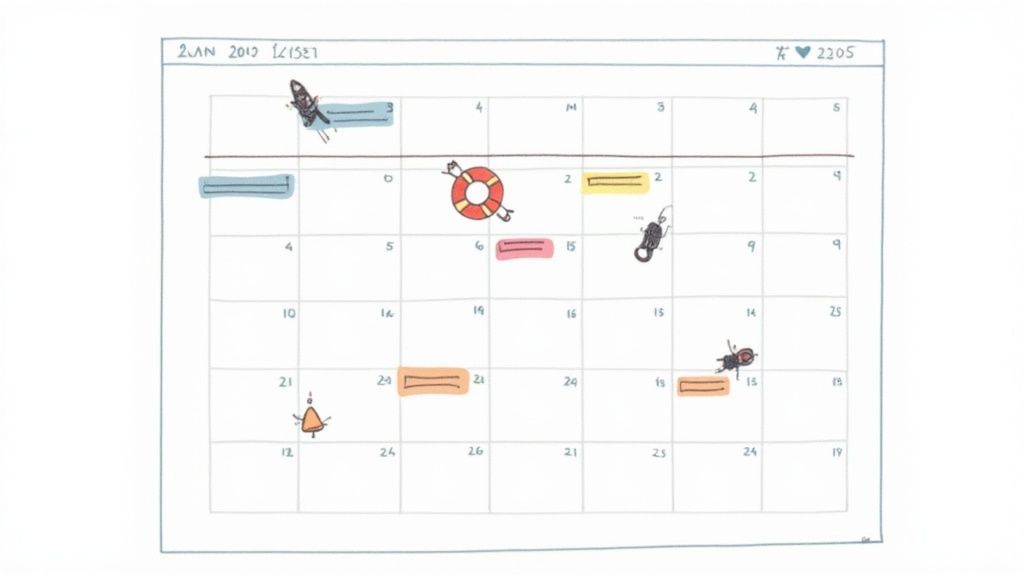
This approach moves a team from a reactive to a proactive state. By formally allocating time for unplanned work, you protect the core sprint commitments while maintaining the flexibility to address critical production issues or stakeholder needs. This practice builds a more resilient and sustainable development pace.
How to Implement Buffer Time
Integrating a buffer requires a conscious decision during the sprint planning meeting to commit to less than the team's theoretical maximum capacity. This isn't about encouraging less work; it's about creating a realistic plan that can withstand real-world pressures.
Actionable Tips:
- Start Small and Adjust: Begin by reserving a 10% buffer. Track all interruptions and unplanned work for a few sprints to see if this is sufficient, then adjust the percentage up or down based on your data.
- Define Usage Criteria: Establish clear rules for when the buffer can be used. Is it for critical bug fixes only? Urgent stakeholder requests? Define this upfront to avoid ambiguity.
- Communicate Proactively: Inform stakeholders about your buffer capacity. This manages their expectations and demonstrates that you have a structured process for handling urgent needs without jeopardizing sprint goals.
- Review in Retrospectives: Make buffer usage a regular topic in your sprint retrospectives. Discussing what consumed the buffer can reveal underlying issues that need to be addressed, helping you improve continuously.
Sprint Planning: 10 Best Practices Comparison
| Practice | Implementation Complexity 🔄 | Resource Requirements ⚡ | Expected Outcomes 📊 | Ideal Use Cases 💡 | Key Advantages ⭐ |
|---|---|---|---|---|---|
| Clearly Define Sprint Goals | Medium — requires team alignment and discussion | Low — short collaborative sessions, stakeholder input | Better focus; reduced scope creep; clearer priorities | New sprints, cross-team alignment, goal-driven work | Clear direction; improved motivation; stakeholder clarity |
| Right-Size User Stories Before Sprint Planning | Medium — ongoing refinement effort | Medium — regular grooming sessions with PO & devs | Shorter planning; improved estimates; predictable sprints | Large backlogs; complex features; teams wanting efficient planning | Higher estimation accuracy; faster planning meetings |
| Time-Box Sprint Planning Meetings | Low — set agenda and strict timers | Low — defined meeting time; Scrum Master facilitation | More efficient meetings; less over-analysis | Teams with long meetings or discipline issues | Enforces focus; respects time; prevents analysis paralysis |
| Involve the Entire Team in Planning | Medium–High — requires facilitation and coordination | High — full-team participation consumes more hours | Better estimates; increased ownership; early issue discovery | Cross-functional work; knowledge-sharing; complex initiatives | Improved accuracy; stronger team buy-in; shared understanding |
| Use Relative Estimation (Story Points) | Medium — needs calibration and training | Low–Medium — planning poker sessions; baseline stories | Consistent velocity; improved forecasting over sprints | Variable-complexity work; teams tracking velocity | More accurate than hours; accounts for uncertainty |
| Establish and Communicate Team Capacity | Medium — needs availability tracking and calculation | Low–Medium — calendar checks, velocity data review | Realistic commitments; reduced overcommitment and burnout | Distributed teams; variable availability; capacity-sensitive work | Prevents overload; improves forecasting and stakeholder transparency |
| Define Clear Acceptance Criteria | Low–Medium — requires clear writing and collaboration | Low — PO + dev + QA time to define criteria | Fewer defects; clearer testing; less rework | New features, QA-heavy projects, BDD adoption | Reduces ambiguity; enables parallel QA; documents expectations |
| Identify Dependencies and Risks Early | High — requires mapping and cross-team communication | Medium–High — dependency matrix, risk owners, meetings | Fewer blockers; proactive mitigations; smoother delivery | Multi-team programs, external integrations, regulated work | Reduces surprises; improves prioritization and contingency planning |
| Maintain a Consistent Sprint Cadence | Low — set and keep fixed sprint length | Low — calendar discipline and regular ceremonies | Predictable velocity; stronger team rhythm | Mature teams needing reliable forecasting | Stable planning; reduced context switching; easier stakeholder sync |
| Build in Buffer Time for Unknowns and Interruptions | Low — allocate explicit buffer and protocol | Low — capacity planning and tracking interruptions | Higher sprint success rate; less burnout; flexible response | Support-heavy teams; high-interruption environments | Protects commitments; accommodates emergencies; improves reliability |
Turning Your Planning into a Competitive Advantage
Mastering sprint planning isn't just about checking boxes on a project management checklist; it's about building a robust, adaptive engine for consistent delivery. Throughout this guide, we've explored ten critical sprint planning best practices that transform this recurring ceremony from a routine task into a strategic asset. By embracing these principles, you move beyond simply assigning work and begin architecting success.
The journey starts with clarity and preparation. Defining a singular, compelling sprint goal gives your team a North Star, while right-sizing user stories beforehand ensures the planning meeting is productive, not bogged down in endless refinement. Respecting the team's time by time-boxing the event and involving everyone in the process fosters ownership and uncovers insights that would otherwise remain hidden.
From there, it's about creating a sustainable and realistic plan. Using relative estimation like story points removes the false precision of time-based guesses, and honestly establishing team capacity prevents the burnout that cripples long-term velocity. Coupled with clear acceptance criteria, this ensures that what the team commits to is both achievable and well-understood. Finally, a resilient sprint plan anticipates reality: it proactively identifies dependencies, maintains a consistent cadence to create rhythm, and strategically builds in buffer time for the inevitable surprises that arise.
Your Actionable Next Steps
Adopting all ten practices at once can be overwhelming. Instead, focus on incremental improvement.
- For your very next sprint planning session, choose just two areas to focus on. Perhaps it's committing to a well-defined sprint goal and ensuring every story has clear acceptance criteria.
- Gather feedback in your retrospective. Ask the team: "Did these changes make our planning more effective? What was the impact on our work during the sprint?"
- Iterate and add another practice. Once the first two are ingrained in your process, introduce a new one, such as formalizing how you calculate and communicate team capacity.
Ultimately, the purpose of excellent sprint planning is to empower your team to efficiently achieve its objectives. For a broader perspective on how to build a reliable system for progress, it's crucial to see these agile practices as part of a larger productivity framework. By implementing these sprint planning best practices, you are not just managing tasks; you are cultivating an environment of predictability, psychological safety, and high performance that will consistently deliver value and give your organization a distinct competitive edge.
Ready to gain deeper insights into your remote team's capacity and focus? DeskCove provides the data-driven feedback you need to make sprint planning more accurate and effective, without disrupting your team's agile workflow. Discover how to enhance your team's productivity at DeskCove.